Wholesale Sheet Metal Fabrication Suppliers China
Wholesale Sheet Metal Fabrication Suppliers China
China is a major global hub for custom and wholesale sheet metal fabrication, and this guide covers how to evaluate suppliers, what processes and materials to expect, and how to manage pricing, quality, and logistics for overseas OEM programs. Whether you need 500 brackets or 50,000 enclosures, the information below will help you source with confidence.
Fast Answer: Why Source Wholesale Sheet Metal Fabrication from China?
China’s sheet metal fabrication market is projected to exceed $15 billion by 2032. The Asia-Pacific region’s demand for sheet metal and steel processing is on track to reach roughly US$570–580 billion by 2035, growing at about 4.9–5.5% CAGR. That scale creates a supplier ecosystem where unit costs (material, labor, overhead) run 30–50% lower than comparable capacity in the USA or EU for orders of thousands of units.
Two clusters dominate. The Pearl River Delta (Dongguan, Shenzhen, Guangzhou) and the Yangtze River Delta (Suzhou, Shanghai) have built specialized labor pools, tooling supply chains, and export infrastructure since 2010. Guangdong Province is known for high-tech enclosures and precision components. Jiangsu Province hosts advanced manufacturing for automotive and telecommunication sectors. Zhejiang Province is recognized for heavy industrial fabrication and stamping. These regions connect to global shipping networks through ports that handle millions of containers annually.
Most fabrication is project-based rather than off-the-shelf wholesale; suppliers engineer each order around customer drawings. Anebon Metal Products Limited, founded in 2010 in Dongguan, holds ISO 9001:2015 and ISO 14001:2015 certifications and focuses on precision sheet metal fabrication and CNC machining for B2B/OEM clients.
Typical wholesale buyers include:
-
Automotive Tier-1 manufacturers
-
Medical device OEMs
-
Industrial machine builders
-
Electronics and telecom brands
-
Robotics and automation firms
About Anebon – Your Wholesale Sheet Metal Fabrication Partner in Dongguan
Anebon Metal Products Limited operates a precision CNC machining and sheet metal fabrication factory in Dongguan, Guangdong. The company has served overseas OEM clients since 2010 with a focus on repeatable, high precision parts across multiple production processes.
Core capabilities span laser cutting, CNC punching, CNC bending, MIG welding and spot welding, sheet metal stamping, cnc machining services (milling, turning, 5-axis), and sheet metal assembly with hardware insertion. These operate under one roof, which reduces coordination overhead for buyers managing multi-step BOMs.
ISO 9001:2015 is a key quality certification that supports traceability and process control. ISO 14001:2015 certification focuses on environmental management, a growing requirement from European and North American OEMs. Both certifications are audited annually.
Anebon supports the full project cycle: sheet metal design review with DFM feedback, rapid prototyping, pilot runs, and mass production. For CNC machined features, tolerances reach ±0.002 mm. Laser cut and bent sheet metal parts hold ±0.05–0.10 mm depending on material and thickness. These numbers reflect what professional sheet metal fabrication operations in Dongguan deliver with calibrated equipment and documented processes.
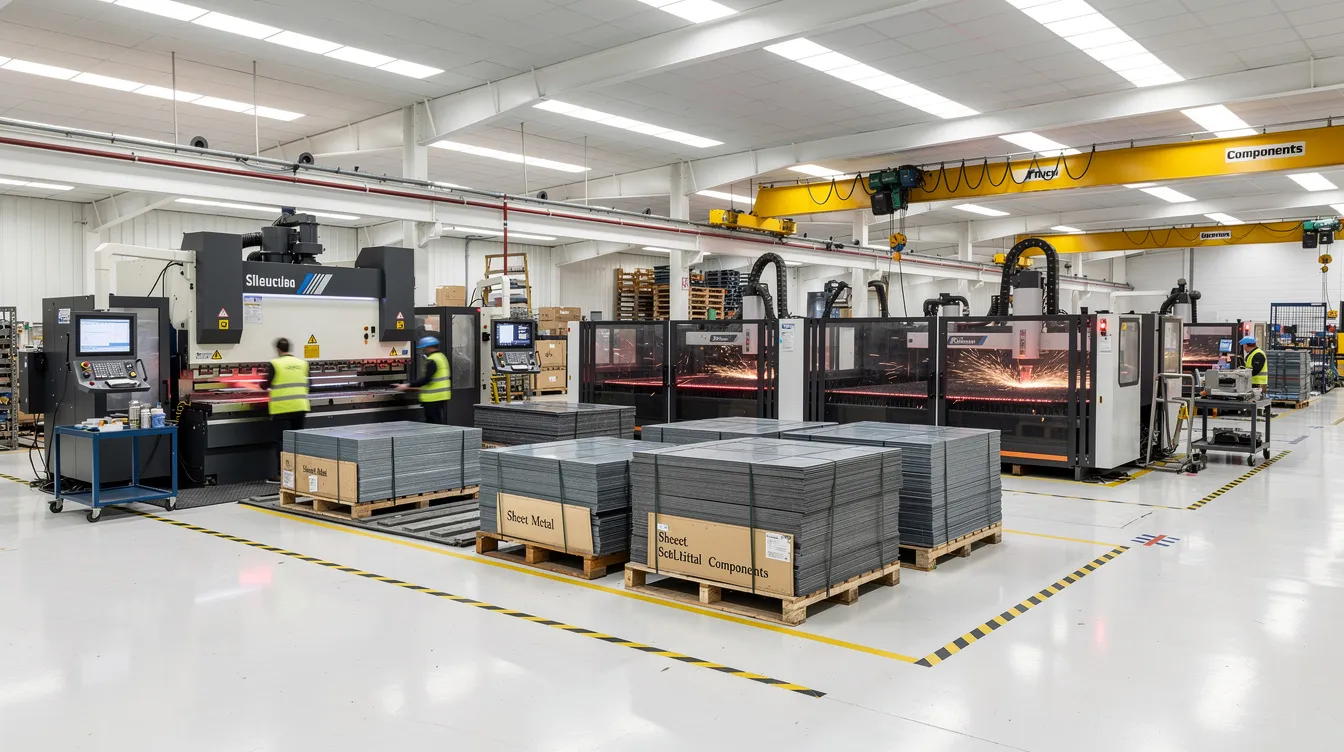
What Is Sheet Metal Fabrication? (Core Processes for Wholesale Buyers)
Sheet metal fabrication transforms flat metal sheets (typically 0.5–6 mm for OEM parts) into three-dimensional sheet metal products through a sequence of forming, cutting, and joining operations. The process combines cutting, bending, and welding to produce finished metal components ready for assembly or end use.
Common sheet metal operations include:
-
Cutting: laser cutting, shearing, plasma cutting, waterjet
-
Stamping/pressing: progressive die, deep draw, transfer die for metal stamping parts
-
Punching: CNC turret punch for holes and patterns
-
Bending/forming: press brakes, panel benders, roll forming
-
Welding and joining: TIG, MIG, spot welding, riveting
-
Hardware insertion: PEM nuts, standoffs, clinch fasteners
-
Assembly: sub-assemblies, functional testing, packaging
Examples of finished sheet metal parts: electrical enclosures, EV battery trays, server racks, medical equipment housings, machine guards, automotive components, and mounting brackets.
The distinction from general metal fabrication lies in working with thin metal sheets where flat pattern development, bend allowances, grain direction, and springback compensation define geometry. A bracket bent from 2 mm steel requires different engineering than a welded structural frame made from thick plate.
Wholesale Sheet Metal Fabrication Process Flow at Anebon
A typical sheet metal fabrication process for overseas OEMs follows nine sequential steps. Here is how Anebon fabricates sheet metal from RFQ to delivery:
-
RFQ and DFM review – Customer submits 2D drawings (DXF/DWG) or 3D CAD files (STEP/IGES). Anebon’s engineers return manufacturability feedback within 24–48 hours, flagging issues like insufficient bend radii or holes too close to bend lines.
-
Material confirmation – Select metal grade, thickness, and finish. Mill certificates confirm material properties. Flat patterns are generated from 3D sheet metal design models using bend deduction calculations.
-
Laser cutting or punching – Nesting software optimizes layout on the sheet to reduce material waste. CNC punching handles repetitive hole patterns faster; laser cutting handles complex contours.
-
Deburring and edge trimming – Burrs are removed for safety, fit, and finish quality.
-
Bending and forming – CNC press brakes execute bend sequences planned to avoid tool collisions. Springback compensation is applied per material type.
-
Welding and assembly – Appropriate welding method selected (MIG, TIG, spot). Hardware insertion (PEM nuts, standoffs) completed. Jigs ensure alignment.
-
Surface finishing – Powder coating, anodizing, plating, or passivation applied per spec.
-
Final QC – Dimensional inspection using CMM, height gauges, and functional fixtures. Sampling plan or 100% inspection depending on risk.
-
Export packaging and shipping – Product packaging requirements should prevent damage or contamination during transit. Edge protectors, pallets, crates, desiccant packs, and moisture barriers protect parts during ocean freight. Export documents prepared per agreed Incoterms (FOB, CIF, DDP).
Prototype lead times run 5–10 calendar days. Wholesale sheet metal production batches typically ship in 2–4 weeks after design lock.
Key Capabilities of Wholesale Sheet Metal Fabrication Suppliers in China
A qualified china sheet metal manufacturer combines multiple fabrication technologies under one facility. This one-stop approach lets buyers consolidate their supplier count and reduce logistics complexity for complex projects with multi-step BOMs.
Sheet metal fabrication capabilities wholesale buyers should verify:
|
Capability |
Function |
Anebon Coverage |
|---|---|---|
|
High-power fiber laser |
Cut carbon steel up to ~25 mm |
Yes |
|
CNC turret punch |
Fast cycle on repetitive features |
Yes |
|
CNC press brake |
Sheet metal bending to spec |
Yes |
|
Progressive stamping press |
High volume production of repeat parts |
Yes |
|
Robotic welding / TIG / MIG |
Consistent weld quality |
Yes |
|
CNC milling and turning |
Precision interfaces, mating features |
Yes |
|
5-axis machining |
Complex geometry on assemblies |
Yes |
Anebon integrates sheet metal fabrication with cnc machining to deliver complete custom metal components rather than just flat blanks. When sheet metal assemblies require precision interfaces (threaded bosses, datum surfaces), 5-axis machining handles those features in a single program. This integration defines the difference between a basic sheet metal fabricator and a full-service precision sheet metal fabrication manufacturer.
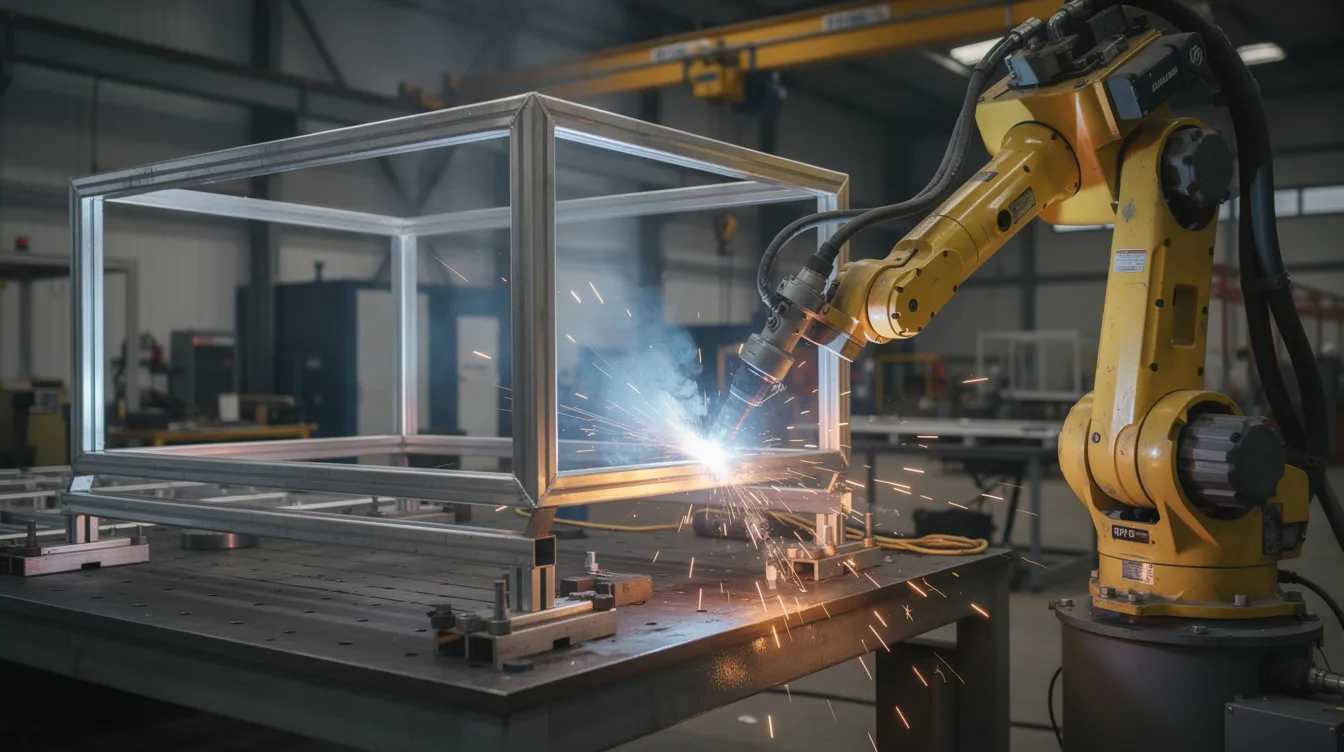
Core Processes: Laser Cutting, Sheet Metal Stamping, Bending & Welding
Process selection drives cost, tolerances, and scalability in wholesale sheet metal manufacturing. Here is what each core process delivers.
Laser cutting using fiber laser cutting technology handles materials from 0.5 mm aluminum to ~25 mm carbon steel. Laser cutting achieves tolerances of ±0.1 mm on thin materials, with clean edges and minimal thermal distortion. Setup is fast, making it ideal for sheet metal prototypes and mixed-SKU production. Advanced machinery with auto-loading tables increases throughput for high volume production.
Sheet metal stamping uses progressive or transfer dies to blank, form, and draw custom sheet metal parts at speed. Die tooling costs range from several thousand to tens of thousands of USD, but per-unit cost drops below laser-cut alternatives once volumes exceed roughly 10,000 pieces per year. Metal stamping is the default for automotive components produced in six-figure annual quantities.
Bending and forming via CNC press brakes and automatic panel benders control bend radius, angle, and flatness. Minimum bend radius depends on material; for mild steel, the radius typically equals the sheet thickness. For stainless steel or aluminum, 1.5× thickness is safer. Advanced equipment with crowning systems compensates for deflection on long bends.
Welding and joining includes MIG welding for steel frames, TIG for stainless steel and aluminum where bead appearance matters, and spot welding for thin-gauge lap joints. Robotic welding ensures consistent quality on repeat runs. Hardware insertion (PEM nuts, standoffs) completes the assembly of metal cabinets and electronics enclosures, as detailed in Anebon’s guide to hardware choices for enclosure manufacturing.
Materials Used by Wholesale Sheet Metal Fabrication Suppliers
Material choice determines strength, weight, corrosion resistance, and cost per metal part. Chinese wholesale suppliers stock or source the following grades:
-
Cold-rolled carbon steel (ASTM A36 / Q235): carbon steel is strong and affordable for structural components like brackets and frames.
-
Stainless steel (SS304, SS316, 316L): stainless steel offers corrosion resistance for moisture-exposed applications, medical equipment, and food-contact surfaces.
-
Aluminum (5052, 6061): aluminum is lightweight, ideal for aerospace and automotive work; good machinability and anodizing response.
-
Galvanized steel (GI/GA): galvanized steel has a protective zinc coating for outdoor use in electrical cabinets, HVAC, and telecom housings.
-
Brass, copper: used for RF shielding, bus bars, and decorative hardware.
Thickness ranges for standard sheet metal processes span 0.5 mm to 6 mm. Below 0.5 mm, handling and flatness become difficult. Above 6 mm crosses into plate territory, requiring heavier presses or plasma cutting.
Suppliers should provide material certificates and a system for tracing material lots to finished parts. Material traceability is crucial in sheet metal fabrication to ensure compliance with quality standards. Anebon supplies mill test certificates, RoHS/REACH compliance documentation, and heat-number tracing for regulated industries.
Sheet Metal Design & DFM for Wholesale Orders
Having solid DFM (Design for Manufacturability) feedback is crucial for efficient manufacturing design. Poor design choices compound at scale: a hole placed 3 mm from a bend line on 10,000 parts means 10,000 distorted features.
Key DFM checks Anebon performs before tooling investment:
-
Minimum bend radius: 1× thickness for mild steel, 1.5× for stainless and aluminum
-
Hole-to-bend clearance: at least 2× thickness plus bend radius to avoid deformation
-
Material standardization: consolidating thicknesses across a BOM to reduce changeovers
-
Bends over welds: replacing welded joints with bent features where geometry allows, cutting labor and distortion risk
-
Relief cuts: adding notches where bends meet edges to prevent tearing
OEM engineers should involve the supplier early to optimize flat patterns, tab-and-slot features, and assembly methods. Anebon provides annotated drawings or marked-up 3D models showing recommended changes before any die or fixture investment. Clear GD&T callouts, surface finish requirements, and critical-to-quality dimensions on drawings guide process control and ensure high quality output on every sheet metal project.
Industries & Typical Wholesale Sheet Metal Products
Sheet metal fabrication is crucial for automotive and aerospace industries, and it serves medical, electronics, telecom, and industrial machinery sectors with equal depth. Chinese suppliers like Anebon manage multiple SKUs and variants under single programs for these sectors.
-
Automotive: EV battery tray housings, bracket systems, heat shields, dashboard support structures. IATF 16949 certification is required for automotive parts quality.
-
Aerospace: avionics trays, interior panels, structural brackets using precision sheet metal parts and tight tolerance controls. AS9100D certification is essential for aerospace quality standards.
-
Medical devices: equipment enclosures, surgical carts, lab analyzer chassis in stainless steel with polished or passivated finishes. ISO 13485 certification is crucial for medical device manufacturing.
-
Electronics and telecom: server racks, 5G base station housings, switchgear cabinets, heatsink plates for custom metal fabrication programs.
-
Industrial machinery and robotics: guards, frames, control panels, sensor brackets.
Other suppliers in the market serve similar sectors. KDM Fabrication specializes in precision sheet metal fabrication for aerospace and automotive industries. RapidDirect offers on-demand manufacturing services including sheet metal fabrication. Ruixi Technology provides custom sheet metal parts with high precision. Komaspec uses CNC laser cutting and robotic welding for high-precision fabrication. Shenzhen HSJ metal fabrication is another regional supplier with export capabilities.
Anebon handles overseas OEM documentation, NDA signing, and export packaging tailored to each application’s sensitivity.
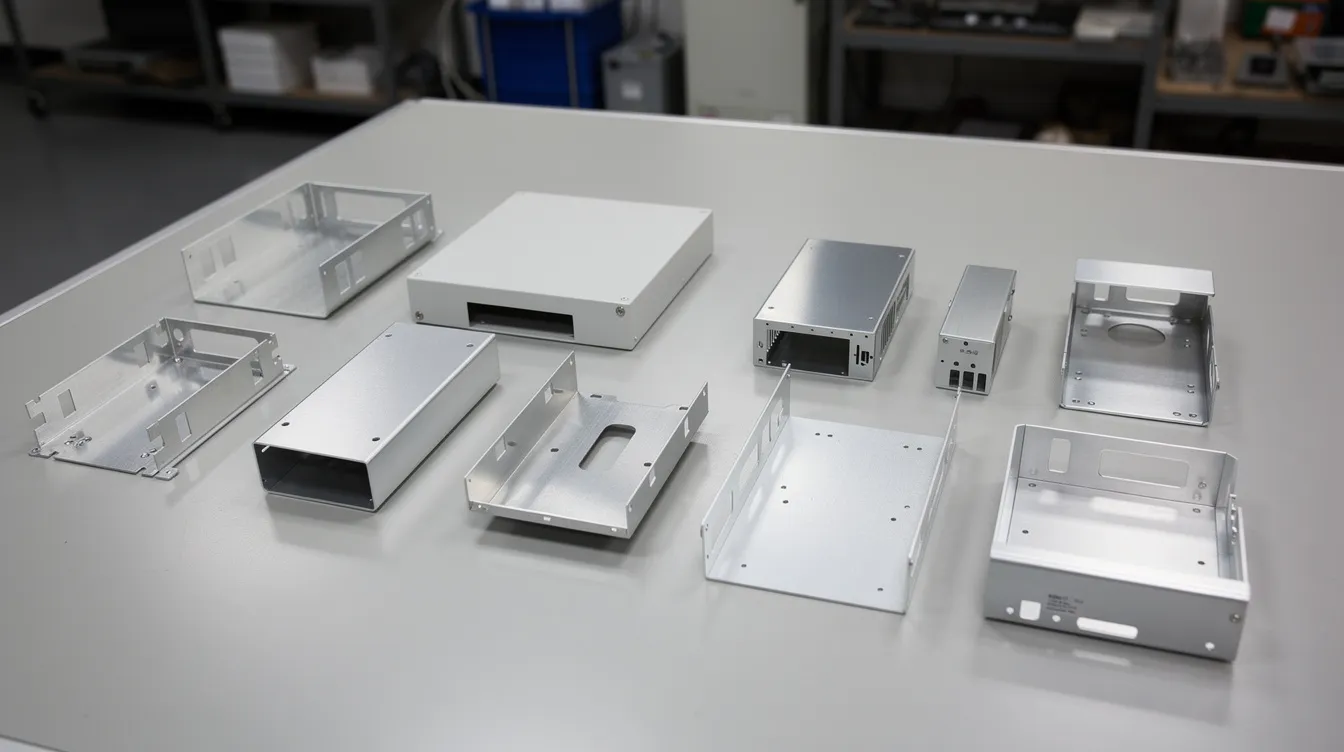
Surface Finishes & Corrosion Protection for Sheet Metal Parts
Surface finishing is a critical step in the sheet metal fabrication process, especially for outdoor, medical, or electronics applications. The right surface treatment determines whether a part survives its operating environment.
Common finishes Chinese suppliers offer:
|
Finish |
Application |
Notes |
|---|---|---|
|
Powder coating |
General industrial, electronics |
Creates a tough skin 75–100 microns thick; corrosion resistant |
|
Anodizing |
Aluminum parts |
Adds hardness and color; see anodizing effects on aluminum |
|
Zinc plating |
Steel parts for outdoor use |
Salt spray resistance rated 240–500 hours |
|
Nickel plating |
Wear surfaces, conductivity |
Uniform deposit on complex geometry |
|
Passivation |
Stainless steel |
Removes free iron; restores corrosion resistance |
|
Brushing / bead blasting |
Cosmetic surfaces |
Uniform matte or satin texture |
Anebon helps specify finishes based on operating environment (indoor, coastal, chemical exposure) and brand requirements (RAL colors, gloss levels). QA checks include cross-hatch adhesion tests, coating thickness measurement via magnetic or eddy current gauges, and color consistency verification across wholesale batches.
Quality Control, Certifications & Traceability
Quality control separates reliable wholesale sheet metal fabrication suppliers from those that ship problems. Anebon’s QC system covers every stage:
-
Incoming material inspection: verify grade, thickness, flatness against mill certificates
-
First article inspection (FAI): dimensional validation before production run begins
-
In-process checks: edge quality after laser cutting, angle verification after bending, weld penetration after welding
-
Final inspection: CMM measurements, height gauges, go/no-go fixtures, and functional jigs for assemblies
Documentation includes FAI reports (PPAP format for automotive), material certificates, RoHS/REACH statements, and dimensional reports for critical features. These records ensure consistent quality across production lots and provide an audit trail for regulated industries.
ISO-certified precision manufacturers invest in documented procedures, calibrated instruments, and trained inspectors. Anebon’s ISO 9001:2015 and ISO 14001:2015 certifications are verified through annual third-party audits, supporting both quality consistency and environmental compliance for global brands.
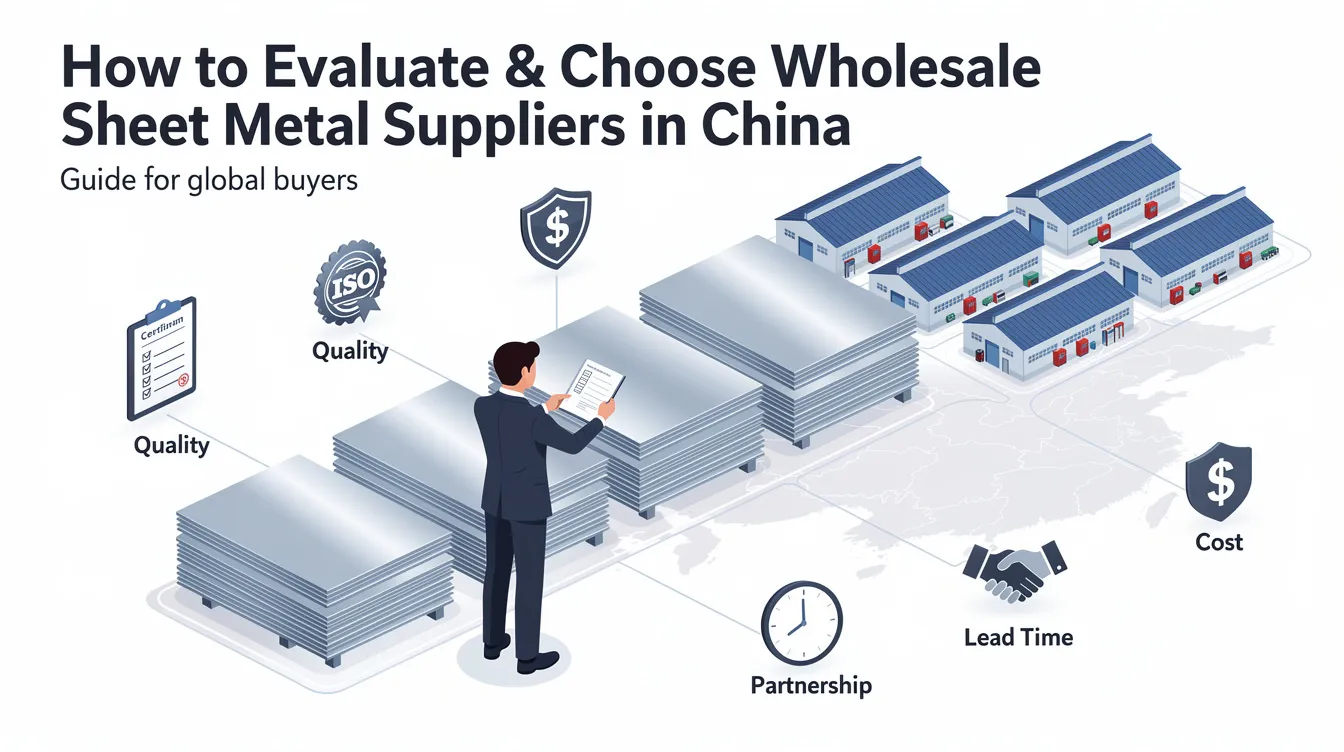
How to Evaluate & Choose Wholesale Sheet Metal Suppliers in China
Selecting a long-term custom metal fabrication partner requires a structured evaluation. A staged approach for supplier selection includes factory audit and sample production before large orders. Intellectual property protection is important when working with suppliers in China; ask about NDA policies and data handling before sharing proprietary designs.
Key criteria:
-
Process scope: confirm the supplier handles laser cutting, stamping, cnc machining, finishing, and assembly. Gaps require sub-suppliers, adding risk.
-
Engineering support: can they deliver DFM feedback, rapid prototyping, and tolerance analysis? Test this during quoting.
-
Quality systems: valid ISO certification, documented QC procedures, willingness to share sample inspection reports.
-
Capacity and scalability: evaluating production capacity helps determine if suppliers can scale output during demand spikes. Ask about machine count, shifts, and peak throughput.
-
Export experience: track record shipping to your region (EU, USA, Japan). Proper export packaging and experience with Incoterms are essential for smooth logistics.
-
Communication: effective communication and language proficiency are critical for avoiding manufacturing errors. Verify that your engineering contact speaks technical English and responds within one business day.
Practical steps: request a video factory tour, order a pilot batch of 50–100 pieces, run capability studies (Cp/Cpk) on critical dimensions, and review case studies in your industry. Anebon serves as a partner for companies needing both rapid prototyping and stable mass production capabilities from one supplier.
Working with Wholesale Sheet Metal Fabrication Suppliers: Lead Times, MOQs & Pricing
Three commercial parameters shape every wholesale sheet metal order: minimum order quantities, tooling investments, and pricing structure. Minimum Order Quantities (MOQ) can affect pricing and production capacity; flexible suppliers accept MOQs in the low hundreds for laser-cut parts, while stamped parts often require 5,000+ pieces to justify die costs.
|
Order Type |
Tooling Cost |
Per-Unit Cost |
Best For |
|---|---|---|---|
|
Prototype (laser cut + bend) |
Low or none |
Higher |
Design validation, 1–50 pcs |
|
Low volume (laser + bend) |
Minimal fixtures |
Moderate |
100–2,000 pcs/year |
|
Progressive stamping |
$3,000–$30,000+ for dies |
Lowest at volume |
10,000+ pcs/year |
Lead times for 2024–2026 from capable Chinese suppliers: quote turnaround in 1–3 business days, prototype sampling in 5–10 days, mass production in 2–4 weeks after design lock. Anebon turns most sheet metal prototypes in under two weeks.
Cost drivers include: material utilization (nesting efficiency), tolerance tightness, number of welds, surface finishing spec, packaging, and shipping mode. A $15/unit FOB product can become roughly $20.80 landed when adding tooling amortization, freight, duties, and inland transport for a 1,000-unit order. A 40-ft container from Shanghai to Los Angeles costs about US$3,200–4,800 depending on carrier and season.
Send your drawings and annual demand estimates to Anebon for a detailed quotation and cost-reduction suggestions through smart manufacturing and process optimization.
Sheet Metal Fabrication FAQs for Wholesale Buyers
Below are answers to questions OEM buyers ask most often about advanced sheet metal fabrication sourcing from China.
What minimum thickness and maximum sheet size can you process? Standard capabilities for steel and stainless steel start at 0.5 mm up to 6 mm (sheet range). Aluminum similarly from 0.5 mm. Maximum sheet size depends on machine bed; typical fiber lasers handle 1,500 × 3,000 mm or 2,000 × 4,000 mm sheets. For guidance on managing different thicknesses, see Anebon’s article on warping and tolerance challenges.
How do you control flatness and warping after cutting and welding? Cold-rolled material, proper fixturing during welding, controlled weld sequencing, and stress-relief techniques maintain flatness. Large panels may need leveling after cutting.
Can you provide both rapid prototypes and mass production with consistent quality? Yes. The same CAD data, materials, and inspection criteria apply to both. Pilot runs of 50–100 pieces validate the production processes and tooling before full ramp. Customized solutions for each program ensure consistent quality across volumes.
What file formats do you accept? DXF and DWG for 2D profiles; STEP, IGES, Parasolid, and SolidWorks native files for 3D. Flat pattern generation from 3D models is standard using bend deduction tables matched to each material.
How do you pack wholesale sheet metal products for sea shipment? Export crating, wooden pallets, PE foam edge protectors, VCI anti-rust paper, desiccant packs, and shrink wrap. Parts are secured to prevent shifting during 3–5 week ocean transit to Europe or North America.
When should I choose laser cutting vs. sheet metal stamping? Laser cutting suits flexible sheet metal production runs under 5,000 pieces per year or designs that change frequently, with low tooling cost. Stamping delivers the lowest per-unit cost once annual volumes exceed 10,000 pieces and the design is stable, but requires upfront die investment and longer tooling lead times.
What advanced technology does Anebon use for unmatched precision on precision sheet metal fabrication? Fiber lasers with auto-focus, CNC press brakes with angle measurement, robotic welding cells, CMM inspection, and advanced equipment for 5-axis cnc machining. These ensure high precision parts across sheet metal production and deliver high quality results.
Contact Anebon Metal Products Limited to discuss your next wholesale sheet metal project. Send your 3D files, annual volume estimates, and finish requirements; the engineering team will return DFM feedback, pricing, and lead times within 48 hours. Whether your program calls for 200 custom metal parts or 200,000 precision sheet metal components, Anebon’s manufacturing capabilities and manufacturing services in Dongguan are built to handle your sheet metal processes from first prototype through sustained high volume production.