Where is the Best Reliable CNC Factory in China? A Comprehensive Guide
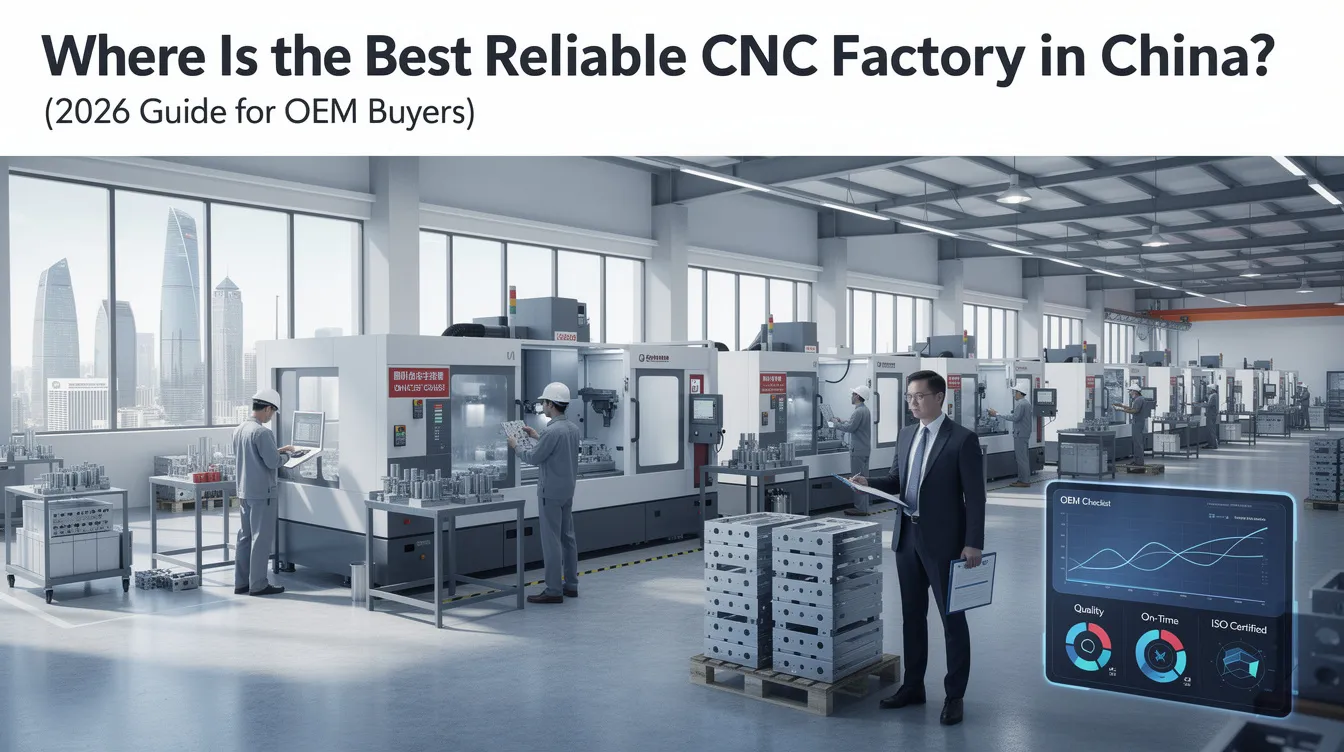
Where Is the Best Reliable CNC Factory in China? (2026 Guide for OEM Buyers)
If you’re an overseas OEM buyer searching for precision parts, the question of where to find the best reliable CNC factory in China comes down to a few proven industrial clusters, a clear vetting process, and a partner that matches your technical requirements. This guide breaks down the regions, the red flags, and the real benchmarks you should use to make that decision in 2026.
Quick Answer: Best Place to Find a Reliable CNC Factory in China
The most reliable CNC machining factories for export are concentrated in Guangdong province-especially Dongguan and Shenzhen-with strong secondary clusters in Jiangsu (Suzhou, Wuxi) and Zhejiang (Ningbo, Hangzhou). According to a 2026 Haizol audit of 456 Chinese CNC factories, these three coastal provinces account for 82.2% of China’s total CNC machining capacity.
For overseas OEMs needing high precision custom parts rather than buying standalone cnc machines, Dongguan in Guangdong is the primary hub. The city’s dense supply chains, export orientation, and concentration of certified factories make it the go-to region for precision engineering projects ranging from single prototypes to high volume production runs.
Anebon Metal Products Co Ltd is one such reliable, ISO-certified CNC machining company in Dongguan. Operating since 2010 and focused exclusively on B2B/OEM clients, Anebon provides precision CNC machining, die casting, and sheet metal fabrication with tolerances as precise as ±0.002 mm.
The rest of this article will walk you through the key regions, how to vet a factory, what technology and certifications to look for, and a detailed look at Anebon as a practical example.
Why China Is a Global Center for CNC Machining in 2026
China’s dominance in CNC machining services isn’t accidental. Decades of industrial policy-including the “Made in China 2025″ initiative tracked by CSIS-have driven massive investment into high-end machine tools, multi-axis cnc machining centers, robotics, and inspection infrastructure. By 2023, China’s export value of machine tools (HS 8456–8465) was already in the billions of USD, with consistent year-over-year growth.
High-speed machining centers are now essential in modern CNC facilities across China’s coastal provinces. Multi-axis machines improve machining capabilities significantly, and Chinese factories increasingly use AI and robotics for CNC machining operations, from tool path optimization to automated part handling with robotic arms. CNC machining also integrates IoT for enhanced automation and efficiency across the shop floor, connecting multiple machines into coordinated production cells with smart manufacturing principles and advanced automation.
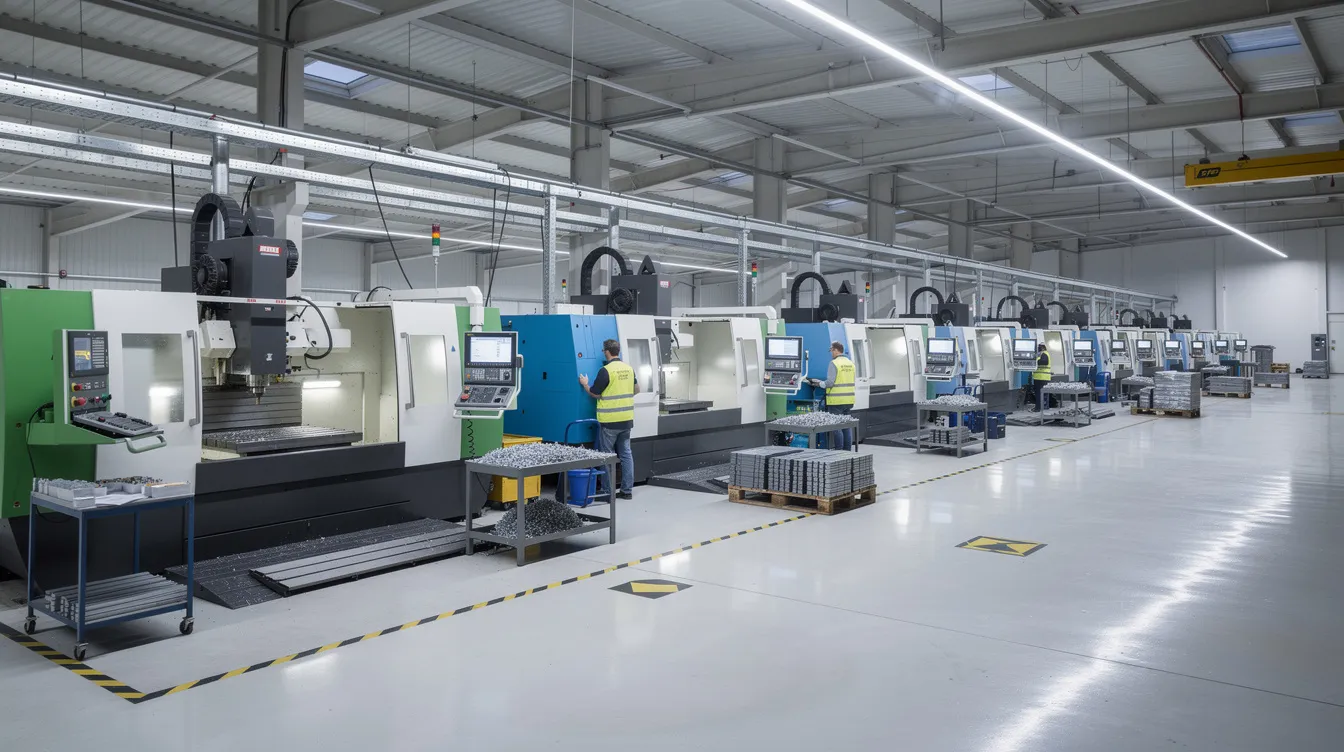
The advantages for overseas buyers are concrete:
-
Cost: CNC machining in China is often 30-50% cheaper than in Western countries. Labor and materials costs are significantly lower, and automated processes reduce machining costs and energy consumption further.
-
Speed: Chinese factories achieve faster lead times, cutting wait times by almost half compared to many Western suppliers.
-
Capacity: Factories handle everything from rapid prototyping to full-scale production of cnc machined parts, with the flexibility to pivot between the two.
-
Technology: Growth in cnc machines, cnc routers, cnc laser machines, laser cutting machines, plasma cutters, and advanced cnc machines has expanded capabilities into virtually every industrial sector.
The result: precision CNC machining in China offers good quality at lower prices, making it a compelling option for OEMs in aerospace, medical, automotive, and electronics.
Best Regions in China to Find Reliable CNC Factories
The “best” cnc machining company isn’t defined by a single factory name. It’s about choosing the right region first, then vetting individual suppliers within that cluster. Each of China’s major CNC hubs has distinct strengths in cnc milling, cnc turning, and related processes. Here’s where overseas OEMs most commonly source work.
Guangdong Province: Dongguan & Shenzhen (Top Choice for Overseas OEMs)
Guangdong is the strongest and most mature cluster for precision machining and cnc milling for export. It contributes 28.9% of China’s audited CNC machining capacity, with Dongguan and Shenzhen as the anchor cities.
Dongguan has been a “workshop of the world” for precision components since the 2000s, with dense supply chains for aluminum, stainless steel, and engineering plastics. Leading CNC factories here often achieve tolerances of ±0.005 mm on standard features, and many top factories are ISO 9001 certified for quality assurance. In the Haizol audit, 52.3% of Guangdong factories operate premium 5-axis milling machines, and quote commitment rates hit 99%.
Anebon Metal Products Limited is located in this region, providing cnc machining, die casting, and sheet metal fabrication with tolerances down to ±0.002 mm. Chinese CNC factories in this zone can handle both prototyping and mass production, which is why the region attracts the majority of overseas RFQs.
Jiangsu Province: Suzhou, Wuxi, Nanjing
Jiangsu hosts 138 of 456 audited factories (roughly 30.3% of capacity), making it China’s single largest province for CNC machining by factory count. The region specializes in high-end cnc machinery, industrial automation components, and precision parts for rail transit, semiconductor equipment, and heavy machinery.
Suzhou and Wuxi feature many horizontal machining centers, vertical cnc machining centers, and multi-axis cnc equipment for larger structural parts, mold bases, and complex housings. Advanced CNC factories here utilize 5-axis machining for complex geometries in demanding applications. Factories often support domestic machine manufacturer brands while also exporting components to Europe and North America.
Choose Jiangsu when you need larger structural parts, molds, and heavy-duty cnc machined components.
Zhejiang Province: Ningbo & Hangzhou
Zhejiang contributes approximately 23% of China’s CNC machining capacity. Ningbo in particular is famous for die casting, automotive subcomponents, and precision machining of aluminum and zinc parts. The province has a strong presence of integrated cnc machining companies that combine casting, machining, and finishing under one roof.
This region suits automotive subcomponents, consumer hardware, and mechanical assemblies with mid-to-high volume demand. However, many factories here focus more on domestic and regional supply compared with Dongguan’s heavily export-oriented infrastructure.
Other Notable CNC Clusters (Chongqing, Shanghai, Tianjin)
Inland hubs like Chongqing and coastal cities like Shanghai and Tianjin also house capable cnc machining services, but they represent just over 10% of audited capacity outside the three main coastal provinces. Shanghai addresses high-end machinery and lab-scale precision work. Chongqing focuses on automotive fabrication and large parts.
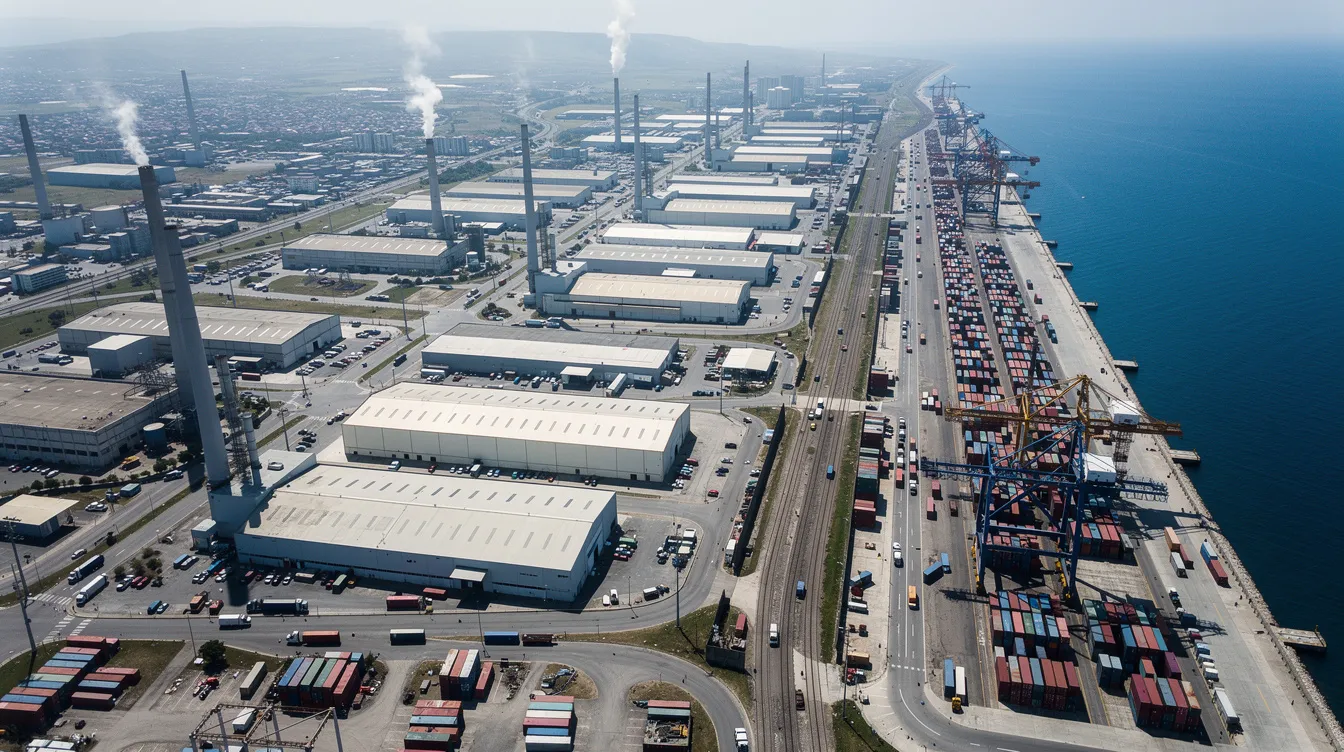
For overseas buyers with standard precision parts needs, Guangdong-based factories still offer better responsiveness, English communication, and proximity to major shipping ports like Shekou and Yantian.
Key Signs of a Reliable CNC Factory in China
Location is only the first filter. Real reliability depends on certifications, process control, communication, and a verifiable track record. Here are the concrete criteria every buyer should verify before committing to any cnc machining company.
Certifications and Quality Management
ISO 9001:2015 is a common certification for CNC manufacturers and a baseline requirement for any serious supplier. ISO 9001 ensures quality management in CNC machining through documented processes, corrective actions, and management review. ISO certifications indicate adherence to international quality standards, but buyers should go further:
-
IATF 16949 for automotive supply chains
-
AS9100 certification is crucial for aerospace industry compliance
-
ISO 13485 is essential for medical device manufacturing standards
-
ISO 14001 for environmental management
Quality certifications should be verified through independent auditing bodies-check certificate numbers, issuing organizations (BSI, TÜV, DNV), and renewal dates. Anebon holds ISO 9001:2015 and ISO 14001:2015 certifications, demonstrating structured quality and environmental control.
Equipment: From 3-Axis to 5-Axis CNC Machines
A reliable factory uses a mix of 3-axis cnc milling machines, 4-axis cnc, and 5-axis CNC machining centers to handle both simple and complex geometries. According to the 2026 Haizol data, 38.8% of audited factories operate 5-axis machines, and 48.2% offer Swiss machining with tolerances around ±0.005 mm.
Advanced CNC machines achieve tolerances as tight as ±0.001 mm on specialized features. Hybrid CNC-3D printing technologies are also emerging, enabling complex design execution that traditional cutting alone cannot achieve. High-precision equipment from suppliers often requires strict tolerances like ±0.002 mm, which demands premium machine tools with verified positioning accuracy.
Buyers should request a machine list specifying brands (DMG MORI, Mazak, Haas, Fanuc-controlled), spindle speeds, axis travel, and whether each machine has an automatic tool changer for unattended operation. Chinese CNC manufacturers routinely achieve tolerances as tight as ±0.005 mm across standard production work.
Inspection Capabilities and Metrology
Precision metrology tools are critical for quality assurance in CNC machining. Serious factories invest not just in cnc machines but also in coordinate measuring machines (CMMs), optical projectors, height gauges, surface roughness testers, and hardness testers.
Leading factories often employ AI-driven quality inspections with defect rates below 0.2%. AI-driven quality inspections maintain defect rates below 0.2% by flagging dimensional drift before it produces scrap. Buyers should confirm the factory performs first-article inspection (FAI), in-process checks, and final inspection with full dimension reports and material certificates.
Engineering Support and DFM Feedback
Many CNC companies offer design for manufacturing support as a standard service. Design for Manufacturing (DFM) reports provide suggestions for design improvements-flagging issues like unsupported thin walls, unnecessarily tight tolerances on non-critical features, or deep pocket geometries that increase cycle time.
For example, a common DFM improvement is increasing internal fillet radii from 0.5 mm to 1.0 mm, which allows standard end mills to be used and cuts machining time by 20–30%. Another is recommending a wall thickness increase from 0.8 mm to 1.2 mm on aluminum housings to prevent distortion during machining.
Anebon’s engineers regularly support overseas R&D teams with DFM suggestions that reduce cost and lead time while maintaining functionality.
Material and Surface Treatment Capabilities
CNC machining services can process various materials including metals and plastics. A reliable factory should handle:
|
Category |
Common Materials |
|---|---|
|
Aluminum alloys |
6061, 6082, 7075, 2024 |
|
Stainless steels |
303, 304, 316, 17-4PH |
|
Other metals |
Titanium (Ti-6Al-4V), tool steels, brass, copper |
|
Plastics |
POM, PEEK, PC, ABS, nylon, PTFE |
Integrated surface treatment options-anodizing, powder coating, passivation, hard anodizing, nickel plating, bead blasting-simplify supply chains. In the 2026 Haizol audit, roughly 60.5% of factories handle secondary processes in-house. A one-stop machining company like Anebon manages both machining and finishing with single-point quality responsibility. Buyers should request material certificates (e.g., EN10204 3.1) and finishing samples, and confirm whether work is performed on metal sheets, solid block billets, or castings.
Communication, Documentation, and NDA
For overseas OEM projects, communication effectiveness can reduce misunderstandings in manufacturing processes significantly. Responsive English communication and clear documentation-quotes, annotated drawings, QC reports-are non-negotiable.
Formal NDAs and IP protection matter, especially for new product development in robotics, medical, and aerospace sectors. Anebon routinely signs NDAs and follows strict data handling procedures, including limited-access servers and restricted shop-floor access to customer prints. Evaluate responsiveness by testing supplier feedback times: reliable factories respond to technical inquiries within 24 hours on business days. Supplier responsiveness to technical inquiries reflects their reliability far more accurately than marketing claims.
On-Time Delivery and Logistics Experience
Experienced factories manage lead times clearly: prototypes typically ship within 5–10 working days; production batches within 2–4 weeks depending on complexity and finishing. CNC machining in China offers rapid prototyping and mass production flexibility that many Western shops struggle to match.
Reliable factories work with standard Incoterms (FOB, CIF, DAP) and coordinate with the buyer’s freight forwarder. Anebon’s location in Dongguan provides direct access to Shekou and Yantian ports, with air express options for urgent builds. On-time delivery rates exceeding 95% are a strong reliability indicator-always request historical data.
Types of CNC Factories in China: Machines vs. Machining Services
Before diving deeper, it’s important to clarify a common confusion. Many buyers searching “best CNC factory in China” conflate two very different types of suppliers. Understanding this distinction will save you significant time.
CNC Machine Manufacturers (Selling Equipment)
These are cnc machine manufacturers that design and build equipment: cnc routers, cnc milling machines, cnc lathe machines, cnc laser machines, laser cutting systems, engraving machines, laser welding machines, laser engraving machines, edge banding machines, desktop cnc routers, laser cutters, laser engravers, laser welders, digital cutters, and plasma cutters. Companies like Shenyang Machine Tool fall into this category, as do many chinese cnc manufacturers producing cnc router machines, fiber lasers, laser machines, and equipment for laser engraving, laser marking technology, plastic cutting, and foam molding.
These factories offer product catalogs with specs-spindle power, axis travel, controller brand-plus installation services. If you buy a new cnc machine or own cnc machine from them, you’ll need your own machinists, programmers, and quality systems. This path suits manufacturers planning long-term in-house production with various cnc machines, co2 laser cutting systems, or similar chinese machines.
CNC Machining Companies (Providing Custom Parts)
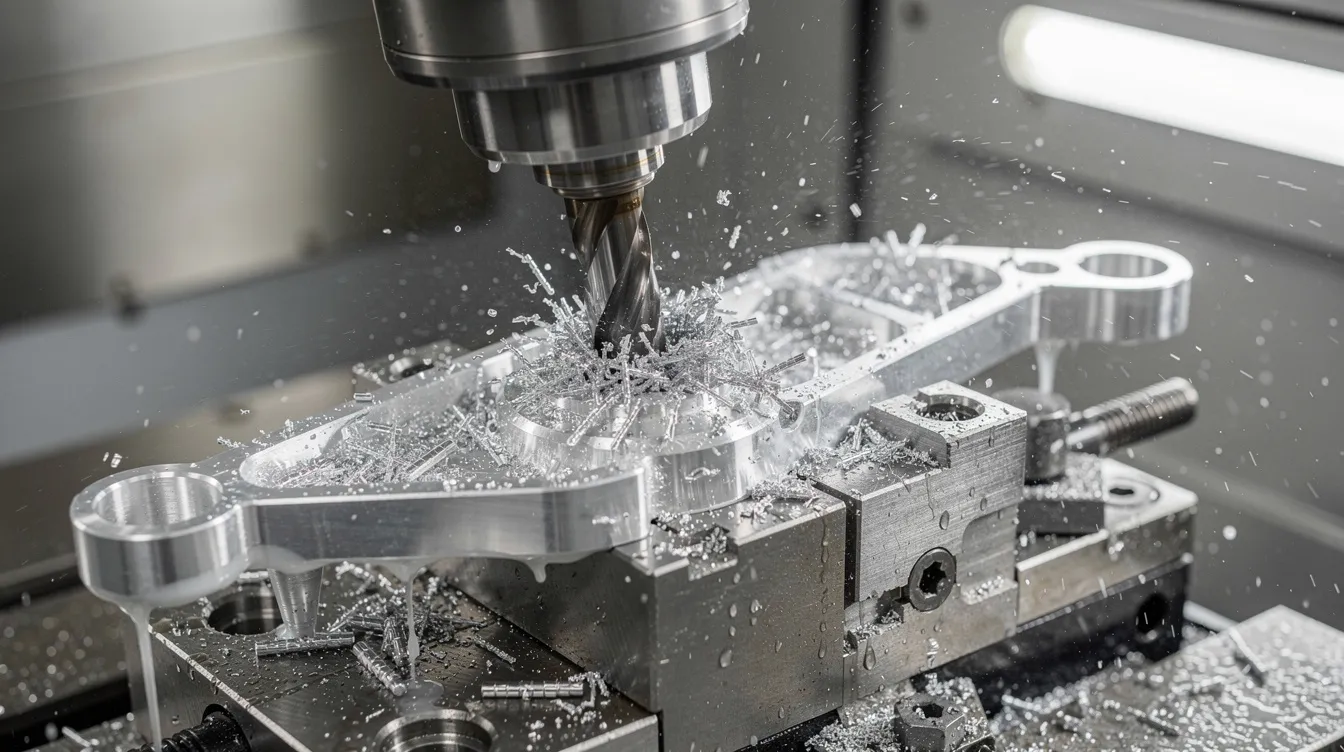
CNC machining companies like Anebon use diverse cnc machines to produce custom metal and plastic components based on client drawings. CNC machining includes milling, turning, and 3D printing, and services range from rapid prototyping to full production. These are cnc machining companies in China that provide comprehensive one-stop services, including die casting, sheet metal fabrication, and secondary finishing.
This is the type of partner most overseas OEMs actually need. As an essential guide to CNC would explain, computer numerical control cnc technology enables these factories to deliver high precision parts from aluminum, titanium, plastic materials, and specialty alloys-without requiring buyers to invest in their own equipment.
The rest of this guide focuses on how to choose this second type of partner.
Case Study: Anebon Metal Products Limited in Dongguan, China
To make the concept of a “best reliable CNC factory” concrete, it helps to examine a real example. Anebon Metal Products Limited operates from Dongguan in Guangdong province-China’s top cnc machining region. Founded in 2010, ISO 9001:2015 and ISO 14001:2015 certified, and serving global OEMs across multiple industries, Anebon illustrates what a credible machining partner looks like in practice.
Company Profile and History
Anebon was founded in 2010 with a focus on export-oriented precision manufacturing. Its B2B/OEM business model targets design engineers and R&D teams primarily in North America, Europe, and other industrialized regions. Over 15 years of continuous operation, the company has built a reputation for tailored solutions in modern manufacturing.
Dongguan’s location provides direct access to raw materials suppliers, surface finishing partners, and advanced technology equipment vendors-all within a compact logistics radius. This ecosystem is what makes Guangdong-based factories competitive on both cost and turnaround.
Core Services: CNC Machining, Die Casting, Sheet Metal Fabrication
Anebon’s core offering includes:
-
Precision cnc milling and turning (3-axis through 5-axis machining)
-
Rapid prototyping for new product validation
-
Low- and high-volume production runs
-
Aluminum and zinc die casting for cost-effective volume parts
-
Sheet metal cutting, bending, welding, and assemblies
This range allows Anebon to act as a one-stop machining company, delivering finished cnc parts with surface treatments and sub-assembly. Typical projects include housings for electronics, medical fixtures, aerospace brackets, and robotics components.
Technical Capabilities and Tolerances
Anebon holds tolerances down to ±0.002 mm on suitable features, with typical general work at ±0.01 mm. CNC machining can achieve tolerances as tight as ±0.001 mm in specialized operations, and Anebon’s equipment portfolio supports this range for demanding OEM projects.
The factory operates multi-axis cnc machining centers, cnc lathe equipment with live tooling, and supporting equipment for complex geometries. Parts are machined from solid block billets, castings, or forgings in both metal and engineering plastic options. For complex surfaces and undercuts common in aerospace parts, 5-axis cnc work is standard.
Materials, Surface Finishes, and Industry Focus
|
Metals |
Plastics |
Surface Treatments |
|---|---|---|
|
Aluminum 6061, 7075 |
ABS, PC |
Anodizing (clear, black, hard) |
|
Stainless 303, 304, 316, 17-4PH |
POM, PA |
Powder coating, bead blasting |
|
Tool steels, titanium |
PEEK, PTFE |
Chromate conversion, plating |
|
Brass, copper, magnesium |
Nylon |
Brushing, polishing, passivation |
These capabilities connect directly to the industries Anebon serves: aerospace components, medical device parts, automotive prototypes, robotics subsystems, and industrial machinery. CNC turned plastic parts are available alongside metal machining.
Quality Assurance and Process Control
Anebon’s quality workflow follows a structured sequence:
-
Contract review and DFM analysis
-
First article inspection (FAI)
-
In-process dimensional checks
-
Final inspection with full dimension reports
-
Shipment approval and documentation package
Calibrated metrology equipment-CMMs, optical projectors, surface roughness testers-ensures traceable measurement. Anebon maintains records including inspection reports, material certificates, and process logs to support customer audits and long-term traceability. The ISO 9001:2015 and ISO 14001:2015 systems provide the management framework for quality management and environmental compliance.
Working With Anebon: From RFQ to Delivery
The engagement process is straightforward:
-
RFQ submission: Upload 3D models (STEP, IGES, Parasolid) and 2D PDF drawings
-
DFM & quote: Receive engineering feedback and pricing within approximately 24 hours on business days
-
Order confirmation: Agree on specs, tolerances, materials, and delivery schedule
-
Prototype build: As fast as a few working days for simple cnc machined parts
-
Production scaling: Validated designs move to volume with consistent quality
-
Logistics: FOB, CIF, or DAP shipping coordinated with your freight forwarder
Ready to test? Send your 3D files and drawings to Anebon for a detailed quote.
How to Evaluate and Shortlist CNC Factories in China
Once you’ve decided that Guangdong (or another Chinese region) is right for your project, you need a structured selection process. Here’s a practical checklist that works whether you’re evaluating Anebon or any other supplier.
Define Technical and Business Requirements
Document key specs before contacting factories: materials, tolerances, annual volumes, required surface finishes, and any special certifications. Clear requirements reduce misquotes and help factories quickly confirm feasibility. Create a standardized RFQ template and use it across all shortlisted suppliers.
Including 3–5 representative parts in your RFQ is far more revealing than sending a single sample. It shows whether the factory has broad or narrow capability.
Request Capability and Certification Packages
Ask for machine lists, sample photos, certification scans, and typical lead times. Quickly screen out factories that lack necessary equipment-no 5-axis capability when your geometry requires it, for example. Requesting facility proof is important in supplier vetting: photos, videos, or virtual tours confirm that the factory matches its claims. Confirm whether critical cnc machining is done in-house or outsourced.
For guidance on structuring this comparison, see Choosing the Right Machining Vendors for Your Manufacturing Needs.
Use Trial Orders to Validate Quality and Communication
Requesting prototypes can help assess machine quality before bulk orders. Trial orders can help evaluate the reliability of CNC suppliers by revealing dimensional accuracy, finish quality, packaging standards, and response times under real conditions.
Measure sample parts independently and compare against the factory’s inspection reports. A strong first trial with a partner like Anebon-where documentation aligns with measured results-is one of the best predictors of long-term reliability.
Compare Total Cost, Not Just Unit Price
Total cost includes unit price, scrap risk, rework, delays, shipping, customs duties, and internal handling. Don’t choose the lowest quote blindly. China’s CNC machining costs are often 30-50% lower than Western countries, but within China, the cheapest option frequently costs more once you factor in quality failures.
Well-optimized factories in Dongguan deliver competitive pricing with 20–40% savings versus Western suppliers while maintaining aerospace- and medical-grade quality. Switching suppliers due to quality problems is almost always more expensive than choosing a slightly higher-priced but reliable partner from the start-a proven way to save money long term with cost effective solutions.
Applications and Industries That Benefit Most from Chinese CNC Factories
Different sectors gain different advantages from working with chinese cnc machining companies. Here are the use cases most aligned with what factories like Anebon deliver daily.
Aerospace and UAV Components
Typical parts include lightweight aluminum brackets, structural housings, and sensor mounts with tight tolerances and full traceability. 5-axis cnc machining and rigorous quality checks (FAI, material certs) are non-negotiable. Anebon machines aluminum, titanium, and stainless components used in drone frames, gimbal systems, and sensor housings for industrial manufacturers in this sector.
Medical Devices and Laboratory Equipment
CNC machined stainless steel and high-performance plastics (PEEK, POM) are standard in surgical tools, laboratory fixtures, and automation hardware for medical applications. Surface finish requirements-smooth, burr-free, easy to disinfect-demand careful process control. Small-to-medium batches with frequent design iterations are typical, and Anebon’s precision and flexibility align well with these needs.
Automotive, EV, and Mobility Components
Common parts include motor housings, battery pack brackets, test fixtures, and prototype drivetrain components. Rapid prototyping combined with scalable production in chinese cnc factories shortens development cycles for EV startups and Tier 1 local suppliers. Anebon supports design engineers with quick-turn prototype parts for validation, combining cnc machining with die casting parts for machinery when volume justifies it.
Electronics, Robotics, and Industrial Machinery
Electronics enclosures, heatsinks, precision gear housings, and robotic arm components are well-suited to axis cnc machining in China. Tight fits, alignment features, and consistent cosmetic finishes matter for high-end products. Anebon delivers custom solutions for automation equipment, robotic systems, and precision jigs-often combining machining, sheet metal, and finishing for complex assemblies that demand custom machining services.
Frequently Asked Questions About CNC Factories in China
These are the most common practical questions from overseas buyers evaluating Chinese CNC machining partners.
Are CNC Machined Parts from China Reliable Enough for Critical Applications?
Yes. Many Chinese factories-particularly in Dongguan, Shenzhen, Suzhou, and Ningbo-routinely supply aerospace, medical, and automotive sectors under stringent certifications. Reliability depends on choosing a certified, well-equipped partner with proven QC processes. Request sample parts, inspection reports, and references before large orders. Focus on process and documentation, not just pricing.
How Much Can I Save by Outsourcing CNC Machining to China?
Typical savings range from 30–50% versus US and EU suppliers, depending on part complexity and volume. These savings come from efficient labor, dense supply chains, and optimized workflows-not from cutting quality corners. Companies like Anebon aim for cost effective solutions while maintaining strict quality control. Compare landed cost (including shipping and duties) rather than unit price alone.
What Lead Times Can I Expect for CNC Machined Parts from China?
Prototype lead times run about 5–10 working days after order confirmation for standard parts. Production runs typically ship within 2–4 weeks. Express air shipping can deliver urgent cnc parts in 3–7 days to most Western countries. Anebon provides realistic schedules up front and prioritizes urgent development builds when needed.
Is It Possible to Order Just a Few Prototype Parts?
Absolutely. Many export-focused cnc machining companies in China, including Anebon, accept low-volume and single-piece prototype orders. In the 2026 Haizol audit, 63.3% of demand consisted of orders of 50 pieces or fewer, with a median MOQ of just 10 units. Pricing per piece is higher at prototype quantities but offers valuable risk reduction before committing to production tooling.
How Is Intellectual Property Protected When Working with Chinese CNC Factories?
Reputable factories sign NDAs, limit file access internally, and avoid reusing customer designs. Best practice is staged disclosure-sharing only the information necessary at each project phase. Anebon regularly works under NDA with global OEMs and follows strict IP protection protocols. For highly sensitive projects, consult legal counsel to align contracts with your home jurisdiction.
Conclusion: Finding the Best Reliable CNC Factory in China
The “best” CNC factory is found in China’s leading machining hubs-especially Dongguan in Guangdong-paired with verified evidence of quality, advanced technology, machine design excellence, and responsive service. Buyers should prioritize ISO-certified factories with 3–5 axis cnc machines, robust quality management, and clear English communication that supports supply chains across continents.
Anebon Metal Products Limited is a prime example of a reliable, export-focused cnc machining partner in Dongguan that meets these criteria: 15+ years of operation, ISO 9001:2015 and ISO 14001:2015 certifications, tolerances to ±0.002 mm, and a full suite of machining, die casting, and sheet metal services.
Ready to get started? Send your 3D models and drawings to Anebon for a fast, detailed quotation on cnc machined parts, die castings, or sheet metal components. Your first quote-including DFM feedback-is free.