Understanding What is a CNC Lathe Machine and Its Applications
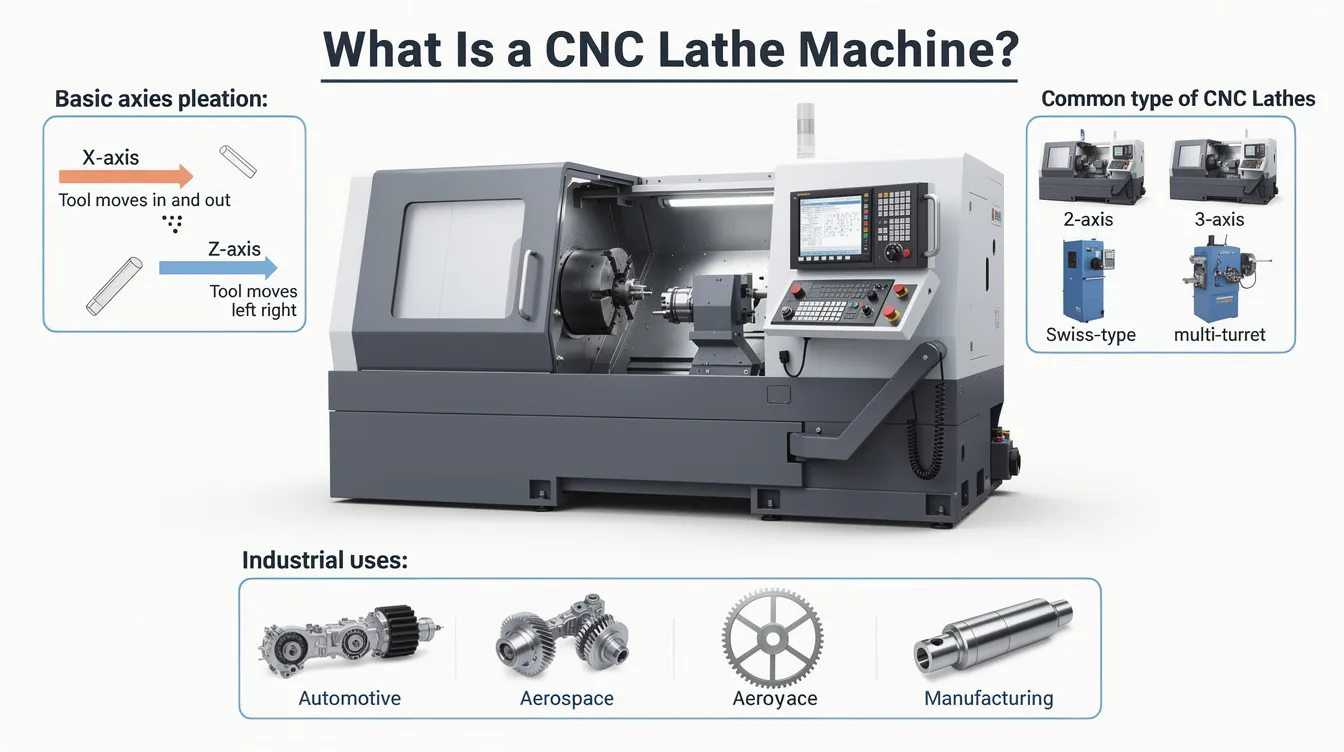
What Is a CNC Lathe Machine? (Basics, Axes, Types & Industrial Uses)
Introduction to CNC Lathe Machines
A cnc lathe machine is a computer controlled machine tool that shapes raw materials by rotating a workpiece against a cutting tool to produce precise cylindrical parts. Unlike a manual lathe, where an operator physically adjusts handwheels and cutting depths, a cnc lathe operates by following precise design instructions stored as digital programs. This computer numerical control approach eliminates guesswork and delivers exceptional accuracy across hundreds or thousands of identical components.
CNC lathes sit alongside CNC mills and 5-axis CNC machines as a core pillar of modern cnc machining. Where mills excel at prismatic shapes with pockets and slots, lathes specialize in rotationally symmetric geometries – shafts, bushings, connectors, and threaded fittings that keep industries running. CNC lathe machines are essential for high-velocity automated production with tight tolerances, making them indispensable for OEM parts in aerospace, medical, and automotive sectors.
At Anebon Metal Products Limited, we use advanced cnc lathe machines as part of our precision manufacturing services to deliver tolerances as tight as ±0.002 mm for customers worldwide. This guide walks you through everything you need to know – from basic principles and axis configurations to components, operations, and how to choose the right CNC lathe partner.
What Is a CNC Lathe Machine?
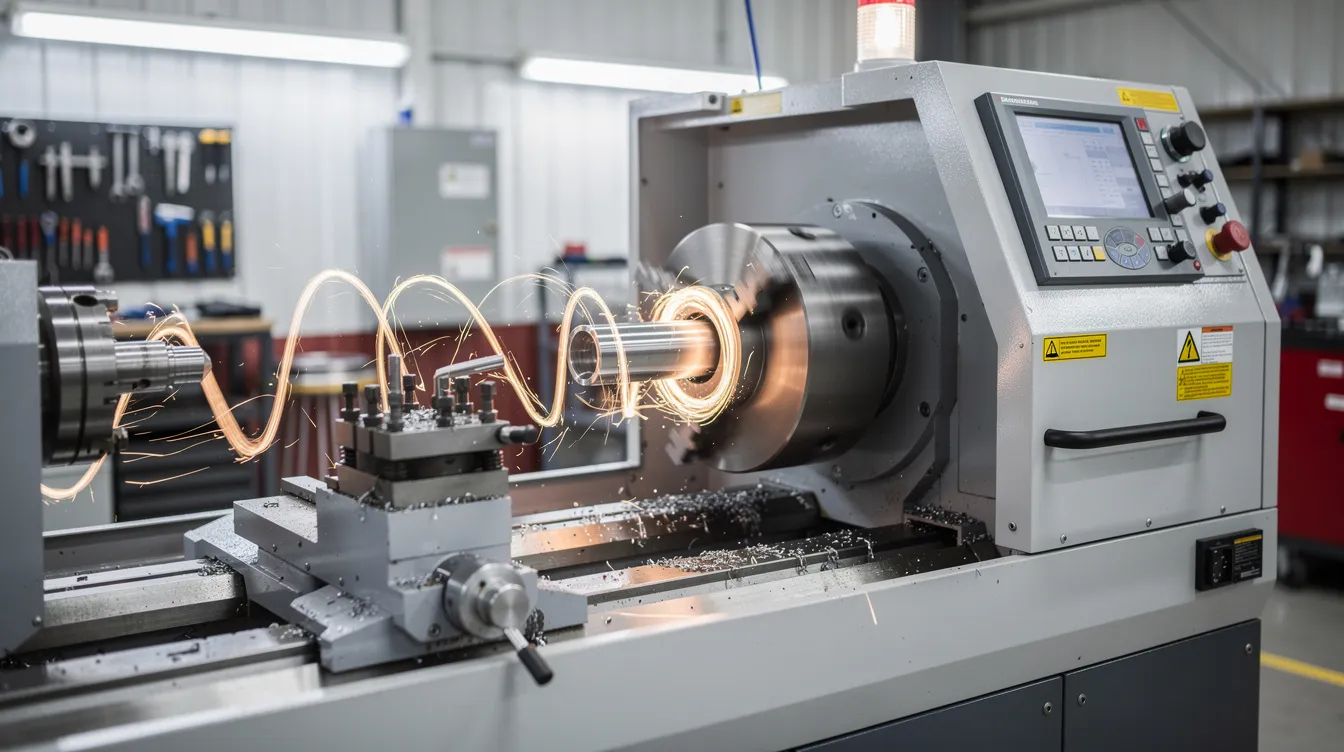
A cnc lathe – short for computer numerical control lathe – is a machine tool designed primarily to shape rotating workpieces through subtractive manufacturing. The basic working principle is straightforward: a cnc lathe rotates a workpiece on the spindle while stationary or driven cutting tools move along programmed axes to remove material. This turning process produces parts with circular symmetry, from simple pins to complex valve bodies.
It is worth distinguishing between a standard lathe machine and a cnc turning center. A basic cnc lathe handles core turning operations on two axes. A cnc turning center, however, typically adds live tooling, a y axis for off-center work, and sometimes a second spindle – blurring the line between turning and milling. Think of a turning center as a lathe that can also drill, tap, and mill features without removing the part from the chuck.
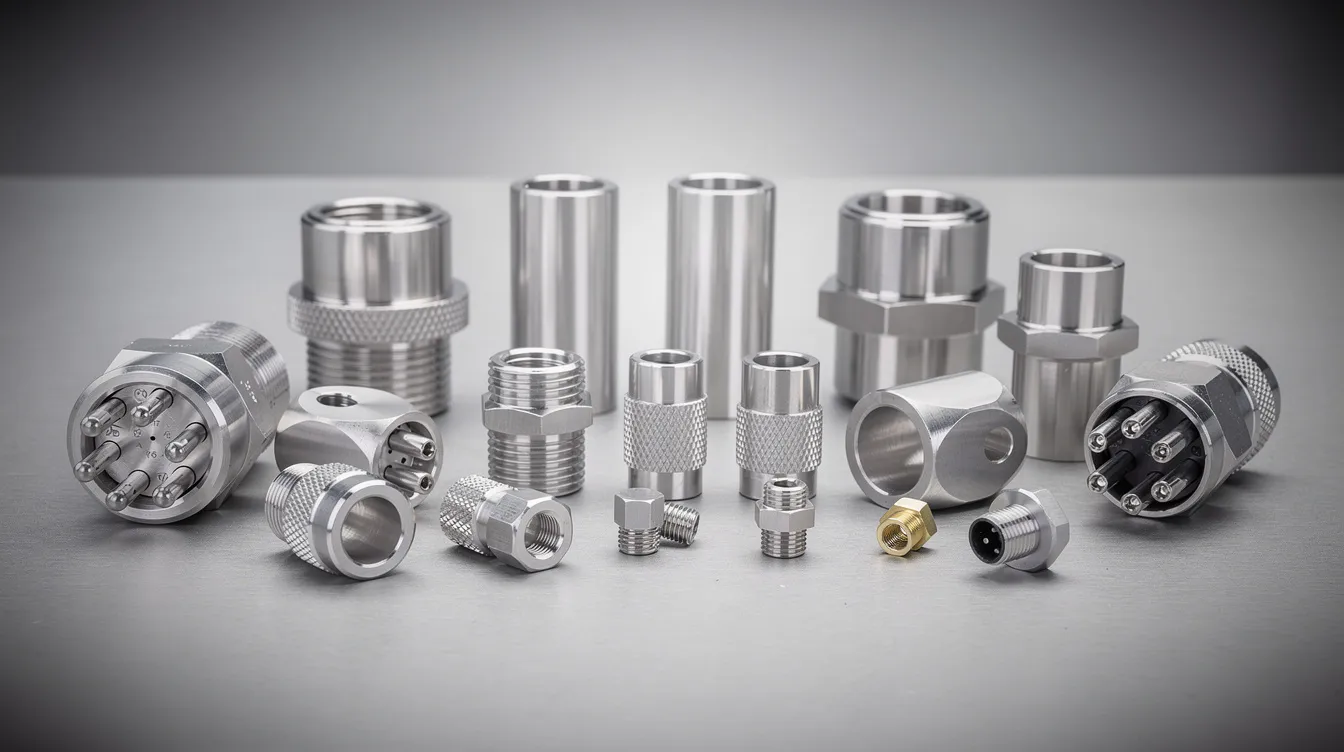
At a high level, the key components of any cnc lathe include the bed (the rigid foundation), the headstock housing the main spindle, a chuck or collet system gripping the workpiece, a tailstock for supporting long parts, a tool turret holding different tools, and the CNC control panel that orchestrates everything. Common turned parts include shafts, bushings, threaded fittings, hydraulic connectors, and fasteners.
Compared to other cnc machines, the fundamental difference is motion. In a cnc lathe, the workpiece spins. In a CNC mill, the cutting tool spins. Rotational machining with CNC lathes is ideal for creating parts with circular symmetry, while mills handle flat surfaces, pockets, and three-dimensional contours. CNC lathes produce precise cylindrical parts that would be slow or impossible to create efficiently on a mill.
How Does a CNC Lathe Work?
Understanding how a cnc lathe operates starts with the journey from digital design to finished part. CNC lathes use G-code for programming machine movements – a language of numbered instructions that tells the machine exactly where to move, how fast to cut, and when to change tools.
The machining process begins with a 3D or 2D part design created in CAD software. Engineers specify critical dimensions, tolerances, surface finish, and the material depends on the application. Next, CAM software translates that geometry into toolpaths – the exact routes the cutting tool moves through to shape the workpiece. These toolpaths are then post-processed into G-code tailored to the specific controller (Fanuc, Siemens, Haas, or similar).
On the shop floor, an operator sets up the machine: loading bar stock into a chuck or collet, installing tools into the tool turret, and establishing work coordinates. A dry run or test cycle verifies that tool paths are collision-free before the full production run begins. During cutting, roughing cycles (such as G71) remove bulk material, followed by finishing passes (G70) that bring the profile to final dimensions. Commands like G00 handle rapid positioning, G01 controls linear cuts at a defined feed rate, and G02/G03 manage circular arcs. The CNC control automates feed rates, spindle speeds, and tool changes throughout each cycle, ensuring repeatable quality from the first part to the thousandth.
CNC lathes can operate 24/7 and are often 3–5 times faster than manual lathes for complex parts, thanks to this level of automation. Cycle times drop dramatically when programming replaces manual intervention.
Axes of a CNC Lathe: From 2-Axis to 5-Axis CNC
The number of axes on a cnc lathe determines how many directions the tool or workpiece can move independently. More axes means more complex shapes can be machined in a single setup – but also more programming complexity and machine cost. Understanding how many axis configurations are available helps you match the right machine to your part requirements.
On a basic cnc lathe, two linear axes do the work: the z axis runs along the spindle (lengthwise), while the x axis moves the tool radially toward or away from the workpiece center. From there, additional axes – y axis, c axis, b axis, and others – progressively expand what a lathe can accomplish.
2-Axis CNC Lathes
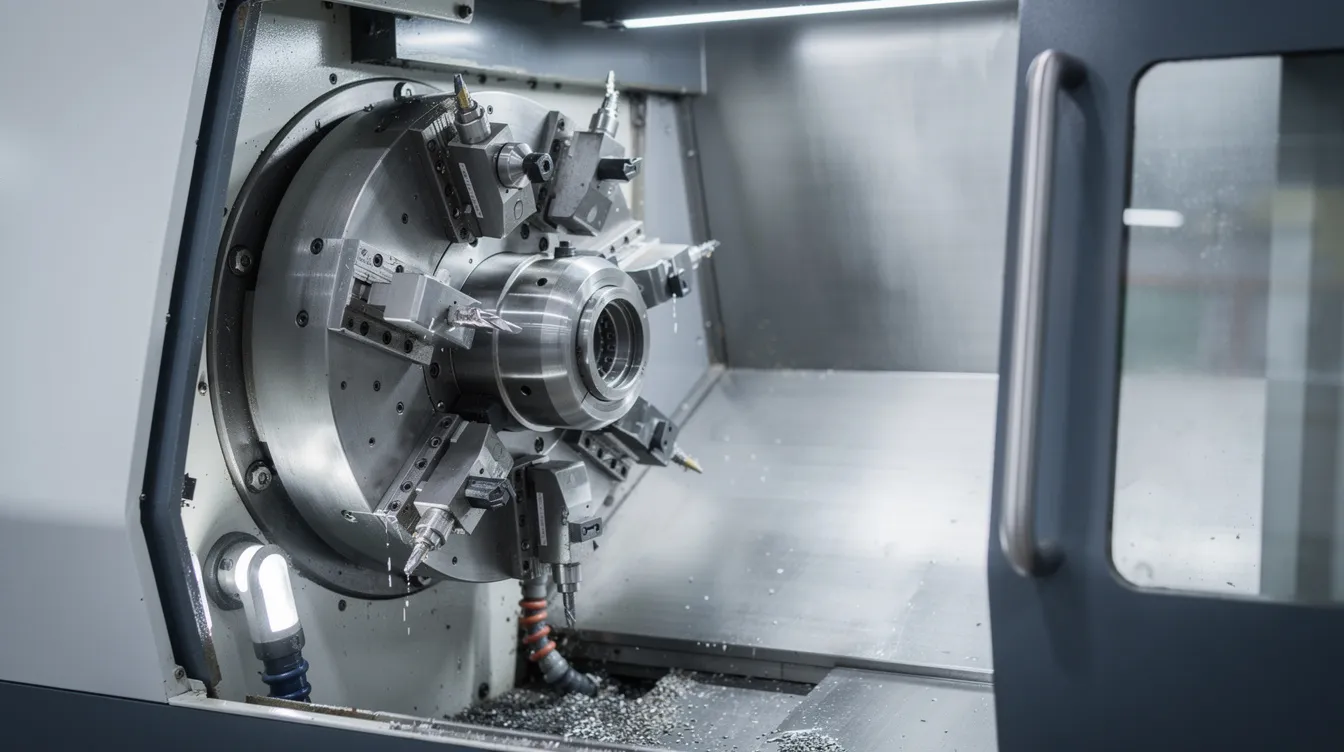
A 2-axis cnc lathe controls tool movement along only the x and z axes. These two axes are sufficient for producing simple cylindrical parts such as shafts, pins, bushings, and threaded rods. The workpiece is often loaded through a bar feeder or gripped in a 3-jaw chuck or collet system, and the cutting tool moves in straight lines and arcs to create outer diameter profiles, tapers, chamfers, and threads.
Despite their simplicity, 2-axis lathes remain the workhorses of many machine shops. For cost-effective high volume production of rotationally symmetric components from bar stock, a two axes configuration is often all that is needed. These machines minimize programming overhead and are fast to set up, making them ideal when part geometry does not require off-center features.
3-Axis CNC Lathes and CNC Turning Centers
Adding a y axis – perpendicular to both x and z – opens up off-center machining capabilities. With three linear axes, a cnc turning center can drill holes, mill flats, and cut keyways at positions that are not aligned with the workpiece centerline. This turns a simple lathe into a more versatile machine that handles standard milling operations alongside turning operations.
Modern 3-axis cnc turning machines often feature dual spindles. A sub-spindle operates in sync with the main spindle, allowing the machine to flip the part and machine both ends in a single cycle – no manual re-chucking needed. This reduces setup time and improves positional accuracy between features on opposite ends of a part.
Practical examples include flatted shafts with milled flats on two sides, parts requiring hex features for wrench engagement, or components with off-center cross-holes. These would normally require a second operation on a CNC mill, but a 3-axis turning center handles them in one setup.
4-Axis CNC Lathes (C-Axis and Live Tooling)
A 4-axis cnc lathe typically adds the c axis – controlled rotational positioning of the main spindle – to the standard X and Z linear axes plus a life tool system (live tooling) in the turret. The c axis transforms the spindle from a simple rotating drive into a precisely indexable rotary axis, enabling the machine to position the workpiece at exact angular orientations for cross-drilling, tapping operations, and light profiling.
Advanced CNC lathes can perform live tooling, allowing for milling and tapping in one setup. Tool holders in the turret carry driven tools – small end mills, drills, and taps – that spin independently of the workpiece. Combined with c axis indexing, this makes it possible to produce bolt-circle hole patterns, cross-drilled ports, and helical milling operations without moving the part to a separate mill.
Industries that benefit most from 4-axis capability include hydraulic component manufacturers (manifolds, connectors), automotive suppliers (complex shafts with drive features), and electronics firms producing intricate parts with both turned and milled geometry.
5-Axis CNC Lathes and Multi-Tasking Machines
A 5-axis cnc lathe adds a b axis (tilting tool head) or a-axis (tilting workpiece fixture) on top of X, Z, Y, and C, enabling compound-angle machining. This lets cutting tools approach the workpiece from virtually any direction, producing complex geometries that would otherwise require multiple setups across different machines.
Multi-tasking machines take this further by combining full 5-axis CNC machining with cnc turning in a single clamping. The result is a machine that can rough-turn an outer diameter, then tilt a milling head to cut turbine blades, sculpted medical implant surfaces, or angled ports – all without unclamping. Positional tolerances between turned and milled features stay extremely tight because the part never moves.
Real-world applications include aerospace turbine shafts machined from titanium, orthopedic implants with complex 3D surfaces, and precision surgical instruments. These are parts where greater precision and fewer setups directly reduce scrap rates and cycle times. While the machines carry higher acquisition costs, the per-part savings on complex shapes often justify the investment.
CNC Swiss-Type Lathes
CNC Swiss-type lathes are purpose-built for small, slender, high precision parts. CNC Swiss lathes typically make parts under 2 inches in diameter (usually under 32 mm). The defining feature is a guide bushing: bar stock slides through a fixed position bushing that supports the material millimeters from the cutting point, virtually eliminating deflection.
This design makes Swiss lathes ideal for electronic connectors, medical screws, watch components, and precision pins where tolerances of ±0.002 mm or better are required. Swiss machines typically run with a bar feeder for long, unattended production runs – often lights-out overnight – producing thousands of identical parts with minimal operator intervention.
Main Components of a CNC Lathe Machine
Understanding the key components of a cnc lathe helps when specifying machines, evaluating suppliers, or troubleshooting quality issues. Every component contributes to the overall rigidity, accuracy, and surface finish the machine can deliver.
The machine bed is the foundation. The machine bed is made of Meehanite cast iron (or similar high-dampening material), chosen for its vibration-absorbing properties and long-term dimensional stability. Slant-bed configurations are common on modern lathes because they improve chip evacuation and give operators better visibility. Guideway design – box ways for rigidity or linear guides for speed – directly influences achievable accuracy and maintenance intervals.
The headstock houses the main spindle assembly. The main spindle includes motors, gears, and a chuck that grip and rotate the workpiece. Spindle power (measured in kW or hp) and maximum RPM determine what materials the machine can handle and at what speed. A high-RPM spindle motor suits aluminum and brass; a high-torque spindle suits hardened steel and titanium. The spindle bore diameter sets the maximum bar stock size for through-bar work.
Cutting tools are mounted on a rotating tool turret, which can hold 8 to 24 or more stations. The tool turret allows for quick tool changes during machining – indexing between tools in fractions of a second during a programmed sequence. Some stations hold static tools for turning and facing; others hold live (driven) tools for drilling, milling, and tapping. The tailstock provides support for long workpieces during machining, pressing a live center into the free end of the part to prevent deflection and chatter.
The CNC control unit – the brain of the machine – reads G-code and coordinates all axis movement, spindle speed, coolant flow, and tool changes. The control panel gives operators access to setup screens, offset tables, simulation, and diagnostics. Modern controllers from brands like Fanuc and Siemens include thermal compensation and adaptive feed-rate features that maintain consistency over long production runs.
What Is a CNC Lathe Used For? Common Operations & Applications
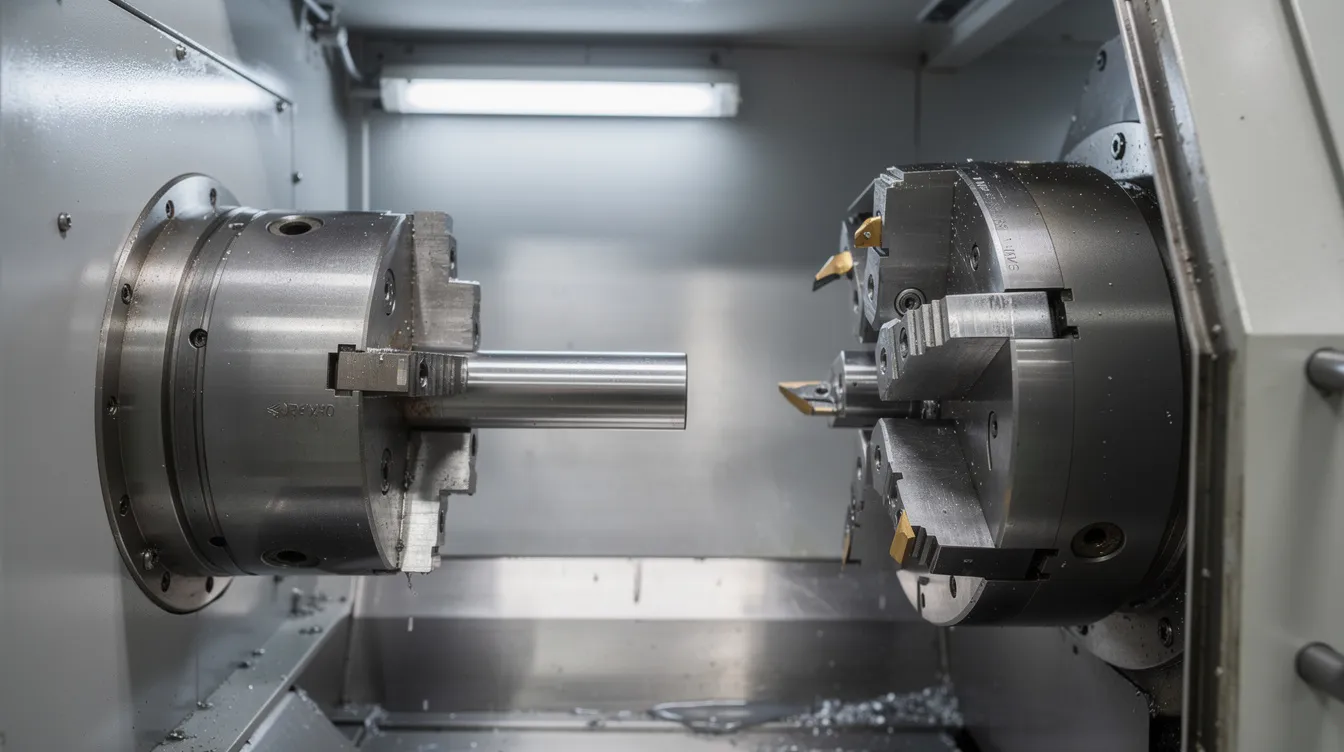
CNC lathes are central to cnc turning operations across various industries, handling everything from roughing to precision finishing in a single program. CNC lathes can perform complex operations like turning, boring, drilling, and tapping automatically, with each cutting operation following a preprogrammed sequence.
Core turning operations include facing (creating flat end surfaces), outer-diameter turning (reducing the outer diameter to a target dimension), boring (enlarging internal diameters), grooving (cutting recesses), parting-off (separating a finished part from bar stock), and threading (cutting external or internal threads). CNC lathes perform operations like turning, threading, and grooving with programmed repeatability that manual methods cannot match. Machining processes include turning, threading, and grooving as standard capabilities on even basic two-axis machines.
On more capable turning centers with live tooling, additional operations include milling flats, cross drilling, tapping, and contouring – bringing standard milling operations onto the lathe platform. CNC lathes are heavily relied upon to mass-produce identical cylindrical components in various industries. CNC lathes are used for manufacturing shafts and bolts, as well as fluid connectors, valves, surgical instruments, and robotics bushings. CNC lathes can process a wide variety of rigid materials, including metals and plastics, from 6061 aluminum and 304 stainless steel to Grade 5 titanium and engineering plastics like PEEK.
At Anebon, we leverage our cnc lathe services for rapid prototyping and full-scale production of OEM components, working across this complete range of materials and operations.
CNC Lathe vs CNC Mill: Key Differences
The fundamental difference between a cnc lathe and a CNC mill is which element moves. In a cnc lathe, the workpiece rotates on the spindle while the tool moves along programmed axes. In cnc milling, the cutting tool rotates in a spindle while the workpiece remains clamped to a table. This distinction drives which machine you reach for first.
CNC lathes excel at rotationally symmetric parts – anything round, conical, or cylindrical. If your part is a shaft, pin, bushing, threaded fitting, or tube, a lathe will produce it faster and more cost-effectively than a mill. CNC mills, on the other hand, handle prismatic parts with flat faces, pockets, slots, and more complex shapes that lack rotational symmetry.
The line between the two has blurred significantly. Modern multi-axis cnc turning centers with live tooling can perform high speed operations that previously required a mill – drilling, tapping, profiling – while other cnc lathes with a b axis approach true 5-axis milling territory. Conversely, some machining centers now offer turning spindles. For design engineers, the rule of thumb remains: if the part is mostly round, start with a lathe; if it is mostly flat or boxlike, start with a mill.
Key Specifications When Choosing a CNC Lathe Machine
Matching machine specifications to part requirements is critical for balancing cost, quality, and lead time. Selecting a machine that is either over- or under-specified wastes money or risks rejects.
Swing over bed (maximum turning diameter) determines the largest part diameter the machine can accommodate – ranging from under 200 mm on small machines to over 1,000 mm on heavy-duty models. Maximum turning length sets how long a part can be, which matters for extended shafts, rods, or multi-feature components machined between centers.
Spindle speed, power, and bore are closely linked. High RPM (sometimes exceeding 6,000 RPM) supports fine finishes on small-diameter aluminum parts, while high torque handles slow sync rotation cuts in hardened steel or titanium. The spindle bore and bar capacity dictate the maximum bar stock diameter for through-bar feeding – a critical spec for Swiss-type and production lathes.
The number of axes, turret capacity, and control system round out the picture. Axis cnc lathe configurations range from basic 2-axis to full 5-axis multi-tasking. CNC lathes achieve tolerances often within ±0.001 mm, suitable for precision machining of critical features. The material depends on the spindle power, tooling, and cooling system available. When requesting a quote, overseas OEMs should provide detailed part drawings with GD&T, surface finish requirements, material grade, and expected batch sizes to receive accurate pricing and DFM feedback.
Industries & Parts That Benefit from CNC Lathe Work
Industries using CNC lathes include aerospace and automotive, along with medical devices, electronics, and robotics – essentially any sector that demands repeatable, dimensionally controlled cylindrical components.
In aerospace, cnc lathe work produces fasteners, actuators, hydraulic fittings, and structural pins. Tolerances for general aerospace features run around ±0.005 inches (≈ ±0.127 mm), while critical dimensions tighten to ±0.0005 inches (≈ ±0.013 mm). In automotive manufacturing, CNC turning machines produce drive shafts, engine bushings, brake pistons, and transmission components at volumes that demand fast cycle times and consistent quality.
Medical devices rely on CNC lathes for bone screws, implant components, and surgical handles, often requiring surface finishes of Ra 0.2–0.4 µm and full material traceability. Electronics manufacturers use Swiss-type lathes for connector pins, housings, and contact elements, while robotics and industrial machinery sectors need precision couplings, actuator rods, and custom fittings machined to tight tolerances.
Anebon provides cnc turning services from rapid prototypes through full-scale production for all of these sectors, backed by ISO 9001:2015 and ISO 14001:2015 certifications that meet the documentation and quality requirements of demanding OEM customers.
How Anebon Uses CNC Lathes in OEM Manufacturing
We integrate CNC lathes with cnc machining services including milling, die casting, and sheet metal fabrication to deliver complete OEM solutions under one roof. This means a part can be turned on a multi-axis lathe, milled for secondary features, surface-treated, and inspected – all managed through a single point of contact.
Our process starts with a DFM (Design for Manufacturability) review, where our engineering team evaluates your part geometry, suggests material alternatives if appropriate, and recommends the most efficient cnc turning strategy. We then produce parts on multi-axis CNC turning centers capable of holding tolerances as precise as ±0.002 mm, working in aluminum alloys, stainless steels, titanium, brass, and engineering plastics.
Every part passes through documented quality assurance checkpoints – from first-article inspection through in-process measurement to final dimensional verification on CMMs. For overseas OEM clients, we provide full inspection reports, material certificates, and traceability documentation as standard. Whether you need five prototypes or fifty thousand production parts, our manufacturing processes scale to match.
Choosing the Right CNC Lathe Partner
Finding the right supplier for cnc lathe work goes beyond comparing price per piece. You want a partner with proven experience in your industry, the right machine tool configurations for your part complexity, and a quality system that matches your certification requirements.
When evaluating potential suppliers, ask specific questions: What axis cnc lathe configurations do you operate? Can you share examples of similar parts with inspection reports? What tolerances and surface finishes can you guarantee on critical features? What raw materials do you stock or source regularly? What surface treatment options – anodizing, plating, passivation – are available in-house or through vetted partners? Traditional lathes and basic setups may suffice for simple parts, but intricate parts with compound-angle features demand multi-axis capability and experienced programmers.
At Anebon, we support overseas OEM clients with integrated cnc turning, cnc milling, and fabrication services backed by over fifteen years of experience and dual ISO certifications. We welcome part drawings, CAD files, and 3D models for DFM review and competitive quoting – whether your project is a first prototype or a scaled production run.
Ready to get started? Send us your drawings or CAD files and our engineering team will provide DFM feedback, material recommendations, and pricing within 48 hours. Request a quote from Anebon today.