Understanding the Manufacturing of CNC Machines: A Complete Guide
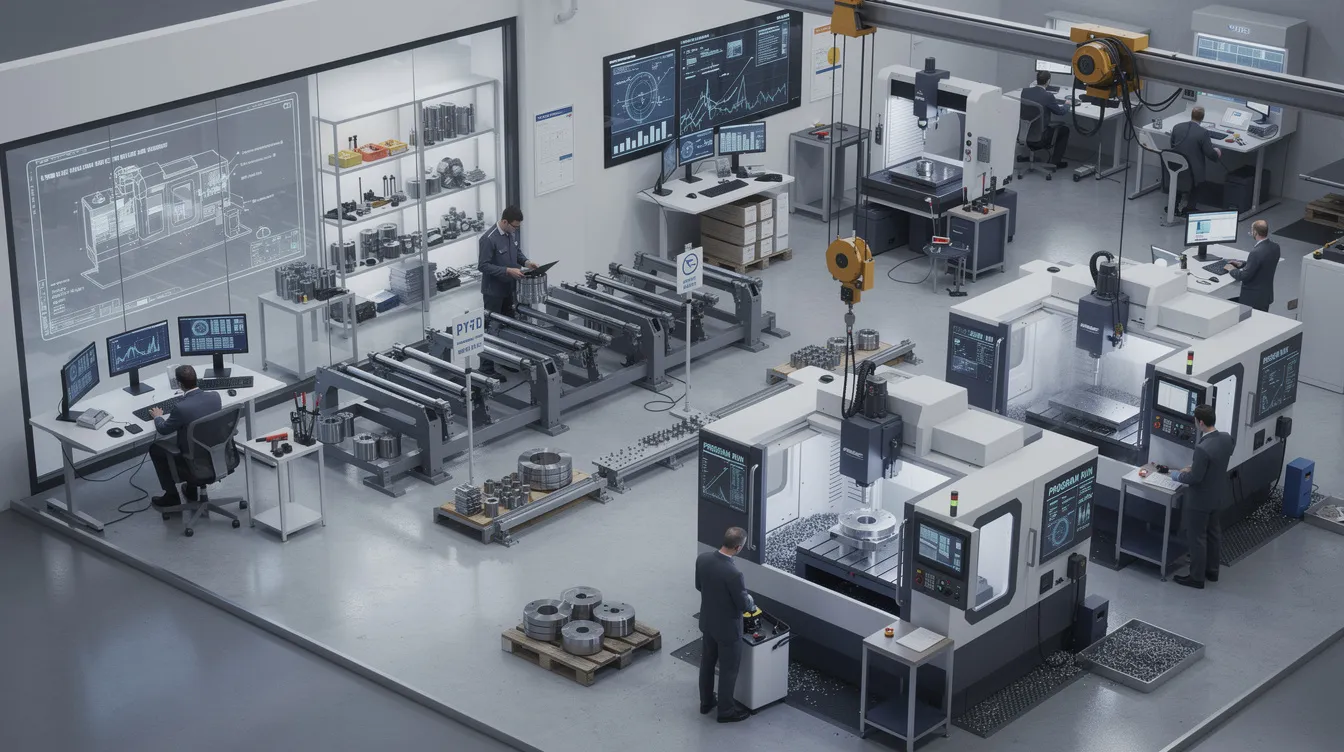
Manufacturing of CNC Machines: From Design to Precision Production
CNC machines are among the most sophisticated products in modern manufacturing. Combining heavy structural elements, precision motion systems, embedded control electronics, and advanced software, every machine tool represents thousands of engineering decisions that determine whether finished parts will meet the micron-level demands of today’s industries.
This article focuses on how CNC machines themselves are designed and built – the manufacturing process behind the machine tools, not simply how those machines are used to cut metal or plastic. If you source precision parts for aerospace, medical, automotive, or electronics applications, understanding this process gives you a clearer picture of what separates a good machine from a great one.
Introduction to CNC Machine Manufacturing
Computer numerical control, or CNC, refers to the automation of machine tools through pre programmed computer software that directs axis movements, spindle speeds, and tool changes without manual control. The manufacturing of cnc machines is a discipline that sits at the intersection of mechanical engineering, electrical systems design, materials science, and software development.
The result is complex machinery capable of shaping various materials – metals, plastics, ceramics, and composites – into finished parts with tolerances that manual methods simply cannot achieve. CNC machines produce parts with high precision and repeatability, and they can operate continuously, 24/7, minimizing downtime in production environments where throughput matters.
There are several primary types of cnc machines used across the manufacturing sector:
-
CNC milling machines – use rotary cutting tools to remove material across three or more axes
-
CNC lathes (turning centers) – rotate the workpiece against a stationary cutting tool to produce cylindrical parts
-
5-axis machining centers – add two rotational axes for sculpting complex geometries in a single setup
-
Grinding machines – deliver sub-micron surface finishes for hardened workpieces
-
EDM (Electrical Discharge Machines) – shape conductive materials using electrical discharges, ideal for hardened steels and exotic alloys
Each of these machine types plays a distinct role in modern factories across various industries, from producing turbine blades for the aerospace industry to creating implants for medical technology applications. CNC machines can handle both metal and plastic materials efficiently, making them indispensable across the manufacturing industry.
Anebon Metal Products Limited, founded in 2010 in Dongguan, Guangdong, is a precision CNC machining and fabrication partner that manufactures high-precision parts for OEMs – not complete machine tools. With ISO 9001:2015 and ISO 14001:2015 certifications, Anebon delivers turned shafts, milled housings, complex contours, and sheet metal fabrication with tolerances as tight as ±0.002 mm for customers in aerospace, medical devices, automotive, and electronics. The quality of Anebon’s output depends directly on the quality of the cnc equipment it operates.
CNC machines play an increasingly central role in industries that demand work with difficult materials. Titanium alloys, Inconel, stainless steels, and composite materials all require machine tools with exceptional stiffness, thermal stability, and motion precision – qualities that start at the design table of the machine manufacturer itself.
Historical Development of CNC Machines
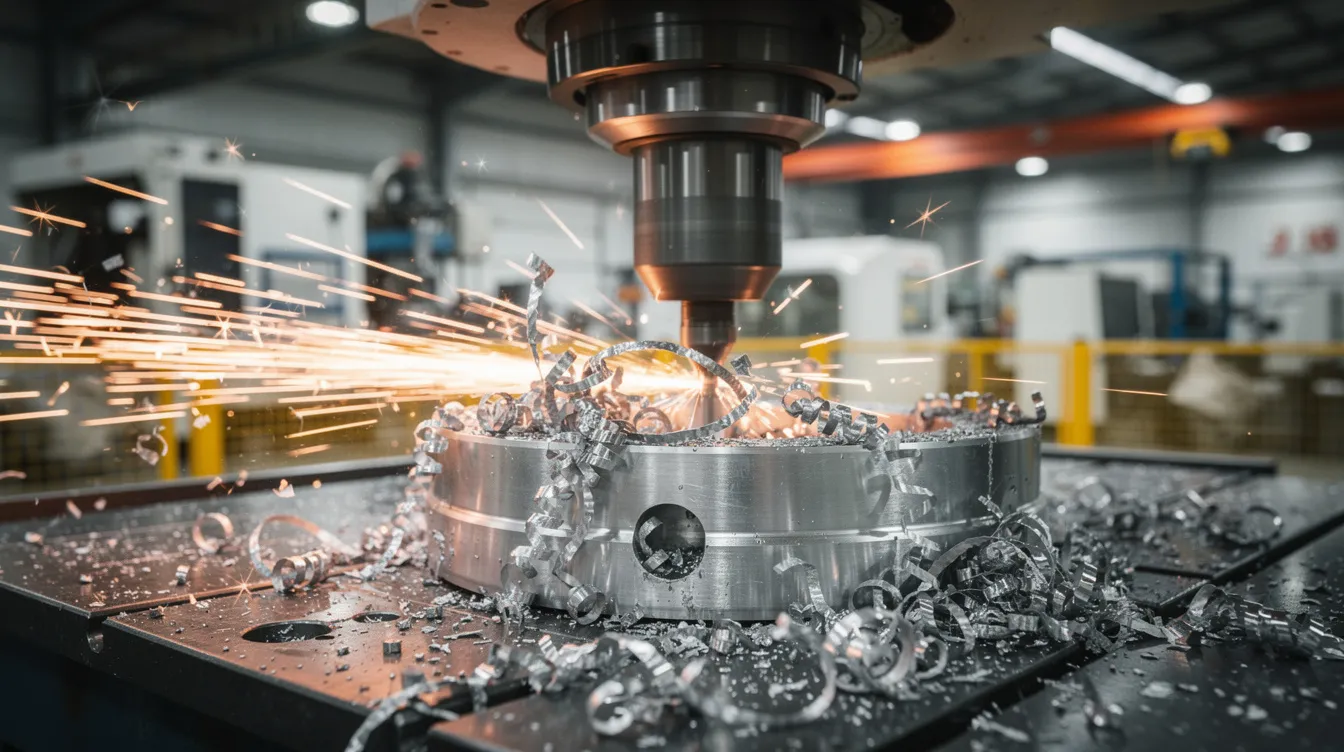
Before numerical control existed, machinists operated mills and lathes by turning handwheels and reading dials. Every cut depended on human skill, and human error was a constant factor in part quality. That changed in the late 1940s when the U.S. Air Force funded early research into automating machine tool movements.
In 1949, MIT began development of what would become the first NC machines – modified milling machines controlled by punched tape and cards. By the early 1950s, commercial NC machines had entered production, and the APT (Automatically Programmed Tooling) programming language emerged to standardize motion instructions. These systems were analog or hybrid, expensive, and limited, but they proved that automated machining could deliver repeatability impossible with manual methods.
The shift to microprocessor-based CNC controls in the 1970s and 1980s was transformative. Digital servo drives, encoders, and interpolation algorithms replaced analog circuits, enabling multi-axis motion with far greater accuracy. By the 1990s and 2000s, advances in computer aided design and computer aided manufacturing cam software – combined with faster spindle speeds, high-acceleration motion systems, and improved structural materials – made 5-axis machining and high-speed cnc milling economical for production work.
This evolution enabled precision manufacturing of jet engine components with complex cooling passages, orthopedic implants requiring few-micron tolerances, and compact electronics enclosures with tight thermal and geometric constraints. CNC machining enhances production speed significantly compared to manual methods, and cnc technology continues to accelerate.
Core Components of a CNC Machine
Every CNC machine is a combination of four subsystems: mechanical structure, motion elements, control electronics, and software. How well these are integrated determines whether the machine can hold tight tolerances over thousands of hours of operation.
Understanding what the main components of a CNC milling machine are helps engineers evaluate machine quality and predict performance.
Structural Base and Frame
The base and structure of CNC machines are often made from cast iron or welded steel. Gray cast iron is the most common choice for beds and columns because of its natural vibration damping and dimensional stability. Welded steel fabrications serve large gantry machines where casting such massive parts is impractical. Some manufacturers use mineral casting (polymer concrete with quartz fillers) for applications demanding exceptional thermal insulation and vibration absorption.
High mass and stiffness are non-negotiable. Without them, cutting forces cause deflection and chatter, destroying surface finish and dimensional accuracy.
Mechanical Elements
Key mechanical elements include:
|
Component |
Function |
|---|---|
|
Linear guideways |
Constrain and guide axis motion with minimal friction |
|
Ball screws or linear motors |
Convert rotary or electrical energy into precise linear motion |
|
Spindle unit |
Rotates the cutting tool (milling) or workpiece (turning) at controlled speeds |
|
Automatic tool changer (ATC) |
Swaps tools without operator intervention for multi-operation work |
|
Rotary tables |
Add 4th or 5th axis rotation for multi-sided and contour machining |
High-precision motors are used to drive the axes of CNC machines, typically brushless AC synchronous servo motors with resolution measured in fractions of a micrometer.
Electrical and Electronic Subsystems
The electrical architecture includes servo drives (amplifiers controlling current and torque), feedback devices such as linear encoders or rotary encoders, a CNC controller that interprets G-code and coordinates axis motion, a PLC for peripheral control and safety interlocks, and an operator panel serving as the human-machine interface.
Auxiliary Systems
Coolant systems (flood, mist, through-spindle), chip conveyors, enclosures, guards, and mist extraction are integrated for safe, continuous cnc machining in production environments. These systems may seem secondary, but they directly affect tool life, surface quality, and operator safety during extended runs.
Design & Engineering of CNC Machines
CNC machine manufacturing starts long before any metal is cut. It begins with detailed CAD models, finite element analysis simulations, and kinematic studies that define every structural dimension and motion parameter.
Axis Configuration and Target Applications
Engineers define the axis configuration – 3-axis, 4-axis, or 5-axis – based on target industries and intended processes. A machine designed primarily for cnc milling of prismatic parts may need only three linear axes, while a machine intended for turbine blade contouring will require simultaneous 5-axis interpolation. Travel ranges, spindle power and speed (ranging from 5,000 RPM for heavy roughing to 50,000+ RPM for high-speed finishing or micromachining), and tool changer capacity are all specified during this phase.
CAD software is used to design the machine and generate the initial structural models. Material type affects CNC machine selection based on strength and speed requirements, so designers must anticipate whether the machine will primarily cut aluminum, steel, titanium, or composite materials.
Structural Optimization
Finite element analysis optimizes column and bed geometry, reducing deflection to micrometer levels under cutting loads. Engineers model static stiffness (resistance to bending under force), dynamic stiffness (resistance to vibration at cutting frequencies), and modal frequencies (natural resonance points that must be kept away from typical spindle speeds).
Thermal Analysis and Compensation
Thermal behavior is one of the largest error sources in precision machining. Heat from the spindle motor, servo drives, friction in bearings and guideways, and even ambient temperature changes can cause structural growth that shifts the tool center point relative to the workpiece.
Compensation strategies involve measuring temperatures at critical points – spindle head, column, bearings – and applying predictive models within the CNC control. Research has shown that well-implemented thermal compensation can reduce errors from tens of microns to single-digit microns, maintaining tolerances like ±0.005 mm over long machining cycles. This is especially important for aerospace and mold making, where even minor drift compromises part quality.
Control System Architecture
Decisions about the CNC control platform – proprietary systems from Fanuc, Siemens, Heidenhain, or Mitsubishi versus open-platform PC-based controllers – affect feedback resolution, interpolation accuracy, and high-speed machining functions. Encoder resolution of 0.1 µm or better on linear scales is common in high-end cnc systems.
Materials Used in CNC Machine Construction
Machine performance depends heavily on material selection for both structural and moving components. The wrong material choice in a machine frame or ball screw can undermine years of careful design work.
Structural Materials
-
Gray cast iron – the standard for bases and columns, valued for internal damping (absorbs vibration energy) and form stability under sustained loads
-
Welded steel fabrications – used in large gantry cnc machines where single castings of sufficient size are impractical or prohibitively expensive
-
Polymer concrete (mineral casting) – used in small to medium machines or specific subsystems for superior damping and reduced thermal expansion
Motion Component Materials
Ball screws, linear guide rails, and spindle shafts require precision-grade alloy steels. Ball screws are typically manufactured from hardened bearing steel (e.g., JIS SUJ2), heat treated to HRC 58–62 for wear resistance and dimensional stability. Linear rails and carriages are hardened, precision ground, and sometimes coated with nitride or ceramic layers.
Aluminum and high-strength steel alloys appear in moving elements like tool changers and rotary axes, where reducing inertia improves acceleration without sacrificing stiffness.
Advanced Coatings and Composites
The growing use of composite materials and advanced coatings in guideways and spindles addresses wear resistance and thermal stability. Hard chrome plating, DLC (diamond-like carbon), and TiN/TiC coatings extend service life on spindle shafts. Ceramic hybrid bearings in spindles reduce friction and allow higher speeds.
Material choice affects cutting speeds, tool wear, and mechanical properties of the finished part – and the same principle applies to the materials used to build the machine itself. CNC machines can work with a wide range of materials, but the machine’s own construction materials determine how well it performs across that range.
Manufacturing Process of CNC Machine Structures
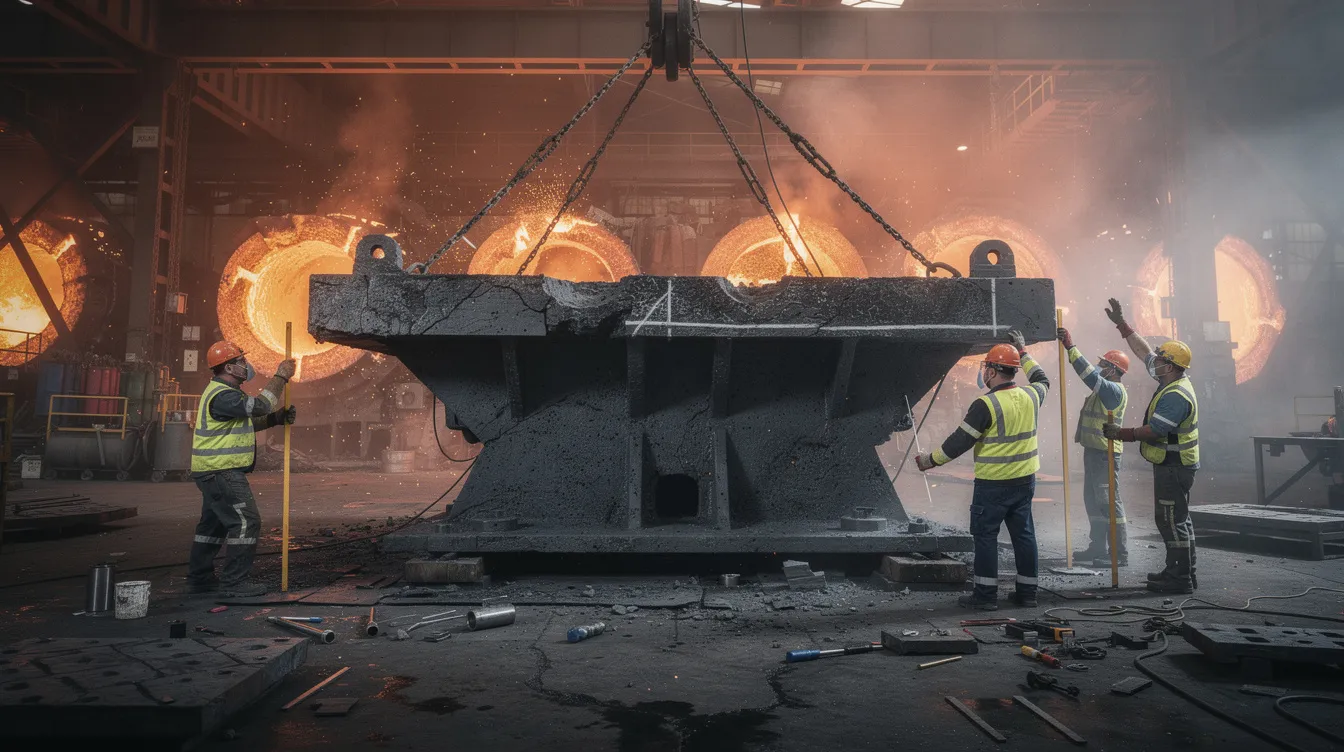
Major CNC machine components – beds, columns, saddles, and gantry beams – are produced using foundry and heavy machining processes. These are among the most physically demanding steps in the entire manufacturing process, often involving castings weighing several tons.
Casting and Heat Treatment
Large structural castings begin with pattern making, followed by mold preparation (sand molds or shell molds), pouring of molten gray or ductile cast iron, controlled cooling, and solidification. After casting, stress-relief heat treatment is essential. Annealing at approximately 500–550 °C for 2–8 hours removes 90–95% of residual internal stresses without altering the microstructure. Without this step, residual stress can cause warping or deformation as the machine heats up during use.
Rough Machining
After heat treatment, rough machining establishes primary reference surfaces: flattening bed surfaces, squaring column faces, and rough boring of major features. These operations are performed on large CNC boring mills or gantry machining centers, since the workpieces may weigh several tons.
CNC machine components are often produced using other CNC machines – a recursive relationship that underscores how foundational machine tool quality is to the entire manufacturing industry.
Precision Machining
Following rough operations, precision steps include:
-
Surface grinding of guideway pads to flatness within micrometers
-
Drilling and tapping for linear rail mounting
-
Boring spindle bores with tight geometric tolerances for roundness and alignment
-
Finishing bearing seats and alignment surfaces
Anebon, as a precision CNC machining supplier, manufactures complex subcomponents such as motor housings, spindle cartridges, and brackets for OEM machine builders. These parts often require multi-axis interpolation on 5-axis mills and CNC turning centers to achieve complex geometries and tolerances in the range of ±0.002 mm.
Precision Machining of Motion Components
Motion components – ball screws, linear guideways, and spindles – define the achievable positioning accuracy and repeatability of a CNC machine. Even a well-designed frame becomes irrelevant if the motion system introduces microns of error.
Precision components in CNC machines include linear guide rails and ball screws, and their manufacturing demands some of the tightest tolerances in the entire machine build.
Ball Screws
Ball screws convert rotary motion from servo motors into linear axis travel. The highest precision is achieved through thread grinding, producing accuracy classes defined by ISO 3408 and JIS B1192:
|
Accuracy Class |
Lead Error (V300) |
Single-Revolution Error (V2π) |
|---|---|---|
|
C3 |
±8 µm over 300 mm |
~6 µm |
|
C5 |
±18 µm over 300 mm |
~8 µm |
|
C7 / C10 |
Standard transport grades |
Higher error allowance |
Preloaded nuts eliminate backlash. The material is typically hardened bearing steel, heat treated to HRC 58–62 or higher.
Linear Guideways
Rails and carriages are hardened, precision ground, and assembled with recirculating ball or roller bearings. Straightness tolerances in the single-digit micrometer per meter range are typical. Surface finish and hardness directly impact wear rate and long-term accuracy.
Spindles
Spindle shafts are turned, ground, and dynamically balanced. Bearings – often ceramic hybrid angular contact – are preselected and preloaded. Tool-holder interface types (BT, CAT, HSK) have their own standard tolerances. Runout at the spindle nose is typically held below 2 micrometers for high-precision machines. CNC machines can produce parts with precision levels of ±0.01 mm, and that capability starts with spindle quality.
Anebon can machine high-precision spindle housings, bearing seats, and tool-holder interfaces to tolerances as tight as ±0.002 mm for OEM clients building machining centers and turning centers.
Assembly of CNC Machines
CNC machine assembly is a staged process that moves from base build-up to full mechanical and electrical integration. Unlike mass production assembly lines, machine tool assembly often involves skilled technicians working on a single unit for days or weeks.
Mechanical Assembly
Linear rails and ball screws are mounted onto the base and column using torque-controlled fasteners. Alignment is verified with precision straightedges, surface plates, and laser interferometers to confirm straightness, parallelism, and squareness between axes. Even small misalignment – a few micrometers over a meter of travel – can cascade into unacceptable volumetric errors.
Major assemblies are then installed: saddle and table, spindle head, automatic tool changer, and any rotary axes. Mechanical limits are set, counterbalances and counterweights adjusted (especially important in vertical-axis gantry or 5-axis machines where gravity loads are significant), and way covers and guards fitted.
Electrical Integration
Electrical wiring follows a structured routing plan:
-
Power cables for servo motors and spindle drives
-
Signal cables for encoders, limit switches, and probes
-
CNC control cabinet assembly with drives, PLC, and power supply
-
Safety circuit wiring (E-stop, door interlocks, light curtains)
CNC machining minimizes human intervention, improving safety, but this depends on properly designed and wired safety systems within the machine.
Final Physical Build
Coolant systems, chip conveyors, enclosures, mist extraction, and operator panels complete the physical build. Each auxiliary system must be tested for leak-free operation and proper control integration before the machine moves to calibration.
Calibration, Testing & Quality Assurance
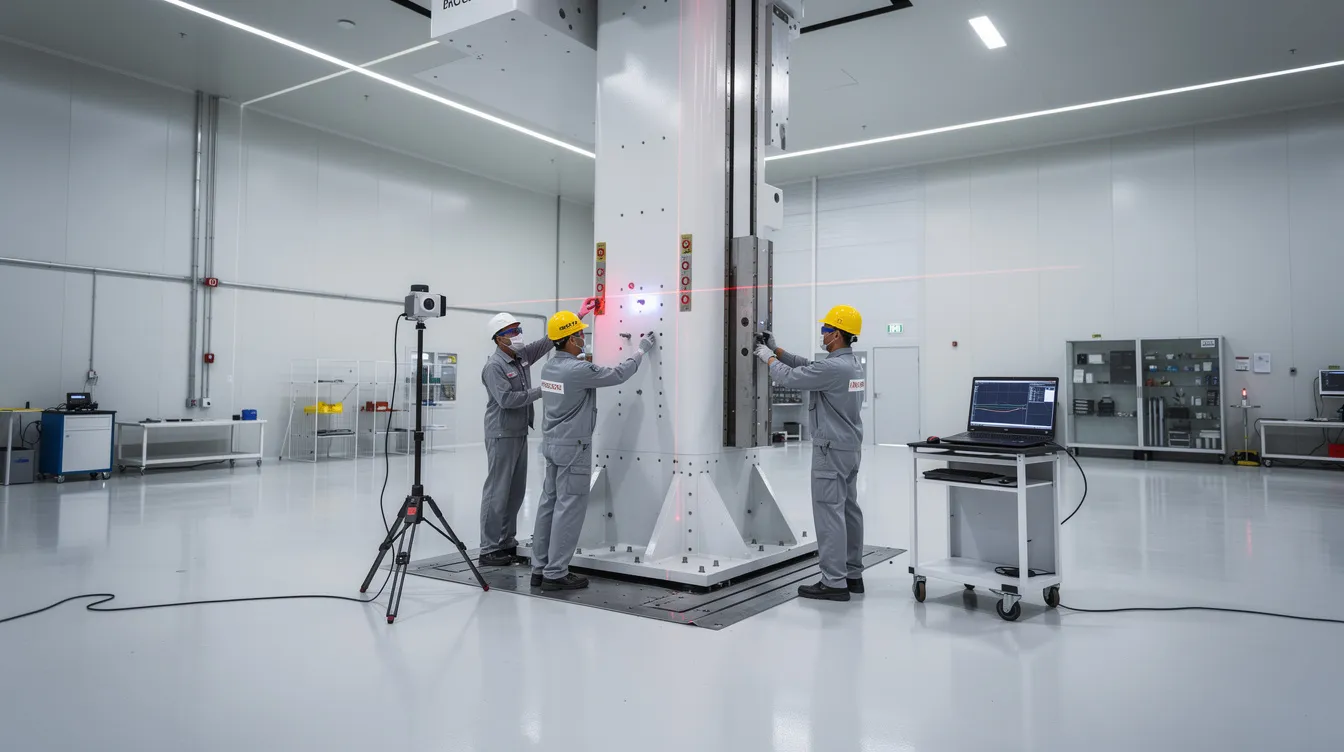
Each CNC machine undergoes metrology-based calibration and exhaustive testing before it leaves the factory. This stage separates a machine that meets specification from one that merely looks complete.
Axis Verification
Laser calibration and coordinate measuring machines are used to verify tolerances across all axes. Laser interferometers measure positioning accuracy, repeatability, and reversal error for each linear axis. Ball-bar tests assess circular interpolation performance – the machine traces a circle, and any deviation from perfect roundness reveals servo tuning issues, backlash, or geometric errors.
CNC machining achieves tolerances as tight as ±0.0001 inches in high-end configurations, and verifying this requires instrumentation with resolution an order of magnitude better.
Geometric Alignment
Squareness between X, Y, and Z axes, straightness of travel, and parallelism of guideways are all checked against established measurement standards. Compensation tables are entered into the CNC control to correct any remaining systematic errors – a process sometimes called volumetric compensation.
Cutting Trials
Test cuts in steel (e.g., 4140) and aluminum confirm that the machine performs as designed under actual load. Measurements include:
-
Surface finish (Ra values, often targeting <0.8 µm for precision work)
-
Dimensional tolerances on sample parts (±0.010 mm or better)
-
Thermal drift during extended cycles
Typical tolerances for CNC machining can achieve ±0.125 mm or tighter depending on the operation and machine class. CNC milling machines typically offer precision levels of ±0.01 mm to ±0.05 mm for general production work.
Post-processing may include cleaning, deburring, and applying surface treatments to test parts as part of the validation protocol.
CNC machine manufacturers typically work under ISO 9001 quality systems. Anebon holds ISO 9001:2015 and ISO 14001:2015 certifications for its CNC machining and fabrication services, with inspection protocols covering chemical composition, physical properties, and dimensional verification before shipping any parts.
Control Systems, Software & CNC Programming
The CNC control system is the hardware and software brain that executes toolpaths and manages the cnc machining process. Without it, the mechanical precision built into the machine would go unused.
CNC machining uses computerized controls for precise part fabrication. Digital designs are converted into G-code for CNC machines, and cnc programming uses G-code to control machine movements and operations – from axis positioning and feed rates to spindle speed and coolant activation.
CAD/CAM Workflow
The workflow begins with computer aided design cad models defining part geometry. Cam software then generates toolpaths – selecting strategies for roughing, semi-finishing, and finishing – and calculates feeds, speeds, and tool engagement. A post-processor translates these toolpaths into controller-specific G-code and M-code. This is the practical implementation of computer aided manufacturing in every CNC shop.
Modern Control Features
Today’s CNC controllers offer capabilities that were unthinkable a generation ago:
-
High-speed look-ahead – reading hundreds of blocks ahead to smooth velocity profiles through curves
-
5-axis simultaneous interpolation – coordinating all five axes for smooth freeform surface machining
-
Tool management – tracking tool life, applying wear offsets automatically
-
Probing cycles – using touch probes for in-machine inspection and workpiece zeroing
-
Digital twin integration – simulating toolpaths and detecting collisions before cutting begins
Feedback and Accuracy
CNC systems use closed-loop feedback via linear scales and rotary encoders to compare commanded positions against actual positions in real time. Open-loop systems (without position feedback) exist in simpler cnc routers and entry-level machines but cannot achieve the accuracy demanded by precision manufacturing. Encoder resolution, backlash compensation, and servo tuning collectively determine whether a machine can hold specified tolerances in CNC mills and CNC turning centers.
CNC machining reduces human error by automating the cutting process, but the control system must be properly configured and maintained for that benefit to hold true.
Anebon’s own production relies on advanced CAD/CAM workflows to program complex 5-axis cnc machining operations for aerospace and medical components, ensuring every part matches the digital model within specified tolerances.
Types of CNC Machines & Their Manufacturing Particularities
Different types of cnc machines share core mechanical, motion, and control principles, but each requires distinct design and manufacturing approaches. Understanding these differences matters when evaluating machine quality or selecting a machining partner.
CNC Milling Machines and Machining Centers
CNC milling machines use rotary cutting tools for shaping materials. Vertical machining centers position the spindle vertically above the worktable, making them well-suited for flat-top or prismatic workpieces. Horizontal machining centers orient the spindle horizontally, improving chip evacuation and enabling pallet changers for high volume production.
Manufacturing these machines demands columns with high bending resistance and spindle housings bored to exacting concentricity. CNC milling is the most widely used subtractive process globally, and the machines that perform it must withstand years of continuous service.
CNC Lathe Machines and Turning Centers
A cnc lathe machine is designed for turning cylindrical parts. The workpiece rotates at high speed while the cutting tool traverses along its length and across its face. Key manufacturing challenges include building headstock assemblies that resist thermal growth and vibration at high RPM, and designing turrets that index repeatably under load.
CNC turning produces shafts, bushings, fittings, and other rotationally symmetric parts at speeds and consistency that manual lathes cannot match.
Multi-Tasking Machines
Multi tasking machines – also called multitasking machines – combine milling and turning capabilities in a single setup. They can perform multiple operations without reclamping the workpiece, eliminating setup errors and reducing cycle times. Manufacturing these machines requires structures rigid in both rotational and linear axes, plus complex control software that seamlessly switches between turning and milling modes. Precision improvement strategies for these platforms focus on thermal stability, tool positioning, and workholding.
5-Axis Machining Centers and Gantry Machines
5-axis CNC machines are ideal for complex milling and turning applications. They add two rotational axes – typically a tilting spindle head and a rotary table – enabling the cutting tool to approach the workpiece from virtually any angle. Manufacturing these machines demands volumetric accuracy across large travel ranges, with special attention to thermal control and mass balancing of moving components.
Gantry CNC machines, used for large aerospace structures like wing skins and fuselage frames, may span several meters in travel. Their welded steel or cast iron structures require stiffening ribs and careful stress relief.
Specialized CNC Equipment
-
Grinding machines – require extremely smooth motion and sub-micron tolerances, often using hydrostatic slides instead of rolling guideways
-
CNC Electrical Discharge Machines shape conductive materials using electrical discharges, needing dielectric fluid handling and precise spark gap control
-
CNC plasma cutters – CNC plasma cutting machines cut through materials using ionized gas, used for heavy plate work in the oil and gas industry and metal fabrication
-
CNC laser cutters use focused laser beams for cutting and engraving, with a focused laser beam delivering kerf widths as narrow as 0.1 mm
-
CNC routers are ideal for cutting and engraving softer materials like wood, plastics, and aluminum sheet
-
Gear cutting machines – specialized cnc machinery for producing gears with involute profiles and tight tooth spacing tolerances
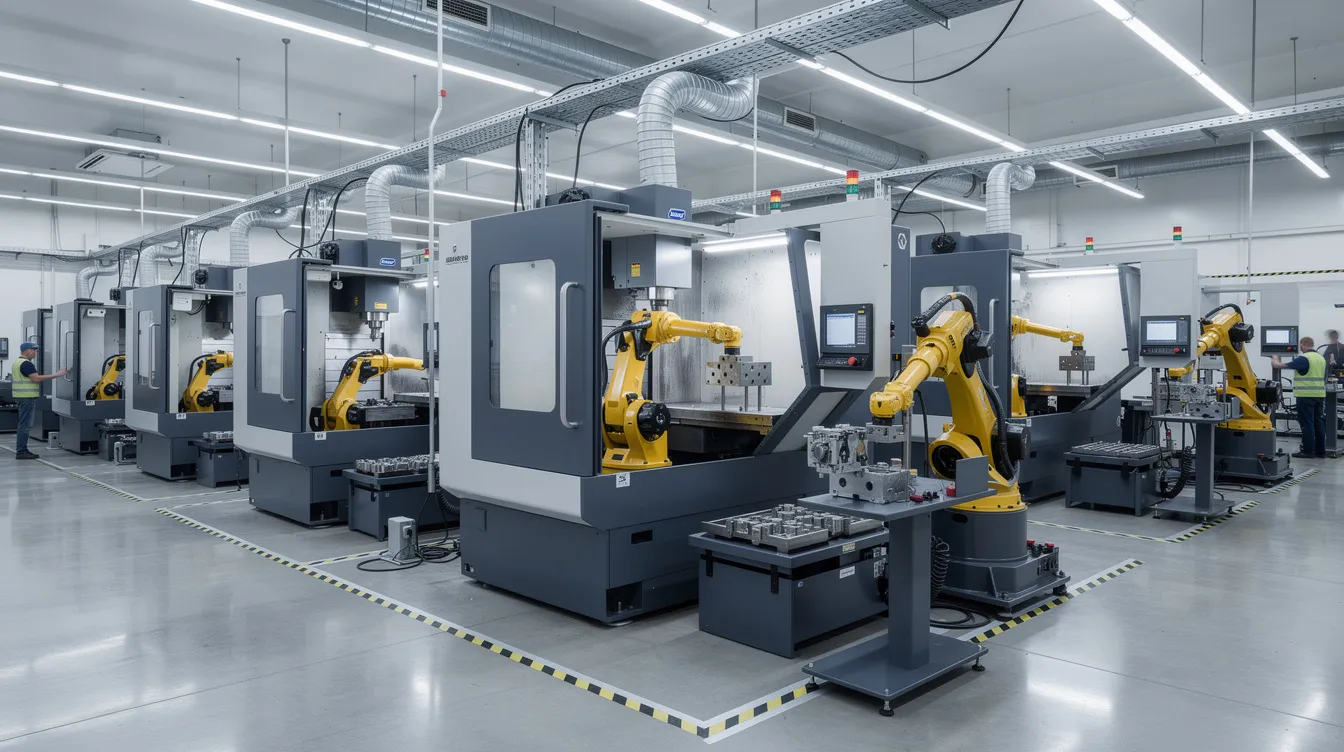
Anebon does not build these machines but uses a combination of 3-axis, 4-axis, and 5-axis CNC mills and lathes to deliver precision OEM parts worldwide. The range of cnc tools and factory tools at its disposal enables production from rapid prototyping through high-volume runs.
Applications of CNC Machines in High-Performance Industries
How CNC machines are manufactured directly affects their performance in critical industries. A machine with poor thermal stability or sloppy motion components will produce parts that fail inspection – and in safety-critical sectors, that failure can have serious consequences.
Aerospace
CNC machining is vital in the aerospace industry for precision parts. Turbine blades, structural brackets, and landing gear components are frequently machined from titanium, Inconel, or carbon-fiber composites – materials that demand high tool rigidity, high torque, and reliable coolant delivery. Modern aircraft like the Boeing 787 and Airbus A350 use high percentages of composite materials, requiring machines that can handle both metallic and non-metallic workpieces.
Advanced 5-axis CNC milling allows complex components to be machined in a single setup, improving surface quality, reducing scrap, and shortening lead times. CNC machining reduces production time compared to traditional methods – a decisive advantage in aerospace where programs run on tight schedules.
Medical Devices
CNC machines manufacture medical devices like implants and instruments with the dimensional accuracy and surface finish that biocompatibility demands. Titanium implants, cobalt-chrome knee joints, and stainless steel surgical instruments routinely require tolerances of ±0.010 mm or tighter and surface roughness values of Ra ≤ 0.8 µm. CNC machining can produce parts from metals, plastics, and ceramics, covering the full range of materials used in medical applications including PEEK polymer implants.
Automotive and E-Mobility
CNC machines produce engine parts in the automotive sector, from cylinder heads and engine blocks to transmission housings. With the shift to electric vehicles, battery enclosures, motor housings, and lightweight structural components demand new machining strategies. CNC machining ensures uniformity in mass production of parts across high-throughput production line environments. Factory automation, including pallet changers and robotic loading, turns machining centers into cells capable of low volume production for prototypes or mass production for series components.
Electronics and Other Industries
CNC machining creates intricate components for the electronics industry, including printed circuit boards, connector housings, heat sinks, and enclosures. The electronics industry demands tight geometric tolerances and fine surface finishes on small, complex parts.
CNC machining is also essential for producing durable marine components, and it supports the oil and gas industry with downhole tools, valve bodies, and manifold blocks machined from corrosion-resistant alloys.
CNC machines can operate continuously, 24/7, reducing production time across all of these sectors. CNC machining operates continuously, 24/7, increasing productivity while maintaining the consistency that quality-critical industries demand.
Anebon supports these sectors as an OEM parts supplier, offering rapid prototyping, low- to high-volume CNC machining, die casting, and sheet metal fabrication. CNC machining offers flexibility from single prototypes to production runs of thousands, and cnc machining makes it possible to deliver consistent quality regardless of batch size.
Future Trends in CNC Machine Manufacturing
The manufacturing of CNC machines is evolving in response to new materials, digital technologies, and sustainability requirements. Several R&D directions are reshaping how cnc machinery is designed and built.
Hybrid and Multi-Process Platforms
Growth in 5-axis and mill-turn platforms continues, driven by demand for fewer setups and faster cycle times. Hybrid CNC machines that combine additive manufacturing (metal deposition) with subtractive machining allow near-net-shape building followed by precision finishing – reducing material waste in expensive alloys. While processes like injection molding and laser cutting serve distinct production niches, CNC machining remains the backbone of precision manufacturing for metal materials and complex components across the manufacturing sector.
Industry 4.0 and Digital Integration
Sensor-rich machines, predictive maintenance algorithms, machine monitoring dashboards, and closed-loop adaptive control are becoming standard in advanced technology CNC platforms. Digital twins simulate the machining process before chips fly, reducing setup time and preventing crashes. These innovations address both factory automation goals and energy consumption reduction targets. CNC machinists increasingly interact with data dashboards rather than handwheels, and the cnc process becomes more transparent and optimizable.
Difficult Materials and New Demands
Advances in machining titanium, Inconel, and carbon-fiber-reinforced composites push CNC machine builders to develop stiffer structures, better thermal management, high speed spindles capable of sustained heavy cutting, and improved coolant delivery. These materials are central to aerospace and energy sectors, and the machines that cut them must evolve in parallel.
Pre programmed software continues to grow more intelligent, with adaptive feed rate control responding to real-time cutting forces and tool wear – extending tool life and improving surface quality without operator intervention. Leading supplier brands of CNC controls are embedding AI-assisted optimization directly into their platforms.
Anebon continues to invest in newer CNC machines and inspection technology to meet tighter tolerances and faster lead times for global OEM customers. As a precision manufacturing partner with deep experience in various materials and complex geometries, Anebon’s commitment to advanced cnc manufacturing and quality-certified processes positions it to support the next generation of OEM requirements.
Whether you’re evaluating machine tool suppliers or sourcing precision OEM parts, understanding how CNC machines are manufactured gives you a sharper eye for quality. The stiffness of a machine bed, the accuracy class of its ball screws, the thermal compensation strategy in its control – these details determine whether your parts will consistently meet specification.
If you need high-precision CNC machined parts, die castings, or sheet metal components produced on well-maintained, quality CNC equipment, Anebon is ready to support your project from prototype through production. Request a quote today and discover how precision starts with the right manufacturing partner.