Top Precision Sheet Metal Fabrication Companies in China
Precision Sheet Metal Fabrication Companies in China: How to Choose the Right OEM Partner
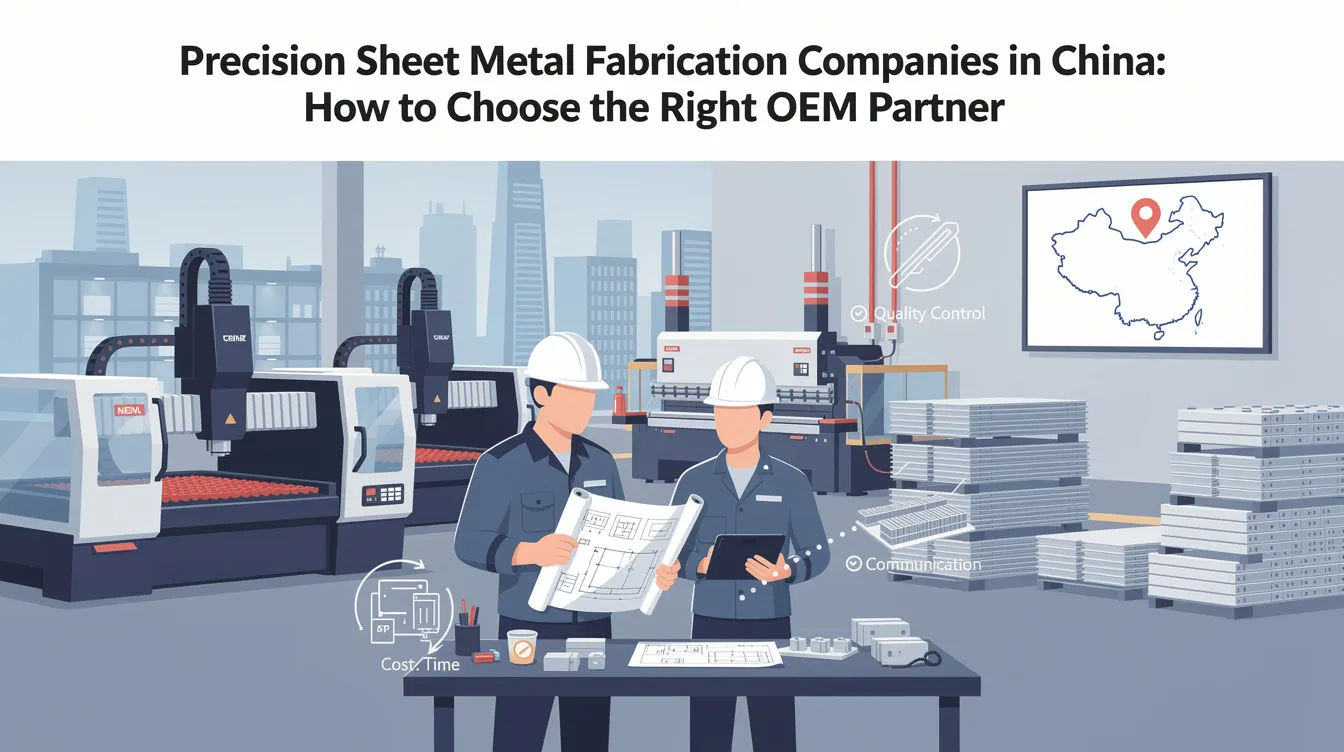
Finding the right precision sheet metal fabrication partner in China can make or break your product timeline, cost structure, and part quality. With hundreds of suppliers advertising similar capabilities, overseas OEMs need a structured approach to separate genuinely capable fabricators from those that simply check boxes on a website. This guide walks you through what to evaluate, what to ask, and how to reduce sourcing risk when working with Chinese sheet metal fabrication companies.
Overview: Why China Dominates Precision Sheet Metal Fabrication
China dominates the global sheet metal fabrication market, and the numbers confirm it. China’s metal fabrication market reached over $20 billion in 2023, driven by a combination of export-oriented infrastructure, deep supplier ecosystems, and aggressive investment in automation and precision equipment. For overseas OEMs seeking custom sheet metal fabrication at competitive prices without sacrificing tolerances, this concentration of capability is difficult to match anywhere else.
Leading sheet metal fabricators in China are clustered in Guangdong, Jiangsu, and Shanghai, with specific cities offering distinct strengths:
-
Dongguan – molds, hardware, sheet metal components, and CNC machining integration
-
Shenzhen – electronics-oriented high precision sheet metal and rapid prototyping
-
Guangzhou – large capacity stamping, finishing, and surface treatment lines
-
Shanghai – automotive and aerospace clusters with deep engineering support
-
Suzhou – precision manufacturing with clean-room assembly capability
-
Ningbo – heavy gauge metal fabrication with direct port access
Anebon Metal Products Limited is a Dongguan-based precision CNC machining and sheet metal fabrication company founded in 2010, operating within this Pearl River Delta ecosystem where custom metal parts move from raw material to finished assembly in remarkably short cycles.
Core advantages that make precision sheet metal fabrication companies in China attractive to international buyers include:
-
Significantly lower production costs for labor-intensive operations
-
Dense industrial clusters enabling fast material sourcing and subcontracting
-
Rapid technology upgrades in laser cutting, CNC bending, and robotic welding
-
Mature export logistics through major ports and bonded zones
What Is Precision Sheet Metal Fabrication?
Sheet metal fabrication transforms flat sheets into functional parts through a series of controlled operations. Common sheet metal operations include cutting, bending, and welding, but what separates precision work from general metal fabrication is the emphasis on tight tolerances, dimensional repeatability, and complex geometries that must hold up across production runs.
Processes typically involved in advanced sheet metal fabrication include laser cutting, CNC punching, CNC bending on press brakes, TIG and MIG welding, hardware insertion, and assembly. When paired with post-machining, features like fitted holes, bosses, and mating surfaces can achieve tolerances far beyond what forming alone allows.
Typical precision sheet metal products include:
-
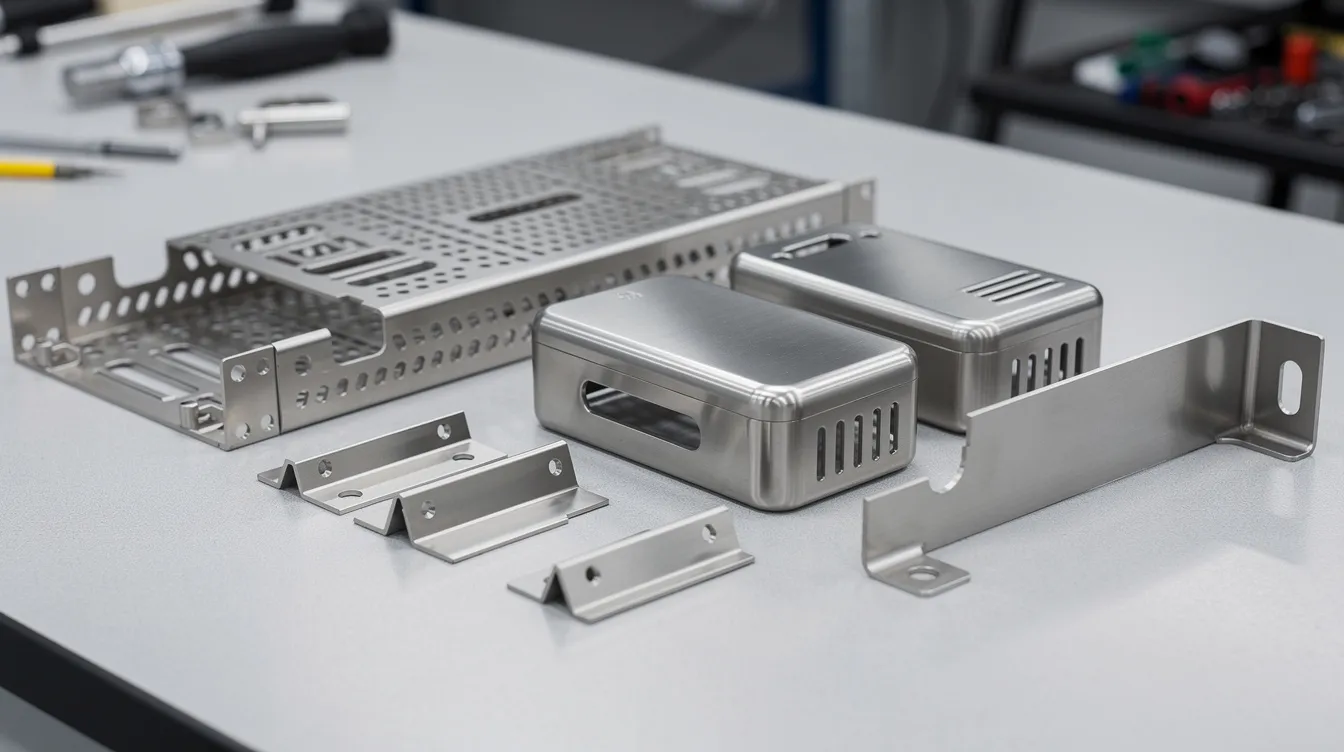
Electronic enclosures and server rack panels
-
Medical device housings and surgical instrument trays
-
Automotive brackets and chassis panels
-
Industrial machinery frames and guards
-
Robotics structural components and mounting plates
Precision requirements can reach ±0.02 mm for critical sheet features, and even tighter for mated CNC machined parts that interface with sheet metal assemblies.
Why Overseas OEMs Source Sheet Metal from China
International buyers from the EU, US, Japan, and Australia consistently turn to Chinese suppliers for custom metal fabrication because the tangible benefits stack up across multiple dimensions:
-
Competitive pricing – even with shipping and duties factored in, total landed cost frequently beats domestic alternatives
-
Fast lead times – many Chinese suppliers reduce lead times by operating in-house manufacturing processes, from cutting through finishing and assembly
-
High-density clusters – related suppliers (material mills, tooling shops, finishing lines) sit within kilometers of each other, accelerating coordination
-
Wide material availability – access to steel, stainless, aluminum, copper, brass, and specialty alloys through local supply networks
-
Mature export logistics – experienced handling of packaging, customs documentation, and compliance (RoHS, REACH)
-
Integrated capability – many manufacturers provide end-to-end manufacturing, handling raw material processing to assembly, combining sheet metal fabrication services with CNC machining services, die casting, and surface finishing under one roof
Precision sheet metal fabricators in China specialize in cost-effective high volume production while increasingly meeting tolerances that were once the exclusive domain of European or Japanese shops.
Core Processes Used by Precision Sheet Metal Fabrication Companies in China
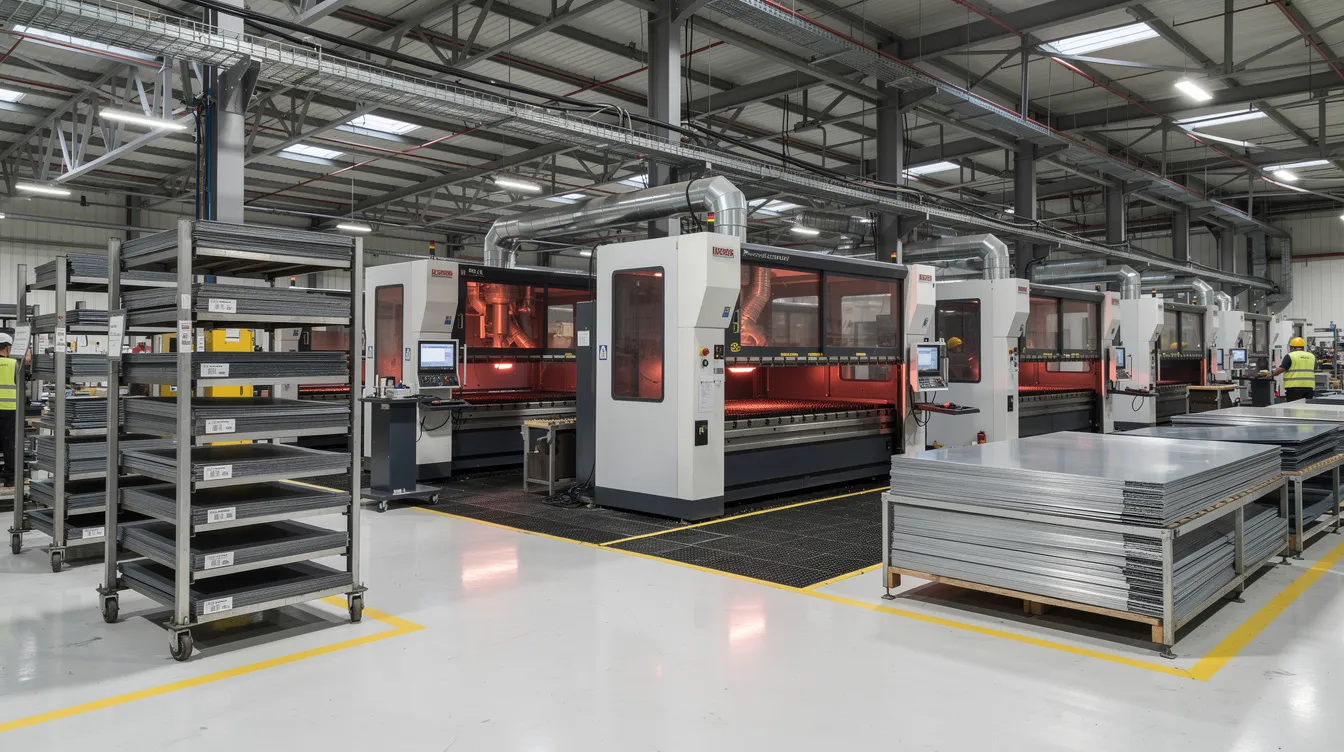
Top Chinese factories integrate multiple processes to deliver complete custom sheet metal fabrication, from flat blank to finished assembly. Key services include laser cutting, CNC bending, and robotic welding, alongside several other critical operations.
-
Fiber laser cutting – typically 2–6 kW systems, with some factories running 10 kW+ machines. High-precision laser cutting can achieve tolerances of ±0.05 mm. Advanced laser cutting systems enhance sheet metal fabrication precision and are now widely used in modern sheet metal processes. Buyers should verify power rating, maximum bed size (commonly 1500 × 3000 mm), and CNC control generation.
-
CNC turret punching – efficient for repetitive hole and slot patterns. Verify tooling capacity and indexing accuracy.
-
CNC bending – press brakes ranging from 2- to 3-axis, handling lengths up to 3–4 meters. Bending tolerances typically ±0.2–0.5 mm standard, ±0.1 mm with precision tooling.
-
Metal stamping – a key process in sheet metal fabrication for high-volume runs. Progressive and fine blanking dies can hold ±0.05 mm on metal stamping parts.
-
Welding – robotic and manual welding techniques include MIG and TIG welding, plus spot welding for panel assemblies. Robotic welding improves consistency on repetitive joints.
-
CNC machining – applied to critical interfaces, bosses, and tight-tolerance holes. Laser cutting is widely used in modern sheet metal processes, but machining handles what forming cannot.
-
Assembly and hardware insertion – PEM studs, insert nuts, riveting, and final assembly services.
For each process, verify machine brands (Trumpf, Amada, Bystronic are common benchmarks), thickness ranges, and whether automation (robotic loading, automated bending cells) is in use.
Industries Served by Chinese Precision Sheet Metal Fabricators
Precision sheet metal fabrication in China supports many different industries requiring custom metal parts with varying complexity and certification demands:
-
Medical devices – imaging equipment covers, surgical instrument trays, ventilator housings. Requires clean finishes, biocompatible materials, and strict documentation for medical applications.
-
Aerospace – avionics housings, structural reinforcement plates, brackets. Demands exotic materials like titanium, used for its high strength-to-weight ratio in aerospace applications.
-
Automotive – chassis panels, sensor housings, heat shields, EV battery enclosures. Rising demand in 2024–2026 for large-format, heavy gauge battery enclosure fabrication.
-
Electronics and telecommunications – server racks, control panel metal enclosures, 5G base-station cabinets. Precise cutouts and EMI shielding are critical.
-
Robotics and industrial machinery – frames, guards, mounts integrating sheet metal and machined structural components.
-
Energy and new energy – solar inverter housings, outdoor cabinets requiring corrosion resistant finishes and environmental sealing.
-
Industrial equipment – machinery guards, conveyor frames, and control panels for factory automation.
Rising demand between 2024 and 2026 is concentrated in EV battery systems, 5G/6G telecom cabinet buildouts, and automation equipment frames, all of which require increasingly tight tolerances and integrated assemblies.
Key Criteria for Evaluating a Chinese Sheet Metal Fabrication Company
Not all suppliers are equal, even when they advertise similar process lists. Your selection criteria will directly determine long-term quality, cost stability, and communication efficiency.
-
Engineering support and DFM – does the supplier review CAD files, suggest bend radius modifications, and flag manufacturability issues? Look for design validation feedback as standard practice.
-
Equipment list – quality, age, and brand of machines. Number and power of lasers, CNC machining centers, press brakes, and stamping dies.
-
Tolerances achievable – request sample measurement records. Can they hold ±0.05 mm on cut features? ±0.02 mm on machined interfaces?
-
Material range – steels, stainless grades, aluminum alloys, copper, brass, exotic metals. Stocked vs. custom-ordered.
-
Secondary processes – welding, surface finishing, heat treatment, hardware insertion, assembly services. In-house vs. subcontracted.
-
Quality systems and certifications – ISO 9001:2015 is a common certification for quality management. ISO 14001 certification focuses on environmental management standards. For automotive work, IATF 16949 is the automotive quality management standard. AS9100D is the aerospace quality management standard. Verify actual audit dates, not just logo placement.
-
Export track record – experience shipping to regulated regions, familiarity with packaging standards, and ability to provide required compliance documentation.
-
Communication and responsiveness – RFQ clarity, English proficiency, and typical quotation turnaround times. Strong suppliers return quotes within 24 hours for straightforward parts.
Anebon Metal Products: Precision CNC & Sheet Metal Partner in Dongguan
We are Anebon Metal Products Limited, an OEM-focused precision metal fabrication company founded in 2010 in Dongguan, Guangdong. Our core mission is straightforward: deliver precision sheet metal parts and CNC machined parts that meet or exceed our clients’ specifications, on time and at competitive cost.
-
Precision CNC machining – 3-, 4-, and 5-axis machining centers for complex custom metal parts
-
Custom sheet metal fabrication – laser cutting, bending, sheet metal stamping, welding, hardware insertion, and full assembly
-
Die casting – aluminum and zinc alloy die casting for high volume production components
-
Rapid prototyping – rapid prototyping accelerates the transition from design to production, and we support runs from single pieces through mass production
-
Tolerances – CNC machining allows for tight tolerances as precise as ±0.002 mm on critical features, compatible with precision sheet metal assemblies
-
Certifications – ISO 9001:2015 and ISO 14001:2015, with experience serving overseas OEMs in medical devices, aerospace, automotive, and robotics
We serve as an extension of our clients’ engineering team, providing DFM feedback and material recommendations from the first RFQ through production ramp.
Our Sheet Metal Fabrication Capabilities
Our integrated approach to custom sheet metal fabrication means we handle the full process chain in-house, reducing handoffs, improving quality control, and shortening lead times.
-
Laser cutting – carbon steel up to 10–12 mm, stainless steel up to 6 mm, aluminum up to 4 mm
-
CNC bending – multi-axis press brakes handling complex bend sequences with repeatability within ±0.1 mm
-
Welding – MIG, TIG, and spot welding for various material combinations; robotic welding for high volume production runs
-
Hardware insertion and assembly – PEM fasteners, insert nuts, riveting, and final assembly lines
-
Volume range – from single sheet metal prototypes through tens of thousands of pieces per month for stable designs
-
Typical prototype lead time – 5–10 days for straightforward parts, including initial DFM review
We routinely combine machined and sheet metal parts in one BOM, which is particularly valuable for complex equipment housings and metal enclosures where both sheet metal forming and precision machined interfaces are required.
Integrated CNC Machining Services for Precision Sheet Metal Projects
Pairing CNC machining services with sheet metal fabrication under one roof eliminates the coordination headaches of managing multiple suppliers for a single assembly. CNC machining enhances precision in sheet metal fabrication by handling features that forming processes alone cannot achieve.
-
CNC milling, turning, and 5-axis machining – for custom metal fabrication of parts that interface directly with sheet metal assemblies
-
Typical use cases – precision shafts, heat sinks, mounting blocks, machined hinges, and medical device components
-
Tolerance capability – we hold ±0.002 mm on critical features using high precision CNC machining centers
-
Inspection – CMM measurement ensures fit within larger sheet metal structures, verifying position, flatness, and hole size
This integration means our clients receive complete, ready-to-install assemblies rather than separate precision parts requiring additional fitting and adjustment.
Materials and Surface Treatments Commonly Used
Material selection is a foundational design step in precision sheet metal fabrication, directly influencing strength, weight, corrosion resistance, and cost.
Common materials:
-
Cold rolled steel (SPCC) – economical baseline for indoor structural components and brackets
-
Carbon steel – strong and affordable for structural components requiring rigidity
-
Stainless steels (304, 316L) – stainless steel offers corrosion resistance for moisture-exposed applications including food equipment and medical devices
-
Aluminum alloys (5052, 6061, 6063) – aluminum is lightweight, ideal for aerospace and automotive work
-
Galvanized steel – galvanized steel has a protective zinc coating for outdoor use, commonly specified for telecom cabinets and outdoor industrial equipment
-
Copper and brass – electrical conductivity and thermal management applications
-
Titanium – used for its high strength-to-weight ratio in aerospace applications
Surface treatments:
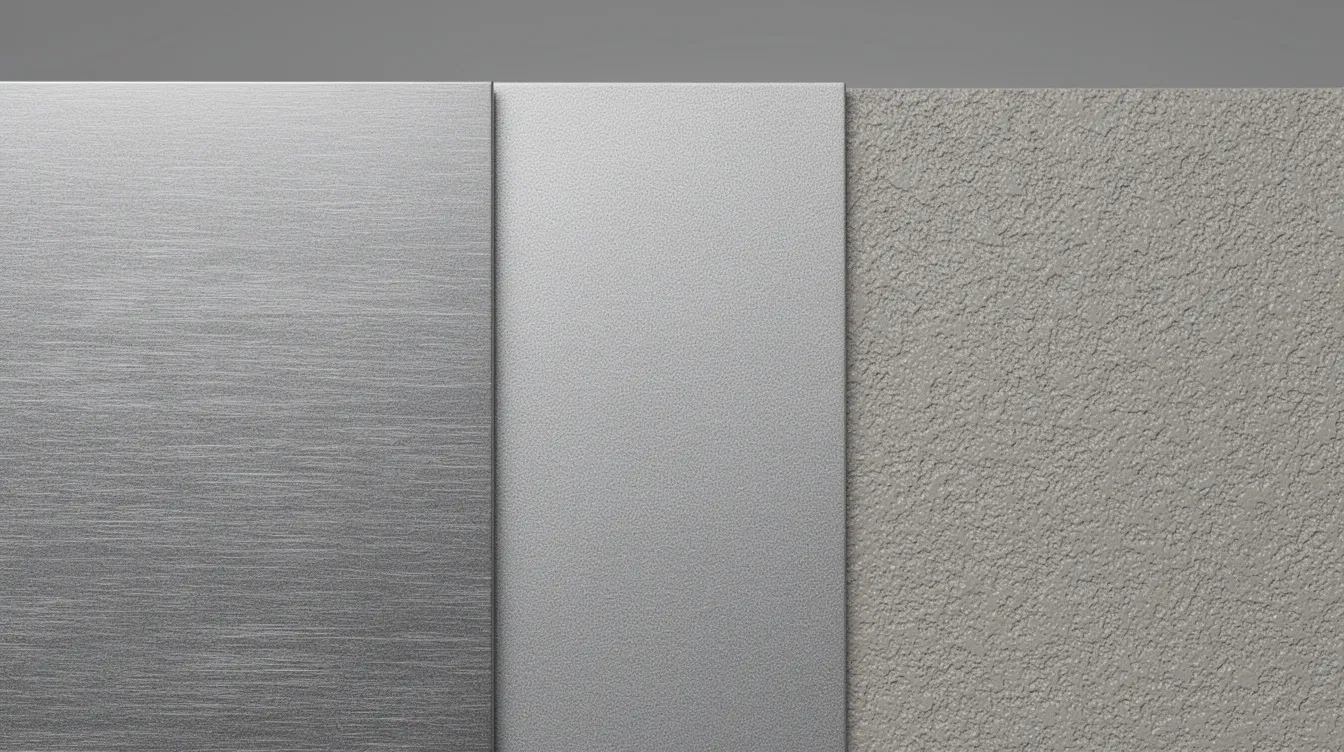
Surface treatments include powder coating, anodizing, and electroplating. Additional options include bead blasting, brushing, passivation for stainless, and painting. Powder coating suits outdoor enclosures and industrial machinery frames, while anodizing is preferred for aluminum sheet metal products in electronics and consumer applications.
We advise on material and finish selection during our DFM review, matching corrosion resistance, appearance, and cost requirements to each client’s specific application and industry.
Quality Control and Certification Expectations
Precision sheet metal fabrication companies in China must back their capabilities with stringent quality control measures that are verifiable, not just claimed. Quality control measures ensure high standards in manufacturing, from incoming inspection through final packaging.
-
Incoming material inspection – verifying mill certificates, thickness, hardness, and surface condition
-
In-process checks – dimensional verification at cutting, bending, welding, and finishing stages
-
Final inspection – CMM measurement, surface finish checks, weld visual and penetrant inspection where applicable
-
Documentation – buyers should expect inspection reports, material test certificates, and RoHS/REACH statements when relevant
At Anebon, we operate under ISO 9001:2015 and ISO 14001:2015, with full traceability from raw material to finished metal products. For regulated sectors like medical devices and aerospace, we align our documentation with each client’s quality system and regulatory requirements, including first article inspection (FAI) reports and PPAP packages when specified.
Lead Times, MOQs, and Typical Project Sizes
Understanding how Chinese fabricators structure timelines and minimums helps set realistic expectations from the start.
-
Prototypes – typically 5–15 days depending on complexity; even 1–5 pieces are feasible for design validation
-
Low-volume runs – 2–4 weeks for batches of 50–500 pieces with mature designs
-
Large-scale production – timeline depends on complexity, tooling, and finishing requirements; batches of 5,000+ brackets may ship in 4–6 weeks
Factors that influence lead time include material availability (especially specialty stainless or exotic alloys), surface treatment queue times, tooling and fixture complexity, and inspection requirements. A 200-piece custom metal enclosure order with powder coating and CNC machined interfaces will naturally take longer than a 5,000-piece flat bracket order requiring only laser cutting and bending.
At Anebon, we support the full spectrum – from rapid prototyping of sheet metal prototypes for engineering validation through mass production for stable, released designs.
How to Request a Quote from a Chinese Sheet Metal Fabrication Company
A clear RFQ speeds up accurate pricing and meaningful DFM feedback. Prepare the following before reaching out:
-
3D CAD files – STEP or IGES format preferred
-
2D drawings – with GD&T, critical tolerances called out, material specifications, and thickness
-
Surface finish requirements – surface treatment type, color, and any special performance needs
-
Quantities – specify target volumes and request alternative pricing scenarios (e.g., 100 / 500 / 1,000 pieces) to understand cost curves
-
Special inspection needs – FAI, specific measurement reports, or third-party inspection requirements
At Anebon, we typically return quotations and initial DFM comments within 24 hours for straightforward precision sheet metal parts. This includes material and process recommendations where we see opportunities to reduce cost or improve manufacturability.
Risk Management When Sourcing Precision Sheet Metal in China
Every cross-border sourcing relationship involves risk. The key is mitigating it systematically rather than avoiding it entirely.
-
Start with sample orders – 5–10 pieces to validate quality, finish, and dimensional accuracy before committing to production volumes
-
Run a pilot batch – 50–100 pieces to stress-test processes, packaging, and logistics
-
Define quality standards clearly – reference specific tolerance classes (e.g., ISO 2768 medium or fine), material grades, and finish requirements in writing
-
Request process documentation – photos, inspection data, or live video calls during production for high mix or high-value orders
-
Consider third-party inspection – for large orders, independent QC agencies can verify before shipment
-
Build delivery buffers – account for holidays, material lead times, and shipping variability
Long-term partnerships with stable suppliers like Anebon reduce risk across multiple product generations. When a fabrication company understands your standards, materials, and design language, iteration speeds up and defect rates drop.
Case Examples: Typical Projects Anebon Supports
These anonymized examples illustrate the types of projects we regularly deliver, showing how integrated fabrication services simplify supply chains.
-
Medical device enclosure (EU client, 2023) – 304 stainless steel housing with CNC machined mounting interfaces and passivated finish. Started with 10 prototypes, moved to 500-piece production run. Combined sheet metal fabrication and precision CNC machining eliminated the client’s need for two separate suppliers. Lead time: 7 days prototype, 3 weeks production.
-
Telecom rack panels (US client, 2022) – galvanized steel panels with powder coating, precise cutouts for cable routing, and PEM hardware insertion. 2,000 pieces per quarter with high precision hole positioning for standard 19-inch rack compatibility. Assembly services included pre-installed hardware.
-
Robotics chassis (Japan client, 2024) – aluminum 6061 frame integrating bent sheet metal panels with CNC machined mounting blocks and precision shafts. 50 prototype units evolved into 300 units per month. The combined BOM approach cut the client’s supplier count from four to one.
-
Industrial equipment guard panels (Australia client, 2023) – carbon steel laser-cut and bent panels with zinc plating for corrosion resistance. 1,500-piece initial order with ongoing quarterly releases. Sheet metal forming combined with welding and finishing delivered ready-to-install structural components.
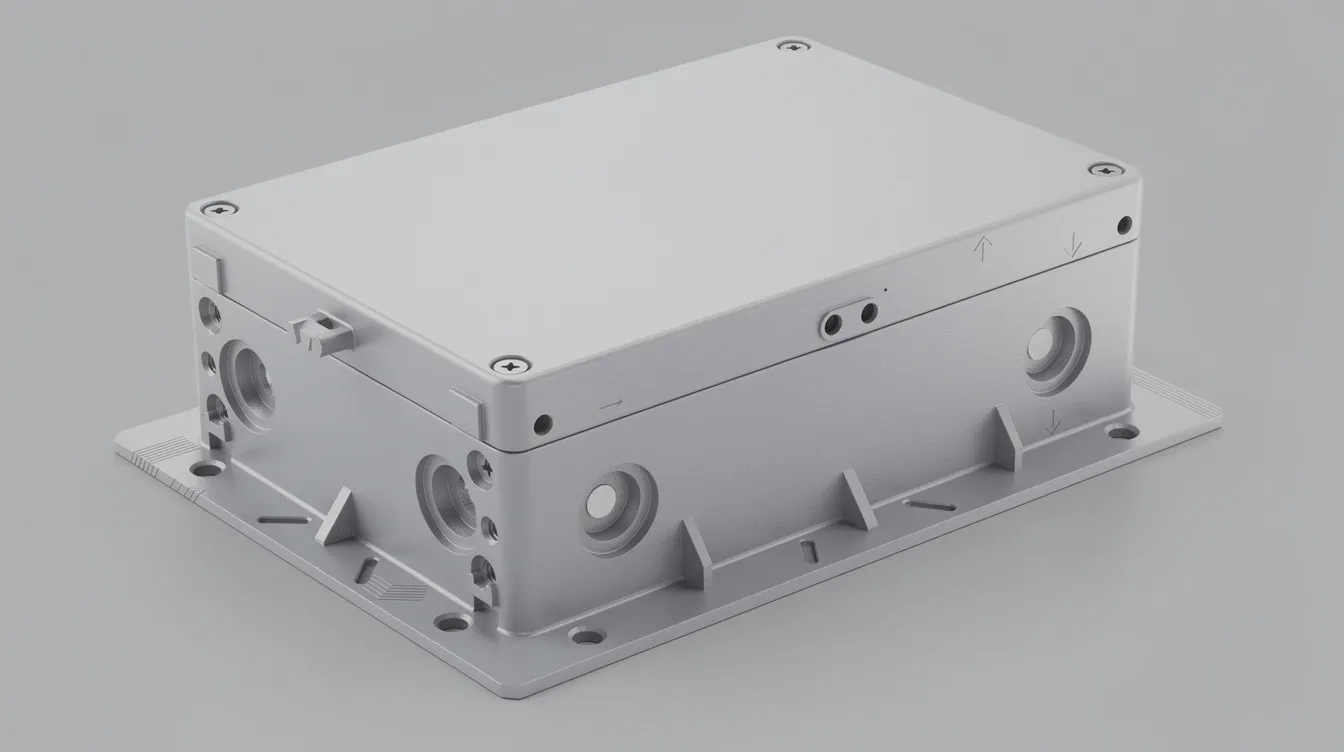
Comparing Chinese Precision Sheet Metal Suppliers: Checklist for Buyers
A structured comparison helps you move beyond marketing claims and evaluate actual capability fit for your industry experience and product requirements.
-
Process range – does the supplier cover all required operations, or will you need secondary vendors?
-
Tolerances – can they demonstrate (not just claim) the precision you need?
-
Engineering support – do they provide DFM feedback, or just quote what you send?
-
Certifications – verified ISO, IATF, or AS certifications with current audit dates?
-
Pricing transparency – itemized quotes or lump-sum black boxes?
-
Sample quality – order samples before committing to production
-
Lead times – realistic timelines with buffer, not optimistic promises
-
Export experience – track record shipping to your region with proper documentation
-
References – can they provide contact details for existing clients in your industry?
For context on the competitive landscape: Komaspec operates 190,000 sq ft across 6 buildings. RapidDirect was founded in 2009 and has 20,000 m² factory space. TUOFA Precision has over 15 years of experience in fabrication. SUPRO MFG has over 30 years of industry experience. 3ERP specializes in low-volume production runs and prototyping. KDM Fabrication is known for handling complex sheet metal projects. Each serves different niches – rank suppliers by capability fit for your specific industry rather than size alone. Weight quality and communication over price for high-risk projects.
Future Trends in Precision Sheet Metal Fabrication in China (2024–2026)
China’s sheet metal fabrication industry is evolving rapidly, and the trajectory favors suppliers investing in precision and integration.
-
Automation acceleration – robotic welding cells, lights-out laser cutting, and automated bending centers are increasingly standard in newer factories, improving consistency and reducing per-part costs
-
Digital quoting and DFM – smart manufacturing leverages real-time data for production efficiency, with leading suppliers offering instant quoting platforms and tolerance stack-up simulations
-
Environmental compliance – driven by ISO 14001 and buyer requirements for greener production, factories are adopting energy-efficient equipment and eco-friendly finishing processes
-
Rising product complexity – EV battery systems, smart medical devices, and 5G infrastructure demand large-format, heavy gauge precision sheet metal with multiple machined interfaces, favoring industry leader fabricators with integrated CNC capability
-
Advanced technology integration – additive manufacturing for tooling and fixtures, AI-assisted nesting for material yield optimization, and digital twins for process simulation are moving from pilot programs to production use
These trends favor precision-focused suppliers who invest continuously in equipment, training, and process control – exactly the trajectory we are on at Anebon.
Partner with Anebon for Precision Sheet Metal Fabrication in China
Anebon Metal Products Limited combines precision CNC machining, custom sheet metal fabrication, and die casting under one roof in Dongguan, serving international buyers who need high precision parts with reliable delivery and clear communication.
-
Tolerances – as precise as ±0.002 mm for CNC machined parts, ±0.02 mm for critical sheet metal features, delivering unmatched precision for demanding applications
-
Integrated processes – sheet metal, CNC machining, die casting, injection moulding partnerships, and metal casting capabilities
-
Certifications – ISO 9001:2015 and ISO 14001:2015
-
Volume flexibility – rapid prototyping through large scale mass production
-
Industry experience – medical devices, aerospace, automotive, electronics, robotics, and industrial machinery
Ready to get started? Send us your CAD files and project details to receive a detailed quote and DFM review. We typically respond within 24 hours and support both new product development and existing product transfers from other suppliers. Whether you need five prototypes or fifty thousand production parts, our engineering team is ready to help you move from design to delivery.