Top High Precision Die Casting Suppliers for Your Manufacturing Needs
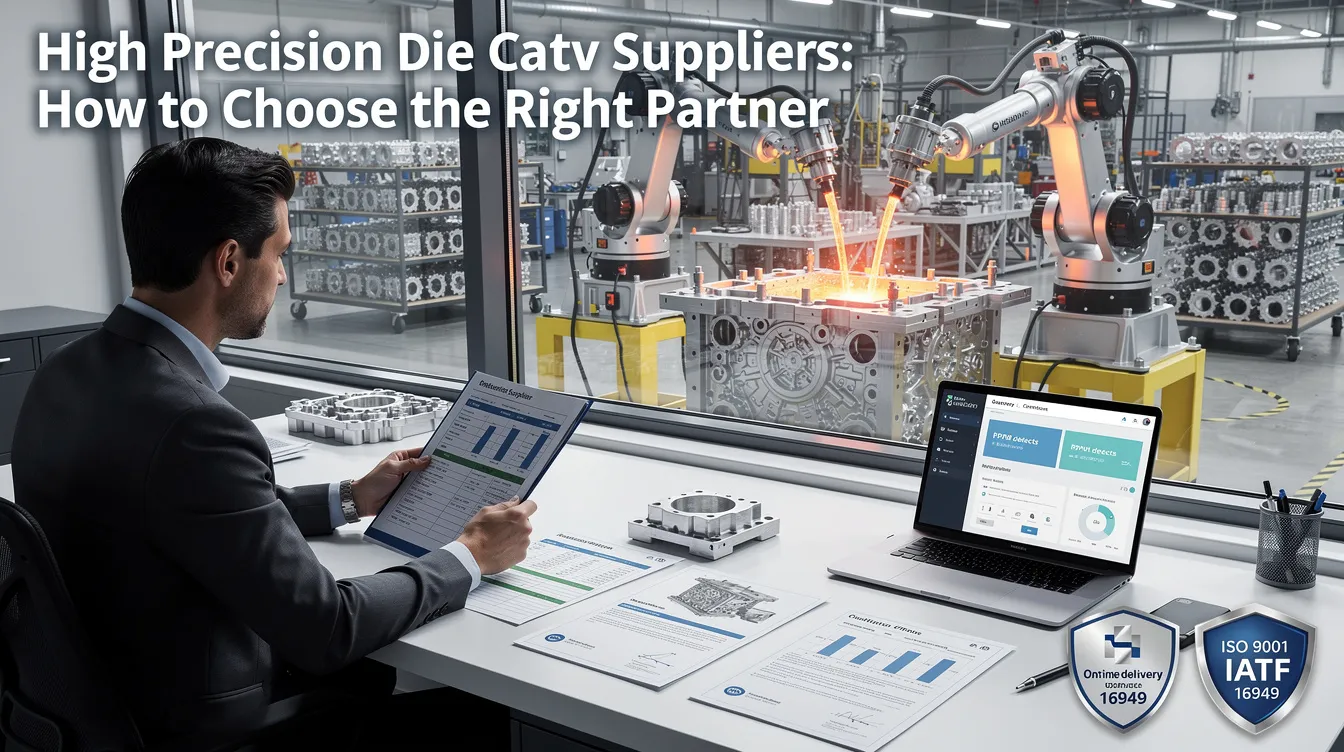
High Precision Die Casting Suppliers: How to Choose the Right Partner
Finding the right manufacturing partner for complex metal components can make or break your product program. This guide walks you through what separates a genuine high precision die casting supplier from a commodity foundry, how to evaluate capabilities, and how to build a supplier relationship that delivers consistent results across automotive, aerospace, electronics, medical, and robotics applications.
Quick Summary: What OEM Buyers Must Know First
High precision die casting suppliers are critical when your project demands complex aluminum and zinc components with tight geometries, reliable performance, and repeatable quality across tens or hundreds of thousands of parts. Choosing the right partner directly impacts cost, quality, and time-to-market. High precision die casting is essential for industries requiring strict tolerances and quality assurance-and the supplier you select determines whether your finished product actually works.
What distinguishes “high precision” from commodity casting? Tight tolerances down to ±0.005–0.05 mm on as-cast geometry, stable repeatability over hundreds of thousands of shots, minimal post-machining, and defect rates low enough to support demanding end-use environments. Precision die casting can reduce production costs by over 50 percent compared to traditional multi-step machining approaches.
Many buyers now look beyond domestic options and engage ISO-certified Chinese partners like Anebon Metal Products Limited for high precision aluminum die casting and integrated cnc machining, gaining access to competitive tooling, scalable capacity, and engineering precision under one roof.
Top decision factors to define before comparing suppliers:
-
Alloy and process selection (hot chamber die casting vs cold chamber die casting)
-
Tolerance capability, both as-cast and post-machined
-
In-house secondary operations (cnc machining, surface finishing, mechanical assembly)
-
Quality certifications (ISO 9001:2015, ISO 14001:2015, IATF 16949 where needed)
Before engaging any die casting supplier, define your part size, annual volume, target tolerances, and functional critical areas. These requirements drive which suppliers qualify as true high precision partners.
Understanding High Precision Die Casting
Die casting is a high pressure metal casting process where molten metal-commonly aluminum, zinc, or magnesium-is injected into a hardened steel mold. Die casting uses high pressure to inject molten metal into the cavity rapidly, producing parts with excellent dimensional control. “High precision” refers to tighter dimensional tolerances, better shot-to-shot repeatability, and cleaner surfaces than standard foundry work. Die casting achieves near-net-shape components with excellent surface finish, which is central to its value for OEMs.
Cold chamber die casting is typically used for aluminum die casting and magnesium alloys with higher melting temperatures. Hot chamber processes are more common for zinc and lower melting point alloys. High precision aluminum die casting is almost always done on cold chamber machines. Meanwhile, magnesium die casting is expanding at 8.25% CAGR due to lightweighting trends across transportation and consumer electronics.
Typical performance ranges include:
-
Injection pressure: High-pressure die casting operates at pressures from hundreds to thousands of psi, with advanced systems exceeding 1,500 bar
-
Cycle times: Measured in seconds, enabling high volume production
-
Wall thickness: Down to 1–1.5 mm for advanced aluminum die design and gating, 0.4–0.8 mm for zinc
Key benefits for precision buyers:
-
Near net shape capability that reduces cnc machining time and material waste
-
Improved mechanical properties through controlled solidification and process control
-
Ability to consolidate multiple machined or stamped parts-including those from metal stamping-into a single casting
These advantages matter most in applications like EV battery housings, 5G telecom chassis, medical pump bodies, and compact gearbox housings where tight tolerances and leak-free performance are mandatory.
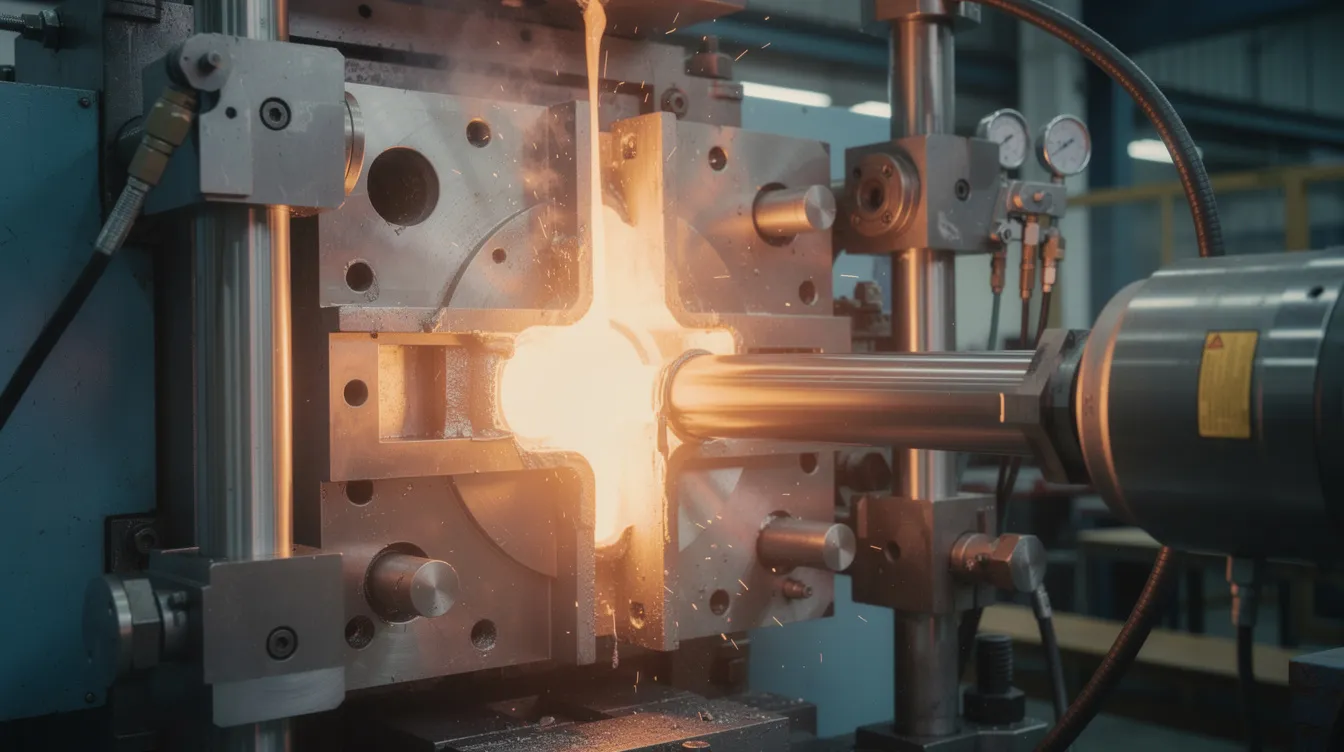
Key Processes: Hot vs. Cold Chamber Die Casting for Precision Parts
Both hot chamber and cold chamber die casting can achieve high precision results when tooling, production processes, and alloy behavior are properly engineered. However, they serve different alloy families, part sizes, and geometry profiles. Choosing the wrong process leads to excessive porosity, poor finish, or unnecessary cost.
In hot chamber die casting, the injection system sits submerged in molten metal. This allows extremely fast cycles-often under 10 seconds per shot-making it ideal for zinc alloys like Zamak 3, Zamak 5, and Zamak 7. Zinc die casting allows for intricate designs and excellent finishing, and zinc die castings are known for high ductility and impact strength. Hot chamber die casting is used for lower melting point alloys and excels in small, high-volume precision parts such as connectors, miniature gears, and hinges used in consumer electronics.
Cold chamber die casting is suitable for aluminum and magnesium. Metal is melted in a separate furnace and poured into a shot sleeve before injection. Cycle times are slightly longer, but cold chamber supports larger, more structural aluminum die cast components-motor housings, steering brackets, robotic arm joints. Die casting machines for cold chamber work range from ~80 tonnes to well over 2,000 tonnes of clamping force.
A versatile high precision die casting supplier should advise on process selection and may run both hot and cold chamber lines, or partner within a casting group or casting corporation to cover multiple process families. Whether you need zinc die casting solutions for miniature components or structural aluminum, the right supplier matches process to requirement.
What Makes a Supplier “High Precision” in Practice?
“High precision” is more than marketing-it is a measurable capability. Reliability in high-precision die casting can be evaluated based on technical capabilities and quality control, with suppliers proving themselves through documented tolerances, process stability, and consistency over production lifecycles of 50,000 to 1,000,000+ parts.
Core technical markers of a precision die casting company:
-
Repeatable dimensional accuracy: ±0.05 mm on as-cast features, with post-machining tolerances down to ±0.002 mm on critical surfaces
-
Robust tooling design: H13 tool steel, thermal management via cooling channels, and advanced die design with proper venting
-
Process monitoring: Real-time shot data logging (pressure, temperature, fill time), vacuum systems, and controlled cooling to maintain high quality die castings
High-precision die casting requires suppliers to have tight process controls. Process control is crucial to reduce defects like porosity and shrinkage in die casting-without it, even good tooling produces inconsistent parts.
Integrated precision machining is equally important. Critical surfaces like sealing faces, bearing bores, and alignment features in gearboxes or robotic actuators demand secondary machining to tolerances as tight as ±0.002 mm.
High precision die casting often requires inspection tools like Coordinate Measuring Machines, along with 3D scanning, X-ray for porosity analysis, leak testing for fluid components, and spectrometer analysis of metal chemistry. A high precision partner should provide documented process capability indices (Cp, Cpk), PPAP reports for automotive and industrial programs, and full traceability from raw material lot to finished casting.
Supplier Evaluation Checklist: How to Compare High Precision Die Casting Partners
This checklist mirrors how experienced OEMs and casting companies qualify suppliers, focusing on objective criteria rather than brand recognition alone. Selecting a die casting supplier should involve evaluating their production capacity and scalability alongside technical fit.
Must-check capability points:
-
Alloy range: A380, ADC12, 383, zinc Zamak 3/5, and aluminum alloys for your target application
-
Machine tonnage: 80T–2,500T for aluminum cold chamber, with hot chamber lines for zinc die parts
-
Shot monitoring technology, vacuum assist, and squeeze casting options
-
Ability to produce both small and large aluminum die castings
-
Experience in specific alloys such as aluminum, zinc, and magnesium is critical for die casting suppliers
Quality system verification:
-
ISO 9001:2015 for baseline quality management
-
ISO 14001:2015 where environmental compliance matters
-
For automotive or EV systems, IATF 16949 or demonstrated experience with OEM PPAP and APQP processes
In-house secondary operations:
Investigate whether the supplier offers cnc milling, turning, drilling, tapping, deburring, and surface finishing like anodizing, powder coating, chromate, and mechanical assembly. These value added services directly impact lead time, dimensional stack-up, and supply-chain complexity.
Commercial and project-management factors:
Engineering support with Design for Manufacturability feedback enhances product quality-confirm your supplier provides DFM review at the RFQ stage. Communication and strong engineering support are vital in the supplier evaluation process. Lead times and the ability to scale production are significant factors in supplier selection. Clarify tooling ownership, maintenance schedules, guaranteed shot counts, and whether the supplier offers competitive tooling pricing for both rapid prototyping and mid range volume production through to high volume runs.
Cold Chamber Aluminum Die Casting for High-Performance Applications
Aluminum die casting dominates many precision applications because of its lightweight properties, good strength-to-weight ratio, corrosion resistance, and thermal conductivity. Aluminum dominates 57% of the North American automotive die casting market, and cold chamber machines are the worldwide standard for producing high quality aluminum and modern aluminum castings.
Typical alloys and their applications:
|
Alloy |
Best For |
|---|---|
|
A380 |
General structural housings, serving automotive components |
|
ADC12 |
High-fluidity alternative to A380, widely used in Asia |
|
383 |
Complex geometries needing excellent castability |
|
413 |
Pressure-tight hydraulic or pump components |
Aluminum die casting is ideal for complex, near-net-shape components, and aluminum die casting offers high dimensional stability for complex shapes. Aluminum die casting offers good strength-to-weight and corrosion resistance, making it the default for EV inverter housings and structural frames, 5G base station chassis, aerospace sensor housings, small gearbox end bells, and medical industries equipment frames.
DFM for cold chamber die casting directly impacts performance. Mold flow analysis ensures structural integrity before tooling is cut in die casting, guiding gating and venting design to reduce porosity, ribbing and fillets to control distortion, and wall thickness optimization to avoid sink marks and cold shuts. Experienced suppliers combine cold chamber die casting with precision CNC machining, 5-axis cnc milling, and tight-tolerance turning to finish functional features without transferring cast parts to a separate machining shop.
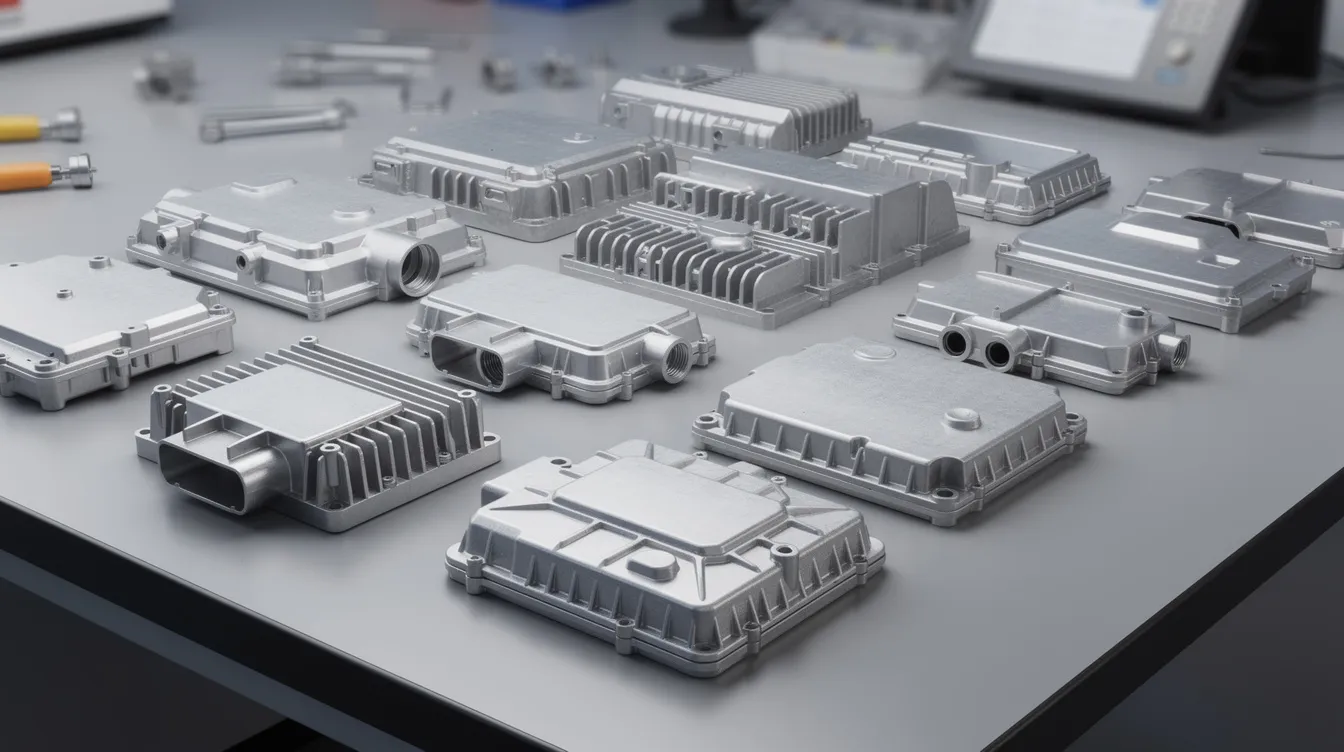
Integrated CNC Machining and Finishing: From Casting to Ready-to-Install Parts
For most high precision projects, the raw casting is only the starting point. Critical tolerances, threads, and sealing surfaces are usually achieved through cnc machining, grinding, or other secondary operations. Suppliers with integrated machining and finishing services can improve quality and reduce lead times compared to splitting work across multiple vendors.
Typical workflow of a full-service precision die casting company:
-
Mold design and tooling design with flow simulation
-
Die casting (hot or cold chamber)
-
Trimming, deburring
-
In-house CNC machining (milling, turning, drilling, tapping)
-
Surface finishing (anodizing, powder coating, plating)
-
Mechanical assembly if required
-
Final inspection (CMM, leak testing, dimensional reports)
In-house secondary operations can reduce tolerance drift and lead times in die casting. Integrating cnc machining within the same facility shortens feedback loops between casting and machining engineers, enables tighter control over datum schemes and fixturing, and reduces handling damage.
Example scenario: An aluminum cold chamber die cast housing for an industrial servo motor starts as a CNC-machined billet prototype for design validation. Once validated, Anebon provides DFM feedback, builds tooling, casts production parts, and machines bearing bores to ±0.002 mm-all within one project team. Automated robotic cells can enhance precision and adherence to industrial tolerances in die casting, supporting stable high volume production output.
Buyers should confirm machining envelope (travel sizes on 3- and 5-axis machines), maximum part size and weight, and availability of automation such as robotic loading and pallet systems for repeatable engineering precision.
Quality Systems, Certifications, and Traceability Requirements
High precision die casting suppliers differentiate themselves through rigorous quality management and documentation, not just equipment. Quality certifications like ISO 9001 and IATF 16949 are essential for die casting suppliers operating in global supply chains.
Key certifications for global buyers:
-
ISO 9001:2015 ensures consistent product quality and is the baseline for any credible die casting company. ISO 9001:2015 certification ensures consistent quality in die casting processes.
-
ISO 14001:2015 covers environmental management-important for OEMs with sustainability commitments
-
IATF 16949:2016 is crucial for automotive manufacturing standards and EV supply chains
Anebon has maintained ISO 9001 and ISO 14001 compliance since the mid-2010s. In the broader die casting industry, A&B Die Casting holds ISO 9001:2015 certification, J&M Precision Die Casting is ISO 9001:2015 certified, and Dynacast operates under IATF 16949:2016 certification-reflecting the standard expectations across industry leaders.
Robust quality assurance includes incoming inspection of aluminum ingots and raw materials, in-process checks at critical dimensions, final inspection with CMM and functional testing, and documented control plans. Traceability is vital for automotive components, aerospace, and medical sectors-tying each batch back to metal chemistry, die maintenance records, and process parameters. Before nominating any casting corporation as an approved vendor, request sample quality documents: FAI/PPAP reports, control plans, capability studies, and certificates of conformance.
Working with Overseas High Precision Die Casting Suppliers (Including China)
Many American precision die casting buyers and European OEMs now work with overseas precision die casting suppliers for competitive tooling costs, scalable capacity, and access to integrated cnc machining and fabrication. This trend reflects the maturation of Chinese manufacturing capabilities, not a compromise on quality.
Anebon Metal Products Limited, established in 2010 in Dongguan, Guangdong, exemplifies this model: a B2B/OEM-focused casting company with ISO certifications, strong experience serving automotive, aerospace, robotics, industrial machinery, and electronics customers, and a dedicated export focus. Anebon’s combination of die casting, cnc machining, and sheet metal fabrication allows OEMs to consolidate vendors instead of managing separate casting services, machining job shops, and finishing houses across multiple countries.
Key risk-management practices for overseas sourcing:
-
Provide complete technical data packages: 2D drawings with GD&T, 3D models (STEP/Parasolid), material specs
-
Agree on inspection standards upfront (ASTM, ISO, or customer-specific)
-
Define sample approval milestones: T0 (pilot casts), T1, PPAP
-
Establish communication channels with English-speaking project engineers
Realistic tooling lead times run 4–8 weeks depending on complexity. Factor in transit times, import duties, and consider safety stock for long term partnerships. Complex projects benefit from a single integrated supplier who can manage die casting solutions, secondary machining, and surface finishing within one facility.
Case-Type Examples: Matching Supplier Capabilities to Real-World Projects
These mini-examples illustrate how to match requirements to supplier capabilities.
Case 1: EV Battery Cooling Plate (American Precision Die Casting Program)
An OEM needs an aluminum cold chamber die cast cooling plate weighing ~12 kg with integral channels, sealing surfaces to ±0.05 mm flatness, and leak-tight performance. Supplier selection weighs machine tonnage (≥800T), vacuum capability, large-format CNC machining, and leak-testing systems. For context, PHB operates 58 die casting presses from 100 to 2,000 tons and PHB Corp. has over 100 years of die casting experience. Empire Die Casting operates a 200,000 square foot facility suited for such heavy truck and automotive-scale components. An overseas partner like Anebon can provide comparable capability with competitive tooling and high quality parts.
Case 2: Miniature Zinc Connector Body for Telecom
A telecom OEM requires a 35 g zinc die casting connector body with 0.5 mm walls and snap features. Hot chamber zinc die casting solutions are preferred for cycle time and surface detail. A&B Die Casting specializes in low-to-medium volume production for such programs, and Dynacast has 25 locations across North America, Europe, and Asia. Anebon can support with follow-on CNC machining or complementary aluminum die parts within the same assembly, serving as a die casting supplier for the broader project.
Case 3: Robotics Gearbox Housing
An industrial automation customer needs an aluminum die cast gearbox housing plus tight-tolerance shafts and brackets. J&M Precision Die Casting has a 40,000 square foot facility focused on similar work, while Cascade Die Casting Group produces aluminum and zinc components for comparable applications. Anebon offers an integrated solution: die casting, CNC turning and milling, and surface finishing-covering the full scope of production processes including proprietary techniques for bearing bore accuracy.
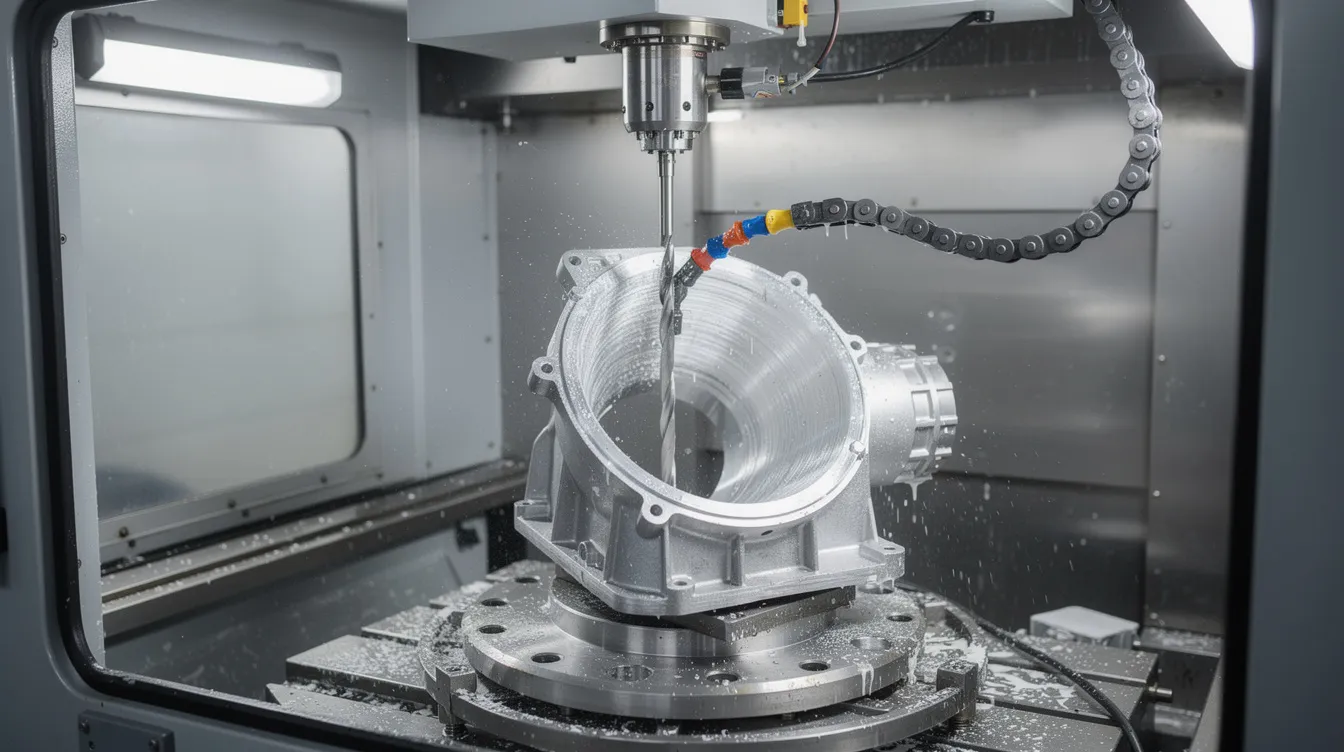
How Anebon Metal Products Limited Supports High Precision Die Casting Programs
Anebon serves as a high precision die casting and CNC machining partner for overseas OEMs across automotive, aerospace, medical industries, robotics, and industrial machinery markets. The company’s manufacturing capabilities span aluminum and zinc high pressure die casting (primarily cold chamber for aluminum die), precision CNC machining with tolerances down to ±0.002 mm, 5-axis machining, rapid prototyping-to-production support, and sheet metal fabrication for complementary components.
With ISO 9001:2015 and ISO 14001:2015 certifications, a founding date of 2010, and a Dongguan location within China’s most mature manufacturing ecosystem, Anebon delivers high quality products with the export infrastructure that North American and European customers require.
Anebon’s typical engagement model:
-
DFM review at RFQ stage with engineering support on draft, wall thickness, and gating
-
Collaborative tooling design with mold flow simulation
-
Sample submission with full dimensional and metallurgical reports
-
Production ramp-up with agreed control plans for permanent mold or HPDC programs
-
Continuous improvement driven by in-field customer feedback
Design engineers, sourcing teams, and R&D leaders can submit 2D/3D files for a quote or DFM consultation. Anebon can act as a standalone precision casting supplier or integrate into a broader casting group strategy as a trusted overseas partner, supporting everything from mid range volume production through high volume programs.
Conclusion: Turning Specifications into a Long-Term Precision Partnership
Choosing a high precision die casting supplier is about aligning your part requirements-material, geometry, tolerances, certification, and volume-with the right mix of casting, machining, and quality capabilities. The die casting industry offers a broad spectrum of suppliers, but only those with documented process control, integrated secondary operations, and proven quality systems deliver the consistency that demanding applications require.
You should now be able to answer the key screening questions: hot vs cold chamber process, aluminum vs zinc or magnesium alloys, need for integrated CNC machining and surface finishing, and regulatory or industry-specific demands for automotive, aerospace, or medical programs.
Anebon stands as a reliable, ISO-certified overseas precision manufacturing partner that supports rapid prototyping, bridge builds, and long term partnerships without forcing a trade-off between cost and quality.
Engage potential suppliers early in your design cycle. The best die casting solutions come from DFM feedback, cost modeling, and risk reduction that start before tooling is cut-turning a transactional casting service into a strategic engineering partnership that delivers high quality products program after program.