Top CNC Vendors with Anodizing Options for Quality Machining Solutions
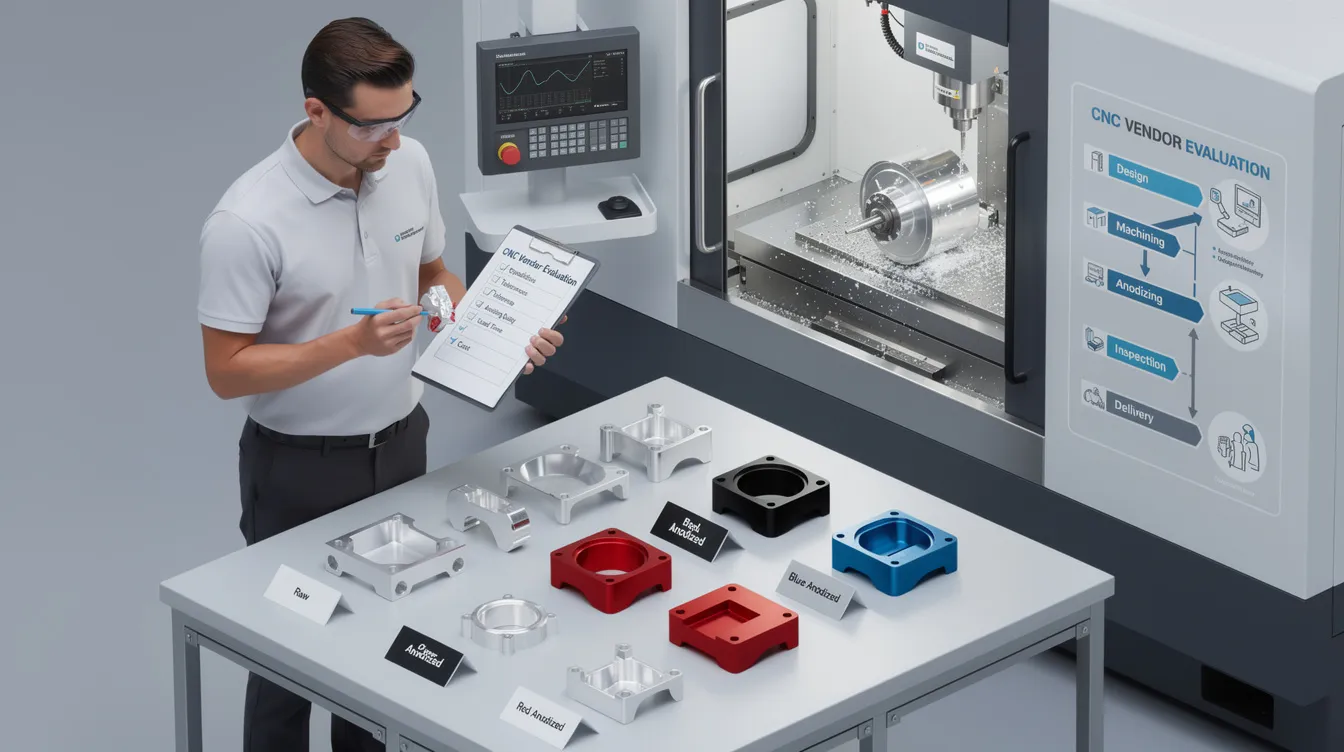
CNC Vendors with Anodizing Options: How to Pick the Right One for Your Aluminum Parts
Introduction: Why CNC + Anodizing in One Vendor Matters
When you source aluminum parts from one shop and send them to a separate facility for anodizing, you introduce handoffs that multiply risk. Parts get scratched in transit, tolerances shift without coordinated compensation, and lead times stretch. Working with cnc vendors with anodizing options under one roof eliminates most of these problems by keeping machining and finishing in a single, accountable workflow.
Anodized aluminum is now a baseline expectation across consumer electronics, robotics, medical housings, and aerospace hardware. The global metal anodizing market reached USD 2.16 billion in 2026, and anodized aluminum accounts for about 66% of that market. The demand is driven by a simple fact: anodizing creates a corrosion resistant oxide layer on aluminum that outlasts paint, resists scratching, and looks better for longer. Anodized layers can last between 10 to 20 years under normal service conditions.
This guide is written from the perspective of Anebon Metal Products Limited, a China-based OEM machining partner founded in 2010 in Dongguan, Guangdong, with ISO 9001:2015 and ISO 14001:2015 certifications. Anodizing, at its core, is an electrochemical process that immerses aluminum in an acid electrolyte bath, forming a durable aluminum oxide layer across the aluminum surface and enabling a wide color range of anodized aluminum colors. Below, we cover anodizing types, vendor selection criteria, typical options from clear anodizing to custom colors, and specific ways Anebon supports overseas OEMs through every stage.
What CNC Vendors with In‑House Anodizing Actually Offer
A “CNC vendor with anodizing options” means the supplier runs cnc machining operations (milling, turning, 5-axis) alongside an integrated anodizing line, or works through a tightly coupled anodizing partner managed as a single process. Either way, the vendor takes ownership from raw aluminum bar or plate through to finished, anodized, and packaged aluminum components ready for export.
Common part types include enclosures, heatsinks, brackets, panels, and precision cnc machined parts in 6061-T6 and 7075-T6 aluminum. CNC machining companies offer anodizing to improve corrosion resistance and appearance simultaneously, and integrated anodizing services enhance quality control for machined parts because the same team manages dimensional checks before and after the anodization process. Machining and anodizing together can produce more consistent results than splitting the work across unrelated suppliers.
What to expect from a capable CNC + anodizing supplier:
-
DFM feedback that accounts for anodizing type, coating thickness, and dimensional growth before machining begins
-
Masking strategy for threads, bearing bores, and mating surfaces where anodizing is not desired
-
Standard and custom anodized color options with sample approval workflows
-
Export packaging designed to protect anodized finishes during shipping
-
Material traceability, mill certifications, and post-anodizing inspection reports
Key Anodizing Types Offered by CNC Vendors
Most CNC shops with anodizing options support the main anodizing types defined by MIL-A-8625 and MIL-PRF-8625, built around sulfuric acid and chromic acid electrolytes. Specifying the correct anodizing type early in your project avoids tolerance, wear, and color issues downstream. Anodizing is one of the most common finishing options for metal parts, and the three primary types differ significantly in film thickness, colorability, and dimensional impact.
|
Type I |
Type II |
Type III |
|
|---|---|---|---|
|
Electrolyte |
Chromic acid |
Sulfuric acid |
Sulfuric acid (cold bath) |
|
Film thickness |
0.5–4.5 µm |
5–25 µm |
25–150 µm |
|
Typical use |
Aerospace tight-tolerance parts |
Decorative & functional parts |
High-wear industrial parts |
|
Colorability |
Very limited (grey tones) |
Excellent (full dye range) |
Limited (dark grey/black) |
Type I: Chromic Acid Anodizing for Tight‑Tolerance Parts
Type I anodizing uses chromic acid to produce a very thin oxide layer, typically 0.5 to 4.5 µm. Because the coating is so thin, dimensional change is negligible, making it suitable for tight tolerance parts where even microns of build-up can cause interference. Type I anodizing uses chromic acid for thin coatings that provide basic corrosion protection without altering critical fits.
Historically, Type I has been standard on legacy airframe components and military hardware. However, hexavalent chromium regulations, particularly in the EU, are progressively restricting its use. The thin layer also limits dye uptake, so vibrant anodized colors are not achievable; parts typically appear grey to dark grey.
Many CNC vendors no longer run Type I in-house. Aerospace work often requires AS9100 and NADCAP certification for anodizing, which means buyers needing chromic acid finishes usually work with specialized NADCAP anodizers. Specify Type I only when legacy specs demand it and coating thickness must stay below 5 µm.
Type II: Sulfuric Acid Anodizing for Decorative and Functional Parts
Type II is the workhorse. Sulfuric acid anodizing produces coatings from roughly 1.8 to 25 micrometers, and it is commonly used for decorative anodizing across industries. The anodizing process can increase the oxide layer thickness to 5-25 micrometers, creating a porous oxide layer that absorbs dyes exceptionally well. This is where you get the full spectrum of anodized colors: black, red, blue, gold, champagne, and clear anodizing for a clean metallic look.
Type II anodizing typically adds 0.0002 to 0.001 inches per side. For most cnc milling components, this growth is manageable with proper DFM planning. Threads and critical fits may require masking to avoid interference. Applications range from consumer electronics housings and robotics brackets to lab equipment panels.
Most cnc vendors with anodizing options, including Anebon, treat type ii anodizing as the default surface treatment for aluminum parts unless the customer specifies otherwise.
Type III: Hardcoat Anodizing for Wear‑Intensive Applications
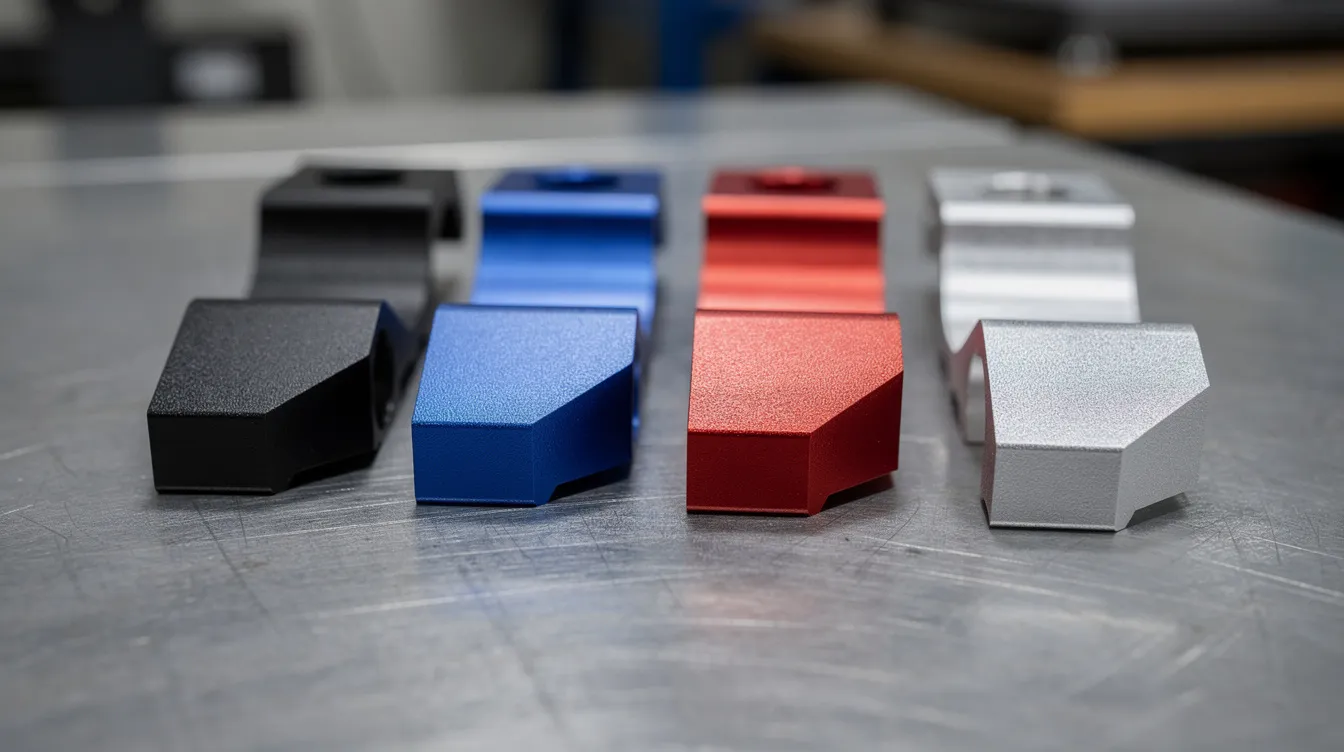
Type III anodizing, also called type iii hardcoat, uses sulfuric acid at lower bath temperatures and higher current density to build dense coatings between 25 and 150 micrometers. Type III anodizing is preferred for high-wear applications where abrasion resistance and surface hardness (roughly 60–70 HRC equivalent) are non-negotiable.
Type III anodizing can add 0.001 to 0.003 inches per side, which is substantial. For cnc parts with sliding fits, press-fit bores, or precision guides, this dimensional change from anodizing must be accounted for in tight tolerances. Pre-machining offsets or post-anodize reaming are common strategies.
Type iii coatings are naturally dark grey to black and do not support bright custom colors the way Type II does. CNC vendors with anodizing options typically recommend type iii anodizing for pistons, tooling, guides, high-duty actuator parts, and outdoor or marine mechanisms where wear resistance matters more than cosmetic finishes.
Typical Anodized Aluminum Colors Offered by CNC Vendors
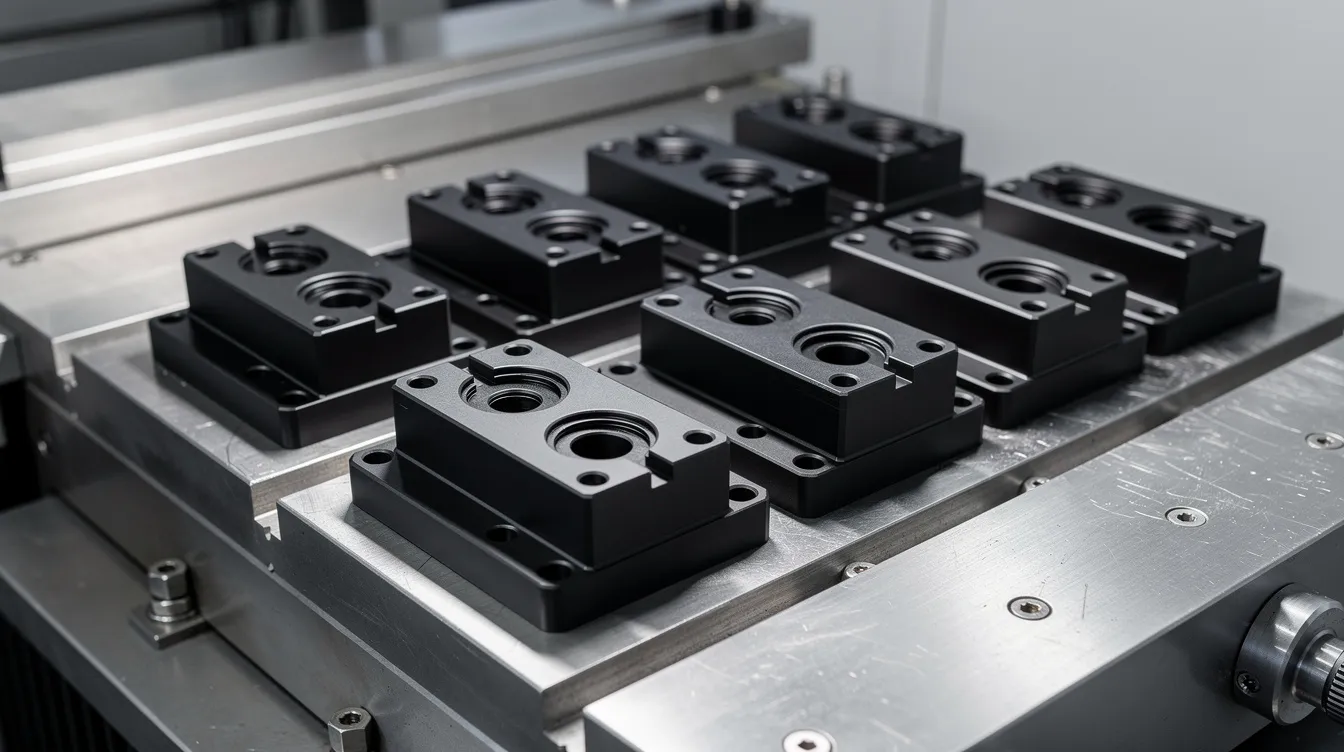
Not every CNC vendor provides a full color chart, but most standardize on a practical set of anodized colors proven to hold up across production batches. Anodizing options can include clear, black, and custom colors. Unlike paint, anodized color lives inside the oxide layer itself, so it won’t peel or flake.
Black anodizing is the most common and fastest anodizing color. Darker colors are generally more consistent in production because they mask minor surface conditions and alloy variation. Here is how most vendors categorize their offerings:
-
Standard colors: Clear/natural, black
-
Brand/aesthetic colors: Red, blue, gold/bronze, champagne-black, red, blue, and gold are the most common anodized colors
-
Custom colors on request: Pantone matching, metallic tones via electrolytic coloring, or specialty shades (green, purple)
Clear anodizing forms a protective aluminum oxide layer over the aluminum surface, preserving the base metal’s natural sheen while adding corrosion resistance. Bare, untreated aluminum oxidizes unevenly over time and darkens. Clear anodized parts maintain their appearance far longer.
Electrolytic coloring offers better repeatability but fewer color options compared to organic dye bath methods. It works well for bronze and gold metallic tones, particularly on architectural cladding and visible hardware. Custom anodized colors often require test runs for matching, especially when matching to brand-specific Pantone references. Anodized black and natural color parts remain the most frequently requested finishes.
How Anodizing Parameters Affect CNC‑Machined Parts
Anodizing is not just a color choice. Process parameters like current density, bath chemistry, time, and sealing method affect dimensions, hardness, color consistency, and durability of every anodized part you receive.
Taking into account dimensional growth is important when anodizing. The oxide layer grows partly into the base material and partly outward from the aluminum surface. Anodizing adds a thin oxide layer to aluminum parts, and for tight fits and sliding interfaces, even small build-up matters. Anodizing can create fitting issues in tight-tolerance parts if growth is not compensated during machining. Engineers should include critical dimensions on drawings to minimize dimensional change.
Current density and film thickness also influence electrolytic coloring results for bronze and gold tones, as well as dye uptake for bold colors. Higher current density at lower temperatures produces harder, thicker coatings (Type III territory) but reduces dye absorption.
Alloy choice directly affects surface finish and color variation. Different alloys respond differently: 6061 gives clean, predictable color consistency across batches, while 7075′s higher zinc content tends to produce warmer, slightly yellow-grey tints in clear finishes and can show batch to batch variation in lighter dyes. Cast alloys like A380 often reveal inclusions and silicon pools as visible spots after anodizing. Anodized colors can vary due to alloy and process conditions, so a vendor experienced with your specific alloy and surface treatment combination will save you rework.
Surface preparation matters too. Tool marks, sharp edges, and contamination all transfer into the finished anodized oxide layer. Process stability in the acid bath, including sulfuric acid concentration and temperature control, determines whether results are repeatable or inconsistent.
How to Evaluate CNC Vendors with Anodizing Options
Use this as a practical checklist when choosing machining vendors who also handle anodizing:
-
Anodizing types supported: Does the vendor offer type ii and type iii anodizing? Can they source Type I through qualified subcontractors? Vendors may provide anodizing in-house or through qualified subcontractors.
-
Thickness control: What coating thickness ranges can they reliably hold? How do they measure (eddy current, cross-section microscopy)?
-
Color range: What standard and custom anodized colors are available? Can they match to a dye bath reference or Pantone swatch? What is their measurable color tolerance (ΔE)?
-
Masking capabilities: Can they mask threads, grounding pads, and mating surfaces? Do they calculate pre-machining offsets for expected growth?
-
Alloy experience: Have they anodized 6061, 7075, 5052, 6063, and cast aluminum alloys? Do they understand how different alloys affect color and process conditions?
-
Certifications: ISO 9001 is the baseline certification for anodizing suppliers. ISO 9001:2015 and ISO 14001:2015 are common quality and environmental certifications. Aerospace programs may need AS9100 or NADCAP; medical devices may need ISO 13485 alignment.
-
Inspection and traceability: Do they provide salt spray test reports, hardness readings, adhesion checks, and material certificates?
-
Samples: Ask for real anodized samples of prior aluminum parts-both clear anodizing and dyed finishes-to inspect color uniformity and surface quality firsthand.
Dedicated Anodizers vs CNC Vendors with Integrated Anodizing
Standalone anodizing houses specialize deeply. They often run a broader range of anodizing type and thickness options, offer niche electrolytic coloring systems and specialty sealing methods, and hold certifications like NADCAP for aerospace and defense work. If you need exotic process conditions or very large batch volumes, a dedicated anodizer may be the right call.
Integrated CNC + anodizing vendors offer a different advantage: simplified sourcing, fewer purchase orders, no inter-plant shipping of delicate cnc machined parts, and faster prototype-to-production transitions. The DFM team can flag anodizing issues before the first chip is cut, reducing rework.
A hybrid model also works. Some CNC vendors coordinate with a preferred external anodizer while maintaining single-point responsibility for quality and timing. This gives buyers process stability without requiring the CNC shop to invest in every anodizing chemistry.
For smaller to mid-volume OEM programs (50–10,000 pieces per batch), integrated machining and anodizing almost always wins on cost, speed, and consistency. For regulated aerospace contracts demanding NADCAP-certified chromic acid processes, a dedicated anodizer remains essential.
Anebon’s CNC Machining and Anodizing Capabilities
Anebon Metal Products Limited is a precision CNC machining, die casting, and sheet metal fabrication company founded in 2010 in Dongguan, Guangdong, China. We serve overseas OEMs across robotics, electronics, automotive, and medical devices.
Our machining capabilities include CNC milling, CNC turning, 5 axis machining, rapid prototyping, and full production runs with tight tolerances as precise as ±0.002 mm on aluminum parts. We work with aluminum alloys including 6061-T6, 6082, and 7075-T6.
On the anodizing finishing side, we support Type II and Type III anodizing with standard anodized colors (clear, black, natural, blue, red) and selected custom colors on request. Our team advises on clear anodizing versus dyed finishes, electrolytic coloring options for metallic tones, and compatibility with other coatings such as powder coating or chem film through qualified partners. Anodizing improves corrosion resistance and wear performance for every aluminum part we ship.
We hold ISO 9001:2015 and ISO 14001:2015 certifications, run in-process QC checks at machining and anodizing stages, and deliver final inspection reports tailored to each customer’s requirements. Anodized aluminum is scratch-resistant and easier to clean, and anodized aluminum is also easier to maintain than untreated aluminum-properties that matter for every cosmetic or functional part we produce.
Specifying Anodizing Correctly for Your CNC Project
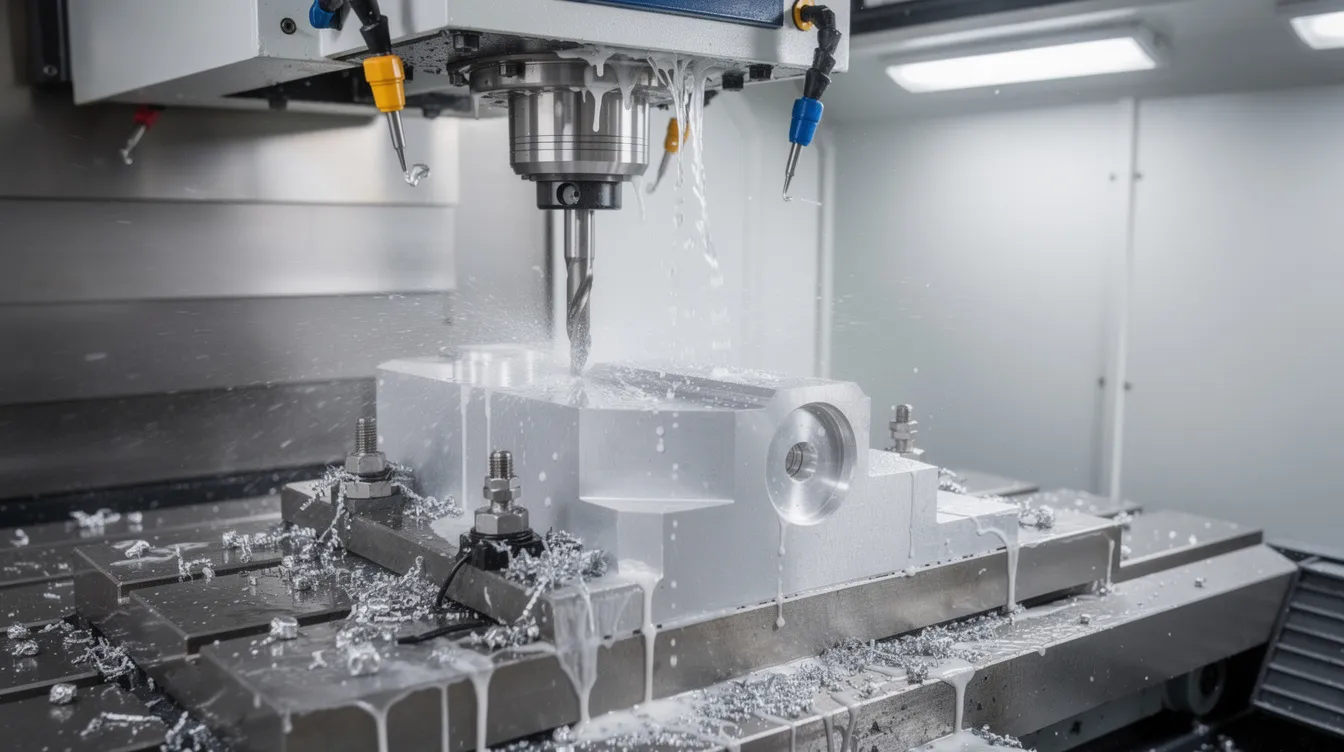
Clear, written specifications prevent most issues related to anodized colors, thickness, and tolerances. Here is what to include in your RFQ when working with any CNC vendor with anodizing options. Typically available anodizing standards include MIL-A-8625 and MIL-PRF-8625, and referencing them removes ambiguity.
Follow this step-by-step list:
-
Specify alloy: State the exact grade (e.g., 6061-T6) since it affects color consistency and dye uptake.
-
Specify anodizing type: Call out Type II or Type III explicitly. Do not leave it to the vendor’s assumption.
-
Define coating thickness range: For example, 10–20 µm for Type II or 50–75 µm for Type III.
-
Define acceptable color tolerance early in the process. Use a measurable reference system for color specification, such as a Pantone code or ΔE value. Avoid vague descriptions like “dark blue.”
-
Specify areas that must not be anodized, like threads, bearing fits, grounding points, and electrical insulation surfaces. Mark these on your 2D drawing and note they require masking.
-
Include critical dimensions on drawings to minimize dimensional change, especially for features that interact with other parts after the anodizing process.
-
Approve physical samples under relevant lighting conditions before locking color into production, especially for visible consumer electronics or medical products.
For a deeper dive into surface treatment processes for materials, our engineering team can walk you through the details during DFM review.
When to Request Samples and Pilot Runs from CNC Anodizing Vendors
Prototypes and small pilot builds are the safest way to validate anodized aluminum appearance and fit before committing to volume production. Anodizing enhances the aesthetic appearance of aluminum, but that appearance must be verified against your actual requirements.
A typical workflow looks like this:
-
Upload CAD files and 2D drawings with anodizing specs
-
Receive DFM feedback covering anodizing type, expected film thickness, and dimensional build-up
-
Approve machining and anodizing samples (typically 3–5 pieces)
-
Validate color stability and tolerance stack-ups after surface treatment
-
Scale to batch production using the same process parameters
Small sample runs help verify anodized aluminum colors under different lighting and confirm that the base metal behaves as expected with your chosen alloy. Color variation between prototype and production can occur if process conditions or bath chemistry drifts, so locking in your vendor’s process early matters.
At Anebon, we move from rapid prototyping to full production for overseas OEMs using the same machining and anodizing processes, which keeps cosmetic finishes and dimensional accuracy consistent across all stages. For critical programs targeting 2026–2027 launches-new EV components, industrial automation systems, or next-generation robotics-budget time for at least one pilot run of anodized cnc machined parts.
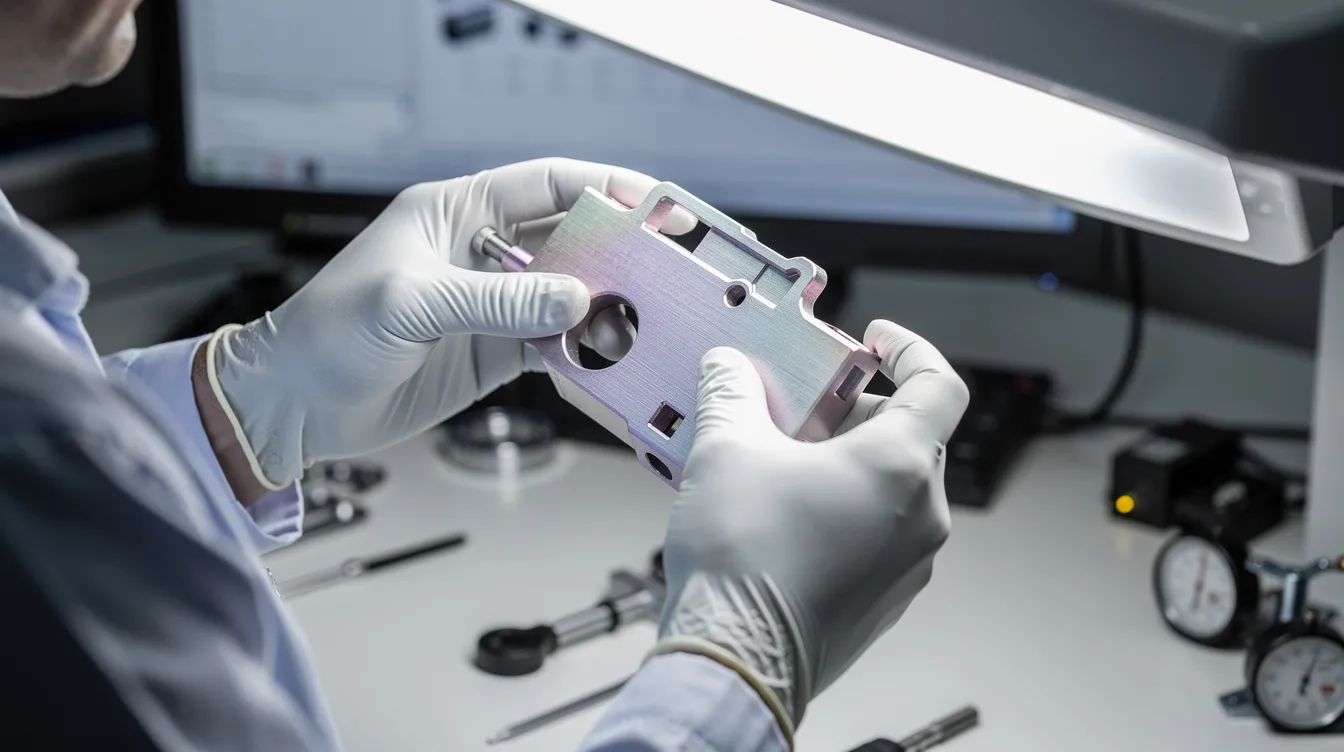
How to Get a Quote from Anebon for CNC Parts with Anodizing
Getting an accurate quote starts with providing the right information upfront. Here is what Anebon needs:
-
3D CAD files (STEP, IGES, or SolidWorks) and 2D drawings with anodizing callouts
-
Target quantities: prototype vs. production volumes
-
Preferred anodizing type: Type II or Type III
-
Target anodized colors or any custom machined part surface treatment notes
-
Special requirements: masking areas, electrical insulation needs, brand color matching, or compliance specs
Our engineering team reviews every design for anodizing-related risks-film thickness build-up on tight fits, color feasibility on your chosen alloy, current density hot spots on complex geometries-before finalizing pricing and lead time. Typical turnaround for machined and anodized samples runs a few days for machining plus several additional days for anodizing, sealing, and inspection, depending on color complexity and batch size.
Contact Anebon directly through our website or email to discuss your specific anodized parts project. Whether you need clear anodizing on a precision bracket or bold colors on a consumer-facing housing, we will walk you through the options and get you samples fast.