Top CNC Factories China: Efficiency and Innovation in Manufacturing
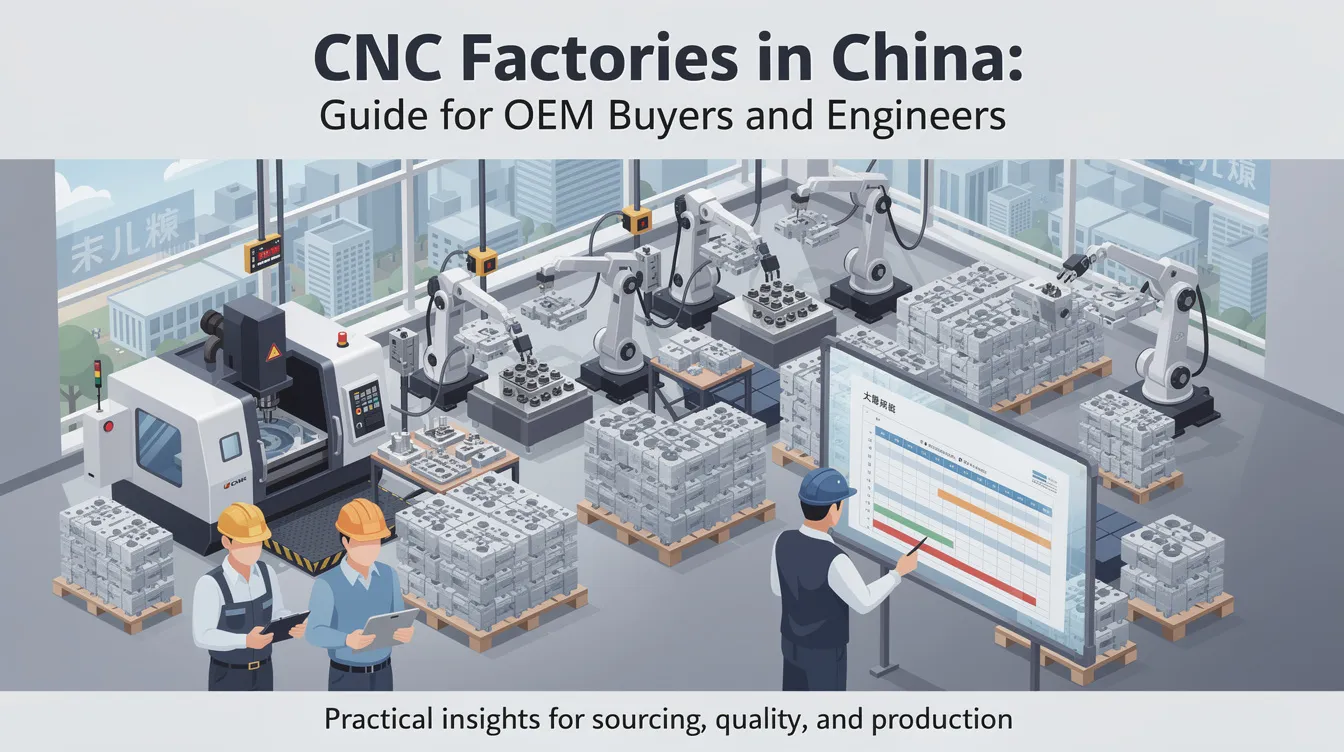
CNC Factories in China: Guide for OEM Buyers and Engineers
If you are sourcing precision metal or plastic parts for your next project, CNC factories in China remain the most significant global option for cost, capacity, and technical range. This guide breaks down what to expect from Chinese CNC machining facilities, how to evaluate them, and where Anebon Metal Products Co., Ltd fits in.
Rapid Overview: Why CNC Factories in China Dominate Global Supply
China has been the world’s largest CNC machining hub since roughly 2010. Its coastal manufacturing clusters export high volumes of precision components to the US, Europe, and Southeast Asia, serving industries from electronics to medical devices to the automotive industry.
Here is why the country keeps attracting overseas OEMs:
-
Scale and clusters: Three provinces – Jiangsu, Guangdong, and Zhejiang – represent about 82% of audited CNC machining capacity in China. Major cities include Dongguan, Shenzhen, Ningbo, Suzhou, and Qingdao.
-
Capability breadth: Nearly 39% of audited factories operate 5-axis milling machines, and 48% offer Swiss-type machining with tolerances down to ±0.005 mm.
-
Small-batch flexibility: The median minimum order quantity across recent RFQs was just 10 units, and over 63% of demand came from orders of 50 pieces or fewer.
-
Digitization reality: Only about 6% of China’s factories are fully digitized. Around 60% are barely digitized. However, leading CNC facilities already operate with modern CAD/CAM, MES, and automated inspection systems, and China is investing heavily in digitization pilot projects to close the gap.
-
Cost advantages: Competitive labor, deep supply chain infrastructure for materials and surface finishes, and strong export logistics make Chinese manufacturers suitable for both prototypes and full production.
CNC machining utilizes computer-controlled machines for precision and minimizes human error in manufacturing processes, which is one reason the manufacturing industry in this market has scaled so rapidly.
Anebon Metal Products Co., Ltd is an ISO 9001:2015 and ISO 14001:2015 certified CNC machining and fabrication factory in Dongguan, serving overseas OEMs since 2010.
What a Modern CNC Factory in China Actually Looks Like
A typical mid-to-large export-oriented CNC factory spans 5,000 to 20,000 m² and houses multiple machining cells – milling, turning, EDM, grinding – alongside a QC lab, material warehouse, tool room, and assembly area. Staff headcounts range from 80 to 300, including machinists, setup operators, QC inspectors, and logistics personnel.
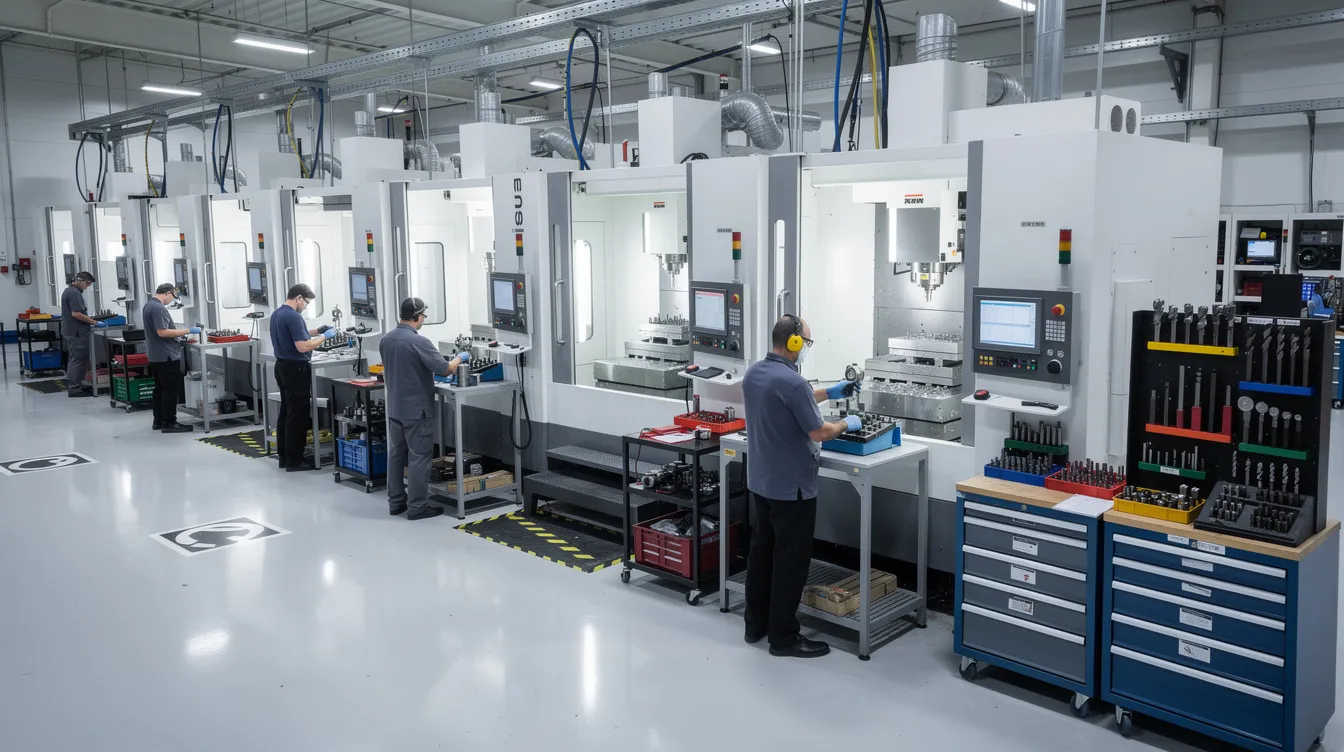
The typical equipment mix includes:
-
3-axis and 4-axis vertical machining centers (VMCs): These can produce complex parts in one clamping, take up less space than horizontal centers, and are user-friendly and easy to operate. They are commonly used in aerospace and medical industries for precision parts.
-
Turning centers with live tooling and dual spindles for combined milling and drilling on a single machine.
-
5-axis machining centers for sculpted surfaces, aerospace components, and medical implants.
-
Drilling machines, tapping centers, EDM (wire and sinker), and precision grinding equipment for secondary operations.
VMCs can machine various materials, enhancing production flexibility across a shop. Common machine brands on the floor include Japanese names like Fanuc and Mazak, German/Japanese DMG Mori, American Haas, and local brands such as SMTCL and Dalian Machine Tool. Factories typically run 30 to over 100 machines.
Higher-level factories maintain climate-controlled inspection rooms equipped with CMMs, optical projectors, hardness testers, and surface roughness testers – essential for verifying micron-level accuracy on critical work.
Core CNC Machining Capabilities Offered by Chinese Factories
CNC machining encompasses subtractive processes – milling, turning, drilling, and related operations – where a workpiece is shaped by removing material under computer control. Here is the typical service scope:
-
CNC milling: 3-axis through 5-axis; CNC milling can produce complex geometries efficiently and is the backbone for housings, brackets, and sculpted components.
-
CNC turning: Achieves micron-level tolerances for precision components such as shafts, pins, and connectors. CNC turning and milling together ensure consistent part quality across production runs.
-
5-axis machining: Essential for intricate geometries and tight tolerances, reducing setups and improving accuracy on multi-sided parts.
-
Secondary operations: Grinding, EDM, tapping, thread milling, reaming on drilling machines, deburring, and polishing.
-
Surface finishes: Anodizing, plating (Ni, Zn), powder coating, passivation, and polishing.
CNC machining produces parts with micron-level tolerances and can create complex shapes and intricate designs. High-precision jobs often require tolerances of ±0.0005 inches or tighter, which capable factories achieve on short runs under controlled conditions with stable materials. CNC services reduce lead times significantly compared to traditional methods, and CNC machining is essential for high-volume production runs. The process can produce parts from various materials like aluminum and titanium.
Volumes served:
|
Order Type |
Typical Quantity |
Use Case |
|---|---|---|
|
1–10 pcs |
Design validation, fit checks |
|
|
Pre-series |
50–500 pcs |
Pilot production, sales samples |
|
Full production |
1,000–100,000+ pcs |
Series manufacturing for OEMs |
Anebon provides the full chain from CNC machining to die casting and sheet metal fabrication, allowing combined or assembled parts for customers who want a one stop solution with fewer suppliers to manage.
Materials and Precision Components Typically Produced
Chinese CNC factories machine a wide range of metals and plastics for export to the world market. Here is what you will commonly find:
Metals:
-
Aluminum alloys (6061, 6082, 7075) for structural parts, housings, and heatsinks. Note that aluminum grades like 6061 and 7075 require distinct cutting speeds and heat management. Aluminum machining can be affected by issues like thermal expansion and burrs, and the anodizing process can affect the dimensions of aluminum parts after machining – something your shop must account for in the process.
-
Stainless steels (304, 316L, 17-4PH) for the medical field, food-grade, and corrosion-resistant applications.
-
Titanium (Ti-6Al-4V) for aerospace and medical sectors.
-
Brass, copper, and tool steels for molds, fixtures, and electronics.
Engineering plastics: POM, PEEK, PC, PA, ABS, and acrylic – used for housings, jigs, insulating components, and interface parts.
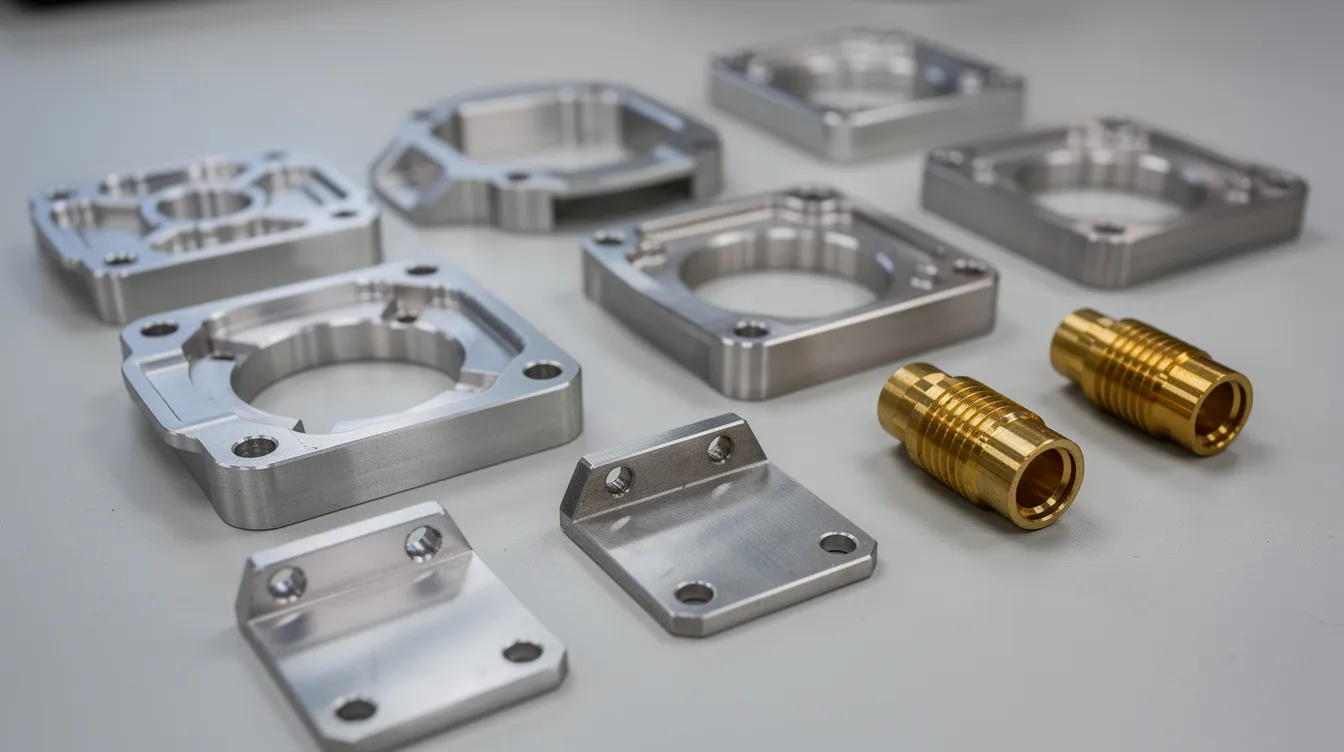
Example parts produced: medical device housings, drone frames, gearbox housings, heatsinks with fine fin geometry, robot end-effectors, sensor brackets, automotive fixturing blocks, and custom molds.
Anebon specializes in tight-tolerance custom OEM parts with traceable materials sourced from certified mills. Full documentation – material certificates, RoHS/REACH compliance where applicable – is available on request.
Factory Digitization and Automation Levels in China
Despite China’s leadership in manufacturing output, only about 6% of factories are fully digitized with integrated ERP–MES–QA data flows. Around 60% of factories in China are barely digitized. Technical hurdles – legacy machinery, fragmented IT systems, workforce training gaps – hinder widespread digitization. However, the environment is shifting: China is investing heavily in digitization pilot projects, with government plans targeting over 85% numerical control rates in key sectors by 2027.
Levels of digital maturity you will encounter:
-
Basic: Offline CNC programming via CAM, paper drawings, manual tooling and inspection tracking.
-
Mid-level: Networked DNC, digital drawing management, partial MES for job tracking, electronic QC reports.
-
Advanced: Full MES/ERP integration, tool wear monitoring, automated probing for in-process measurement, robotic loading/unloading via pallet changers, and live production dashboards.
Automation features in top-tier factories include pallet changers, robotic loading arms, in-line probing for coordinate systems verification, and vision-based surface defect detection. They offer high precision with tight tolerances, minimizing human error across the production line.
Automated design-for-manufacturability (DFM) analysis also aids in CNC machining, helping engineers realize potential cost or manufacturability issues before chips start flying.
What this means for overseas customers: faster quoting, better traceability, real-time order status, and more reliable quality records from digitized shops.
Anebon uses CAD/CAM software, digital drawing management, and electronic inspection reports to support OEM and R&D clients throughout each project.
Quality Control, Certifications, and Compliance
For overseas OEM buyers, QA systems matter more than machine brand or hourly rate. A reliable CNC factory should have independent quality control protocols and strict quality control at every stage.
Certifications to verify:
-
ISO 9001:2015 – indicates a documented quality management system.
-
ISO 14001:2015 – environmental management and safety compliance.
-
IATF 16949 – required for automotive suppliers.
-
ISO 13485 – for medical device components.
-
AS9100 – for aerospace precision components.
Standard QC practices:
-
Incoming material inspection (composition, hardness, dimensions). Material traceability is critical for quality assurance in CNC machining.
-
First Article Inspection (FAI) – FAI reports provide essential documentation for quality control on initial production runs.
-
In-process checks using fixtures, gauges, and probing at critical features.
-
Final inspection for dimensional accuracy, surface finish, and cosmetics. Machining processes often demand inspections for both.
-
PPAP documentation where automotive-like traceability is requested.
Quality tracking throughout the CNC machining process is essential for precision. CMM (Coordinate Measuring Machine) is used for precise quality control in machining, alongside height gauges, pin gauges, thread gauges, and surface roughness testers. Inspection records are typically exported in digital formats (PDF, Excel) for customer satisfaction and audit readiness.
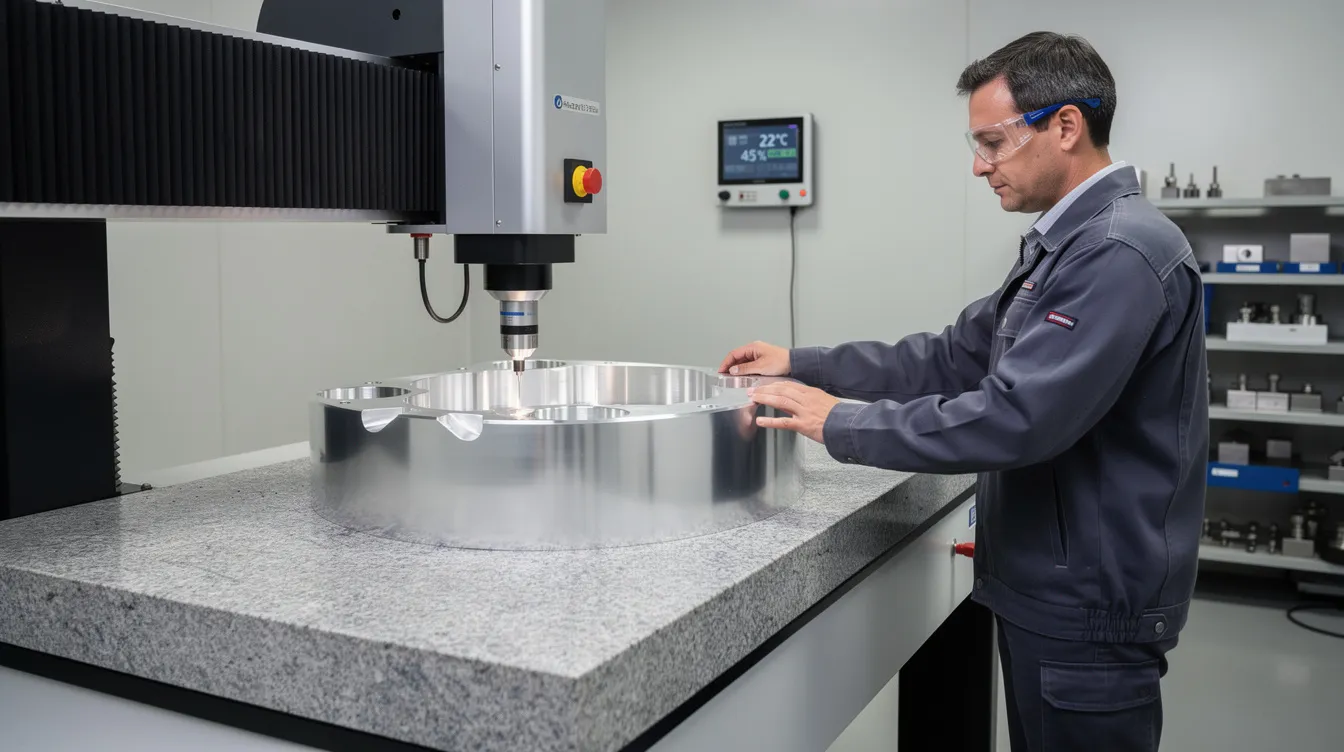
Anebon Metal Products Co., Ltd holds ISO 9001:2015 and ISO 14001:2015 certifications and supports full traceability and documented inspection for export projects.
Cost Structure, Lead Times, and Typical Order Process
Pricing in Chinese CNC factories is driven by material cost, machining time (number of axis passes, complexity), setup time and tooling, surface finish requirements, and inspection complexity. CNC machining services include precision machining and die casting, so bundled projects can shift pricing significantly.
Pricing behavior:
-
Prototype orders (1–10 pcs) carry high per-part cost due to setup amortization.
-
Volume discounts average roughly 37% at mid-tier quantities and up to 54% at high volume.
-
MOQ policies vary: some factories accept single-piece prototyping; others set minimums of 10–50 pcs.
Standard lead times:
|
Stage |
Typical Timeline |
|---|---|
|
Quote turnaround |
24–48 hours (median under 1 hour on platforms) |
|
Prototype parts |
5–10 working days |
|
Pre-series / small batch |
2–3 weeks |
|
Full production |
3–5 weeks |
Lead time adherence is an important factor to evaluate in CNC machining services – ask suppliers for on-time delivery metrics.
Step-by-step order process:
-
RFQ submission – provide 2D/3D files (STEP, IGES), material specs, tolerances, finish, quantity.
-
DFM feedback – the manufacturer reviews for manufacturability. Engaging in Design for Manufacturability (DFM) feedback is crucial for project success.
-
Formal quotation – with breakdown of tooling, machining, finishing, and shipping.
-
Sample approval – small trial orders are advisable before jumping into mass production.
-
Mass production – with inline QA.
-
Final inspection, packing, and international shipping (air or sea).
Anebon focuses on rapid response for overseas OEMs. Send your drawings and requirements to receive a custom CNC machining quote with fast turnaround.
How to Evaluate and Choose a CNC Factory in China
Whether you are in the US or Europe, choosing a reliable CNC supplier requires examining their technical capabilities and QC system before committing budget. Here is a practical checklist:
-
Machine and capacity list: Confirm brands, axis count, age of equipment, and whether they are equipped for your work area and part shape requirements.
-
Industry experience: Have they served sectors similar to yours (aerospace, medical, robotics, cars, electronics)? Ask for reference parts and measurement reports.
-
Tolerance and finish capabilities: Request documented evidence – not just sales claims – of achieving the precision and efficiency your project demands.
-
DFM and design support: Can they proactively suggest cost or manufacturability improvements?
-
Certifications and audit reports: Verify ISO, IATF, or AS9100 through third-party registries or audit firms. Check references from existing overseas customers, including Americans and buyers across Europe.
-
Communication quality: Technical English ability, responsiveness (speed matters), clarity in discussing CAD models, GD&T, coordinate systems, and inspection plans.
-
Subcontracted processes: Ask which operations (anodizing, plating, powder coat) go to external suppliers and whether those partners meet your standards.
-
Export packaging: Confirm parts will be cleaned, protected, and packed to avoid rust or damage in transit – a detail many buyers overlook in the past until it is too late.
Why Overseas OEMs Partner with Anebon Metal Products Co., Ltd
Anebon is a Dongguan-based CNC and fabrication company focused on B2B/OEM projects since 2010. Here is why manufacturers across the world choose to work with us:
-
Full-chain services: Precision CNC machining, die casting, and sheet metal fabrication from prototype to mass production – a true one stop solution.
-
High precision: Tolerances down to ±0.002 mm on select features, 5-axis machining for complex geometries, and production of high-precision precision components in aluminum, stainless steel, titanium, and engineering plastics.
-
Certifications: ISO 9001:2015 and ISO 14001:2015 certified, with full traceability and documented inspection exported to customers worldwide.
-
Value-added services: DFM design consulting, project management, assembly, and multiple surface treatments via vetted local partners (anodizing, powder coating, plating, polishing).
-
Global reach: Parts exported to customers across North America, Europe, Southeast Asia, and beyond, with air and sea shipping support.
To remain competitive, you need machinery, quality, and a partner who understands your requirements. Contact Anebon to create a detailed quotation for your next CNC machining project – send your 2D/3D drawings and let us help you achieve the precision your product demands.