The Essential Guide to CNC Machining: Process and Benefits Explained
CNC Machining: Complete Guide to CNC Machines, Processes, and Industrial Applications
CNC machining is a computer-controlled, subtractive manufacturing process that uses a cnc machine to remove material from a solid block and produce accurate metal or plastic components. In practice, cnc machines follow digital instructions to create cnc machined parts with repeatable dimensions, clean features, and tight tolerances.
This guide explains how cnc machining works, which machine tools are used, how materials affect the machining process, and how buyers can reduce cnc machining cost through better design decisions. It is written for engineers, sourcing teams, and OEM buyers who need high precision parts for real industrial manufacturing.
Anebon Metal Products Limited provides ISO 9001:2015-certified cnc machining services, die casting, sheet metal fabrication, and rapid prototyping for automotive, aerospace, medical devices, communication equipment, petrochemical, and construction machinery customers.
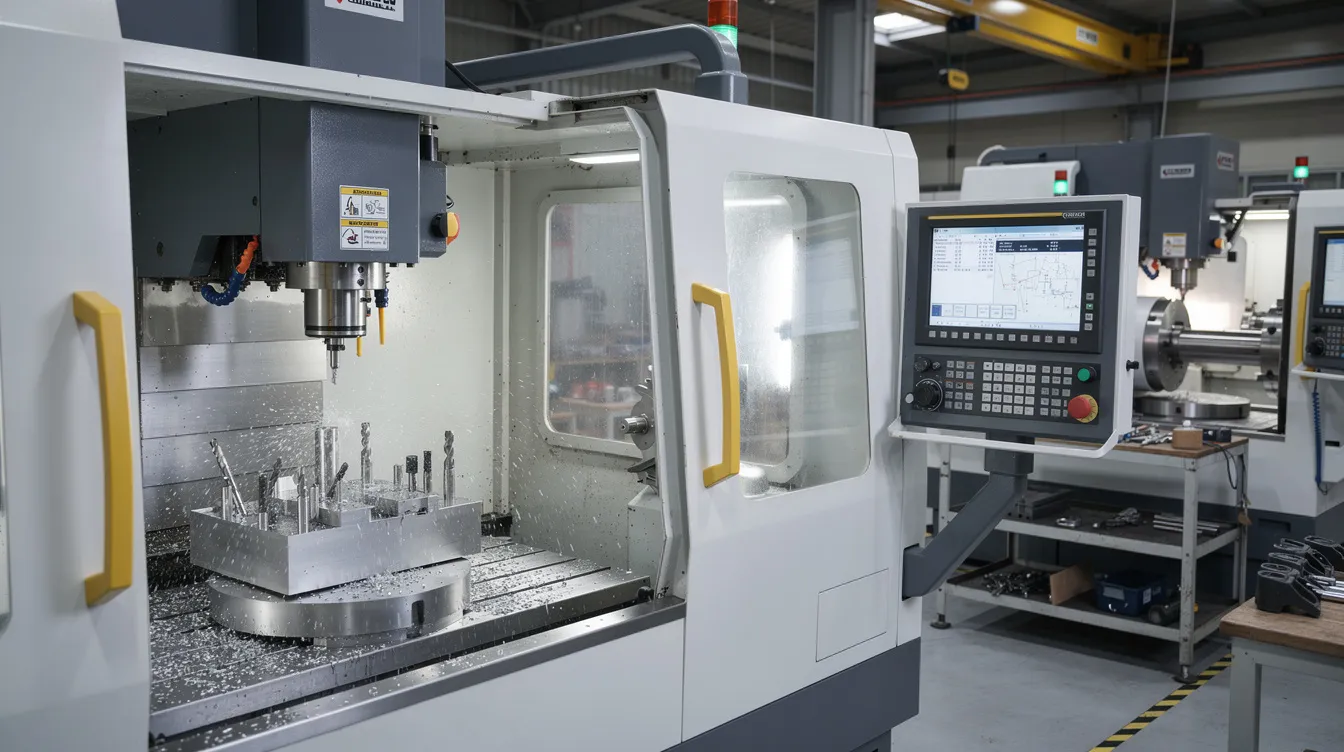
Introduction to CNC Machining
CNC machining works by using computer programs to control tools instead of relying on hand movements for every cut. This reduces human error during production and makes it possible to produce thousands of identical parts consistently.
Unlike manual machining, where manual machining requires constant human attention for each cut, CNC systems can operate continuously without human intervention. CNC machines can operate continuously for 24 hours, and CNC machines operate continuously without fatigue, increasing efficiency.
CNC machining can produce parts in volumes from 1 to 100,000, making it useful for both rapid prototypes and scaled production. It also allows for fast iterative design changes without the need for expensive tooling, which is a major advantage compared with injection molding for early-stage product development.
For precision buyers, the key value is control. CNC machining achieves tolerances of +/-0.005″ to 0.01″, and CNC machining achieves tolerances within +/-0.005 inches for many well-designed features.
What Does CNC Mean in Manufacturing?
CNC means computer numerical control, a method of controlling cnc machinery with numerical instructions generated from digital design data. You may also see the phrase computer numerical control cnc in engineering documents, especially when comparing CNC with older numerical control equipment.
In practical terms, CNC replaces manual levers and handwheels with digital positioning commands, servo motors, drives, and feedback systems. The cnc system tells the machine where to move, how fast to move, when to start the spindle, and when to change tools.
CNC programming uses G-code to control machine movements. G-code specifies the speed and position of CNC tools, while M-code handles auxiliary functions such as coolant, spindle direction, and tool changes.
Modern CNC factories combine computer aided design, computer aided design cad models, cam software, and computer aided manufacturing workflows. A designer creates the part model, CAM converts it into toolpaths, and the cnc manufacturing process turns those toolpaths into finished components.
How Does a CNC Machine Work?
A CNC machine converts CAD geometry into controlled movement along each axis cnc direction. Most CNC mills typically operate on a three-axis system using X, Y, and Z, while 4-axis and 5-axis CNC machines add rotary movement for producing complex shapes.
The controller reads code, coordinates the spindle and axes, and sends commands to servo drives. Encoders provide position feedback so the closed-loop cnc system can correct small deviations and keep the tool aligned with the programmed path.
CAM software creates cutting paths, feed rates, spindle speeds, and tool sequences. After post-processing, CNC machines operate using G-code to control movements on a specific controller such as FANUC, Siemens, or Haas.
Precision depends on the machine, fixturing, tool condition, and inspection plan. CNC machines can achieve tolerances within 0.025 mm, while precision work can reach ±0.01 mm or better. CNC machining can achieve tolerances as tight as ±0.001 inches when the part, machine, and quality control plan justify the extra cost.
For example, an aluminum bracket may begin as a rectangular billet. Rough cnc milling removes most material, finishing passes create accurate surfaces, and inspection confirms dimensions such as hole position, flatness, and profile accuracy; on cnc lathes, similar principles apply when machining eccentric turned parts with precise offset control.
CNC Programming and CAM Software
CNC programming translates CAD designs into machine-readable code. The goal is not only to make the part fit the drawing, but also to control cycle time, tool life, surface finish, and scrap risk.
CAM software builds toolpaths for roughing, finishing, drilling, tapping, boring, and contouring. It also assigns cutting tools, feeds, speeds, stepovers, and safe retract moves, and accurate cutting speed and feed rate calculations directly affect the cnc operation.
A simple G-code example may look like this:
T1 M6
S12000 M3
G0 X0 Y0 Z5
G1 Z-5 F300
G1 X50 Y0
M8
M9
M30
This code includes a tool call, spindle speed, coordinates, feedrate, and coolant commands. Post-processors then adapt the program for different types of cnc machines, including 3-axis mills, 5-axis centers, cnc routers, cnc lathes, and mill-turn machines.
CNC Machining Process: From CAD Model to Finished Part
The cnc machining process includes design, programming, setup, machining, and inspection. In most shops, the CNC process starts with a CAD model for design and ends with a verified part packed for delivery.
The CNC manufacturing process consists of 4 key stages including CAD design and CAM conversion, machine setup, machining, and inspection. In real production, these stages are supported by DFM review, material control, deburring, surface treatment, and documentation.
Design begins when the customer provides 2D technical drawings and 3D CAD files. A process engineer checks tolerances, wall thickness, material, surface finish, and whether the geometry is suitable for the selected cnc machine type.
Programming follows the DFM review. The programmer chooses tools, creates toolpaths, simulates collisions, and prepares setup sheets for the cnc machinist or cnc operator, especially when writing CNC turning programs with G and M codes.
Setup includes material preparation, workholding, offsets, tool loading, and dry-run verification. Strong setup control is essential because CNC machining reduces material waste through optimized tool paths only when the setup is stable.
Machining removes material in planned stages. Roughing creates the main shape, semi-finishing stabilizes the part, and finishing brings critical features to final size.
Inspection confirms that the part meets the drawing. Anebon focuses on process control for on-time delivery and repeatability in medium-to-large batches, especially where cnc manufacturing must support PPAP, material certificates, and inspection reports.
Main Steps in the CNC Manufacturing Process
CAD design is typically handled by the customer’s designer or product engineer. The goal is to define the complete part geometry, material, tolerances, threads, and surface finish requirements.
Material selection is reviewed by the process engineer. CNC machining can use over 50 metal and plastic materials, so the team checks strength, machinability, corrosion resistance, chemical resistance, and cost.
Fixture and tool design are prepared before production. The manufacturing engineer selects vises, soft jaws, clamps, pallets, cutting tools, and gauges to hold the part securely without distortion.
CNC programming defines the machining operations. The programmer uses pre programmed software and cam software to generate toolpaths, then verifies the program before release.
A dry-run or simulation is used to check tool clearance, toolholder collisions, and rapid moves. This step helps protect advanced machines from crashes.
The production run is handled by a cnc operator or cnc machinist. The operator monitors tool wear, chips, coolant, offsets, and any unusual vibration or noise.
In-process inspection uses calipers, micrometers, height gauges, plug gauges, and sometimes CMM checks. Final QC may use a CMM, surface roughness gauges, thread gauges, and visual inspection before packaging.
Main Parts and Axes of a CNC Machine
Common CNC machines combine mechanical structure, motion control, spindle power, tooling, coolant, and software. Each part contributes to accuracy, repeatability, and cutting performance.
The bed and frame provide rigidity. Linear guides or box ways support axis movement, while ball screws or linear motors convert motor rotation into precise linear motion.
The spindle holds and rotates the tool or workpiece. Tool changers store multiple cutters so the machine can move from roughing to drilling to finishing without manual intervention.
Coolant and chip management systems control heat and remove chips from the cutting zone. This is especially important when machining stainless steel, titanium, and deep pockets.
Axis notation describes movement. X, Y, and Z are linear axes; A, B, and C are rotary axes. More axes allow 5-axis CNC machines to create complex shapes with high precision and fewer setups.
Spindle, Controller, and Motion System Functions
The spindle determines available speed, torque, and tool interface. BT40, BT30, HSK, and similar interfaces are selected based on machine size, rigidity, and required metal cutting performance.
The CNC controller acts as the machine’s brain. It coordinates tool changes, spindle commands, feed motion, coolant, probing, and safety interlocks during every cnc operation.
Servo motors, drives, and encoders form the motion system. When properly tuned, they improve surface finish, dimensional accuracy, and tool life.
Maintenance matters. Loose ball screws, worn bearings, poor lubrication, or incorrect thermal compensation can cause chatter, taper, poor finish, and rejected machine parts.
Types of CNC Machines
The main types of cnc machines include milling machines, cnc lathes, mill-turn centers, cnc routers, cnc grinding machines, cnc edm machines, laser cutting machines, plasma cutters, and 5-axis machining centers. The right choice depends on material, geometry, tolerance, surface finish, and batch size.
CNC milling machines use rotating cutting tools to create slots, pockets, holes, profiles, and flat surfaces. CNC mills create precise cavities, slots, and contours in materials, making them common for housings, brackets, molds, and fixtures.
CNC lathes rotate the workpiece while a fixed or driven tool cuts the shape. CNC lathes usually consist of two axes: X and Z, and cnc lathes consist of a spindle, chuck, turret, toolholders, and tailstock or sub-spindle depending on configuration.
Mill-turn centers combine turning and milling in one setup. This reduces handling and improves concentricity on shafts, valve bodies, and hydraulic components.
CNC routers are often gantry-style machines used for aluminum plate, plastics, composites, and wood. They are useful for large panels but are usually less rigid than heavy machining centers.
CNC grinding machines remove small amounts of material with abrasive wheels. They are used when diameter, flatness, or surface roughness requirements are beyond standard milling or turning.
CNC EDM machines use electrical discharge machining to cut hard conductive materials. Wire edm is especially useful for dies, punches, small slots, and intricate profiles.
CNC laser cutting machines provide clean cuts using focused laser beams. CNC plasma cutters use a high-temperature plasma arc for cutting thicker conductive plates where speed matters more than ultra-tight tolerances.
CNC Milling Machines (3-Axis, 4-Axis, 5-Axis)
CNC milling removes material with rotating tools. CNC milling typically uses a 3-axis system for material removal, which is suitable for brackets, housings, covers, plates, and many mold components.
A 3-axis mill cuts from the top and sides that are accessible in one setup. Indexed 3+2 machining rotates the part to a fixed angle, while full 5-axis cnc milling moves rotary axes simultaneously with linear axes.
Anebon’s 5-axis capability supports aerospace, medical, and complex automotive parts. A turbine-related housing, impeller, or orthopedic trial component is often better suited to 5-axis machining because fewer setups reduce accumulated error.
CNC Lathes and Turn-Mill Centers
CNC turning is used for shafts, bushings, pins, fittings, rollers, and valve bodies. Typically a lathe is the best choice when the main geometry is round and concentric.
Most cnc lathes are designed for efficient rough turning, finish turning, grooving, threading, boring, and parting-off. Live-tooling machines add milling, drilling, and cross-hole operations.
Turn-mill production is valuable for high-volume automotive and hydraulic parts. One setup reduces loading time and improves tight tolerances between turned and milled features.
CNC Routers and Gantry Machines
CNC routers are common for sheet, plate, plastic, composite, and aluminum panel work. They are widely used for enclosures, signage, covers, and lightweight structural panels.
Large-format gantry machines provide long travel and fast cutting over big work envelopes. Compared with heavier cnc milling centers, routers usually trade rigidity for speed and size.
EDM, Laser Cutting, and Plasma Cutters
EDM is ideal for hard tool steels, molds, dies, sharp internal corners, and features that are difficult to reach with rotating cutters. Wire edm can hold extremely fine profiles when the material is conductive.
Laser cutting is a high speed sheet cutting method with narrow kerf and low distortion. CNC laser cutting is often used to prepare blanks before bending, welding, or secondary machining.
Plasma cutting is cost-effective for mild steel and thicker plate. CNC plasma cutters and plasma cutters are less precise than laser systems but efficient for structural profiles.
CNC water jet cutters use high-pressure water to cut materials. They are useful when heat-affected zones must be avoided.
Types of CNC Machining Processes
CNC machining operations include milling, turning, drilling, boring, tapping, reaming, grinding, EDM, laser cutting, and plasma cutting. Each process is chosen according to the feature being made, the tolerance, and the surface finish requirement.
Milling creates flat faces, profiles, pockets, and 3D surfaces. Turning creates round diameters and threads. Drilling creates holes, while boring and reaming improve hole accuracy. Grinding improves size and finish after heat treatment. Cutting processes prepare profiles or blanks for later machining.
Milling, Turning, and Drilling Operations
Face milling creates flat reference surfaces on blocks, plates, and housings. Peripheral milling and contouring cut outside profiles, while pocketing removes material from cavities.
CNC mills typically operate on a three-axis system, but 5-axis milling can maintain better tool angle on curved surfaces. This is useful for producing complex shapes such as medical implants and aerospace blades.
Turning operations include rough turning, finish turning, grooving, threading, and parting-off. On cnc lathes, round parts can be held in a chuck or collet for high repeatability.
Drilling cycles control depth, position, retract height, and chip evacuation. Peck drilling is useful for deep holes, while reaming may follow drilling when hole size is critical.
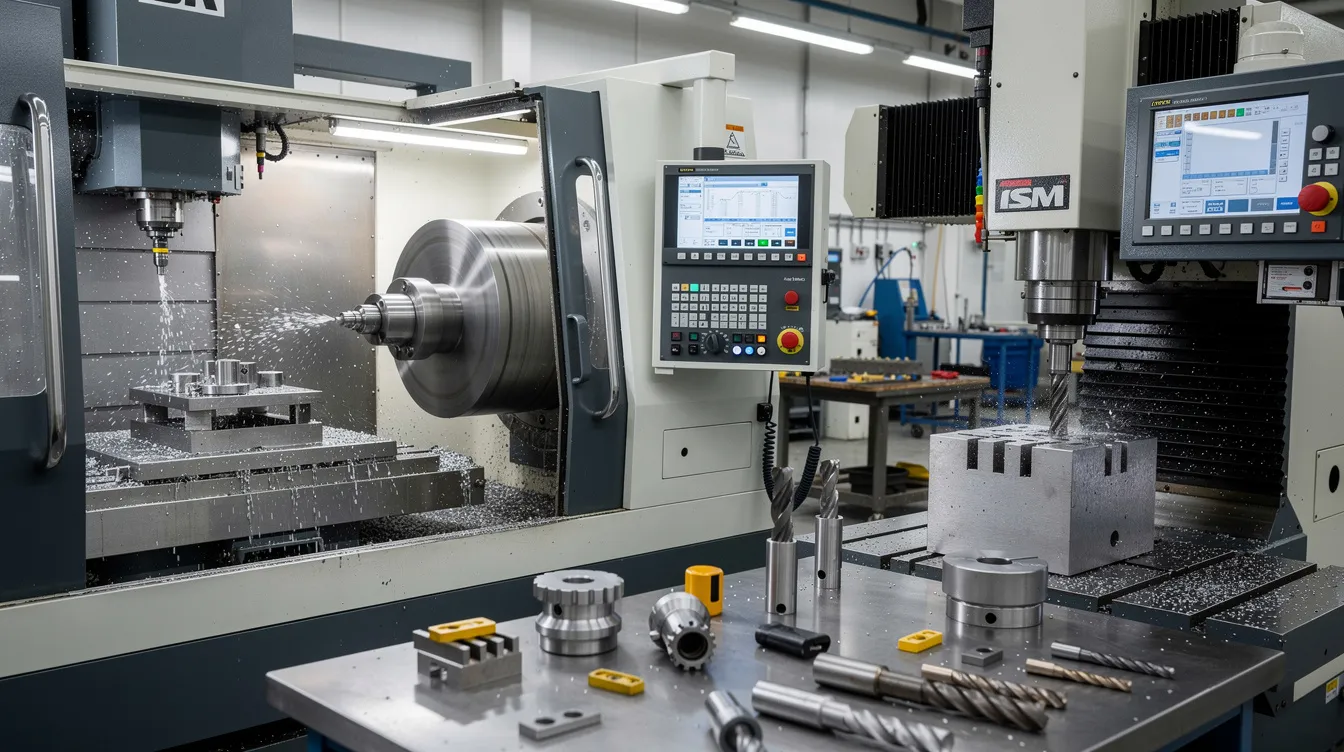
Advanced and Finishing Processes: Boring, Grinding, EDM, and Cutting
Precision boring is used for bearing seats, valve bores, and engine housings. It can hold accurate diameter, roundness, and alignment when the setup is rigid.
Grinding is used after milling, turning, or heat treatment. Surface and cylindrical grinding can achieve fine finishes such as Ra 0.4 μm and exact diameters.
EDM supports intricate tool cavities, inserts, and sharp corners. Laser cutting and plasma cutting often prepare blanks before cnc machining finishing operations add holes, threads, and precision faces.
CNC Materials: Metals and Plastics
CNC machining materials include aluminum, steel, stainless steel, brass, copper, titanium, and engineering plastics. CNC machining can use over 50 metal and plastic materials depending on strength, weight, wear, temperature, and regulatory needs.
Anebon regularly machines metal materials and plastics for automotive, aerospace, medical, electronics, and industrial equipment. The best material is the one that meets performance requirements without adding unnecessary machining time.
Common Metals for CNC Machining
Aluminum is commonly used in CNC machining for its machinability. Alloys such as 6061-T6, 6082, and 7075-T6 offer low weight, good mechanical properties, and strong cost-performance for housings, brackets, and heat sinks.
Stainless steel is available in five types for CNC machining, including austenitic, ferritic, martensitic, duplex, and precipitation-hardening families. Grades such as 304, 316, and 17-4PH offer corrosion resistant performance and excellent corrosion resistance in harsh environments.
Carbon and alloy steels such as 1018, 1045, medium carbon steel, and 4140 are used for gears, shafts, fixtures, and high-load components. Mild steel is economical and weldable, while alloy steels offer higher strength after heat treatment.
Brass and copper are used for electrical connectors, fittings, RF parts, and thermal components. Soft metals machine quickly but may require sharp tools and careful chip control.
Titanium, including Ti-6Al-4V, is used where high strength-to-weight ratio and biocompatibility are essential. CNC machining can process titanium for aerospace applications and medical implants, but tool wear and heat control must be managed carefully.
Engineering Plastics and Composites
Plastics like Nylon and ABS are frequently machined using CNC. Other common choices include POM/Acetal, polycarbonate, PEEK, and PTFE.
Engineering plastics offer low weight, electrical insulation, chemical resistance, and reduced noise. PEEK is used for high-performance medical and aerospace parts, nylon for gears and wear pads, and polycarbonate for clear covers.
Plastic machining requires sharp tools, controlled clamping, and chip evacuation. Heat buildup can deform parts, especially on thin walls or tight tolerance features.
Design for CNC Machining: Key Considerations
Good DFM reduces cost, lead time, and scrap. CNC machining is essential for producing complex geometries, but every unnecessary deep pocket, sharp internal corner, or over-specified tolerance can increase cycle time.
-
Wall thickness should be strong enough to resist vibration and clamping distortion. Thin walls may require extra setups, light cuts, and special fixtures.
-
Internal radii should match realistic cutter sizes. Sharp internal corners usually require EDM or very small tools, which increases machining time.
-
Threads should use standard sizes where possible. Standard taps, thread mills, and gauges make the manufacturing process faster and easier to inspect.
-
Tolerances should be assigned only where function requires them. CNC machining allows for complex geometries that manual methods cannot achieve, but tight tolerances should be reserved for sealing faces, bearing seats, and assembly interfaces.
-
Setup planning matters. A 5-axis strategy may reduce setups for complex geometry, while a simpler 3-axis approach may be more economical for flat, prismatic parts.
Tolerances, Surface Finish, and Cost Trade-Offs
Standard CNC tolerances are often around ±0.05 mm, while precision features may be held to ±0.01–0.02 mm. For reference, tolerance guides often list standard and precision ranges by process and material.
CNC machining can produce parts with tolerances of +/-0.005 inches, and CNC machining achieves tolerances within +/-0.005 inches in many production conditions. With specialized equipment and inspection, CNC machining can achieve tolerances as tight as ±0.001 inches.
Surface finishes include as-machined, bead blasting, anodizing, black oxide, electroplating, painting, passivation, and polishing. As-machined surfaces may be suitable for internal parts, while visible or corrosion-critical components may require finishing.
Tighter tolerances, finer finishes, and extra inspection increase cnc machining cost, so selecting the appropriate surface roughness grade for CNC machined parts is an important balance between performance and price. Buyers can reduce cost by separating critical dimensions from non-critical dimensions on technical drawings.
Anebon supports custom tolerance and surface treatment plans under ISO-based quality systems. This is especially important for automotive, aerospace, and medical customers that require documented quality control.
Applications and Industries Using CNC Machining
CNC machining offers repeatability, traceability, and accuracy for industries where failure is expensive. CNC machining is crucial for industries requiring intricate components like aerospace and medical manufacturing.
Automotive companies use CNC for engine, transmission, chassis, and fixture components. Aerospace buyers use it for lightweight structural parts and complex airframe hardware. Medical manufacturers use it for surgical tools, implants, and diagnostic housings. CNC machining also produces components for the defense industry.
Automotive, Aerospace, and Medical Sectors
CNC machining produces precise engine blocks for the automotive industry, along with transmission parts, brackets, housings, and custom gauges. Automotive projects may require PPAP, batch inspection, and material traceability.
CNC machining creates turbine blades for the aerospace industry. Aerospace work often uses aluminum, titanium, and stainless alloys, with 5-axis machining for curved surfaces and strict inspection reports.
CNC machining manufactures custom medical devices and implants. Medical projects may require biocompatible materials such as titanium, 316L stainless steel, or PEEK, plus validated cleaning and documentation.
Electronics, Communication, Energy, and Industrial Equipment
Electronics and communication parts include heat sinks, RF housings, connector shells, shielding covers, and precision enclosures. CNC machining is used for high-speed drilling of circuit boards as well as metal housings.
Energy and petrochemical parts include valve bodies, pump housings, flanges, high-pressure fittings, and corrosion-resistant components. Stainless steel and alloy steels are common where pressure and corrosion resistance matter.
Construction and industrial equipment projects include bushings, gears, spacers, shafts, mounting plates, and replacement machine parts. CNC machining supports both spare parts and new product introductions.
Anebon Metal Products Limited: CNC Capabilities and Services
Anebon Metal Products Limited provides precision CNC machining and aluminum machining services for metal parts, including CNC milling, cnc turning, 5-axis machining, drilling, tapping, boring, and finishing support. We also support die casting, sheet metal fabrication, and rapid prototyping.
Since 2010, Anebon has served export projects for Europe, North America, and Asia-Pacific customers. Our milestones include ISO 9001:2015 quality management, expanded 5-axis capability, and broader support for medium-to-large production batches.
Our project flow is straightforward. Customers send drawings and 3D files, our engineers review DFM, we quote, produce samples, support validation, and then move into series production.
Anebon is built for B2B buyers who need reliable delivery, not just one good sample. Our team focuses on cnc technology, stable cnc manufacturing, controlled documentation, and practical cost-down suggestions.
If your machining project needs advanced manufacturing support, we can help compare cnc machining with die casting, sheet metal, or rapid prototyping alternatives. The best route depends on geometry, volume, material, tooling budget, and delivery schedule.
Quality Control, Lead Times, and Supply Chain Support
Anebon’s quality control includes incoming material inspection, in-process checks, and final inspection against drawings. We use calipers, micrometers, gauges, CMM inspection, and surface roughness measurement where required.
Prototype lead times are often 5–10 working days depending on geometry, material, finish, and workload. Production batches are planned around capacity, material availability, surface treatment, and logistics requirements, so understanding the CNC machine cost per hour is important for realistic scheduling and pricing.
We can coordinate finishing, simple sub-assemblies, packaging, and international shipment support. For urgent automotive or aerospace projects, early engineering communication helps shorten the cnc manufacturing process and reduce avoidable rework.
Anebon also supports cnc certification requirements, inspection reports, and material certificates when project documentation is required. Engage our engineering team early so the cnc process can be optimized before production starts.
Conclusion
CNC machining combines modern CNC machines, cnc programming, CAM software, cutting tools, and disciplined inspection to produce accurate, repeatable parts across demanding industries. It is an automated manufacturing process and subtractive manufacturing process that supports prototypes, bridge production, and full-scale manufacturing.
Anebon Metal Products Limited is ready to support your next cnc machining projects, from rapid prototypes to high-volume metal parts with tight tolerances and certified quality. Send your drawings, 3D models, and requirements for a DFM review and quotation.