The Ductility of Iron: Understanding Its Importance in Metalworking
Ductility of Iron: How Ductile Iron Transforms Modern Iron Castings
Quick Overview: What “Ductility of Iron” Really Means
Ductility in iron refers to its capacity to undergo significant permanent deformation under tensile stress before fracturing. Unlike a brittle material that snaps without warning, ductile materials typically give warning before failure by bending or stretching. This property significantly influences how iron behaves under load, and it is the single most important factor separating safe, long-lasting castings from components that fail catastrophically.
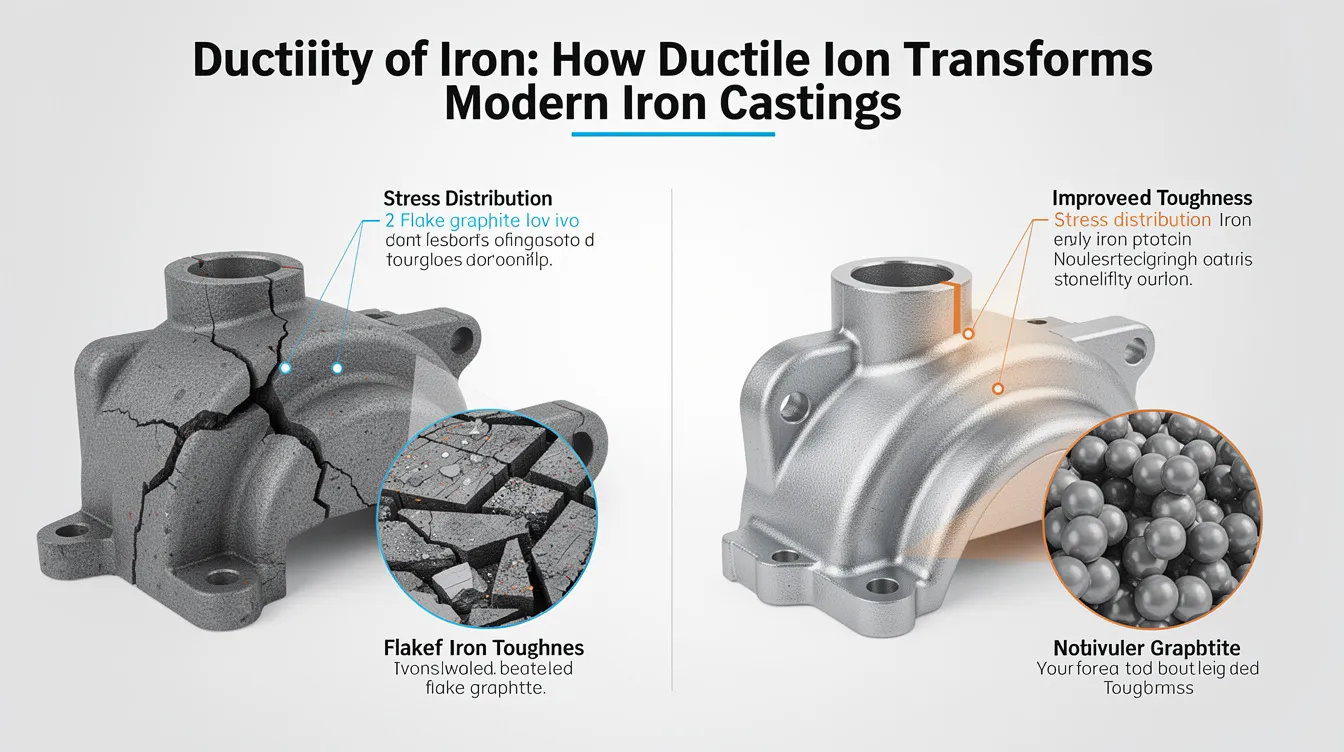
But not all iron is created equal. Pure iron is soft and very ductile yet too weak for most engineering uses. Gray cast iron, with its flake graphite microstructure, offers virtually no elongation under tension and fails in a brittle manner. Ductile iron-also called nodular iron, nodular cast iron, or spheroidal graphite cast iron-contains spherical graphite nodules instead of flakes, and that difference transforms performance. Ductile iron was invented in 1943 by Keith Millis at the International Nickel Company, and its spheroidal graphite structure dramatically improves ductility compared with traditional cast iron.
To put numbers on it: common ductile iron grades deliver elongation values between roughly 3% and 18%, while standard gray iron approaches 0%. This article connects the concept of ductility of iron to real-world uses such as automotive components, pressure pipes, and high-fatigue CNC-machined parts. Ductile iron is suitable for pipes, automotive parts, and machinery components-and understanding why starts with understanding what happens at the microstructural level.
Fundamentals: Iron, Cast Iron, and Ductility
Pure iron is highly ductile but structurally weak and rarely used on its own in engineering. It can be stretched and bent extensively, yet its low tensile and yield strength make it impractical for load-bearing parts without alloying or heat treatment.
Cast iron is broadly defined as a ferrous alloy containing approximately 2.0–4.0% carbon along with silicon and other elements. That high carbon content forms graphite during solidification, and the shape of that graphite is what determines whether the resulting casting is brittle or ductile. Increasing carbon content generally increases strength and hardness while reducing ductility in iron, but the form in which that carbon contained in the alloy appears matters even more than the amount.
In gray iron, the carbon precipitates as flake graphite-flat, elongated discontinuities that act like internal cracks. Under tensile stress, these graphite flakes concentrate stress at their sharp tips and initiate fractures with little plastic deformation. In ductile iron, the carbon (over 3 percent) precipitates as nodular graphite inclusions-rounded particles that blunt stress concentrations. Carbon steel, by contrast, keeps most of its carbon dissolved in the metal matrix or bound as iron carbide, avoiding free graphite altogether. Comparing iron vs carbon steel vs cast iron on ductility alone: gray iron elongation is near 0%, ductile iron ranges from about 3–18%, and medium carbon steel typically achieves 10–18%.
Microstructure Behind Ductility: From Gray Iron to Ductile Iron
Microstructure is what controls macroscopic ductility in every ferrous alloy. Two castings can have nearly identical chemical composition yet behave completely differently under load depending on how their graphite particles and metallic matrix are arranged.
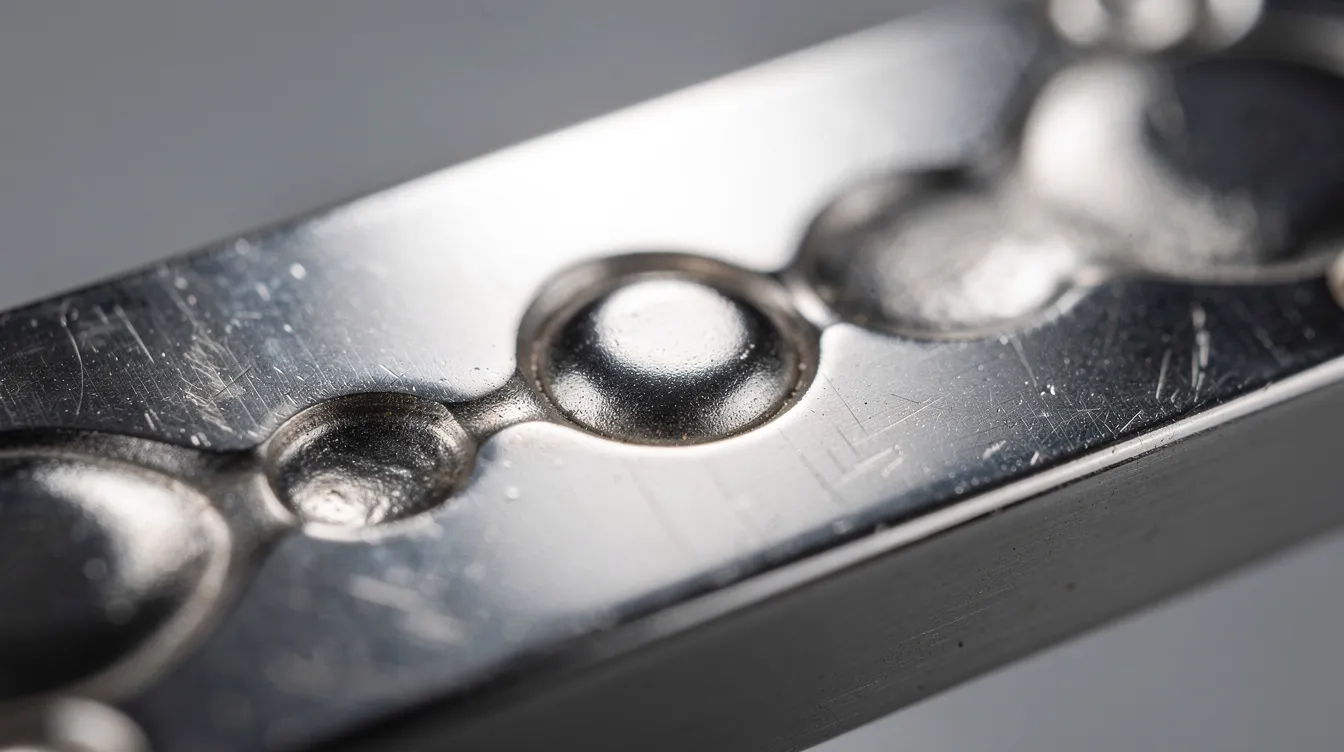
Gray iron microstructure consists of a pearlitic or mixed pearlite-ferrite matrix structure interspersed with graphite flakes. Those flakes act as internal crack initiators. Under tension, cracks propagate along the flake tips, resulting in low tensile strength and virtually no elongation. The contrasting physical properties caused by graphite shape become obvious when you examine the core difference between gray cast iron and ductile cast iron: ductile iron occurs when magnesium or cerium is added to molten iron just before pouring, transforming the graphite from flakes into spheroids. This spheroidal graphite iron can bend without fracturing, unlike gray iron, because the nodules allow the surrounding matrix to deform plastically.
The desired matrix within ductile iron further tunes the strength-ductility tradeoff. A fully ferritic matrix maximizes ductility and impact resistance. A pearlitic matrix raises strength and wear resistance but lowers elongation. Mixed ferritic-pearlitic structures offer a compromise. Finer grain size typically improves the ductility of iron regardless of matrix type.
Austempered ductile iron (ADI), introduced commercially around the 1970s, uses heat treatment to produce an ausferrite microstructure-acicular ferrite plus retained austenite. ADI can approach or exceed many alloy steels in tensile strength while maintaining good ductility and excellent fatigue resistance. Heat treatments like annealing can also enhance the ductility of iron in standard grades, making ductile iron a modern iteration of engineered cast iron.
Measurable Ductile Iron Properties (vs. Gray Iron and Carbon Steel)
Engineers assess ductility and toughness through quantitative mechanical properties: tensile and yield strength, percentage elongation, impact energy, and fatigue resistance. Ductility is commonly measured using percentage elongation or reduction in cross-sectional area during a tensile test, and these numbers drive material selection for every safety-critical part.
Ductile iron grades are designated under ASTM A536 using a format of “tensile–yield–elongation.” Grade 60-40-18 delivers ultimate tensile strength of approximately 60,000 psi (414 MPa), yield strength around 40,000 psi (276 MPa), and elongation of about 18%. Grade 65-45-12 reaches tensile strength near 65,000 psi (448 MPa), and ductile iron can achieve a yield strength of 45,000 psi (310 MPa), with elongation of about 12%. Ductile iron exhibits elongation of at least 12% in 50 mm at this grade. Grade 80-55-06 pushes tensile strength to roughly 80,000 psi (552 MPa) with yield strength near 55,000 psi (379 MPa) and elongation around 6%. Ductile iron has a tensile strength of at least 60,000 psi across all standard grades, and a key property of ductile iron is its ability to stretch under tension before failure-something gray iron simply cannot do.
By comparison, gray iron’s tensile strength ranges from 20,000 to 60,000 psi (138–414 MPa) with elongation approaching 0–2% and much lower impact and fatigue resistance. Ductile iron exhibits excellent fatigue resistance under repeated loads, making it far more reliable under cyclic service.
When comparing properties of ductile iron to common carbon steel such as AISI 1045 (tensile strength roughly 570–700 MPa, elongation 10–18%), the overlap is significant. Different grades of ductile iron can approach steel-like strengths while retaining casting advantages such as complex shapes, superior castability, and lower cost. Graphite nodules also support vibration damping, act as dry lubricant reducing friction, and improve machinability by breaking chips cleanly-all of which indirectly benefit fatigue resistance and service life.
Ductile Iron Casting Process and How It Controls Ductility
Ductility in ductile iron production is engineered through deliberate process control rather than left to chance. Every step from melting through solidification affects whether the final casting will contain well-formed spheroidal graphite or degraded, ductility-robbing graphite forms.
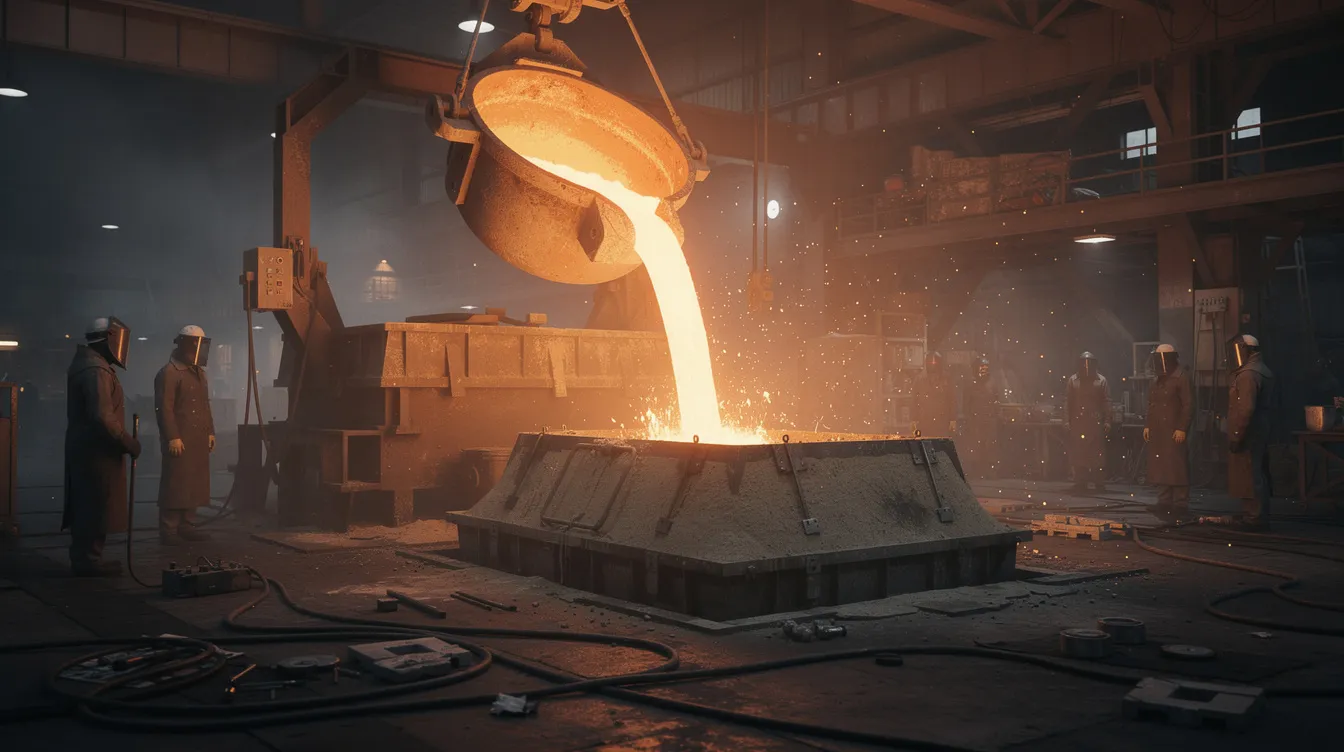
The base melt for ductile iron is produced primarily from pig iron, steel scrap, and foundry returns, melted in induction or cupola furnaces to a controlled chemistry. The molten iron-which reaches a melting point of 1149 degrees Celsius-must have carbon in the range of 3.0–3.8%, silicon around 2.0–2.8%, and carefully minimized sulfur and phosphorus. Understanding what is the casting process at a fundamental level helps engineers appreciate how much chemistry and timing matter.
Just before pouring, a nodulizing treatment introduces magnesium (or magnesium-ferrosilicon alloy, sometimes with cerium) into the melt. Magnesium modifies graphite formation, promoting spheroidal graphite instead of flake graphite. Immediately after, inoculation with ferrosilicon seeds the melt with nucleation sites, refining graphite nodule count and distribution. The sequence-furnace melt, treatment ladle with Mg addition, inoculation, pouring into sand or permanent molds, controlled solidification-must be carefully timed because magnesium is volatile and oxidizes rapidly.
Standard foundry methods including sand casting, shell molding, investment casting, and permanent mold can all produce ductile iron castings, provided nodularity and matrix control are maintained. Continuous casting produces ductile iron bar stock with fine, uniform microstructure ideal for precision CNC machining. Ductile iron can be cast and machined easily, which is one reason it has become the preferred material for many OEM applications.
Benefits of Ductile Iron Ductility in Engineering Applications
Higher ductility translates directly into engineering safety and performance. Ductile iron absorbs energy and resists cracking under impact, and it can sustain substantial plastic deformation before breaking. This means ductile iron allows for structural safety by yielding under stress instead of failing abruptly. Ductility reduces the risk of sudden fracture in iron-based materials, and ductility increases toughness in iron-based materials-two advantages that gray iron cannot match.
Fatigue resistance in nodular graphite structures supports long service lives for crankshafts, connecting rods, gears, and suspension components under millions of loading cycles. Temperature increases generally improve the ductility of iron, which is beneficial for components operating in elevated-temperature environments. The balance of ductility, strength, and machinability makes ductile cast iron a cost-effective alternative to forged carbon steel in many OEM designs, especially where precision machining in the automotive industry demands tight tolerances on cast parts.
Ductile iron provides better vibration damping than steel, good wear resistance from graphite’s lubricating effect, and the ability to be surface hardened-for example, induction hardened to 60 HRC-while keeping a ductile core. These unique advantages reduce weight, part count, and life-cycle cost in heavy machinery and automotive assemblies by enabling complex near-net-shape castings that replace multi-piece weldments or forgings.
Iron vs. Ductile Iron vs. Gray Iron: Choosing the Right Iron Casting
The practical question for engineers is not “iron vs” some generic metal but rather which specific iron alloy-gray iron, ductile iron, or steel-fits the application. The key differences come down to load type, failure mode, and cost.
Gray cast iron remains the preferred choice where positive compressive load capabilities matter most and tensile ductility is secondary. Its excellent vibration damping, good machinability, and lower cost make it ideal for machine frames, brake rotors, and engine blocks. Gray iron also offers good heat transfer properties for thermal applications. However, its poor wear resistance under tensile or shock loading and virtually zero elongation disqualify it from dynamic service.
Ductile iron is the better choice for shock loading applications-parts subjected to bending, pressure, or cyclic loads. Ductile iron can withstand bending without fracturing, making it the preferred material for pump housings, hydraulic components, gears, hubs, and structural brackets. Ductile iron is ideal for manufacturing gears due to its strength, and it is used in pump housings for its durability. Malleable iron, an older solution offering moderate impact resistance through heat treatment, has been mostly displaced by ductile iron for new designs.
When comparing iron and ductile iron to steel, designers upgrade to forged or rolled steel when ultimate strength, weldability, or extreme temperature performance justifies the higher cost. But ductile iron can often replace medium carbon steel to save material and machining cost, especially when selecting materials for cast geometries that would be expensive to forge.
Typical Use Cases Where Ductility of Iron Is Critical
Ductility determines whether a part bends safely under overload or fails suddenly. Modern ductile iron is deliberately selected as the best material for high-risk and safety-critical components across multiple industries.
In water and wastewater infrastructure, ductile iron pipes handle high-pressure water flow effectively while tolerating ground movement, installation impact, and corrosion resistance demands that would crack a brittle material. These iron castings serve reliably for decades in buried service.
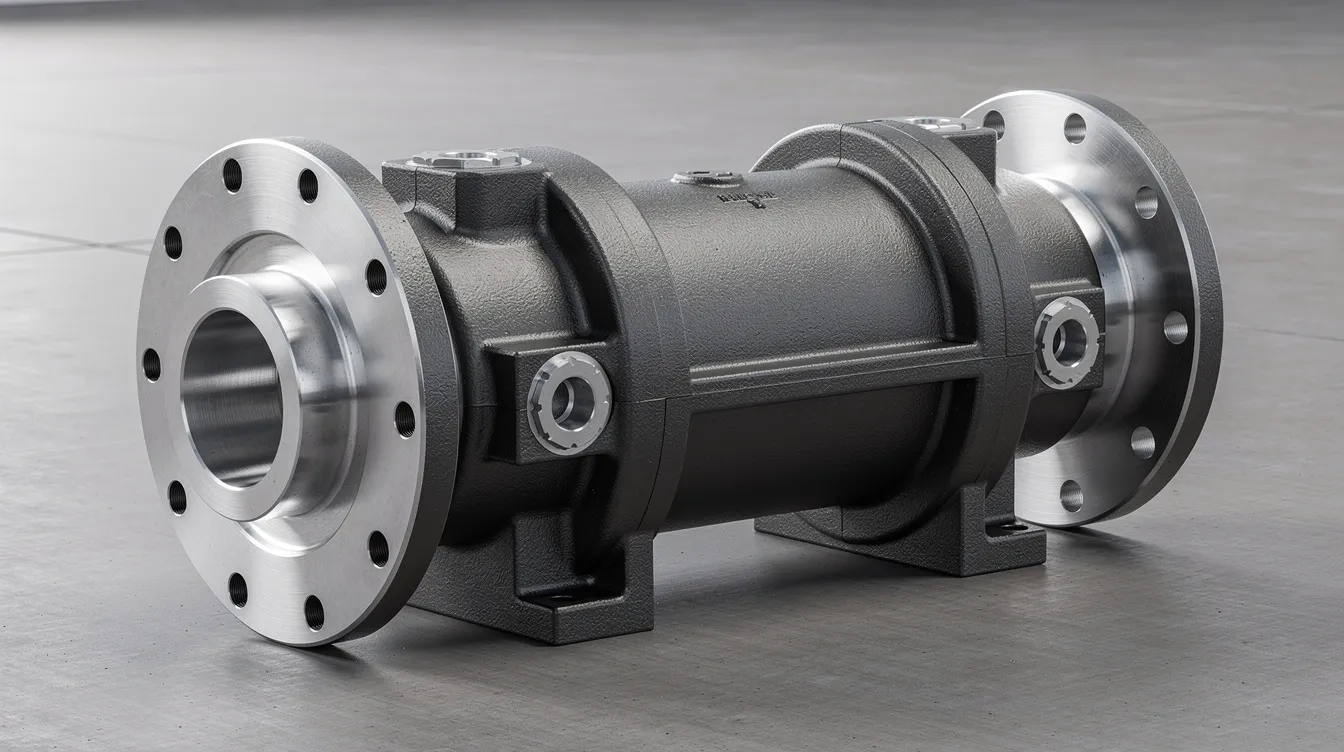
Automotive components represent another major category. Ductile iron is used in automotive components like engine blocks, crankshafts, steering knuckles, control arms, and differential housings. These parts rely on ductility, fatigue resistance, and moderate impact resistance under dynamic loads. Many of these parts benefit from CNC machining of auto parts after casting.
Heavy industrial applications include gearboxes, compressor housings, industrial rollers, and crane components where shock, misalignment, and vibration are common. Ductile iron is also utilized in machine frames for wind power applications, where the combination of strength, vibration damping, and ductility improves reliability across millions of load cycles in the energy sector.
Designing with Ductile Iron: From Material Selection to Machining
For design engineers and OEMs, leveraging the ductility of iron in new parts starts with clear performance requirements: expected tensile loads, allowable deformation, required fatigue life, and environmental exposure including temperature, corrosion, and vibration.
Different grades let you prioritize ductility or strength. Ferritic grades (more carbon in ferrite form, higher elongation) suit impact-critical parts, while pearlitic grades offer excellent wear resistance and higher hardness for wear surfaces. The physical properties you need drive the grade selection. Design best practices include maintaining generous radii at corners, avoiding sharp notches and sudden wall-thickness transitions, and ensuring uniform sections to prevent shrinkage defects and stress concentrations.
Machining implications are equally important. Continuously cast ductile iron bars and high-quality castings machine well on CNC turning and CNC milling centers, with graphite nodules acting as chip breakers that reduce tool wear compared with other forms of carbon steel. Ductile iron supports tight tolerances when paired with precision machining-for example, Anebon’s ±0.002 mm capability-making it suitable for high-precision OEM components that demand both strength and dimensional accuracy after casting.
Anebon’s Capabilities in Ductile Iron and Precision Machining
Anebon Metal Products Limited is an ISO 9001:2015 and ISO 14001:2015 certified manufacturer based in Dongguan, China, serving overseas OEMs since 2010. We support projects that rely on the ductility of iron-especially ductile iron castings and gray iron components requiring secondary CNC machining, drilling, tapping, or finishing.
Our core services for ductile iron parts include CNC milling and CNC turning of castings and continuously cast bar, 5-axis machining for complex geometries, and rapid prototyping to validate iron vs. ductile iron vs. carbon steel design choices before committing to production. We work across a wide material range-ductile iron, gray iron, carbon steel, aluminum, stainless steel, titanium, and engineering plastics-enabling direct comparison and redesign for better ductility or weight savings.
Our DFM feedback helps customers optimize wall thickness, fillets, draft angles, and machining allowances in ductile cast iron components to preserve ductility while reducing cost. Quality assurance processes including dimensional inspection, material certification, and surface finish checks are particularly important for fatigue-critical parts. If you’re evaluating whether ductile iron is the right fit for your next project, request a quote and let our engineering team help you make the call.
Conclusion: Using Ductility of Iron to Build Safer, Longer-Lasting Parts
The evolution from gray cast iron to ductile iron has fundamentally changed what engineers can expect from iron castings. What was once a brittle, compression-only material now delivers meaningful ductility, fatigue resistance, and toughness-all in a casting-friendly, cost-effective package.
Smart selection between gray iron, ductile iron, and carbon steel lets OEMs balance performance, cost, and manufacturability across industrial applications. Leveraging ductile iron properties-especially ductility and fatigue resistance-reduces failures, maintenance costs, and safety risks in demanding environments from automotive drivetrains to water infrastructure.
Whether you need to confirm that ductile iron is the best material for a new design or want to convert an existing steel forging into a more economical casting, Anebon can provide end-to-end support from prototype to full-scale production.