The Best Sheet Steel Roller: Your Guide to Efficient Metal Forming
Sheet Steel Roller: A Practical Guide for OEM Engineers
A sheet steel roller is used to bend flat sheet metal into curves and cylinders, and it remains one of the most essential machines in precision metal fabrication. This guide covers how these machines work, which configurations fit specific OEM requirements, and how to integrate rolling into a complete CNC fabrication workflow.
Introduction to Sheet Steel Rollers
In metal fabrication, a sheet steel roller – also called a plate rolling machine – progressively deforms flat steel, aluminum, or stainless steel stock between powered cylindrical rolls. Sheet metal rollers can produce cylinders, cones, and curved panels for everything from motor housings to structural rings. Sheet metal fabrication includes processes like cutting and bending, but rolling is what transforms a flat plate into a seamless curved shell. Rolling sheet metal shapes cylindrical ductwork, piping, and ventilation system components across dozens of industries.
In everyday english the word “sheet” as a noun refers to paper or any thin flat material. In engineering, “sheet steel” means flat metal stock with a defined thickness, width, and standardized mechanical properties. That distinction matters when specifying parts for a fabricator.
Anebon Metal Products Limited, founded in 2010 in Dongguan, uses CNC-controlled rolling as part of its ISO 9001:2015 sheet metal fabrication workflow for overseas OEM clients. Here is why that should matter to you:
-
Sheet steel rollers are vital for custom fabrication and have key industrial uses spanning medical devices, robotics, and energy equipment.
-
Common materials for sheet metal fabrication are aluminum and stainless steel, but carbon steel, galvanized plate, and alloy grades are equally common.
-
Sheet metal fabrication is essential in industries like aerospace and automotive, where curved enclosures and housings must meet strict tolerances.
-
Machine selection directly impacts achievable diameter, surface quality, and cost per part – choices a product team should make early in design.
How a Sheet Steel Roller Works
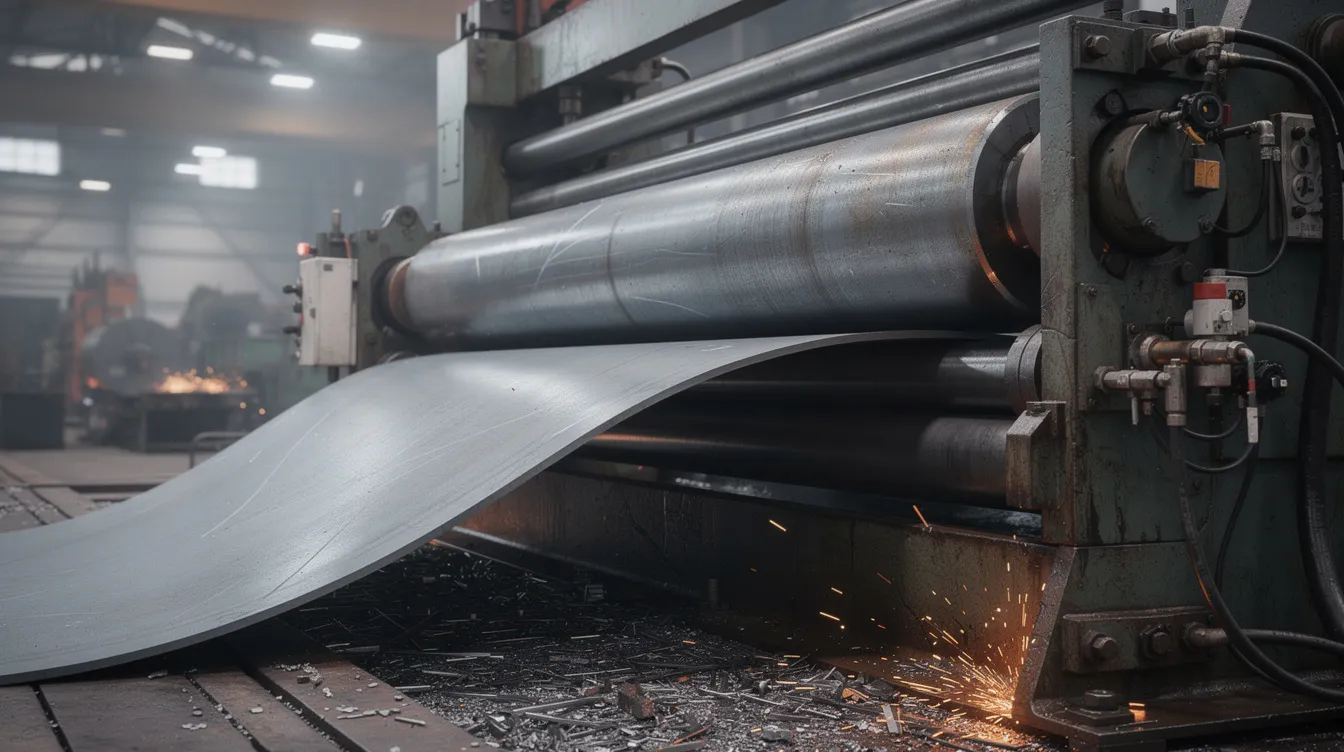
A sheet steel roller bends metal by passing it between powered cylindrical rolls under controlled hydraulic or mechanical pressure. The flat metal sheet is fed between a set of pinch rollers, which grip and advance the work while side rolls apply lateral force to create curvature. Adjusting the rollers unevenly allows the machine to shape metal into conical forms as well as simple cylinders.
Core components include:
-
Upper pinch roll – grips and feeds the sheet.
-
Lower support rolls – provide the reaction surface; may be fixed or adjustable.
-
Side rolls – control curvature radius; in 4-roll machines these enable single-pass bending.
-
Hydraulic cylinders and CNC controller – position rolls with closed-loop feedback for repeatable set points.
-
Safety guards and feed tables – protect operators and support heavy plate at entry and exit.
The forming principle relies on progressive plastic deformation: outer fibers stretch, inner fibers compress, and a neutral axis sits in between. After unloading, elastic springback partially opens the curve, so fabricators apply over-bending – typically 2–3° for annealed 304 stainless at 2 mm thickness – to hit the target diameter.
Powered rollers are necessary for thick steel or high-volume production, while manual rollers are suitable for light-gauge metals and hobbyist budgets. Hot rolling makes steel highly malleable for complex shapes, whereas cold work at room temperature preserves tighter tolerances. Sheet steel rollers provide high precision and repeatability in forming, especially when CNC hydraulic drives replace manual adjustment. Anebon relies primarily on CNC-controlled hydraulic machines for that reason.
Types of Sheet Steel Rollers and Their Capabilities
Machine configuration – number of rolls, geometry, drive type – determines minimum diameter, plate thickness capacity, and throughput. Sheet steel rollers typically feature three or four parallel adjustable rollers. Sheet metal rollers are offered in two categories: single and double-pinch, each suited to different production scenarios.
-
2-roll machines – Two-roll machines are ideal for thin, highly repetitive cylindrical rolling (0.5–3.0 mm stainless or mild steel). Best for high-volume identical parts like motor housings and decorative aluminum panels.
-
3-roll initial-pinch – Three-roll machines are often the popular choice for general metal fabrication. They cover light to medium plate (roughly 2–10 mm), prototyping, and forming sheet metal into machine guards or enclosure panels.
-
3-roll double-pinch – Symmetric grip reduces manual pre-bending; useful for small batch OEM cylinder production up to roughly 12–16 mm thickness.
-
4-roll CNC – Four-roll machines offer the highest level of control and automation. Single-pass rolling, precise edge pre-bending, and the ability to roll cones make them the go-to for tight-tolerance shells. Learn more about how to make a sheet metal cone.
Typical industrial ranges span working lengths from 1 m to 3 m and thickness from 0.5 mm up to around 20 mm, depending on the specific machine model and material grade.
Key Parameters When Rolling Sheet Steel
Correct parameter selection prevents defects like flat spots, wrinkles, and out-of-round cylinders that can occur when settings miss the mark.
-
Yield strength – Mild carbon steel (ASTM A36) yields at roughly 250–350 MPa. Harder materials like stainless steel have higher yield strengths than mild steel – annealed 304 starts around 205 MPa but work-hardens aggressively toward 515–620 MPa tensile. Material thickness and yield strength affect a roller’s rated capacity directly.
-
Thickness and width – For OEM machine guards, 2–6 mm carbon steel is typical; stainless enclosures often run 1–3 mm. Wider and thicker stock demands greater roll stiffness to avoid deflection along the length. Understanding how sheet metal is measured helps ensure the right stock is ordered.
-
Cold vs. hot rolled stock – Cold rolling increases the steel’s strength by up to 20%, which raises springback and required bending force compared to hot-rolled plate of the same grade.
-
Minimum rolling diameter – Governed by top roll diameter, material properties, and number of passes. A common guideline is that the minimum inside diameter should be at least five times the top roll diameter.
-
Tolerances – On typical small shells under 1 m diameter, roundness within ±0.5 mm is achievable. Precision tolerances in sheet metal fabrication can be as tight as ±0.002 mm when rolled parts proceed to CNC machining for critical mating features.
-
Springback compensation – Specify your target inside diameter, material grade, and temper. Consult the fabricator for material-specific over-bend angles before finalizing drawings.
Integrating Sheet Steel Rolling with CNC Machining and Fabrication
Rolling is usually one step in a larger CNC machining and sheet metal fabrication process for OEM assemblies.
-
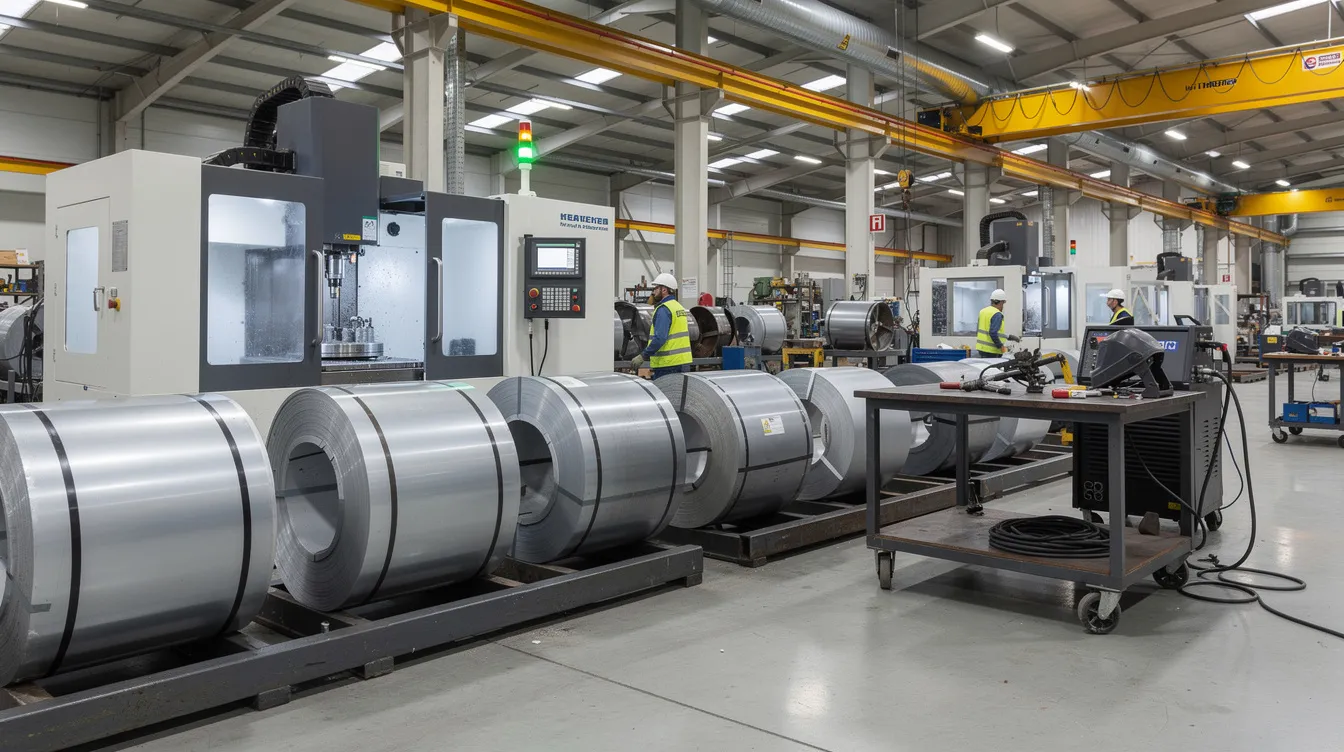
Typical process chain at Anebon: flat laser cutting or stamping → rolling on a sheet steel roller → welding or flanging → CNC milling or CNC turning of mating features → surface treatment (powder coat, anodizing, polishing) → inspection → packaging for export.
-
Datum alignment: rolled parts are registered to machined components using locating pins, jigs, and fixtures so that tolerances as precise as ±0.002 mm on machined segments are maintained relative to the cylinder axis.
-
Compatible materials: aluminum is a common material in sheet metal production (6061/6082 for lightweight housings). Stainless steel is widely used for its corrosion resistance (304/316 for medical or food-grade enclosures). Titanium is valued for its strength-to-weight ratio in aerospace applications. Copper is used in electrical applications due to its conductivity. Sheet metal can be galvanized for enhanced durability in outdoor or corrosive environments. Where complex geometry exceeds what rolling can achieve, die casting or 5-axis machining may complement rolled parts in a single project.
-
DFM feedback: Anebon reviews drawings before quoting, advising on bend sequences, seam locations, and weld allowances so changes happen early – before they become expensive.
Digital Workflow: Managing Sheet Steel Roller Projects with Data and Spreadsheets
Precise data tracking is essential for rolling projects, covering everything from material heat number to bend settings and inspection results. Without it, teams risk losing traceability on day one of production – and losing traceability means losing the ability to diagnose defects quickly.
-
Anebon uses spreadsheets – including the google sheets app and excel files – to log setup parameters, revisions, dimensional checks, and serial dates for every batch. Files are automatically saved, so colleagues across time zones never worry about losing work entered during a session.
-
Additional google sheets features like real-time collaboration, version history, and controlled access let users in Europe or the US view charts, edit files, and share spreadsheets on the same spreadsheet with the factory in Dongguan anytime – whether on a computer running windows or a mobile app. Google workspace subscribers also benefit from enterprise grade security, and google ai can surface insights fast from historical parameter logs. Teams can insert formulas for springback calculations, receive notifications when collaborators make changes, convert excel spreadsheets to new spreadsheets in google sheets, and even open them with offline access when connectivity is unreliable – say, on a day when rain sheeted against the building during monsoon season. These performance improvements and other business critical tools within google workspace create the best possible experience for distributed product teams building custom solutions.
-
Linguistic note: In production documentation the sheet noun appears everywhere – data sheet, routing sheet, inspection sheet – all distinct from “sheet steel” as a material. Both uses cover critical information for quality and traceability. A developer or engineer should realize these are not synonyms but context-dependent terms in english.
-
OEM clients can share structured RFQ sheets, BOMs, and tolerance tables in google sheets to accelerate quoting and reduce ambiguity. A well-formatted specification in spreadsheet format – with material grade, thickness, target diameter, quantity, and number of units – lets Anebon’s teams quickly collaborate on feedback, chat through open questions, and set a quote within the agreed timeline.
Quality Assurance, Standards, and Choosing a Sheet Steel Rolling Partner
When sourcing rolled sheet steel components globally, QA and certifications are non-negotiable. A single out-of-spec shell can stall an assembly line on another continent, and paper certifications alone do not prevent that – rigorous in-process checks do.
-
Incoming material verification: supplier certificates, heat numbers, chemical composition checks, thickness and size confirmation against the order.
-
In-process checks: roll setup validation, intermittent diameter and roundness measurement, surface inspection for scratches – critical on brushed or polished stainless.
-
Final inspection: CMM measurement of diameter, roundness, and wall thickness on assemblies that also involve CNC machining; surface roughness verification where specified.
-
Certifications: Anebon holds ISO 9001:2015 and ISO 14001:2015, applied across sheet metal forming, CNC machining, and die casting projects since 2010.
When choosing the right machining vendor, OEMs should evaluate:
-
Machine range – can the supplier handle your required thickness, width, and minimum diameter?
-
Industry experience – medical, automotive, and robotics each demand different finishes and documentation.
-
Communication – prompt, clear responses in the buyer’s language reduce errors on every project.
-
Lead times – prototypes may need longer setup; production runs benefit from optimized roll programs and button-press repeatability.
Prepare a dimensioned drawing and a simple specification sheet – share it via Google Sheets or PDF – and request a quote from Anebon Metal Products Limited. Whether you need one prototype or thousands of production cylinders, the right sheet steel roller partner turns flat plate into precision-curved components on schedule.