The Best High Precision Die Casting Suppliers in the China 2026
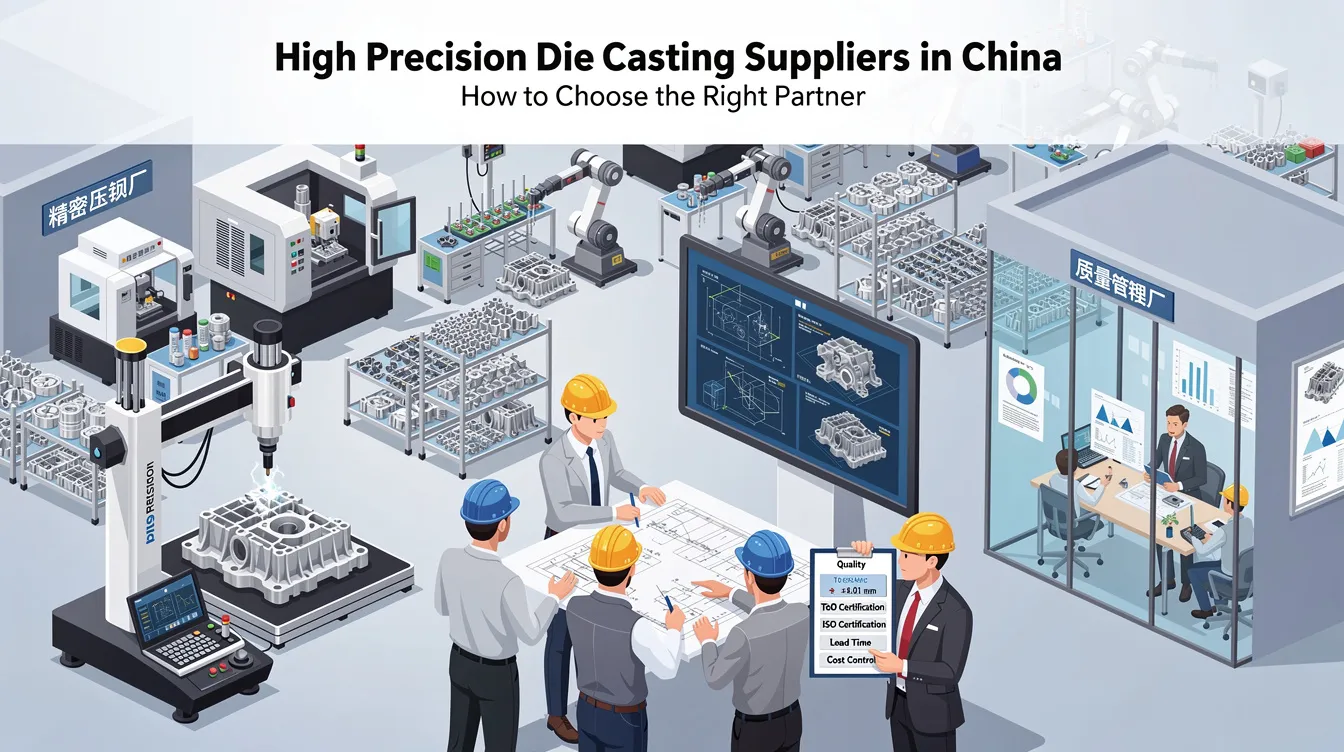
High Precision Die Casting Suppliers in China: How to Choose the Right Partner
Finding a reliable high precision die casting supplier in China can feel overwhelming when there are thousands of factories to sift through. This guide gives you a structured framework to evaluate suppliers, understand their capabilities, and make a confident sourcing decision-whether you’re developing a new product or switching from an existing vendor.
Quick Answer: How to Find a High-Precision Die Casting Supplier in China
High precision die casting requires tight dimensional tolerances often within ±0.01 to ±0.02 mm on critical features at the foundry level, with even tighter results achievable after CNC post-machining. In 2026, China remains the world’s largest die casting hub, with an aluminum die casting industry valued at roughly USD 4.8 billion and more than 3,000 enterprises operating across the country.
The best suppliers combine high pressure die casting, advanced casting equipment, and in-house cnc precision machining under one quality system. Several reputable manufacturers specialize in high-precision die casting in China, but not all can deliver repeatable accuracy at volume.
Anebon Metal Products Limited, a die casting manufacturer founded in 2010 in Dongguan, Guangdong, is positioned as a one-stop, ISO-certified partner for overseas OEMs needing precision casting through full-scale mass production.
Top 5 criteria to check immediately:
-
Achievable tolerances (as-cast and post-machined)
-
Certifications (ISO 9001, IATF 16949, ISO 14001)
-
Casting process range (HPDC, low-pressure, gravity)
-
Materials and surface treatment capability
-
Export experience and English-language engineering support
The rest of this article gives you a step-by-step framework to shortlist trusted die casting factories and compare them objectively.
Overview of High-Precision Die Casting in China
China’s die casting industry in 2026 is concentrated in five major hubs: Guangdong (Dongguan, Shenzhen), Zhejiang (Ningbo, Beilun), Jiangsu, Chongqing, and Shandong. Each cluster has its strengths-Ningbo dominates automotive structural parts, while Guangdong leads in small-to-medium precision components for electronics and telecom.
In quantitative terms, common foundry tolerances for as-cast aluminum parts fall in the ±0.05–0.13 mm range. When you add post-cast cnc machining, critical features can reach ±0.01 mm or better. That combination of near-net-shape casting plus selective machining is what defines “high precision” in this context.
Aluminum die casting dominates because it is lightweight and withstands high temperatures, offers excellent thermal and electrical conductivity, and is highly recyclable. That said, zinc alloys and magnesium die casting alloy materials are widely used for intricate or ultra-lightweight components. Aluminum die casting is the most common die casting process globally, and China leads production by a wide margin.
Many leading co ltd in China have been operating since the early 2000s, with modern lines added after 2015 to serve EV, 5G infrastructure, and aerospace parts demand.
Key Capabilities to Look for in a High-Precision Die Casting Manufacturer
Not every die casting factory can hold tight tolerances or produce complex geometries reliably. The gap between an average shop and a precision-focused casting manufacturer is significant.
Essential capabilities to verify:
-
High pressure die casting with casting machines ranging from ~160T to 3,000T+ clamping force, supporting multi-cavity dies, thin-wall casting, and complex cores/slides
-
Multi-slide die casting, which allows for complex part designs that would otherwise require assembly
-
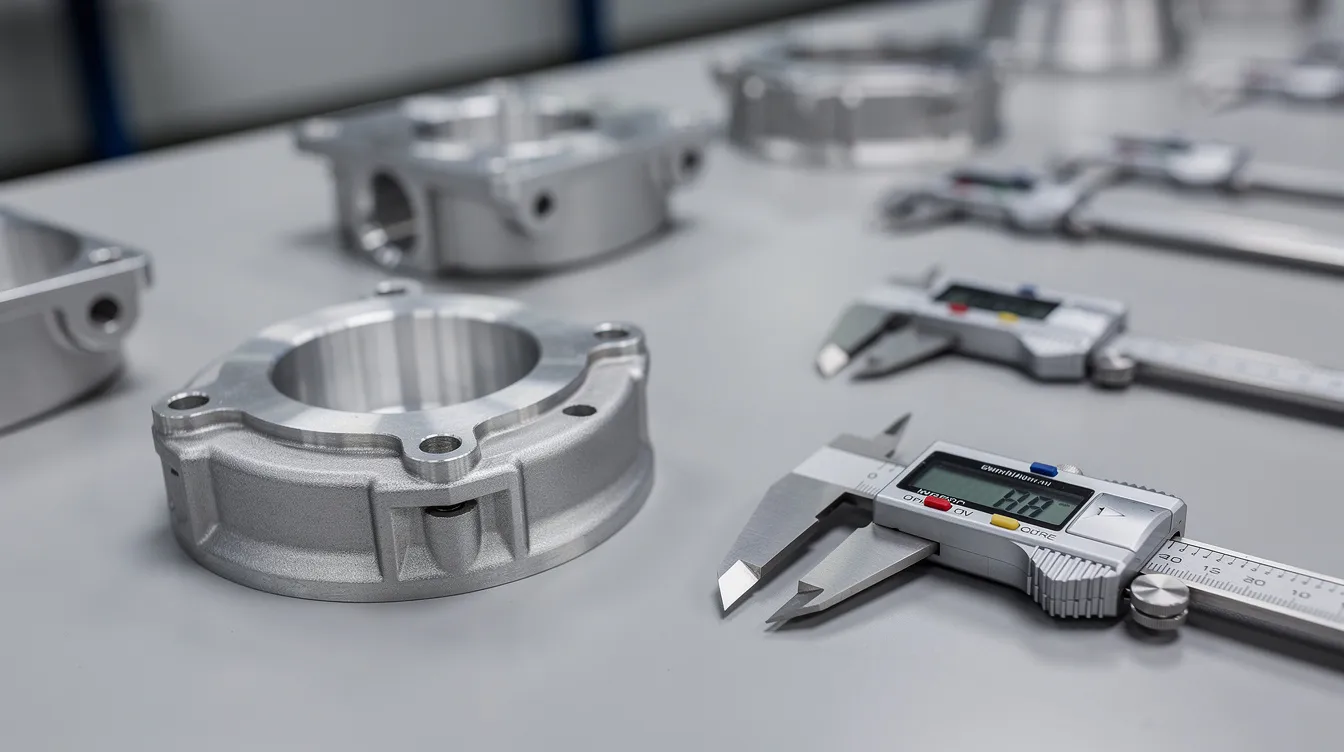
In-house cnc machining (3-, 4-, and 5-axis) for features needing ±0.005–0.01 mm, such as medical housings, robotic joints, and precision aluminum die casting components
-
Coordinate Measuring Machines (CMM), which are essential for verifying complex 3D geometric dimensions
-
Spectrometer and X-ray/CT inspection for porosity detection
-
Documented process control: SPC, PPAP, and APQP for automotive clients
Modern die casting suppliers utilize high-pressure die casting machines and CNC machining centers as core infrastructure. Robust post-cast CNC machining centers are necessary to maintain precise tolerances in die casting. Key factors for choosing suppliers include engineering capability and quality control systems.
A supplier worth your time should handle the full lifecycle: DFM design support, rapid prototyping, pilot runs, and ramp-up to mass production. Anebon, for example, combines all of these capabilities under one roof in Dongguan.
Understanding the Die Casting Process for Precision Parts
If you’re evaluating whether a die casting supplier truly controls its die casting process, understanding the production stages helps you ask the right questions.
Main stages:
-
Mold design and tooling manufacture – parting line, gating, cooling channels
-
Die casting – hot chamber die casting or cold chamber die casting depending on alloy
-
Trimming and deburring – removing flash, runners, overflows
-
Heat treatment – stress relief or T6 temper where needed
-
CNC machining – precision features, datum surfaces, threaded holes
-
Surface treatment – anodizing, powder coating, plating, etc.
Gating, runner design, and cooling channel layout directly affect dimensional stability and porosity. Suppliers should provide mold flow analysis to eliminate defects during the design phase, before cutting steel.
Hot chamber die casting uses a hydraulic piston for injection and is suited to zinc alloys and magnesium. Cold chamber die casting requires separate heating of metal and is the standard for aluminum alloys. For example, a zinc die casting connector housing runs on a hot chamber machine, while an aluminum motor housing requires cold chamber die casting.
Automated rotary degassers are used to remove hydrogen gas and prevent micro-porosity in die casting-a critical step many lower-tier shops skip.
Anebon provides DFM feedback at the design stage to optimize the casting process, often reducing secondary machining cost and tool iterations.
High-Pressure Die Casting vs. Other Casting Processes
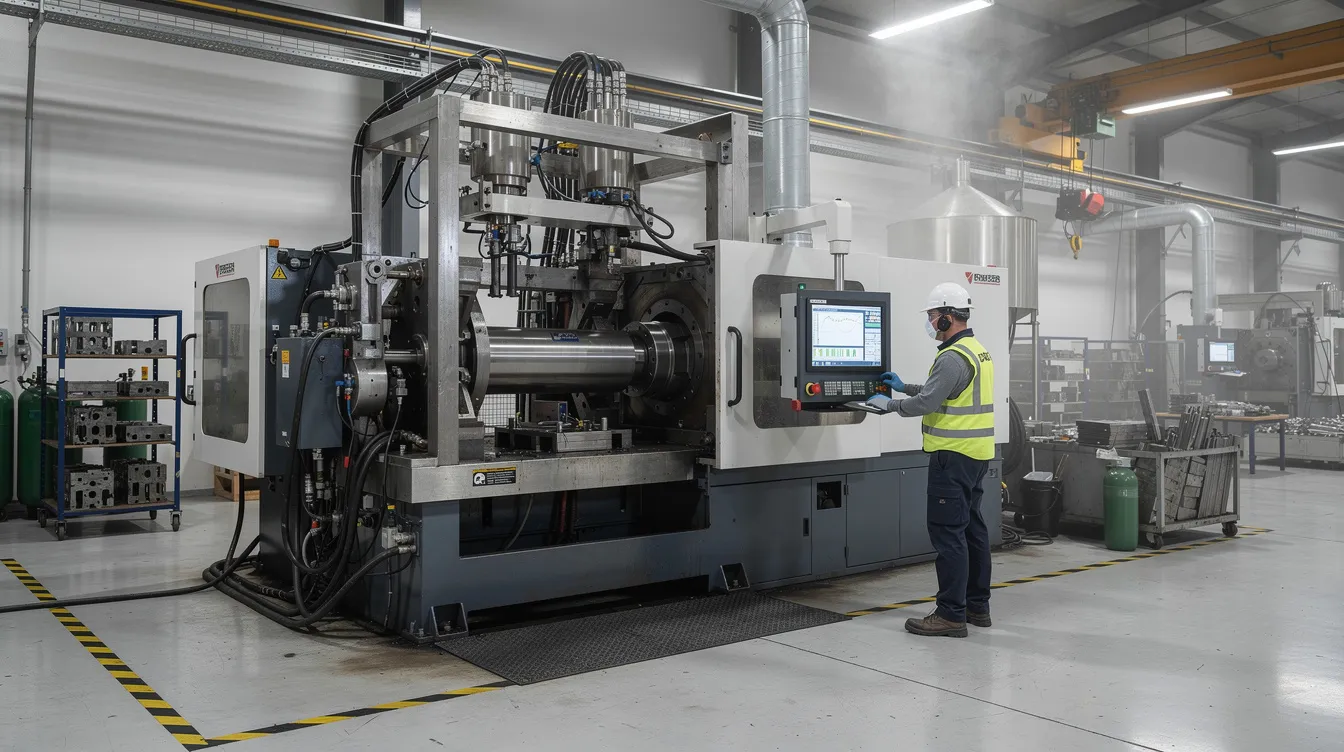
High pressure die casting is the go-to metal casting process for precision, speed, and repeatability. It forces molten metal into a die casting mold at pressures of 1,000–1,500+ bar, producing parts with thin walls (down to ~1 mm for aluminum), excellent dimensional accuracy, and smooth surfaces. High-pressure casting produces excellent dimensional accuracy that competing processes struggle to match.
By contrast, gravity casting fills molds under gravity alone, yielding thicker walls and lower volumes but with less porosity risk for structural parts. Sand casting offers design flexibility for very large or low-volume components but at much coarser tolerances. Permanent mold casting and investment casting (sometimes called lost wax casting or wax casting) sit between these extremes, each with trade-offs.
|
Process |
Typical Tolerance |
Surface Finish (Ra) |
Tooling Cost |
Best-Fit Volume |
|---|---|---|---|---|
|
High pressure die casting |
±0.05–0.13 mm |
Ra 1.6–3.2 μm |
High |
5,000–1,000,000+ |
|
Gravity casting |
±0.3–0.5 mm |
Ra 6.3–12.5 μm |
Medium |
500–20,000 |
|
Sand casting |
±0.5–2.0 mm |
Ra 12.5–25 μm |
Low |
1–5,000 |
|
Permanent mold casting |
±0.2–0.4 mm |
Ra 3.2–6.3 μm |
Medium |
1,000–50,000 |
|
Investment casting (precision casting) |
±0.1–0.2 mm |
Ra 1.6–3.2 μm |
Medium-High |
100–10,000 |
Aluminum die casting allows for complex shapes with smooth surfaces and is ideal for high-volume production. High-precision suppliers often combine high pressure die casting with selected alternative processes and post-CNC to meet both cost and performance targets.
Tooling and Mold Engineering: Foundation of Precision
Die design quality is the single biggest driver of repeatable precision and cycle time. A poorly designed die casting mold will produce inconsistent parts no matter how good the machine is.
Critical mold engineering topics:
-
Parting line selection to minimize flash on functional surfaces
-
Draft angles (typically 1–3° depending on alloy and wall thickness)
-
Uniform wall thickness to prevent warpage and shrinkage porosity
-
Advanced cooling channel design for balanced solidification
Top Chinese suppliers use 3D flow simulation, multi-slide die design, and high-hardness tool steels with precise heat treatment to extend die life. Mold design at this level is engineering, not guesswork.
Anebon’s engineering team provides early-stage mold DFM reviews, sometimes reducing tool iterations and sample loops by weeks. Well-maintained tooling reduces burrs, flash, and dimensional drift over tens of thousands of shots-a point worth verifying during any factory audit.
Materials and Aluminum Alloys for High-Precision Die Casting
Alloy selection directly affects mechanical properties, machinability, and achievable tolerances. Choosing the wrong raw material can compromise an otherwise well-designed part.
Key aluminum die casting alloys used in China:
-
A380 – the most commonly used alloy for die casting; good fluidity, pressure tightness, and machinability
-
A383 – better fluidity than A380 for thin-wall and complex geometry parts
-
ADC12 – widely used in Asia, similar properties to A383
-
A360 – higher corrosion resistance and pressure tightness, slightly harder to cast
Aluminum die casting parts are lightweight yet strong, offer high thermal and electrical conductivity, and provide excellent corrosion resistance.
When should you choose primary versus secondary (recycled) aluminum? Primary aluminum minimizes impurity risk and porosity, which matters for safety-critical automotive or aerospace parts. Secondary aluminum reduces cost and environmental impact but requires stronger quality control for alloy purity and degassing.
A capable die casting manufacturer can also handle zinc and magnesium alloy materials. Zinc die casting is versatile for intricate components, and zinc alloys are used for producing dimensionally accurate parts. Magnesium die casting is ideal for weight reduction applications in automotive and electronics.
Anebon helps customers select alloys based on application-whether it’s an automotive EV inverter housing, a medical enclosure, or a telecom base-station component.
Surface Treatment and Finishing Options
Surface treatment is critical for corrosion resistance, wear protection, and appearance in aluminum die casting parts. Without proper surface finishing, even a dimensionally perfect part can fail in its service environment.
Common treatments offered by advanced Chinese suppliers:
-
Anodizing (Type II and Type III hard anodize)
-
Powder coating for durable, uniform color finishes
-
Painting (wet spray, e-coat)
-
Passivation and chromate conversion coating
-
Polishing and bead blasting
-
Electroplating (nickel, chrome, zinc)
Part design features like deep ribs, embossed text, and undercuts can impact achievable surface finish and finishing costs. A comprehensive approach to surface treatment should be considered during DFM, not after tooling is cut.
Example finishing stacks by industry:
-
Medical housings: black anodized, Ra ≤ 1.6 μm
-
Automotive brackets: powder coating, salt spray 500+ hours
-
Telecom enclosures: chromate conversion + EMI shielding paint
-
Led lighting heat sinks: clear anodized for thermal performance
Anebon provides in-house or closely integrated surface treatment services, reducing lead time and logistics complexity.
CNC Precision Machining After Die Casting
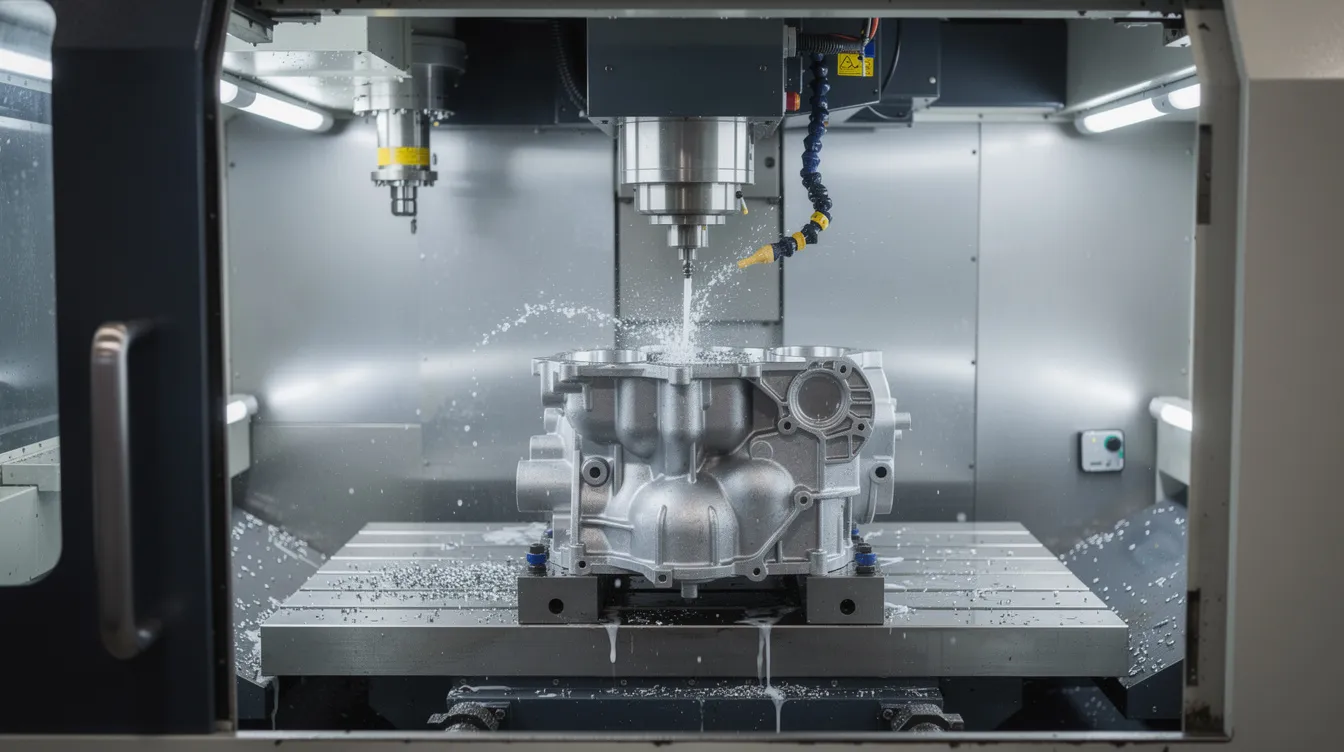
High-precision requirements are often met by combining near-net-shape die casting with targeted CNC machining. The casting gets you 90% of the way; machining handles the last critical percent.
Typical CNC operations on castings:
-
Milling of datum surfaces
-
Drilling and tapping threaded holes
-
Boring bearing seats to ±0.005 mm
-
Machining sealing faces for O-ring grooves
-
Adding precision slots and keyways
Leading suppliers in China operate multi-axis CNC machining centers and turning centers, with fixture design optimized for cast parts. Anebon advertises tolerances as precise as ±0.002 mm for select critical features, with surface roughness targets of Ra 0.4–0.8 μm after machining.
Statistical Process Control (SPC) is crucial for maintaining quality in high-volume production runs. Die casting cnc machining integration under one quality system ensures consistent traceability and shorter lead times versus outsourcing machining to a third party.
Quality Assurance and Certifications (ISO, IATF) in Chinese Die Casting Factories
Strong quality management systems are indicated by certifications like ISO 9001 and IATF 16949. These aren’t just badges-they represent documented, audited processes for stable quality and repeatable high-precision production.
Certifications to verify:
-
ISO 9001:2015 – many Chinese die casting manufacturers hold ISO 9001 certification (Anebon holds this)
-
ISO 14001:2015 – indicates environmental management compliance (Anebon holds this)
-
IATF 16949 – common among automotive die casting firms
-
ISO 13485 – essential for medical device manufacturing
-
VDA 6.1 – recognized in the automotive industry, especially for European OEMs
ISO 9001 and IATF 16949 certifications are essential for quality assurance in die casting. Suppliers must manage material traceability and provide certifications for alloy composition from raw material through final shipment.
Key QA tools include CMM inspection, First Article Inspection (FAI) reports, PPAP documentation, APQP planning, and SPC charting. Environmental compliance (RoHS, REACH) and proper waste handling for surface treatment chemicals are also non-negotiable for responsible casting companies.
Always request sample inspection reports and process documentation before committing to large-volume orders.
Industries and Applications Served by High-Precision Chinese Die Casting Suppliers
Precision die casting supports high-value sectors requiring tight tolerances and stable quality across long production runs.
Main industries and example parts:
-
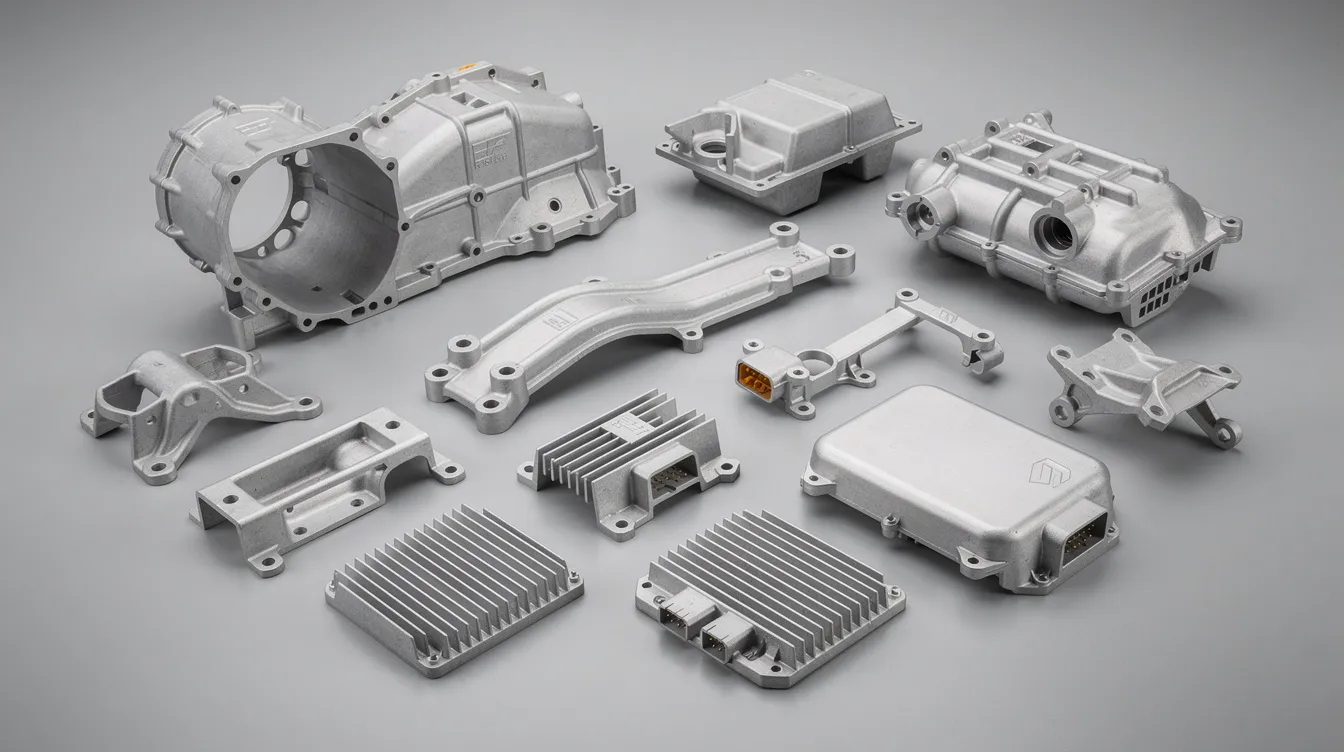
Automotive and EV – motor housings, inverter cases, EV structural frames, battery pack brackets
-
Aerospace – interior structural brackets, avionics enclosures
-
Medical devices – pump bodies, imaging housings, surgical device enclosures
-
Electronics and telecom – heat sinks, RF housings, electronic components, led lighting fixtures
-
Robotics and industrial equipment – gearbox housings, servo mounts, construction machinery components
-
Marine – marine hardware housings and connectors
Anebon focuses heavily on overseas OEMs across these sectors, offering both prototyping and full production support. For one international client, a complex aluminum die casting gearbox housing moved from prototype to series production within six months, achieving defect rates below 0.3% and cycle times reduced by 15% versus the client’s previous supplier.
Evaluating a Trusted Die Casting Supplier: Checklist for Overseas Buyers
This section is your practical buyer’s checklist-use it before committing to any die casting supplier.
Evaluation items:
-
Factory location, size, and age of the die casting company
-
Range and tonnage of casting equipment (die casting machine inventory)
-
CNC capacity (number of axes, machines, shift flexibility)
-
In-house tooling capability and surface treatment partnerships
-
ISO certificates, equipment lists, sample PPAP/FAI reports
-
Material certificates and references from existing overseas clients
-
English-speaking engineering support and responsiveness
-
Clear lead-time commitments and production scale flexibility
Geographic diversification of production can mitigate regional disruptions in supply chains, so consider suppliers in different clusters.
Among top aluminum die casting companies in China, notable names include: Ningbo Yujun Mechanical Technology, established in 2014; Zhejiang Yulong Vehicle Industry, with a facility size of over 30,000 m²; Suzhou Xiyi Trading, which holds five quality certifications including ISO 9001; L-TOOLING (HK), operating a facility between 10,000 to 30,000 m²; Global Metal Plastic, with IATF 16949 and ISO 13485 certifications; and Dongguan Xinghang Precision Hardware, which focuses on high-precision aluminium die casting.
Conduct remote or on-site factory audits and request trial batches before locking in long-term contracts.
Cost Drivers in High-Precision Die Casting Projects
Major cost components include tooling cost, alloy cost, die casting machine time, secondary precision machining, surface finishing, and quality assurance overhead.
Tolerance levels, part complexity, and expected annual production capacity heavily influence both tool design and piece price. A housing requiring ±0.02 mm on six features costs meaningfully more than one with only two critical surfaces.
Strategies to reduce cost:
-
Consolidate multiple parts into one die casting where possible
-
Optimize wall thickness to reduce alloy use and cycle time
-
Use standard alloys like A380 unless the application demands otherwise
-
Minimize unnecessary tight tolerances-apply them only where function requires it
Chinese suppliers like Anebon can provide DFM feedback to re-design aluminum casting parts for lower cost without sacrificing performance. As a simple example, relaxing non-critical bore tolerances from ±0.01 mm to ±0.05 mm on a typical aluminum housing can reduce per-piece machining cost by 10–20%.
Lead Times, MOQs, and Production Scalability in China
In 2026, typical lead times for tooling from a Chinese die casting factory run 4–8 weeks for medium complexity tools. First article samples usually follow 1–2 weeks after tool approval.
Different suppliers handle MOQs differently. Rapid prototyping and low-volume runs (even single-digit quantities via CNC-machined prototypes) are common for development, while automotive-scale orders may require thousands per month to justify dedicated die casting services.
Scalability depends on availability of multiple casting machines in similar tonnage, parallel CNC capacity, and flexible shift planning. The die casting field rewards suppliers with impressive annual production capacity and the infrastructure to back it up.
Anebon’s experience spans moving from prototype CNC-machined parts to full die cast production for OEM clients. Buyers should align annual volume forecasts and ramp schedules with the selected manufacturer early in the project.
Risk Management: Porosity, Warpage, and Dimensional Stability
The most common technical risks in high pressure die casting-porosity, warpage, and dimensional drift-can turn a good design into scrap if unmanaged.
Porosity causes and mitigation:
-
Poor gating and turbulence → optimized gate/runner/vent design via flow simulation
-
Trapped gas → vacuum-assisted die casting and automated rotary degassing
-
Shrinkage → controlled solidification via balanced cooling channels
Warpage and dimensional drift:
-
Uneven cooling or thick-to-thin transitions → uniform wall design and balanced cooling
-
Die wear over time → programmed maintenance and rework schedules
-
Alloy impurities in recycled aluminum → spectrometer checks and certified raw material sourcing
Experienced Chinese suppliers routinely perform sampling studies and capability analyses (Cp, Cpk) on critical dimensions. Anebon uses feedback loops from CNC inspection to refine casting parameters and tooling over the early production processes, reducing defect rates progressively.
Working with Anebon Metal Products Limited as Your Precision Die Casting Partner
Anebon Metal Products Limited was founded in 2010 and is based in Dongguan, Guangdong-China’s electronics and precision manufacturing heartland. The company is a B2B OEM-focused die casting company holding both ISO 9001:2015 and ISO 14001:2015 certifications.
Core services:
-
Aluminum die casting and alloy die casting (including zinc alloys and magnesium)
-
CNC machining including 5-axis for complex geometries
-
Sheet metal fabrication
-
Rapid prototyping for overseas OEMs
Anebon delivers tolerances as precise as ±0.002 mm on machined features and has experience with complex die casting products for aerospace, medical devices, robotics, and electronics.
One-stop project workflow: DFM consultation → tooling design → sample validation → mass production → integrated surface treatment and quality assurance.
Ready to get started? Send your 3D/2D files to Anebon for a free manufacturability review and detailed quotation.
Case Study: From Prototype to Mass Production with a Chinese Die Casting Supplier
In late 2024, an overseas robotics company needed an aluminum gearbox housing with six critical bearing seats, two sealing surfaces, and an integrated cooling fin array. Their existing machined-from-billet approach cost too much at volume.
Project timeline (Anebon’s perspective):
-
Week 1–2: Received STEP files and GD&T drawings. Provided DFM feedback, recommending wall thickness adjustments and draft angle changes to improve castability.
-
Week 3–4: CNC-machined prototypes delivered for fit testing.
-
Week 5–12: Die casting mold designed, simulated (mold flow analysis), and manufactured.
-
Week 13–14: T0 samples cast and inspected; two features required minor tool adjustment.
-
Week 15–16: T1 samples approved-all critical dimensions within ±0.01 mm after CNC machining.
-
Month 5 onward: Production ramp to 3,000 units/month with Cpk > 1.67 on critical bores.
Outcomes: 42% cost reduction versus billet machining, cycle time of 72 seconds per casting, and defect rate below 0.25%.
How to Communicate Technical Requirements Effectively with Chinese Suppliers
Clear and complete technical documentation prevents costly misunderstandings in cross-border projects.
Required documents to provide:
-
3D models (STEP/IGES format)
-
2D drawings with full GD&T per ISO or ASME Y14.5
-
Alloy specifications and any special raw material requirements
-
Surface finish and coating requirements
-
Annual volume estimates and ramp schedule
Use color-coded drawings with tolerance zoning (critical vs. non-critical features) so engineers on both sides share the same priorities. Schedule online engineering reviews via video call early-especially to align on draft angles, parting lines, and gate locations.
Anebon’s engineering team supports English-language discussions and proactively proposes design changes to improve manufacturability.
Comparing China’s High-Precision Die Casting Suppliers with Global Alternatives
China consistently wins on cost and capacity for aluminum die casting and integrated cnc precision machining. Tooling costs are often 40–60% lower than equivalent European or North American options, and production lead times are competitive.
Some Western competitors like Protolabs and Xometry focus on ultra-fast prototyping with shorter lead times for small batches. Chinese firms, including Anebon, often excel at scaling from prototyping through to high-volume mass production-a transition where cutting edge technology in both casting and machining matters most.
Anebon bridges this gap by offering rapid prototyping plus series production at competitive China manufacturing costs. Evaluate total landed cost, lead time, and technical risk-not just piece price-when choosing a trusted partner and reliable partner for your die casting needs.
Environmental and Sustainability Considerations in Die Casting
Environmental performance is increasingly important for global OEMs in 2026. Using recycled (secondary) aluminum saves up to 95% of the energy required to produce primary aluminum, but quality-focused suppliers must rigorously control alloy cleanliness.
ISO 14001 certification indicates environmental management compliance-Anebon’s ISO 14001:2015 system supports customers’ ESG and sustainability reporting requirements. Responsible practices include closed-loop cooling systems, proper handling of waste from surface treatment, and energy-efficient casting equipment.
Design choices also matter: optimizing wall thickness, selecting the right material, and consolidating parts all reduce the total environmental footprint of your die casting products.
Future Trends in High-Precision Die Casting in China
Looking ahead, several trends will shape long-term sourcing decisions in the die casting field.
Automation and robotics are increasingly integrated into die casting cells and CNC lines for consistency and labor efficiency. Advanced technology in real-time process monitoring, data-driven quality control, and AI-assisted parameter optimization is pushing the industry toward zero-defect manufacturing.
Structural aluminum die castings for EVs continue to grow, with single-vehicle aluminum use climbing from ~160 kg toward 185 kg and beyond. Gigacasting-using machines with 6,000–9,000 tonnes of clamping force-is enabling one-piece structural casting that was unthinkable five years ago.
Suppliers like Anebon are continually upgrading casting equipment and CNC capacity to meet tighter tolerances and new material demands-positioning themselves as a trusted die casting supplier in china for the next decade.
Conclusion: Selecting the Right High-Precision Die Casting Partner in China
The main selection criteria come down to process capability, tooling expertise, cnc precision machining, quality systems, and communication. China offers a deep pool of high-precision die casting suppliers with impressive annual production capacity, but careful evaluation is essential to find a truly trusted die partner who delivers stable quality at production scale.
Anebon Metal Products Limited stands as an ISO-certified, Dongguan-based one-stop die casting manufacturer focused on overseas OEMs-from rapid prototyping through full-volume aluminum casting production.
Your next step: Send your RFQs, CAD files, or technical drawings to Anebon for a detailed quotation and free DFM review. Whether you need a single prototype or thousands of aluminum die casting parts per month, the right casting supplier in china starts with a conversation about your exact requirements.