The Best CNC Parts Suppliers: Top Choices for Quality and Reliability
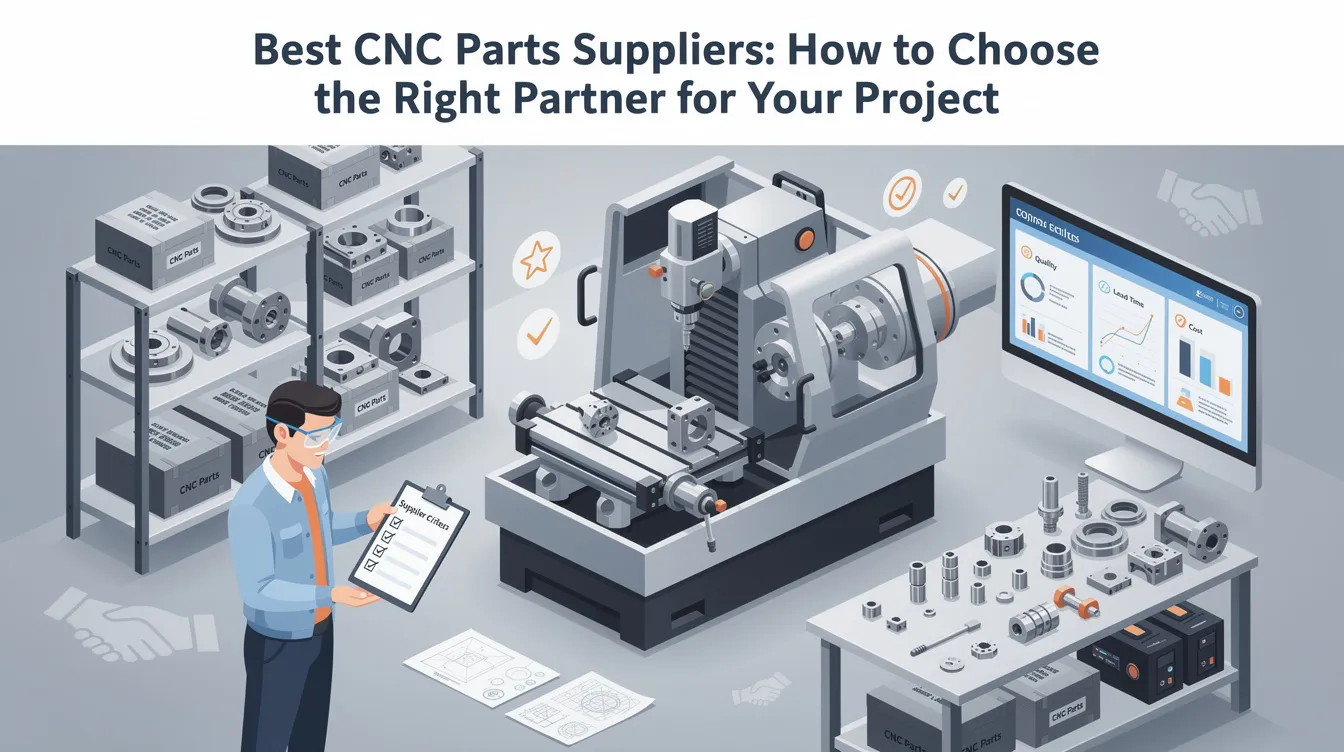
Best CNC Parts Suppliers: How to Choose the Right Partner for Your Project
Finding the right CNC parts supplier can determine whether your product ships on time or stalls in development. The difference between a good supplier and a mediocre one shows up in scrap rates, missed deadlines, and machined parts that don’t fit their assemblies. This guide breaks down what to evaluate, which capabilities matter, and how to run a structured supplier selection process.
Quick Answer: What Makes the Best CNC Parts Supplier?
The best CNC parts suppliers combine reliable quality, realistic lead times, and engineering support that starts at the RFQ stage and continues through shipment. They balance precision, cost efficiency, and communication rather than excelling in one area while failing in others.
Here is what separates them:
-
Consistent tolerances on CNC parts. Aerospace components require tolerances as tight as ±0.002 mm. General industrial applications may allow for more flexible tolerances, such as ±0.05 mm. The best suppliers specify which range they can hold and prove it with inspection data.
-
Transparent lead time. A supplier quoting 5–7 working days for a prototype should include programming, fixturing, machining, and inspection in that window. If they don’t, the number is meaningless.
-
Responsive communication. Good communication is essential for a successful partnership with suppliers. That means same-day replies to RFQs, clarifying questions on ambiguous drawings, and proactive updates when schedules shift.
-
Modern CNC machines. Brands like DMG Mori, Haas, and Mazak indicate investment in equipment. Combined with CAD/CAM workflows, in-process inspection, and digital instant quote systems, these tools let a shop deliver both speed and precision.
Anebon Metal Products Limited operates as an example of this model: an ISO-certified overseas CNC machining services partner for OEMs that need custom parts in aluminum, stainless steel, titanium, brass, copper, and engineering plastics.
What to Look For in a CNC Parts Supplier
Choosing the right supplier means balancing quality, cost, and lead times rather than chasing the lowest quote. A $3-per-unit price advantage means nothing if 15% of parts fail incoming inspection.
Evaluate suppliers based on technical capability, quality systems, and delivery performance. Here are the specific criteria:
-
Range of CNC machining processes. Look for 3-, 4-, and 5-axis CNC milling; CNC turning (including Swiss turning for small parts and high-precision shafts); grinding; and EDM. A shop limited to 3-axis milling cannot produce complex geometries without multiple setups, which hurts accuracy and raises cost.
-
Material capabilities. The supplier should stock or source your materials: aluminum 6061/7075, brass C360, titanium Grade 5, tool steels like 4140, stainless steel 303/304/316/17-4PH, and plastics such as PEEK, Delrin, and polycarbonate. Leading shops stock 50+ grades.
-
Industry track record. Ask for examples of parts similar to yours. A shop machining drone frames in 7075 aluminum has different process knowledge than one making oilfield couplers in Inconel.
-
Machine inventory. Check what brands and types they run. Horizontal and vertical mills, live-tool lathes, and 5-axis machines tell you what part complexity they can handle. Machines from DMG Mori, Okuma, Brother, or Mazak signal capital investment.
-
Certifications. ISO 9001:2015 and ISO 14001:2015 certifications indicate quality management and environmental standards. For automotive, ask about PPAP; for aerospace, ask about AS9102 first article inspection. Full material lot traceability is important for compliance in manufacturing.
-
Scalability. Some suppliers specialize in high-volume production while others focus on prototypes. The best CNC suppliers handle both, from 1-piece rapid prototyping to 50,000+ production parts, with flexible lot sizes.
-
In-house control. Evaluate suppliers based on their in-house capabilities versus outsourcing. A factory that machines, finishes, and inspects under one roof reduces variability and protects your IP.
Capabilities That Separate Top CNC Machining Suppliers
Not all CNC machining services are equal. The machine park and process scope determine what is manufacturable, at what tolerance, and at what speed.
Core processes. High-speed CNC milling handles complex 3D surfaces: heat sinks with thin fins, structural housings with deep pockets, impeller blades. CNC turning produces shafts, bushings, fittings, and threaded features; live-tool turning centers can drill and mill on turned parts in a single setup. 5-axis machining allows for complex geometries and intricate details that would otherwise require multiple fixtures. It reduces setup time, which directly improves accuracy for parts like aerospace brackets or medical implants.
By contrast, 3-axis machining is simpler and often less expensive, but it typically requires multiple setups for complex parts, with each re-fixturing introducing positional error.
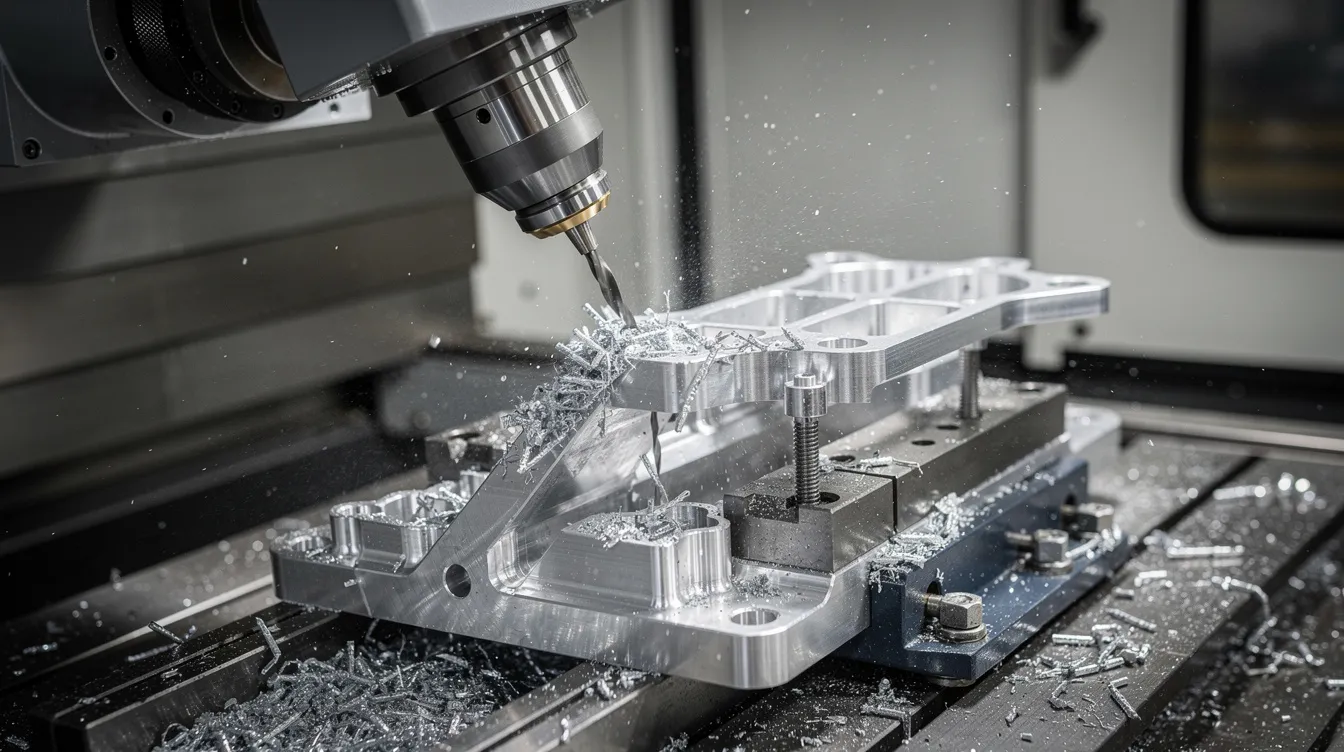
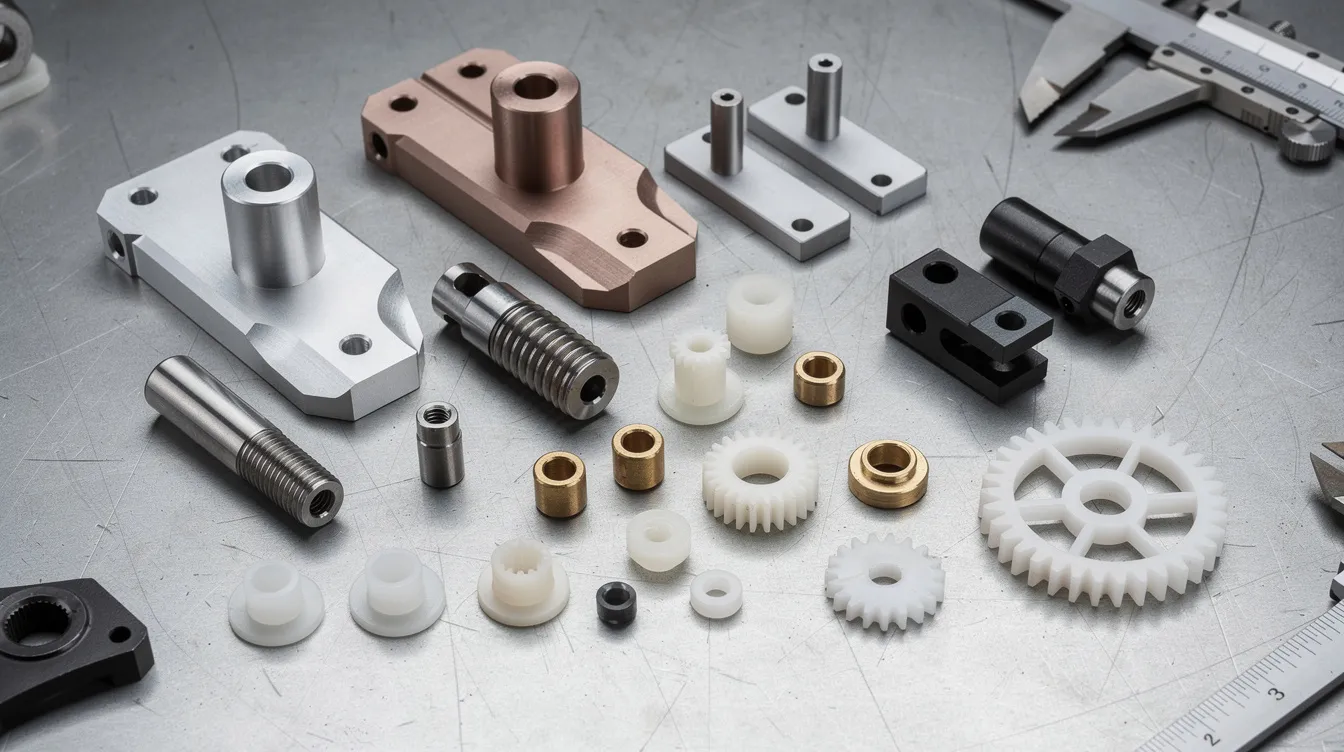
Real part examples. Aluminum 7075 drone frames needing stiff, thin-walled structures at low weight. Stainless steel 316L medical brackets requiring corrosion resistance and biocompatibility. Brass inserts with fine threads and tight concentricity. Titanium orthopedic components machined to surface finishes below Ra 0.8 µm. Tight-tolerance housings controlled by GD&T for flatness and parallelism.
Value-added processes. Tapping, reaming, knurling, thread milling, and EDM (wire and sinker) for features impossible by conventional milling. CNC routers handle plastics and softer materials where relevant. Top suppliers also offer sheet metal fabrication and die casting under one roof, enabling hybrid assemblies for OEM machine parts.
CNC machining can produce over 10,000 parts per month when the process is dialed in. Anebon holds tolerances down to about ±0.002 mm on critical CNC machining parts using precision equipment and strict process control across its milling, turning, EDM, and grinding operations.
Materials Expertise: Metals and Plastics for CNC Parts
The best CNC parts suppliers are defined as much by material selection expertise as by machines. Feeds, speeds, fixturing, and coolant strategy differ across every alloy and polymer. A shop that runs aluminum all day will struggle with titanium unless they have specific tooling and process knowledge.
Metals. Aluminum alloys like 6061-T6 and 7075 are commonly used for lightweight housings, heatsinks, and structural frames. 6061 machines at roughly 300–400% the speed of brass (machinability base 100), making it a cost-friendly choice. 7075 and 2024 offer higher tensile strength but require stress-relief after roughing to hold tight tolerances. Brass C360 is easy to machine and corrosion-resistant, ideal for precision threaded inserts and valves. Copper works for electrical contacts and thermal conductors. Stainless steel (303, 304, 316, 17-4PH) is known for its excellent machinability in free-machining grades like 303; 304 and 316 work-harden and need careful feed control. Steel alloy grades 4140 and 4340 serve high-load mechanical engineering applications but demand rigid setups. Titanium (Grade 2, Grade 5/Ti-6Al-4V) offers a high strength-to-weight ratio for CNC machining, but its low thermal conductivity causes heat buildup at the cutting edge, requiring CBN tooling and controlled coolant flow.
Plastics. ABS and Delrin are popular for CNC machining of prototypes and low-volume functional parts. PEEK provides thermal stability and chemical resistance for demanding environments but needs precise tooling to avoid burning. Nylon absorbs moisture, which affects dimensional stability. PTFE is soft and prone to creep. Polycarbonate offers impact resistance for housings and covers. CNC machining of plastics is preferred over injection molding when volumes are low, tolerances are tight, or design changes are frequent.
Materials commonly used in CNC machining include aluminum, stainless steel, and engineering plastics. Anebon stocks a broad range of metals and plastics and provides material certificates (EN 10204 3.1) on request for aerospace and medical customers who require documented traceability.
Quality Systems and Tolerances: Getting CNC Parts That Actually Fit
Quality in CNC machining is the combination of process control, inspection, and documentation. A part that measures correctly on one run but drifts on the next is a process control failure, not just a measurement problem. Quality control is essential in CNC machining and often includes inspections and certifications at multiple stages.
Inspection tools and methods. Inspection systems like CMM are used in quality assurance for CNC products, verifying critical dimensions and geometric tolerances (true position, flatness, concentricity). Height gauges and micrometers handle simpler checks. Surface roughness testers measure Ra and Rz values. Go/no-go gauges verify hole and shaft fits. Optical projectors inspect threads and fine features.
Tolerance ranges and cost. Precision tolerances can be as tight as ±0.0001 inches (about ±0.0025 mm) on specialized equipment. CNC machining can achieve tolerances as tight as ±0.0001 mm in ultra-precision applications, though this requires substantial investment. Moving from ±0.1 mm to ±0.005 mm on a 6061-T6 bracket can increase per-unit cost from about $40 to $55. Dropping to ±0.002 mm pushes it to roughly $80. Tolerances impact the functionality and safety of CNC parts; specify tight tolerances only where the design requires them.
Industry-specific requirements. Precision requirements vary by industry, especially aerospace and medical. Aerospace brackets often require true position within 0.01 mm. Precision machining is critical for medical device manufacturing, where consistent fits across batches prevent assembly failures. Industrial machinery parts may function well at ±0.05 mm.
ISO certifications indicate a supplier’s commitment to quality standards. Anebon’s ISO 9001:2015 and ISO 14001:2015 certifications, combined with documented inspection plans and material traceability, help ensure repeatable CNC machining quality for overseas OEMs. A best CNC supplier will share first article inspection (FAI) reports and adjust CNC programs if dimensions drift during production runs.
Lead Times, Instant Quotes, and Pricing Transparency
Realistic, dependable lead times matter as much as per-unit price. A quote that promises 5 days but delivers in 15 disrupts your entire development schedule. Lead times vary based on production capacity and complexity of parts.
Typical ranges. Simple CNC prototypes: 3–7 working days. Complex assemblies or mid-volume runs: 10–20 days. Parts needing heat treatment, coatings, or special surface treatment: add 3–7 days on top. Rapid prototyping serves to quickly produce parts before full-scale production, but prototyping often requires prompt quoting and responsive communication from suppliers.
Quoting and real time pricing. Digital RFQ portals and online quotes tools help engineers compare options fast. But the best suppliers still perform DFM checks before locking pricing and delivery. A purely automated instant quote system that skips engineering review risks quoting a part that cannot actually be made as drawn.
Cost drivers. CNC parts suppliers should provide itemized quotes detailing cost drivers:
-
Material choice (titanium costs 5–10x more than aluminum per kg)
-
Part complexity and number of setups
-
Required surface finish (Ra ≤ 0.8 µm costs more than Ra 3.2 µm)
-
Tolerance level (tighter = more machine time and inspection)
-
Whether 5-axis machining or multiple 3-axis setups are needed
-
Maximum size of the part relative to machine envelope
-
Finishing: anodizing, plating, bead blasting
Anebon returns detailed quotes, including freight options, taxes where applicable, and estimated ship dates, within about 24 hours for clear drawings and 3D models. A reliable CNC machining service partner avoids promising 2–3 day turnaround for complex custom parts. Instead, they build buffer time for programming, fixturing, and inspection. Define your CNC part requirements clearly before sourcing suppliers so the quote reflects actual project conditions.
Domestic vs Overseas CNC Parts Suppliers
Buyers often weigh domestic convenience against the lower cost of overseas CNC machining, especially from factories in China and Southeast Asia. Both options have real trade-offs, and the right choice depends on volume, timeline, and risk tolerance.
Domestic advantages. Easier time-zone alignment. On-site visits without international travel. Faster shipping for urgent rework. Familiarity with local standards and legal frameworks.
Overseas advantages. A reputable overseas supplier like Anebon in Dongguan, China, offers lower machining cost for mid-to-high volumes, broad material availability, and a wide machine park (including 5-axis equipment) dedicated to OEM export work. For mass production and high volume production runs, the per-unit savings can offset shipping and customs costs.
Risk mitigation. NDA agreements before sharing drawings. Sample runs before full production. Approval of first articles against inspection reports. Trackable shipping with customs-prepared documentation. These steps reduce the practical gap between domestic and overseas sourcing.
For many design engineers in Europe and North America, a hybrid approach works: early prototypes with a domestic shop for speed, then volume production with a trusted overseas partner once the design is validated. Anebon has been working with overseas OEMs since around 2010 and is structured around English-language communication and export logistics, operating as a reliable CNC factory for international customers.
Evaluating Communication, Engineering Support, and DFM
The best CNC supplier is not just a shop with good machines but a collaborative partner that helps improve designs before chips are cut. Engineering support can include suggestions for materials and design improvements that reduce cost or improve part performance.
What good DFM looks like. A competent supplier reviews your CAD files and flags issues:
-
Deep narrow pockets where standard end mills cannot reach without excessive deflection
-
Internal corners requiring EDM instead of milling
-
Tolerances tighter than the part function demands, adding cost without adding performance
-
Thread types that are difficult to inspect or non-standard for the material
-
Wall thickness below safe machining limits for the chosen material
Design for Manufacturability (DFM) feedback helps optimize part designs and reduce costs. Good suppliers suggest alternatives: a fillet radius of 1 mm instead of a sharp corner, a looser tolerance on a non-critical bore, a material swap from 316 stainless to 303 for better machinability when corrosion resistance is not the primary concern.
Communication speed. Clear, fast communication (same-day email replies, shared 3D models with markups, scheduled calls for complex assemblies) reduces risk of misinterpretation and rework. Anebon assigns a dedicated project engineer to overseas customers, keeping CNC machining projects aligned from instant quote through final delivery.
Good shops and good suppliers ask clarifying questions when drawings are incomplete or contradictory rather than guessing. That discipline protects the final fit of CNC machining parts.
Examples of Strong CNC Parts Suppliers and Their Focus Areas
Different top CNC suppliers tend to specialize. Some focus on high-mix low volume work; others on tight-tolerance aerospace production parts; others on cost-optimized OEM mass production. Knowing a shop’s strength helps you match it to your project.
Typical profiles. US-based shops often focus on quick-turn prototyping with Haas and Okuma machines, serving product development teams that need 5–10 parts in a week. European firms concentrate on medical components and aerospace, with full traceability and EN/ISO compliance. Asian suppliers optimized for large OEM batches deliver competitive prices on runs of 1,000+ units by running machines around the clock.
Machine builders like DMG Mori, Mazak, and Haas serve as indicators of a shop’s investment, but process discipline matters as much as machine brand. A Haas VF-2 in the hands of a skilled operator with proper tooling and inspection protocols outperforms a DMG Mori in a house with no quality control processes.
Concrete examples. One shop might specialize in 7075 aluminum drone frames and robotics brackets, running 5-axis mills at high feed rates with vacuum fixturing. Another focuses on stainless steel oilfield couplers requiring tight thread tolerances. A third produces precision brass inserts and turned electrical fittings on Swiss turning machines.
Anebon fits the category of full-service overseas OEM partner: CNC milling, CNC turning, die casting, and sheet metal fabrication under one roof, enabling consistent good quality across families of machine parts. In one case, Anebon’s engineers caught an incorrect thread specification (M6x0.75 called out where M6x1.0 was needed for a standard housing) at the DFM stage, saving a batch of 2,000 parts from rework.
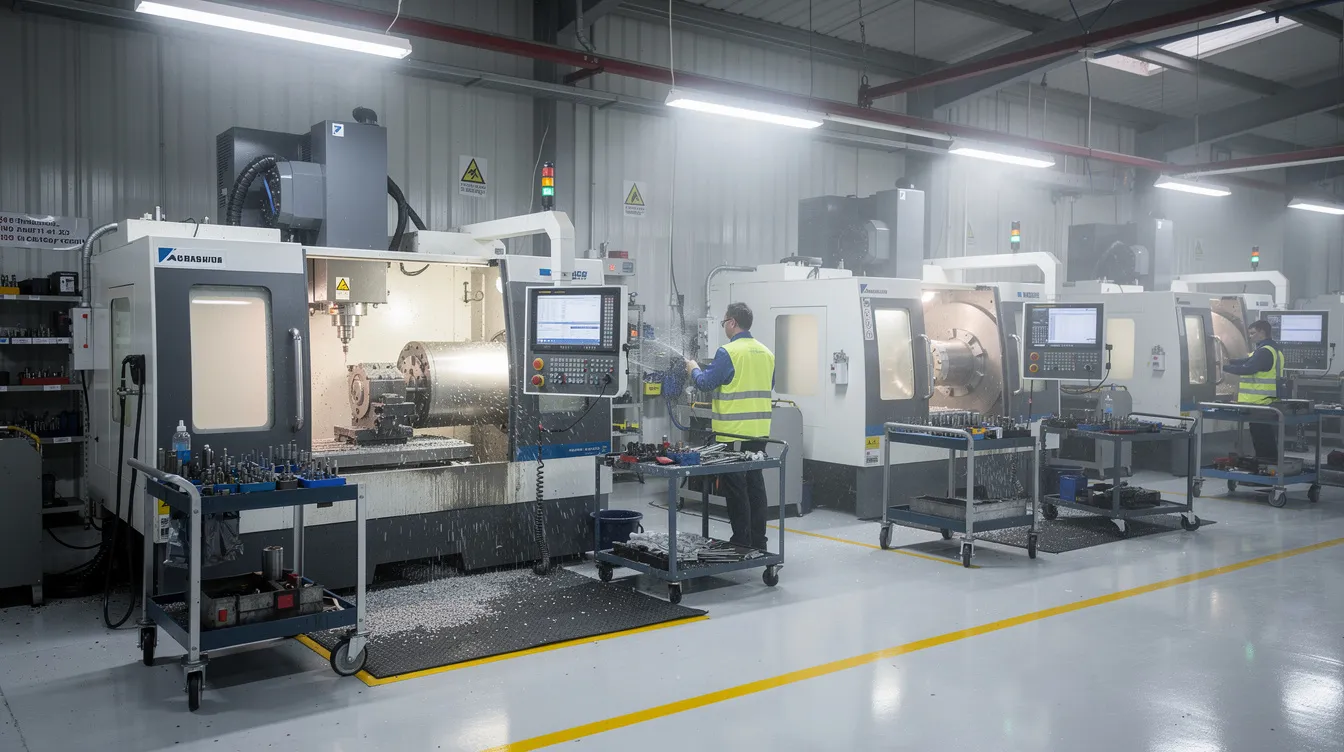
How Anebon Metal Products Limited Stands Out as a CNC Parts Supplier
Anebon Metal Products Limited is a B2B CNC machining and fabrication company founded in 2010 in Dongguan, Guangdong, China. The company serves overseas OEMs in automotive, aerospace, medical devices, electronics, and robotics with precision machined parts and assemblies.
Services. Precision CNC machining (3–5-axis milling, CNC turning), rapid prototyping, die casting, and sheet metal fabrication. Orders range from 1 prototype to 10,000+ production parts per run.
Technical strengths. Tolerances down to ±0.002 mm on critical dimensions. Experience with aluminum, stainless steel, titanium, brass, copper, and engineering plastics. Surface treatments through local partners: anodizing, plating, painting, bead blasting. Cutting edge technology in the form of imported multi-axis CNC machines, EDM equipment, and surface grinders.
Quality and environment. ISO 9001:2015 and ISO 14001:2015 certified. Documented inspection procedures, CMM verification, and material traceability for every order.
Customer support. English-speaking engineers providing DFM feedback. Detailed quotes within about 24 hours for clear drawings. Support from prototype through full scale production.
Industries and parts served:
-
Drone components and robotics enclosures
-
Medical device housings and surgical instrument parts
-
EV battery hardware and automotive brackets
-
Sensor brackets and electronics enclosures
-
Aerospace structural components
Practical Checklist for Choosing the Best CNC Parts Supplier
Use this checklist to evaluate any CNC parts supplier before committing to a production order. It condenses the criteria covered above into questions a sourcing manager or engineer can run through in 15 minutes.
Machines and capacity. Does the supplier have the right CNC machines for your part complexity? Can they handle your volumes, whether that is 10 prototypes or 10,000 production parts? If your design has complex designs with undercuts or curved surfaces, do they have 5-axis capability? What happens if a machine breaks down; do they have backup capacity?
Materials and tolerances. Can they work in your required materials? Can they reliably hold your tolerances, and do they verify with CMM? Do they provide material certificates and inspection reports?
Certifications and traceability. Are they ISO-certified? Can they provide first article inspection reports, PPAP documentation, or AS9102 forms if needed?
Lead time and logistics. Can they meet your schedule reliably? Are shipping methods and Incoterms (FOB, DAP, DDP) defined? Do they offer realistic lead times rather than optimistic promises?
Communication and DFM. How fast do they respond to RFQs? Are DFM suggestions specific and actionable? Do you have a single point of contact?
Pilot order. Test a new supplier with a prototype batch to validate quality, consistency, packaging, and service before moving production of critical parts. Supplier selection should be based on scalability from prototypes to high-volume production; a pilot run reveals whether they can grow with your needs.
Consider Anebon as a candidate for that pilot run if you are looking for a long-term overseas CNC machining partner for custom parts.
How to Get Started with Anebon for Your Next CNC Machining Project
If you are ready to test a new CNC parts supplier, start by submitting your CAD files and technical drawings.
Typical engagement steps:
-
Send 2D/3D files (STEP, IGES, or similar) along with quantities and tolerance requirements
-
Receive DFM feedback and a detailed quote covering pricing, lead times, and shipping options
-
Approve samples or first article before committing to batch production
-
Scale to full production once quality is confirmed
Uploads and drawings are handled confidentially. NDAs are available on request. Anebon typically returns a detailed quote within about 24 hours on working days, including suggestions to optimize cost vs. performance through material and process options.
Prepare clear tolerance requirements, surface finish notes, and any special testing needs (leak tests, hardness verification, coating thickness) so the quote reflects real project conditions.
By partnering with a specialized CNC parts supplier like Anebon, OEMs reduce unit cost, improve part consistency, and shorten development cycles from prototype to full production. Upload your files and find out what your project will cost.