Qué es CNC: Introducción a la fabricación automatizada y su impacto
What Is CNC? Complete Guide to Computer Numerical Control Machining
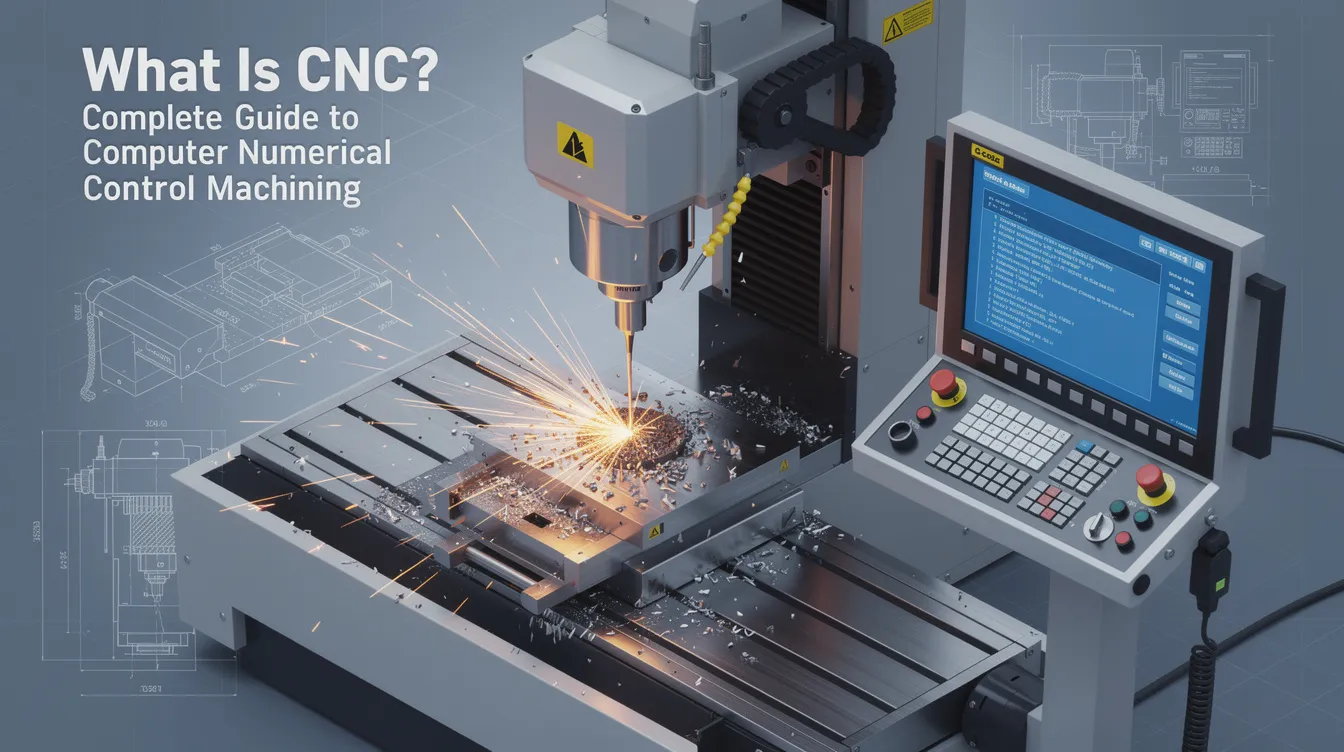
If you have ever wondered qué es CNC, the answer is straightforward: CNC stands for Computer Numerical Control. It is a method of automated manufacturing controlled by computers, and it is the standard way to machine metal and plastic parts in modern factories around the world. In this guide, we break down how el mecanizado CNC works, the machines involved, the materials you can cut, and how to choose the right supplier for your project.
What Is CNC and Why It Matters Today
So, qué es el CNC in practical terms? CNC is a technology where a computer sends programmed digital commands to move tools and axes on a machine tool, transforming raw stock into a finished part with high precision and la precisión needed for demanding applications. CNC operates through a subtractive manufacturing process, es decir, material is removed from a solid block rather than added layer by layer. CNC technology is essential in modern manufacturing for its precision, repeatability, and ability to run with minimal human intervention.
In Spanish-speaking contexts, this technology is often called control numérico por computadora or “control numérico computarizado.” Es una tecnología clave de mecanizado en la industria actual, used across automotive, aerospace, medical, electronics, and military sectors.
Las máquinas CNC include mills, lathes, 5-axis machining centers, routers for soft materials, laser cutters, and more. CNC machines include routers for soft materials and lathes for cylindrical pieces, but this article focuses mainly on de mecanizado of metals and engineering plastics. CNC machines can have 2 to 12 axes depending on the complexity required.
Anebon Metal Products Limited is a precision CNC machining partner for overseas OEMs, holding ISO 9001:2015 and ISO 14001:2015 certifications and capable of tolerances as tight as ±0.002 mm.
Basic Concept of CNC: El Control Numérico Explained
El control numérico is a method to control machine-tool motion via a list of numeric instructions – a program – instead of manual handwheels. In other words, en otras palabras, a digital file replaces the operator’s hands for positioning, speed, and tool selection.
A CNC machine works in a 3D coordinate system. CNC machines operate on at least two axes: X and Y, while most machining centers add a Z axis for depth. Some machines include additional rotary axes (A, B, C), enabling multi-axis movements relative to de la pieza. The CNC controller reads G-code, interprets feed rates (velocidad de avance), spindle speeds, and tool changes, then sends signals to servomotors, encoders, and drives that move la herramienta and the workpiece with closed-loop accuracy.
Here are concrete examples of operations en un centro de mecanizado CNC:
-
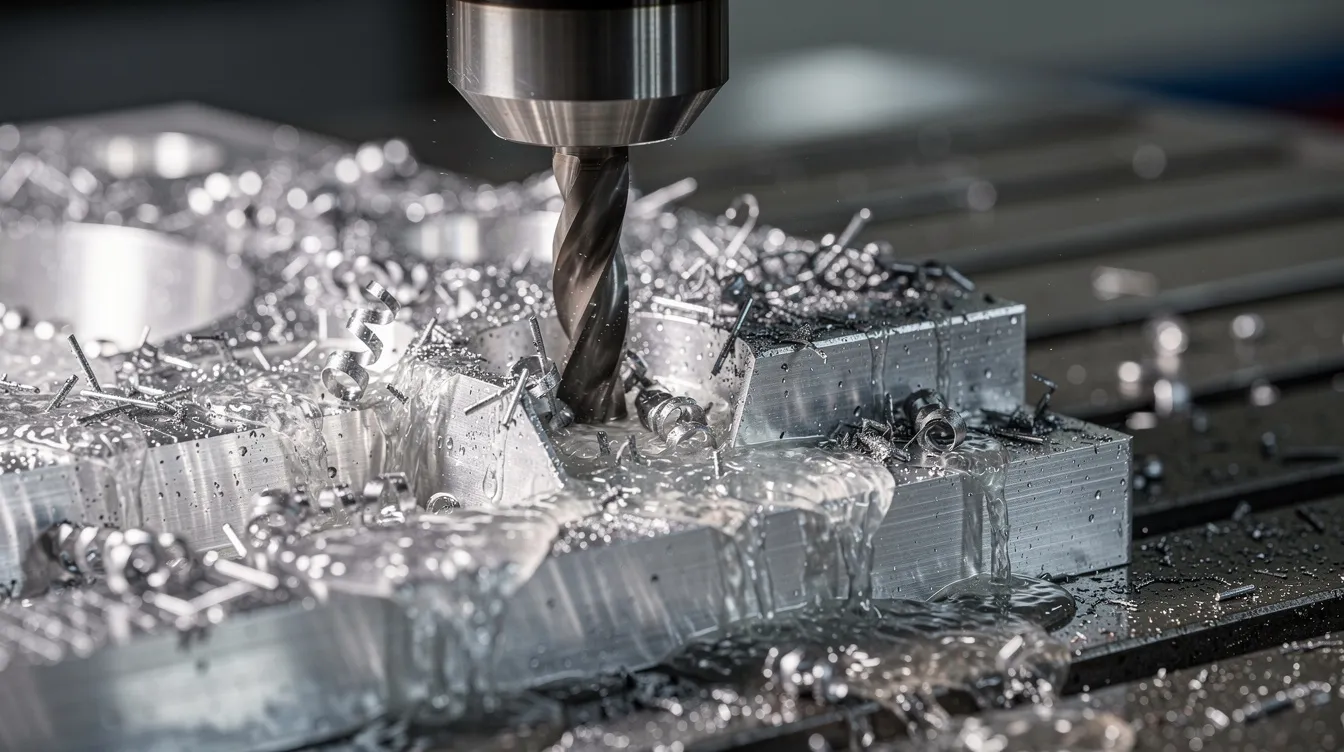
Milling a pocket in aluminum: An end mill creates an internal cavity with roughing passes followed by a finishing cut, all with coordinated X, Y, Z movements.
-
Drilling holes in a stainless-steel bracket: Successive drilling passes with controlled feed and coolant, possibly followed by tapping.
-
Turning a titanium shaft: The cylinder rotates while a stationary tool removes material for threading, grooving, or mirror finishing.
CNC provides high accuracy ensuring uniformity of produced parts. By automating motion, la tecnología CNC improves repeatability and allows 24/7 production. CNC minimizes waste by optimizing material use and reducing errors compared to manual methods, por lo que manufacturers consistently choose it over hand-operated alternatives.
Brief History of CNC and Evolution of the Technology
The path from manual machine tools to modern CNC machining centers spans several centuries. An early precedent is Jacques de Vaucanson, who in the 1750s developed automated looms and metal lathes, lo que dio lugar to the first concepts of machine automation.
CNC technology emerged during World War II for precision machining, when the US aerospace sector needed accurate parts for aircraft. In the 1940s–50s, John T. Parsons and Frank L. Stulen developed systems that loaded aerodynamic surface data on punched cards into machines. By 1952, MIT’s Servomechanisms Laboratory had built working NC prototypes. During the 1970s, microprocessors transformed NC into full CNC, and G-code standardizes CNC instructions since 1970, giving programmers a universal language. De este modo, the industry gained flexibility, memory, and more sophisticated programming.
In los años 1980s–1990s, CNC became dominant in automotive, aerospace, and general manufacturing – especially in Japan, Germany, the US, and later China. In the 2000s, advances in CAD/CAM software and 5-axis machines enabled complex freeform surfaces, molds, and turbine blades that were previously difficult to produce.
Anebon, founded in 2010 in Dongguan, grew within this context, adopting modern multi-axis CNC equipment and digital workflows to serve overseas OEMs across multiple industries.
Main Components of a CNC Machine
Although there are many models en el mercado, las máquinas CNC share basic components that determine performance and la precisión:
-
Machine structure: A rigid cast-iron or welded-steel frame with high-precision linear guides and ball screws. Rigidity matters because any flex under load degrades surface finish and micrometric tolerances. CNC machining centers can support weights up to 7,000 kg on heavy-duty models.
-
Spindle system: Power in typical industrial machining centers ranges from 7 to 30 kW, with speeds from approximately 4,000 to 24,000 rpm depending on material. Tool holders (BT, CAT, HSK) influence cutting capability and de la herramienta rigidity.
-
Axes and drives: Linear axes with servomotors and encoders provide closed-loop positioning. Rotary tables add 4th and 5th axis capability for complex geometries.
-
CNC controller and HMI: The screen, keypad, program storage, and networking (Ethernet, USB) form the interface. The controller handles in-process monitoring, alarms, and simulation. The system is designed to be fácil de usar for trained operators.
-
Auxiliary systems: Coolant delivery, chip evacuation, automatic tool changer (ATC), tool magazine, and workholding devices (vises, chucks, fixtures) for la pieza. These machines can change tools automatically during operations, keeping the process uninterrupted.
CNC machining centers operate with minimal human intervention once the program is running and se está mecanizando the part.
How CNC Machining Works Step by Step
Here is a simple, chronological explanation of cómo funciona el proceso de mecanizado en CNC, from design to finished part.
Step 1 – CAD design: An engineer creates a 3D model of la pieza using diseño asistido por ordenador software, defining critical dimensions and tolerances. A DFM (Design for Manufacturability) review helps simplify machining and reduce cost. CNC enables rapid prototyping from CAD designs to physical objects, making it straightforward to validate designs early.
Step 2 – CAM programming: El CAM (fabricación asistida por ordenador, also called fabricación asistida por computadora) generates toolpaths – roughing, semi-finishing, finishing, drilling, tapping – and outputs G-code. CNC programming uses G-code for machine instructions, defining movements, feeds, and speeds. CNC programming requires CAD and CAM software integration; por ejemplo, Fusion 360 integrates CAD and CAM for CNC machining in a single platform. El CAD model feeds directly into el CAM workflow.
Step 3 – Machine setup: The operator mounts raw stock (aluminum bar, steel plate, plastic block) on una máquina CNC, sets the work coordinate system (WCS), and configures tool length offsets.
Step 4 – Trial run and verification: A dry run or air cut confirms the program, then a first-off part is checked with calipers, micrometers, or CMM. CNC machining can achieve tolerances of ±0.025 mm on critical features.
Step 5 – Production run: Once validated, la máquina runs the program repeatedly, producing dozens or thousands of identical parts with minimal adjustments.
Suggested diagram: a flowchart showing CAD → CAM → CNC (setup, test, production) → Inspection → Delivery, with arrows connecting each stage.
Common Types of CNC Machines Used for Machining
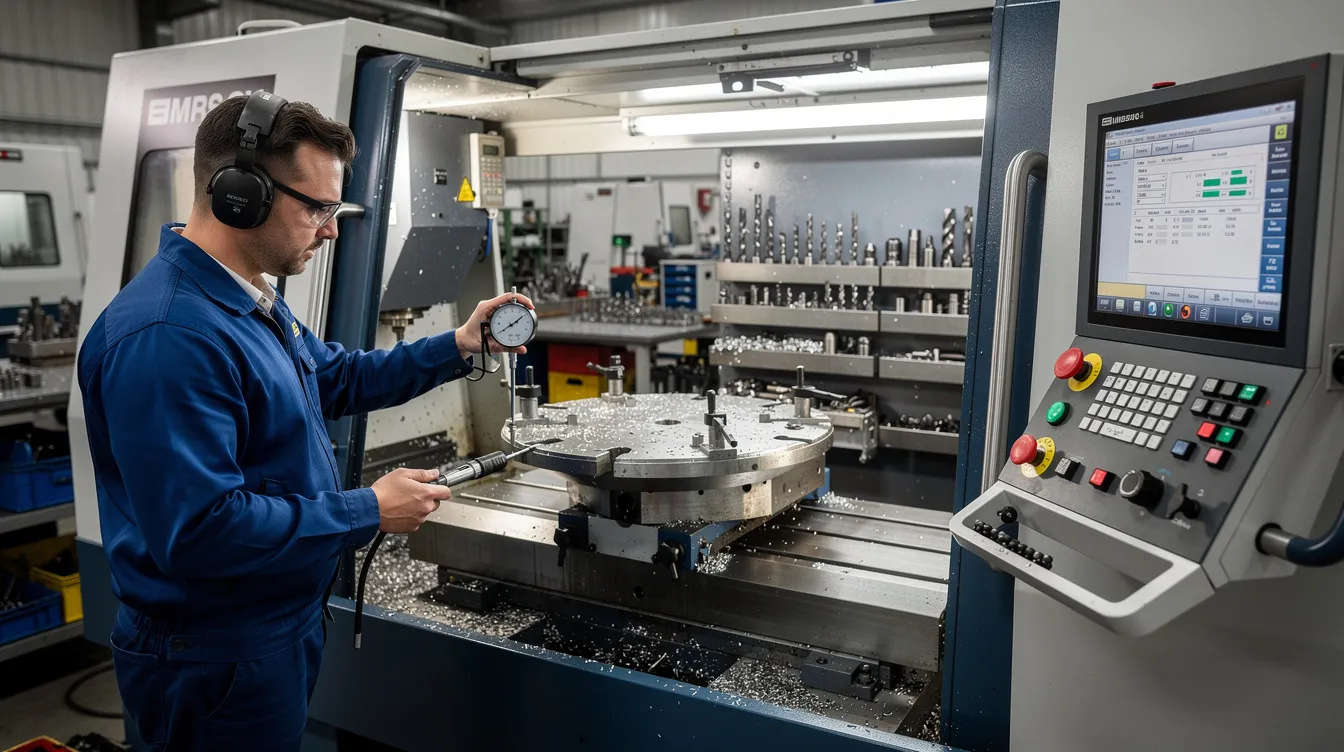
Una máquina CNC can refer to many configurations. Choosing the right type de máquinas depends on the geometry, tolerances, and volume de las piezas.
-
CNC milling centers (vertical and horizontal): The most common for prismatic parts, pockets, holes, and complex 3D surfaces.
-
CNC lathes / turning centers: For parts of revolution – shafts, bushings, threaded components – with bar feeding for high-volume production.
-
5-axis machining centers: For complex aerospace, medical, and mold components, reducing setups and improving surface quality.
-
Complementary CNC processes used en la industria: CNC grinding for high-precision surfaces, EDM (wire and sinker) for difficult geometries, and CNC laser/waterjet for flat sheet cutting.
Anebon operates multi-axis milling, CNC turning, and related processes to cover rapid prototyping and series production for OEM customers.
CNC Milling (Fresado CNC)
In CNC milling, a rotating herramienta de corte removes material while the workpiece is fixed or moving on multiple axes. Vertical machining centers are ideal for flat piece milling, while horizontal machining centers facilitate chip evacuation during deep machining.
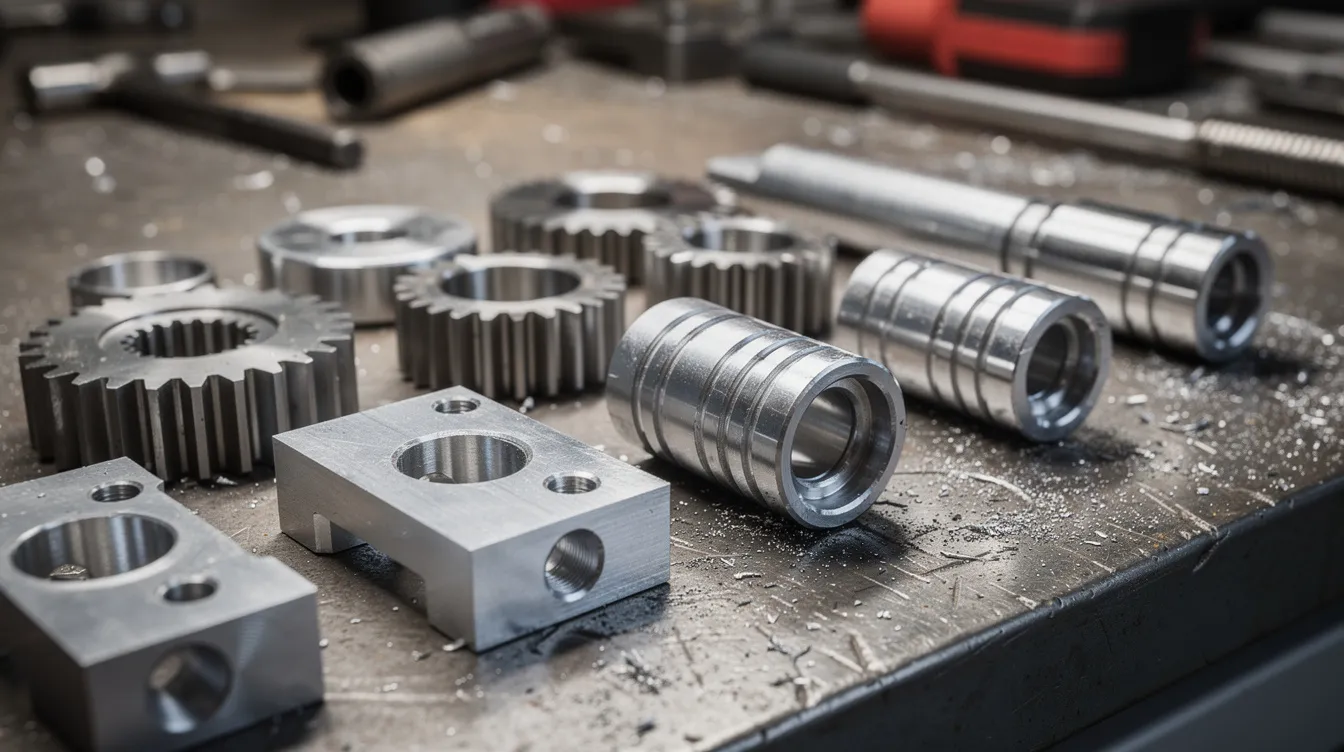
Typical use cases include housings, brackets, plates, heat sinks, molds, and die inserts – especially in aluminum and stainless steel. Basic operaciones de mecanizado in a milling setup include face milling, contouring, pocketing, drilling, and tapping, all performed in the same setup using automatic tool changes. CNC machining centers can perform multiple operations in one setup, y se reduce handling time significantly.
Comparing axis configurations: 3-axis milling handles flat or prismatic geometries with lower cost; 4-axis adds rotation for side machining; and 5-axis milling enables access to undercuts and complex contoured surfaces en una sola máquina. CNC machining centers achieve micrometric precision in machining operations – in a professional shop, tolerances of ±0.01 mm are typical, and high-precision environments like Anebon can reach ±0.002 mm on critical features.
CNC Turning (Torneado CNC)
In turning, la pieza rotates while a stationary or moving tool removes material. En este caso, the process is ideal for cylindrical parts. CNC lathes produce cylindrical shapes with high material removal speed, making them efficient for medium and high volumes.
Typical products include shafts, connectors, medical implants, threaded fasteners, and bushings in materials such as steel, titanium, brass, and engineering plastics. Multi-axis turning centers with live tools (C-axis, Y-axis) can perform milling and drilling on the same machine, giving you mill-turn capability that eliminates secondary operations.
CNC turning is efficient for high-volume production with bar feeders and automatic part catchers, reducing manual handling. Por ejemplo, producing 10,000 stainless-steel valves for an automotive OEM using a multi-turret turning center with bar feeder is a common scenario where cycle times and consistency drive cost savings.
5-Axis and Advanced CNC Machining
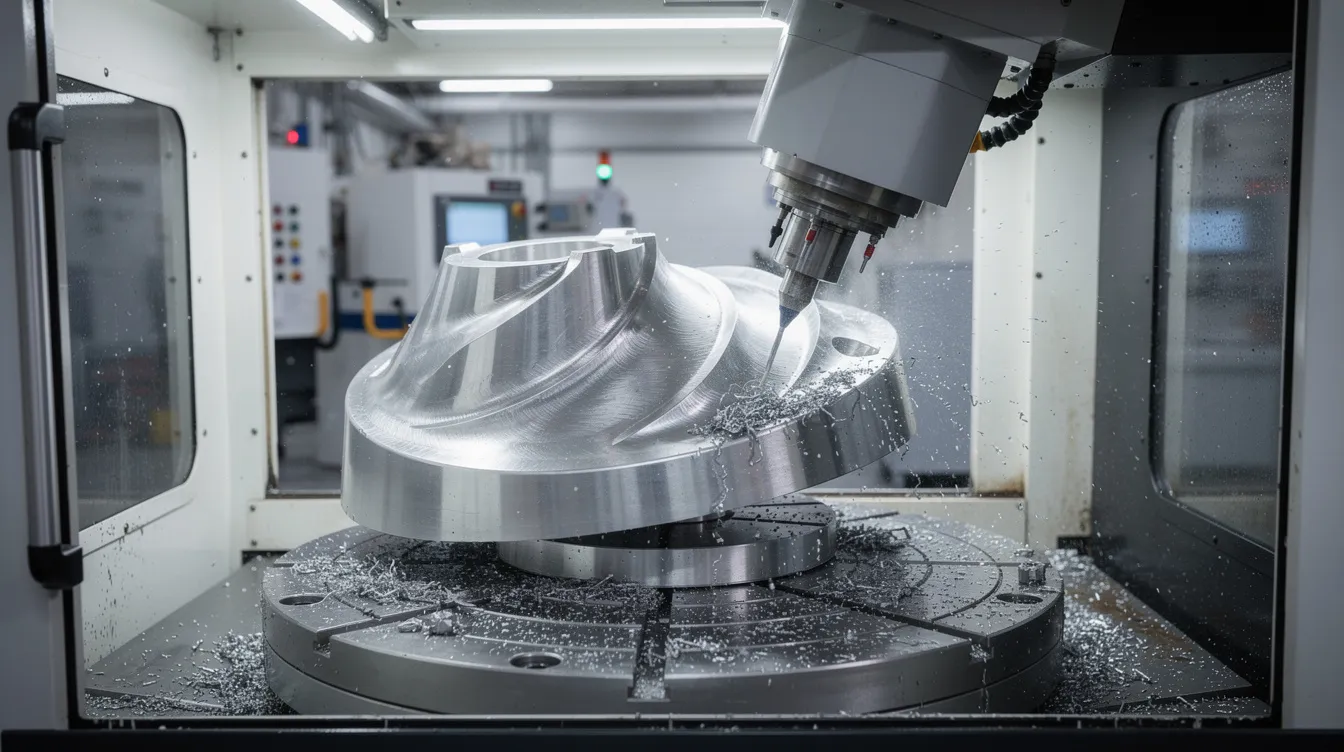
5-axis machining involves simultaneous or positional movement along X, Y, Z plus two rotary axes, allowing complex shapes en una sola sujeción. 5-axis CNC machines create highly complex geometries that would otherwise require multiple setups. CNC machines can operate with multiple axes for complex shapes, por lo tanto reducing accumulated errors.
Main advantages include fewer setups, better accuracy between features, the possibility to use shorter and more rigid tools de corte, and improved surface quality on contoured parts. Typical applications span aerospace turbine blades, impellers, orthopedic implants, high-end mold cavities, and robotics components.
A 3+2 strategy (positional 5-axis) is often a cost-effective compromise: rotary axes are positioned before cutting, then the machine works in 3 axes. Comparing the two approaches: 3-axis suits flat or simple prismatic geometry with shorter cycle times and lower cost; 5-axis excels at freeform surfaces, inclined angles, and complejidad de la pieza that demand fewer setups, though machine, programming, and maintenance costs are higher. Anebon supports complex parts through advanced multi-axis strategies.
Programming in CNC: G-Code and CAM Basics
All CNC machining is driven by a program that tells the machine how each movement, speed, and tool change should happen. CNC machines operate using programmed digital commands translated into a language the controller understands.
G-code is that language. Each line (block) contains commands like G00 (rapid move), G01 (linear cutting move), feed rates (F), spindle speed (S), and tool numbers (T). Here is a simplified example:
T1 M06            ; select tool 1
G54               ; work coordinate system
M03 S8000         ; spindle on at 8000 rpm
G00 X0 Y0 Z5      ; rapid move to start
G01 Z-1 F200      ; plunge at 200 mm/min
G01 X50 Y50 F100  ; linear cut to position
M05               ; stop spindle
M30               ; end program
Historically, operators wrote G-code by hand. Today, most professional shops rely on CAM to generate programs automatically from CAD models. Typical CAM tasks include selecting operations de mecanizado, choosing appropriate tools and cutting parameters per material (aluminum vs stainless steel vs plastics), running simulation to avoid collisions, and post-processing the output for a specific controller (Fanuc, Siemens, Heidenhain). Good post-processors and verification are critical to prevent crashes that could damage la máquina, de la pieza, or tooling. Ya que a single collision can cost thousands, simulation is never optional in a professional environment.
Materials Commonly Machined en CNC
CNC machining is versatile and supports a wide range of metals and plastics used in OEM products. En cuanto a material selection, here are the most common families:
-
Aluminum alloys (6061, 6082, 7075): Easy to machine, excellent strength-to-weight ratio. Common in aerospace, electronics housings, and automotive parts. Allow high spindle speeds and aggressive feed rates.
-
Steels and stainless steels (304, 316, 17-4PH): Used for structural, medical, and food-contact components where strength or corrosion resistance is critical. Slower machining, tougher tool requirements.
-
Titanium (Ti-6Al-4V): High strength, low weight, corrosion resistance. Harder to machine, often requiring rigid setups, optimized toolpaths, and effective cooling.
-
Copper, brass, and bronze: Good electrical and thermal conductivity. Typical for connectors, heat exchangers, and fluid-system components.
-
Engineering plastics (POM/Delrin, PEEK, PTFE, ABS, PC): Non-conductive, lightweight, used for insulators, medical devices, and prototypes. They require controlled speeds to avoid thermal deformation.
Anebon offers wide material options and advises customers on suitable grades depending on industry standards and operating conditions.
Advantages of CNC Machining vs Manual or Other Processes
CNC is not the only manufacturing method, but it offers a unique balance of precision, flexibility, and cost – especially from de una pieza to medium series. Al igual que other automated processes, it excels when consistency matters.
-
Precision and repeatability: Typical tolerances range from ±0.05 mm for non-critical features down to ±0.005 mm for critical dimensions. Por lo general, cost increases 2–5× when moving from standard to extreme tolerances.
-
Productivity and cost: CNC machines can run unattended with automatic tool changers and multi-pallet systems, reducing labor cost per part. Por tanto, high-volume runs become very competitive.
-
Flexibility: Switching from one part to another only requires loading a different program, ideal for prototyping, engineering changes, and small-batch production. De hecho, this flexibility is one of the reasons CNC dominates la fabricación of custom parts.
-
Digital design compatibility: The direct link from CAD to CAM to machine reduces errors from manual transcription and allows quick design iterations.
-
Safety: CNC improves workplace safety by keeping operators away from active cutting tools during el proceso de mecanizado.
Compared to 3D printing (fabricación aditiva), CNC delivers tighter tolerances, better mechanical strength, and a wider range of de fabricación materials. Sin embargo, 3D printing excels for complex internal geometries and very low volumes. CNC technology is used to manufacture parts for military applications as well, where reliability and material integrity are non-negotiable.
Applications of CNC Machining in Key Industries
CNC is utilized in various sectors including automotive and aerospace. Here are the key sectors where Anebon-type services are most relevant:
-
Aerospace: Brackets, housings, and structural fittings in aluminum and titanium, often with 5-axis machining and strict traceability. CNC machining is widely used in the aerospace industry for both structural and engine components.
-
Medical devices: Orthopedic implants, surgical instruments, and diagnostic equipment parts. CNC machining creates precise components for the medical industry, with emphasis on biocompatible materials and very fine surface finish.
-
Automotive and transportation: Engine and transmission components, suspension parts, EV battery housings, and cooling plates. CNC machines produce durable parts for the transportation sector at medium to high volumes en la cadena de suministro.
-
Electronics and robotics: Precision enclosures, heat sinks, actuator brackets, and robot end-effectors. CNC machining is essential for creating electronic device components with tight dimensional requirements.
-
Industrial machinery and automation: Custom fixtures, sensor housings, manifolds, and replacement parts requiring robust tolerances.
Anebon focuses on B2B / OEM clients in these sectors, supplying custom parts from rapid prototyping to full production.
Quality Control and Certifications in CNC Machining
High-precision CNC machining must be backed by strong quality assurance systems. Por eso, inspection is not an afterthought – it is built into every stage of el proceso.
Typical inspection tools include calipers, micrometers, height gauges, coordinate measuring machines (CMM), and surface roughness testers. The basic QC workflow follows three stages:
-
First-article inspection – verifying los planos against the first machined part.
-
In-process checks – monitoring during the run for tool wear and thermal drift.
-
Final inspection – confirming all features before shipping.
ISO 9001:2015 covers quality management, while ISO 14001:2015 addresses environmental management. Anebon is certified to both. For some industries (aerospace, medical), customers may also require material certificates, RoHS/REACH compliance, and full traceability de las piezas.
How to Choose a CNC Machining Supplier
For design engineers and OEM buyers, selecting the right partner is crucial for cost, lead time, and reliability. Here is what to evaluate:
-
Technical capabilities: Check axis count (3, 4, 5-axis), maximum part size, tolerances, supported materials, and surface finishes of de máquinas cnc the supplier operates.
-
Industry experience: Look for case studies or references in aerospace, medical, automotive, or electronics relevant to your products.
-
Quality and certifications: ISO 9001, ISO 14001, documented inspection processes, and the ability to supply measurement reports when needed.
-
Communication and DFM support: Willingness to review designs, suggest cost-saving changes, and provide feedback before production. En un entorno internacional, clear English communication is non-negotiable.
-
Scalability: Capacity to support both rapid prototyping and scaling to thousands of parts without sacrificing lead times.
Anebon exemplifies this tipo de partner: located in Dongguan, China, focused on overseas OEMs, with the ability to provide quick, detailed quotations and consolidated shipping of los centros de producción across multiple part numbers.
Working with Anebon for CNC Machining Projects
Now that you understand qué es CNC machining and how it works, here is how to move from knowledge to action if you need custom parts.
A typical engagement with Anebon follows this flow:
-
RFQ – Send your drawings and quantities.
-
DFM review and quotation – Anebon’s engineers review the design, suggest improvements, and quote.
-
Prototype run – Validate fit, form, and function with a small batch.
-
Production ramp-up – Scale to full volume with consistent quality.
Anebon offers CNC milling, CNC turning, 5-axis machining, die casting, and sheet metal fabrication under one roof, por lo que you can consolidate your supply chain. La inteligencia artificial is increasingly being integrated into CAM optimization and predictive maintenance, and Anebon stays current with these trends to keep improving cycle times and quality.
Strengths that matter for overseas OEMs: English communication, competitive lead times, consistent quality backed by ISO certifications, de precisión down to ±0.002 mm, and consolidated shipping of multiple part numbers.
Ready to get started? Send your CAD files or technical drawings to Anebon to request a quote and discuss una solución de mecanizado en CNC adecuada for your project. Whether you need a single prototype or thousands of production parts, the right CNC partner makes all the difference.