Precision in Aerospace: CNC Machining Services for Parts Manufacturing
CNC Machining Services for the Aerospace Industry: Precision Machining & Aerospace CNC Parts Manufacturing
Introduction: CNC Machining’s Role in Modern Aerospace Manufacturing
Anebon Metal Products Limited provides aerospace CNC machining services spanning rapid prototyping – as few as one to ten pieces – through series production reaching tens of thousands of parts. Whether the end use is a commercial aircraft, a business jet, a rotorcraft, or a spacecraft, CNC machining services provide the foundational digital precision that aerospace components demand. Rapid prototyping in CNC machining supports low-volume custom builds and mass production alike, making it the backbone of modern aerospace manufacturing.
Mission-critical aerospace parts such as turbine blades, landing gear components, and avionics housings depend on tight tolerances, often down to ±0.005 mm. Where designs require it, CNC machining produces parts with tolerances as tight as ±0.002 mm – a level of accuracy that separates aerospace precision machining from general industrial work. Standard industrial machining typically handles looser tolerances, simpler geometries, and far less documentation. Aerospace CNC machining, by contrast, is the computer-controlled production of flight-critical parts under rigorous quality controls, full traceability, and process stability that directly affect safety and performance.
What Is Aerospace CNC Machining & Why Precision Matters
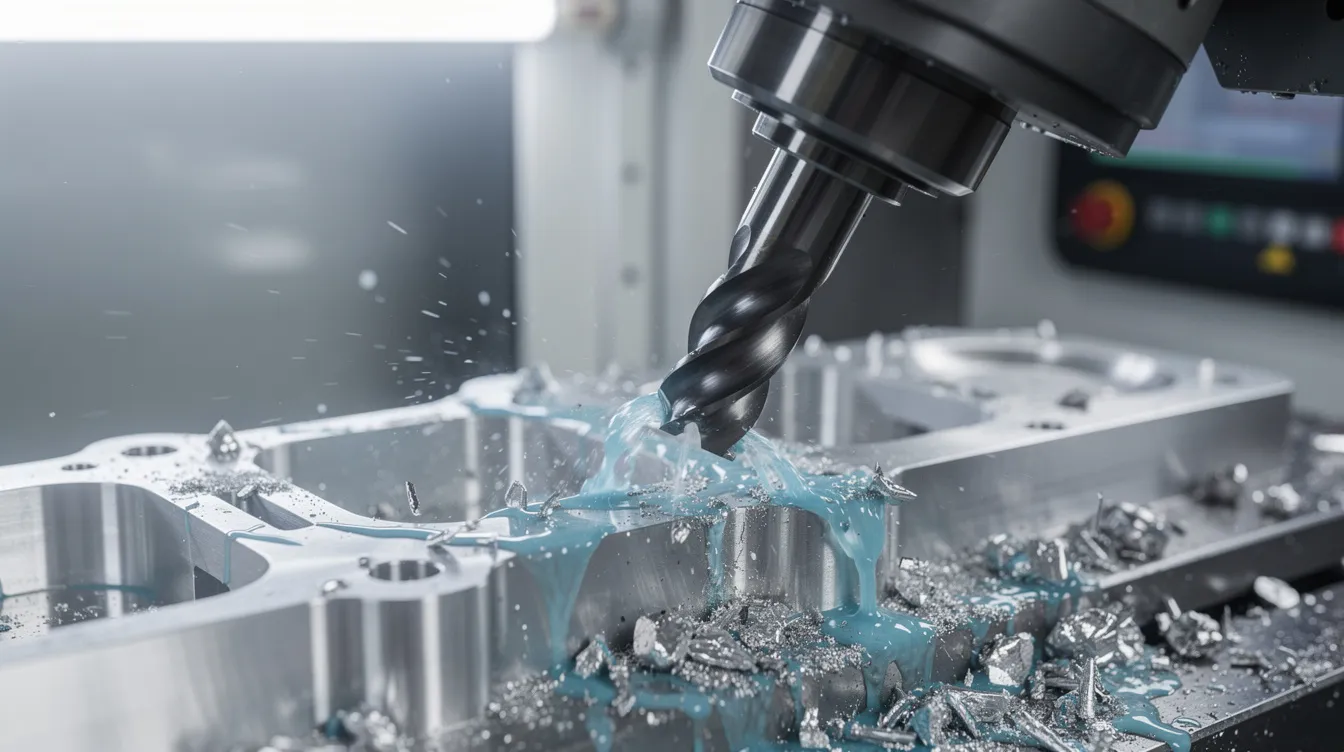
Aerospace CNC machining is the computer-controlled removal of material to produce safety-critical and flight-critical components for aircraft, satellites, rockets, and UAVs. These precision machined components must endure extreme temperatures and high pressures across every phase of operation, from takeoff to orbit. Precision machining is critical for life-sustaining aerospace systems – and precision failures can lead to catastrophic aerospace incidents.
The aerospace CNC machining industry demands higher precision and documentation than typical industrial sectors. Aerospace parts must meet strict FAA and EASA standards, and quality frameworks like AS9100 set the expectations that aerospace companies follow across their supply chains. Achieving tight tolerances is critical in aerospace machining because tight tolerances in aerospace components often need accuracy within micrometers. Aerospace manufacturing requires extremely tight tolerances and consistent quality – not just on a single part, but across every unit in a production lot.
Tight tolerances, accurate GD&T, and rigorous process control prevent vibration, fatigue cracking, and premature wear in aircraft wings, fuselage frames, and engine assemblies. Consider a concrete example: a 0.02 mm misalignment in a turbine disk bore or a landing gear trunnion can magnify stress under cyclic loads, accelerating fatigue cracks and reducing service life by orders of magnitude. Tolerance stack analysis is essential for multiple component alignment in these assemblies, where even microscopic errors compound. CNC machining can achieve tolerances as tight as ±0.002 mm, and that capability directly translates into safer flights, lower maintenance costs, and reduced Aircraft On Ground events. Precision machining also minimizes friction and promotes fuel efficiency – a direct contributor to optimal performance in jet engines and propulsion systems.
Aerospace CNC Machining Applications: From Airframe to Interior
CNC machining services touch nearly every subsystem of a modern airframe. From structural components deep inside the wing box to interior components in the passenger cabin, precision CNC machining is the process that turns raw metal alloy stock into flight-ready hardware. Aerospace components feature intricate internal channels and thin walls requiring advanced machining capabilities, and the range of aerospace applications continues to expand.
The major application groups include: (1) structural components such as ribs, spars, bulkheads, and seat tracks – for example, wing ribs and floor beams in commercial aircraft such as the Airbus A320neo and Boeing 787, where approximately 50% of the Boeing 787 is made of composite materials but the metallic structural inserts, brackets, and fittings are all precisely machined; (2) engine components and powertrain parts including turbine blades, compressor housings, and engine mounts, often machined from high performance alloys like Inconel and titanium; (3) landing gear and braking components – main and nose gear struts, torque links, actuator bodies, and brake calipers that handle enormous shock and impact loads; (4) avionics and sensor housings for control systems, navigation systems, and communication line-replaceable units in both military aircraft and civilian platforms; (5) satellite components and launcher structures, including payload mounting blocks and interstage hardware for low-Earth-orbit satellite constellations deployed since 2019, as well as space shuttle components and related propulsion hardware; (6) UAV and eVTOL airframes and propulsion hardware – electric vertical takeoff and landing aircraft are transforming aviation, and their motor mounts, rotor hubs, and structural frames increasingly rely on CNC machined aerospace parts.
Anebon typically produces small to medium-sized aerospace CNC parts within a milling envelope of approximately 800 × 500 × 400 mm and a turning envelope up to Ø300 × 500 mm. We focus on tight-tolerance metallic and engineering plastic precision components rather than giant monolithic wing skins or full fuselage panels.
Key CNC Machining Processes Used for Aerospace Components
No single CNC method covers all aerospace parts. Aerospace CNC machining manufacturers combine milling, turning, grinding, and EDM with inspection and finishing to produce the diverse range of mechanical components that aerospace firms require.
3-axis CNC machining is used for simpler geometries – prismatic structural components like brackets, frames, and housings. CNC milling at this level typically runs at spindle speeds of 10,000 to 15,000 rpm with tool changers carrying 20 to 40 tools for roughing, finishing, drilling, boring, and tapping. When parts demand freeform surfaces and complex geometries, 5-axis CNC machining handles them effectively, reducing setups and improving accuracy on curved aerodynamic surfaces such as turbine blades, blisks, impellers, and structural nodes. Precision milling on five axes enables aerospace machining companies to produce complex parts that would otherwise require multiple fixtures and re-clamping – each of which introduces cumulative error.
CNC turning is essential for round aerospace parts: shafts, bushings, hydraulic fittings, and valve bodies. Multi axis machining on live-tool and mill-turn platforms allows CNC turning operations to drill and mill features off the cylindrical surfaces without re-fixturing, holding concentricity and cylindricity to ±0.005 mm or tighter on critical diameters. CNC grinding ensures high-quality surface finishes for components like bearing fits and sealing surfaces in hydraulic systems. Wire and sinker EDM handle intricate aerospace components in hard alloys – internal cavities, thin slits, and features where conventional tool access is limited. CNC machining allows for controlled cutting processes on difficult-to-machine materials, and these CNC machining processes integrate into a seamless workflow with in-process probing and final inspection. Additive manufacturing can be integrated with CNC machining as well; hybrid manufacturing integrates CNC machining with additive technologies to produce complex components with internal channels or lattice structures that subtractive methods alone cannot achieve.
Materials in Aerospace CNC Machining: Metals, Alloys & High-Performance Polymers
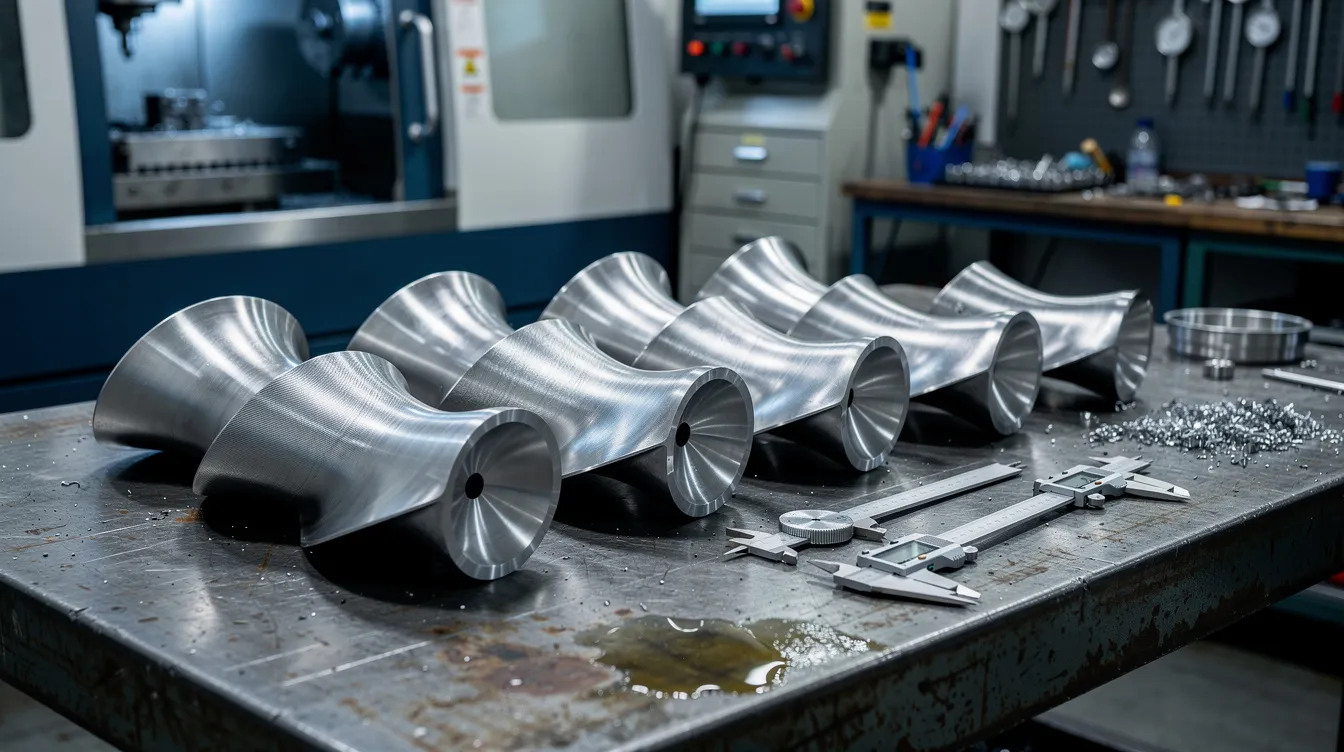
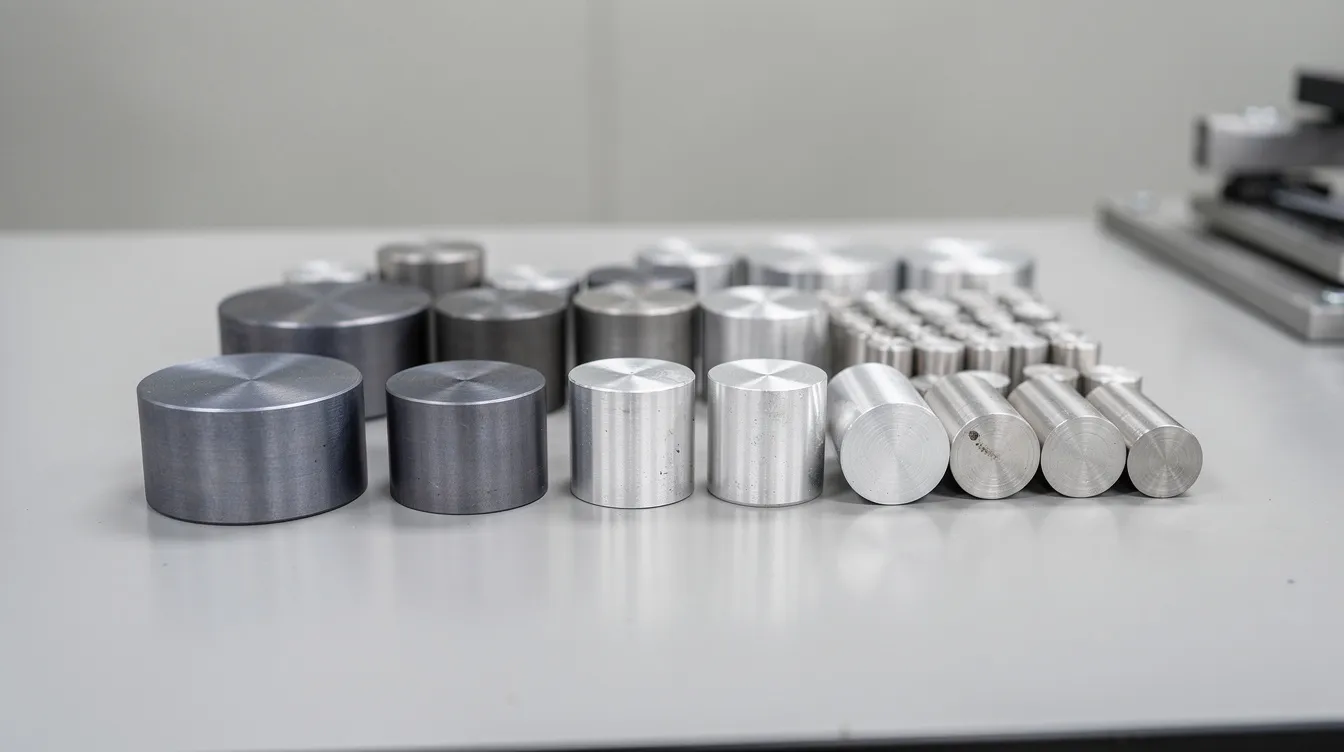
Aerospace manufacturing prioritizes strength-to-weight ratio, temperature resistance, and corrosion resistance. Material selection affects mechanical and thermal properties in machining, and advanced material processing capabilities are crucial for the aerospace sector. The materials used in aerospace machining include titanium, Inconel, and aluminum alloys – each chosen for specific operating conditions.
Among several aluminum alloys common in aerospace, 6061-T6, 7075-T6, and 2024-T351 see the widest use for ribs, brackets, avionics trays, and interior structures. Aluminum alloys are lightweight and corrosion resistant, with 7075-T6 offering yield strength around 500 MPa and excellent machinability. Surface treatments are necessary for corrosion resistance in aerospace parts: anodizing, alodine, chemical films, and hard anodizing are standard. These are among the most common aerospace materials.
Titanium alloys, especially Ti-6Al-4V, dominate applications needing high strength near hot zones – landing gear fittings, engine pylons, and structural fittings. Titanium alloys withstand higher temperatures than steel or aluminum, but their thermal conductivity of roughly 6.7 W/m·K is one-sixteenth that of aluminum 6061, trapping heat at the cutting zone. Work hardening complicates machining of certain aerospace materials like titanium, and springback from its low elastic modulus demands careful process planning. Tool life when drilling titanium can be as low as 300 to 500 holes, compared to thousands for aluminum under similar conditions.
Stainless steels and nickel superalloys – 17-4 PH, 15-5 PH, Inconel 718 – serve high-temperature or corrosion-critical roles in turbine hardware, exhaust systems, and fasteners. Superalloys offer exceptional mechanical strength and corrosion resistance, making them essential aerospace materials for critical engine parts and other aerospace components exposed to extreme heat.
Engineering plastics including PEEK, ULTEM, and PTFE address applications like electrical insulation, lightweight interior fixtures, and non-metallic wear surfaces. PEEK is used in critical engine parts for high temperatures where metal would add unnecessary weight. Anebon routinely machines all these alloys and plastics for aerospace customers, and our engineers can advise on material selection during DFM reviews, balancing cost, machinability, weight, and thermal environment.
Challenges in Aerospace Precision Machining & How We Address Them
The main challenges in aerospace precision machining include ultra-tight tolerances, complex geometries, difficult-to-cut alloys, and demanding documentation and traceability requirements. Selection of CNC services for aerospace requires uncompromising standards and careful evaluation, and evaluation criteria for aerospace CNC services include experience with aerospace materials and processes.
Heat generation, rapid tool wear, and workpiece distortion are acute when machining titanium and Inconel. Strategies include optimized trochoidal toolpaths that limit tool engagement, high-pressure coolant directed at the tool-chip interface, AlTiN or PVD tool coatings, and controlled step-down depths. Thin-walled or slender parts – actuator rods, landing gear struts, large flat panels – require rigid fixtures and vibration-damping tooling to prevent chatter and warping.
Anebon performs process planning with CAM simulation and collision avoidance, monitors tool life to replace cutters before failure, and uses in-process probing to verify critical features during machining. For batch repeatability, we maintain control charts and full lot traceability of CNC equipment, tools, and operators. As an example, in 2024 we delivered a thin-wall milled housing for a satellite communication module: aluminum alloy, multiple cable pass-throughs, wall thickness below 1 mm, flatness under 0.02 mm, and surface finish Ra 0.8 μm – requiring pilot runs, a custom fixture, and post-heat stress relief.
While we hold ISO 9001:2015 and ISO 14001:2015 certifications, we align our internal procedures with many AS9100 expectations – full lot traceability, material certification, first article inspection, and inspection records – without falsely claiming AS9100 or ITAR registration. The aerospace sector is focusing on greener, fuel-efficient designs, and AI and machine learning are shaping aerospace manufacturing by improving toolpath optimization and predictive maintenance across our operations.
Anebon’s Aerospace CNC Machining Capabilities & Services
Anebon Metal Products Limited is a Dongguan, China–based precision machining company founded in 2010, serving overseas OEM and aerospace customers across North America, Europe, and Asia-Pacific. Our aerospace machining capabilities are built around high precision CNC machining for small to medium-sized precision components.
Our core CNC machining services include 3- to 5-axis CNC milling, CNC turning with live-tool and mill-turn capability, plus complementary die casting and sheet metal fabrication for aerospace projects needing mixed manufacturing processes. Typical tolerance ranges reach down to ±0.002 mm on critical features, with maximum milling envelopes of 800 × 500 × 400 mm and turning capacity to Ø300 × 500 mm. Volume ranges span single-unit aerospace prototypes to recurring production orders in the thousands.
Our engineers provide design for manufacturability support on every aerospace project: reviewing submitted CAD and drawings, suggesting tolerance relaxation where function allows, and proposing geometry or material changes that reduce cost and machining time. Quality assurance infrastructure includes coordinate measuring machines for dimensional verification, optical measurement, hardness and roughness testing, material certificates conforming to EN and ASTM grades, and full inspection reports – including FAI-style documentation – on request. We serve as a reliable aerospace machining company for machining companies and aerospace manufacturers who need a proven, responsive machined parts manufacturer.
Typical Aerospace Components We Manufacture
Most Anebon aerospace projects involve small to medium-sized, high precision components rather than complete assemblies. We produce complex parts across a diverse range of aerospace applications, from commercial aircraft cabin hardware to satellite payload structures.
Concrete examples include aluminum and titanium brackets for commercial aircraft cabin and cargo systems – seat track brackets, overhead bin framing, cargo door supports; precision-milled avionics and sensor housings for navigation, communication, and flight control electronics; CNC turned hydraulic fittings, precision fasteners, and bushings for fluid control and actuation in hydraulic systems; 5-axis machined turbine blade prototypes and pump impellers; and structural inserts and mounting blocks for satellite payloads and UAV airframes. These CNC machined parts are integrated into commercial aircraft families launched after 2010, subsystems for small launchers and LEO satellites, actuator hardware for flight-control systems in helicopters, and military equipment and military aircraft platforms. We efficiently machine families of similar parts – bracket series with multiple hole patterns, for instance – using standardized fixtures and program variants that cut cycle time across the production run.
Quality Control, Traceability & Compliance for Aerospace Customers
Aerospace customers require documented proof of quality – not just good parts, but verified, traceable, certified parts. Full material traceability is mandatory in aerospace manufacturing, and organizations seek suppliers that demonstrate robust process controls and traceability in aerospace CNC machining.
Anebon’s ISO 9001:2015 quality management system documents process control from RFQ through shipping. Quality standards like AS9100 ensure compliance in aerospace manufacturing, and AS9100 certification is specific to aerospace quality management; while we do not hold AS9100, we align our procedures with its core expectations: incoming material inspection with certificates of conformity and heat/lot numbers, full traceability from raw stock through final shipment, and drawing revision control. Coordinate measuring machines are used for aerospace inspections at our facility, running CMM programs based on customer drawings with sampling plans and 100% inspection on safety-critical dimensions. Non-destructive testing techniques ensure aerospace part integrity when specified. Digital inspection reports are shared directly with customers. Our ISO 14001:2015 certification addresses environmental and sustainability management – coolant handling, waste metal recycling, chemical treatment controls – relevant to aerospace OEMs building greener supply chains.
Partnering With Anebon for Aerospace CNC Machining Projects
Overseas OEMs, design engineers, and R&D teams engage with Anebon for aerospace CNC machining from early-stage prototypes through production ramp-ups. The typical workflow follows a clear path: NDA, then RFQ with 3D models and drawings, DFM feedback typically within 24 to 48 hours, quotation, prototype run, feedback loop, production validation, and ongoing supply. Small batch CNC machining transitions smoothly into high-volume orders as programs mature.
Partnering with Anebon gives aerospace customers access to a mature Chinese precision manufacturing base with competitive lead times and pricing, a single supplier for machining, die casting, and sheet metal fabrication, responsive engineering support across time zones, and the ability to scale from five to ten prototypes to thousands of parts per year. If you have an upcoming aerospace project – whether it involves high performance alloys, complex components, or precision machined components for next-generation platforms – we invite you to send your CAD files or request a quote. Anebon is ready to support your aerospace manufacturing programs in 2026 and beyond, delivering the precision, traceability, and reliability that this industry demands.