Maximizing Efficiency: The Power of Slide Forming in Metal Production
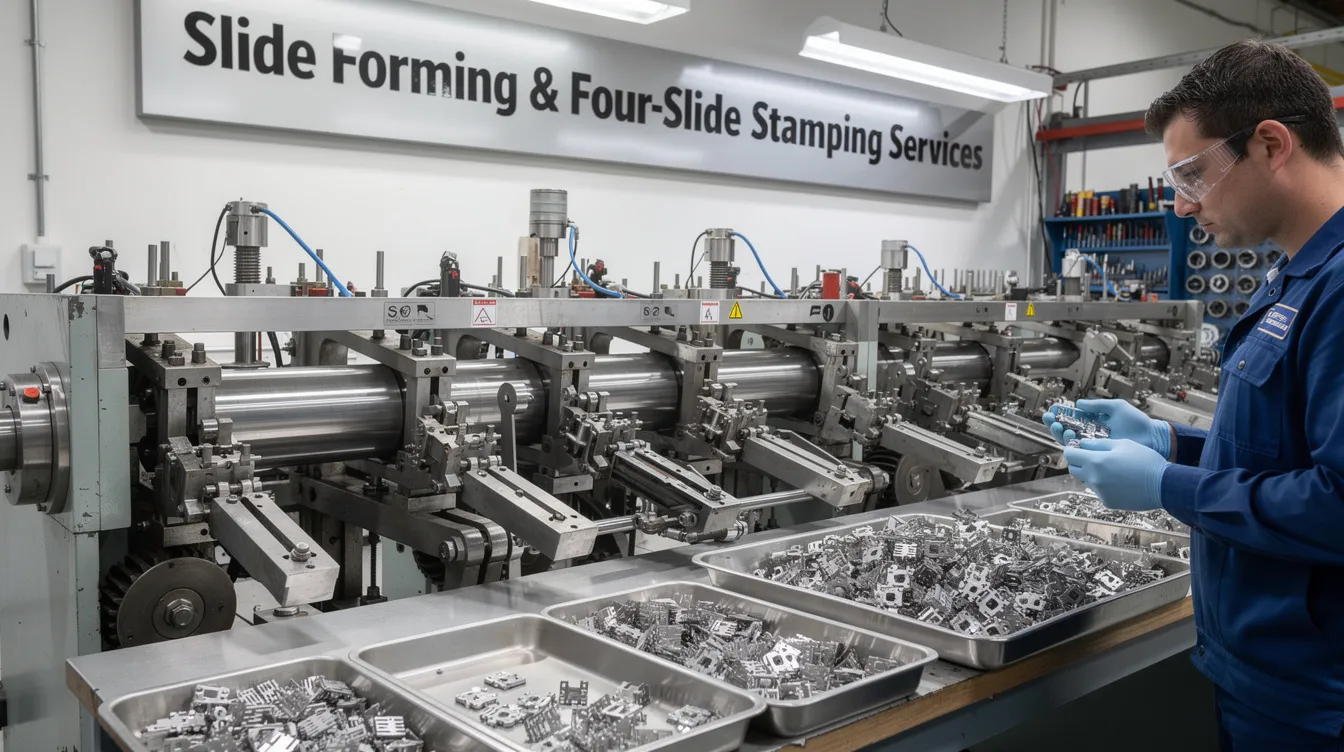
Slide Forming & Four Slide Stamping Services
Overview of Slide Forming at Anebon Metal Products Limited
Slide forming is a high-speed metalworking process used to fabricate intricate parts from metal strip or wire stock. The slide forming process involves feeding material into a machine where multiple slides shape the metal through sequential bending, punching, and cutting operations – all in a single setup. Slide forming produces components like clips and fasteners, connectors, brackets, and spring elements that OEM engineers rely on across demanding industries.
Anebon Metal Products Limited, founded in 2010 in Dongguan, China, offers four slide, multi slide, and traditional stamping alongside CNC machining and die casting services. Our production volumes range from tens of thousands to millions of parts annually, with tight tolerances down to ±0.02 mm on many slide formed features. Ready to get started? Request a quote, send your drawings or 3D models, or consult our engineers for DFM feedback.
What Is Four Slide & Multi Slide Forming?
Unlike conventional vertical stamping presses that move dies up and down, slide forming uses horizontal tools that approach the workpiece from multiple directions around a central forming area. Slide forming is often referred to as four-slide or multislide technology, though these terms differ slightly in configuration.
A four slide setup positions exactly four tools at right angles around a mandrel, while multi slide machines add slides or rotary stations for greater complexity. Strip or wire stock is fed, indexed, and shaped as side-mounted tools bend, form, and stamp in sequence. Compared to transfer presses (best for large deep draws), progressive dies (ideal for linear punch-and-blank sequences), and four slide machines (superior for small parts needing multiple bends from different directions), slide stamping delivers lower scrap and tooling cost for complex small components.
Slide Forming Capabilities at Anebon
Anebon’s slide forming capabilities are part of a broader precision metal fabrication offering that includes CNC machining, sheet metal fabrication, and die casting. We handle flat strip up to approximately 75 mm wide and 2.5 mm thick, and wire up to roughly 4–5 mm diameter, with exact limits depending on alloy and geometry. Slide forming is suitable for various materials including steel, brass, copper, and aluminum – plus stainless steel 304/316, phosphor bronze, beryllium copper, aluminum 5052/6061, and selected spring steels.
Typical part sizes are small to medium components for connectors, clips, housings, and flat springs used in automotive, medical, electronics, and industrial products. Four-slide stamping excels at producing small to medium-sized components efficiently, and slide forming achieves tighter tolerances compared to traditional methods. Integration with in-house machining and die casting enables hybrid assemblies or secondary machining on formed parts. We provide design consulting, rapid prototyping, and full-scale production backed by ISO 9001:2015 and ISO 14001:2015 certified systems.
How Four Slide & Multi Slide Processes Work
The slide forming production process is continuous and high-speed, designed to minimize handling between operations. The step-by-step flow runs: decoiling strip or wire, straightening, pre-stamping holes or slots if needed, progressive bending in four slide or multi slide stations, cutting off, and ejecting finished parts.
Slide forming machines use cam-driven tooling to cut, bend, and form parts, with servo systems available on advanced equipment for programmable motion control. Complex part geometry can be achieved due to multidirectional forming motions – advanced machines allow 8–14 forming directions using additional slides or rotary plates. Production rates can reach almost 15,000 pieces per hour, while slide forming can produce approximately 3,500 pieces per hour in high-volume manufacturing of more complex geometries. Slide forming machines can handle complex bends greater than 90 degrees in one cycle, far outpacing manual forming speed.
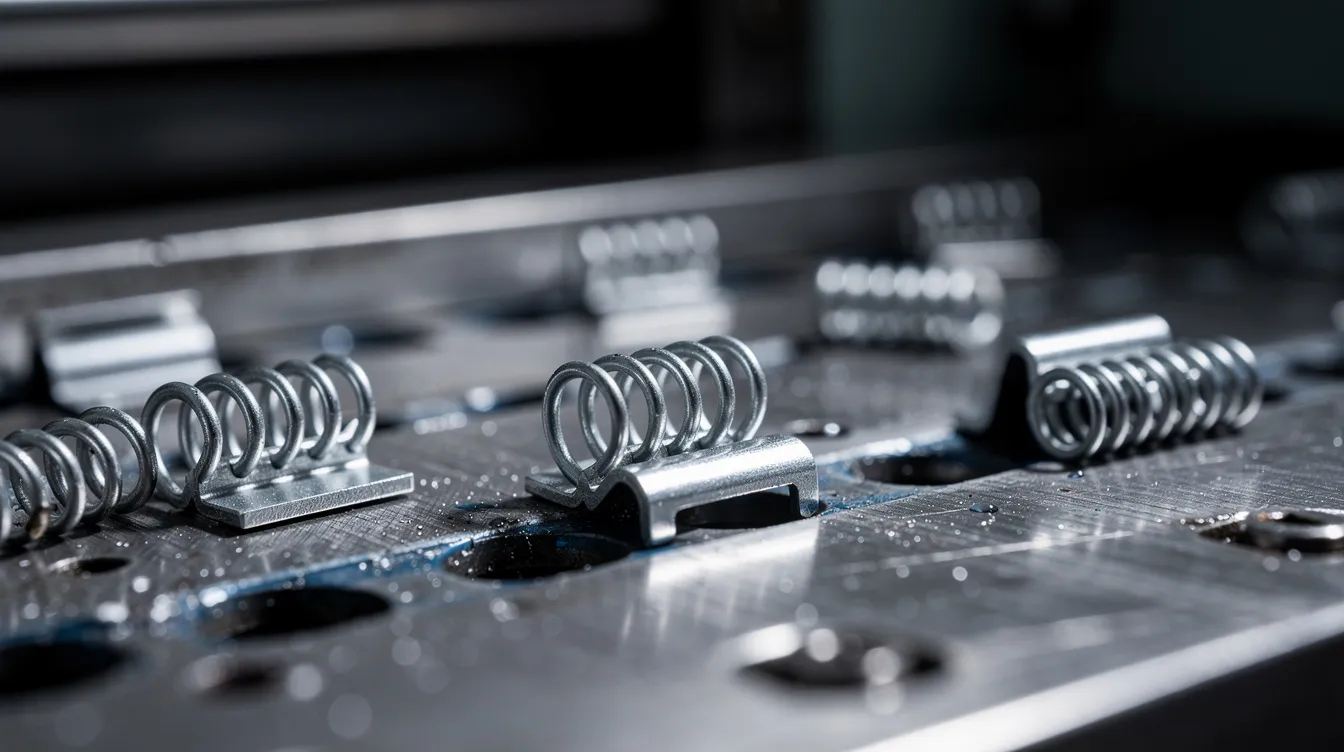
Benefits of Four Slide Stamping vs. Traditional Metal Forming
Four slide stamping technologies offer measurable advantages over progressive dies and transfer presses for the right applications:
|
Factor |
Four Slide Stamping |
Progressive Die |
|---|---|---|
|
Tooling cost |
As low as one-third |
3–10× higher |
|
Material scrap |
5–15% |
15–30% |
|
Bending directions |
4+ simultaneous |
Typically 1–2 |
|
Best part size |
Small to medium |
Small to large |
Slide forming reduces scrap by utilizing the full strip of material and utilizes raw stock edges to minimize material waste. Slide forming tooling can be significantly less expensive than traditional progressive die tooling – often one-third of the cost. Slide forming allows for multiple bends in one setup, eliminating secondary operations such as manual bending, welding, or assembly. Primary advantages of slide forming include lower tooling costs and reduced material waste.
Limitations are honest: the process is constrained by material width and thickness, slide travel distances, and is best suited for small to medium intricate parts at moderate to high volumes.
Typical Slide Forming Applications & Industries
Slide forming is widely used for intricate small metal parts across multiple industries Anebon serves. Representative components include electrical connectors, spring contacts, battery tabs, flat springs, clips, clamps, sensor brackets, EMI/RFI shields, and small housings. Slide forming is used in automotive, medical, and military industries, as well as electronics, aerospace, robotics, and industrial control systems.
In automotive, typical parts are retainer clips, terminal springs, and ABS sensor brackets – often produced at volumes of hundreds of thousands to millions per year. In electronics and telecom, grounding clips and micro-connectors demand tight tolerances and repeatability. In medical devices, precision stainless clips and catheter components require traceability and process validation. Each sector benefits from the ability to produce repeatable, high-strength, light-weight metal stamping parts.
Four Slide, Multi Slide, and Slide Stamping Machines
Different slide machines are chosen based on geometry, material, and required throughput. Classic four slide machines position four main slides approaching from 90° intervals around a central mandrel – ideal for most clips, brackets, and flat spring parts produced at high speed. Multi slide machines add forming slides or rotary platens allowing more complex multi-directional bends and integrated stamping from multiple sides.
Servo-driven slides and CNC-controlled feed systems improve repeatability, setup efficiency, and capability for quick design changes. Modern slide-forming machines can integrate inline processes, eliminating slower manual operations. At Anebon, machine selection is part of the DFM discussion, where our team balances tooling cost, cycle time, and part geometry with each project’s budget and construction requirements to serve customers effectively.
Slide Forming Design Guidelines for Engineers
Design engineers can make parts slide forming friendly by following a few key geometric rules. Maintain minimum bend radius at or above material thickness for most alloys. Keep hole and slot placement at least 1.5× material thickness from bend lines to avoid distortion. Ensure minimum flange widths are adequate for tool support, and maintain enough distance between bends for slide clearance.
Slide forming allows for design flexibility for intricate multi-axis bends, but very deep draws, severe extrusions, and substantial upsetting fall outside slide forming’s sweet spot and may need hybrid processes. Slide forming can create intricate geometries and multiple bends – the difference is collaborating early with Anebon’s engineering team for VA/VE and cost-driven design trade-offs. We recommend sharing before-and-after DFM sketches to illustrate improved designs on every project.
Secondary Operations & Integrated Processes
Slide forming can reduce secondary operations but also integrate them when required. Typical integrated or follow-on operations include in-line tapping, piercing, coining, light assembly, and adding solder-bearing material. Surface finishing options at Anebon include deburring, tumbling, electroplating (tin, nickel, zinc), anodizing for aluminum, and passivation for stainless steel.
We can combine slide formed parts with CNC machining, laser cutting, or sheet metal fabrication in the same project for sub-assembly delivery. Consolidating operations at one house simplifies logistics and reduces lead times for OEM customers. Quality control tools applied during secondary operations maintain dimensional consistency and cosmetic standards across every run.
Cost Savings & When Slide Forming Is the Best Choice
Total landed cost – including material, tooling, cycle time, scrap, handling, and shipping – is what matters, not just per-piece price. Slide forming tooling costs can be as low as one-third of traditional tooling, and slide forming maximizes yield per strip, lowering per-piece costs. Material efficiency in slide forming leads to lower overall cost, especially for expensive alloys like copper, brass, and stainless steel.
Slide forming delivers clear cost savings for high-volume runs of small, complex bent wire forms and strip components. Progressive dies, transfer presses, or CNC bending may be better suited when parts are large, need deep draws, or involve very thick materials. Anebon evaluates part complexity, annual usage, and material to recommend slide forming, multi slide, or alternative processes – send projected yearly quantities and 3D files to receive a precise cost comparison and access our VA/VE expertise.
Quality Assurance & Certifications
Anebon’s quality management system ensures every slide formed component meets specification. Our ISO 9001:2015 and ISO 14001:2015 certifications apply across slide forming, CNC machining, and die casting operations, providing the reliability overseas OEMs need. Key inspection methods include first-article inspection, in-process dimensional checks, statistical process control, and final inspection reports.
PPAP documentation, material traceability, and lot control are available for automotive, medical, and aerospace customers. Measurement tools include CMM, optical comparators, and custom gauges capable of verifying tight tolerances and complex bends on high precision stamping parts. These quality and environmental controls support stable, long-term production partnerships worldwide.
Working with Anebon: From Prototype to Production
A typical slide forming project progresses through clear stages: initial inquiry and DFM review, material selection, prototype or pilot run, tooling design and build, pre-production validation, and full-scale production. Our team shares 2D/3D files, tolerance stacks, and inspection plans via secure channels with overseas clients throughout the manufacture cycle.
Tooling lead times for slide forming are longer than CNC-only prototypes but early engagement compresses launch timelines. Located in Dongguan, Guangdong, Anebon has experience shipping to Europe, North America, and Asia-Pacific OEMs. Prepare your CAD models, material specs, and estimated annual volumes before reaching out to speed up quoting on this page.
Request a Quote for Slide Forming & Four Slide Stamping
Engineers, buyers, and project managers – submit your RFQs for four slide stamping, multi slide forming, or combined fabrication projects today. Anebon quotes from 2D drawings (DXF, DWG, PDF) and 3D models (STEP, IGES) and provides DFM feedback on every submission. We support rapid prototyping, pilot runs, and full production with consistent processes and documentation.
Contact us directly via our quote request page to get started. Anebon delivers cost-efficient, precise slide formed components on time to global OEM clients – every run, every combination of materials, every production volume.