Mastering the Art of Bend Stainless Steel for Optimal Performance
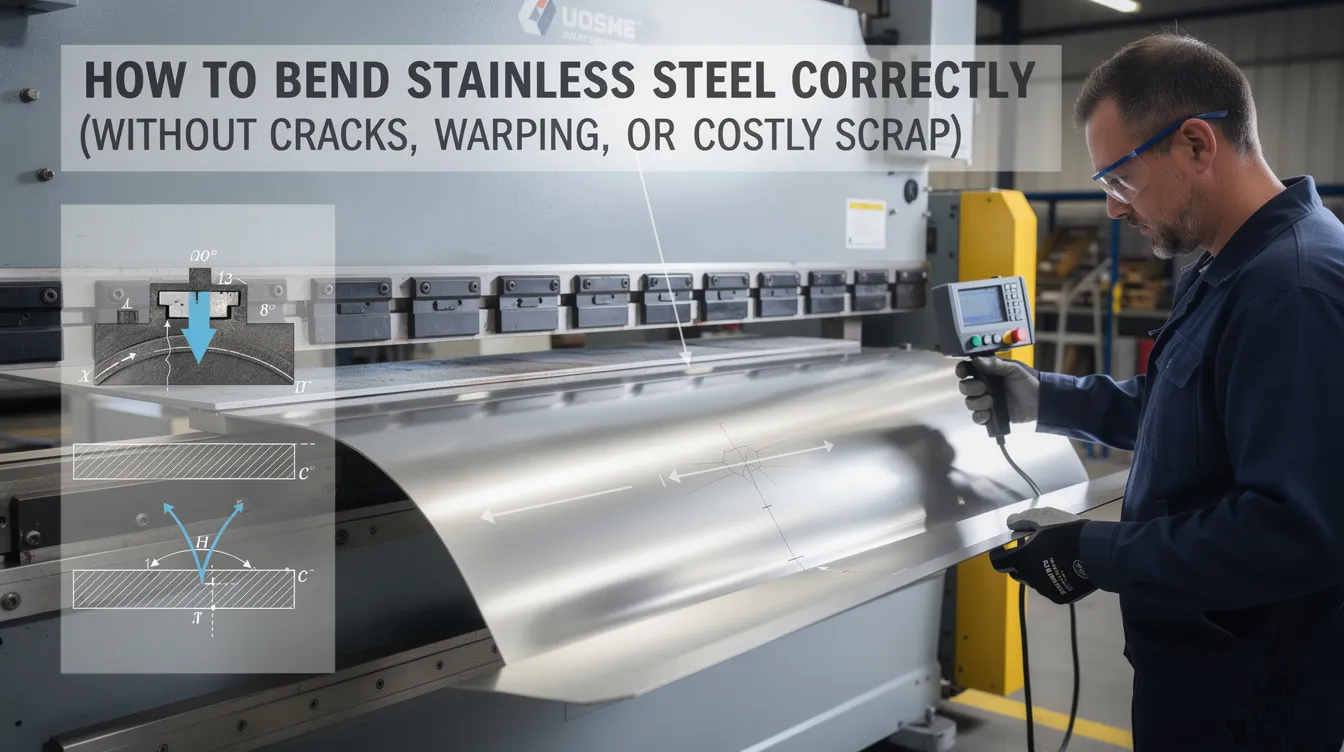
How to Bend Stainless Steel Correctly (Without Cracks, Warping, or Costly Scrap)
Stainless steel is a well known member of the metal family in various industries, from medical devices to electronics enclosures. But bending stainless steel correctly demands a fundamentally different approach than working with mild steel. Get it wrong, and you face cracking, warped parts, and expensive scrap. This guide covers everything OEM engineers need to know-from material science to shop-floor practice.
Fast Answers: Can You Bend Stainless Steel Like Mild Steel?
Yes, you can bend stainless steel-but not the way you bend mild steel. Bending stainless steel requires careful handling to prevent cracking and springback, because austenitic stainless steel grades like 304 and 316 work harden rapidly, exhibit stronger elastic recovery, and demand higher tonnage from your bending machines. If you apply the same tooling, bend radius, and correction techniques used for mild steel, you will likely end up with cracked parts or angles that spring far from the desired angle.
In concrete terms, 304 and 316 stainless steel sheet need a larger radius, roughly 1.3× more required force, and significantly more planning than mild steel of the same thickness. Typical use-cases for bending stainless include OEM housings, brackets, enclosures, medical device chassis, electronics frames, and architectural panels-parts that Anebon Metal Products Limited has been producing at its Dongguan facility since 2010.
The safest default: use cold bending on a calibrated CNC press brake, always create test coupons from the same material batch, and never try to “tune” a stainless bend by repeated hammer blows along the same bend line. Anebon offers stainless steel sheet metal fabrication including air bending, bottoming, and roll bending for both prototypes and volume production runs.
Stainless vs Mild Steel: Why Bending Behaves So Differently
The mechanical properties of stainless and mild steel diverge in ways that directly affect every bending process. Here is where the trouble starts:
-
Mild steel (e.g., ASTM A36) has a yield strength of roughly 250 MPa and ultimate tensile strength around 400–550 MPa. It is relatively soft, forgiving, and tolerates multiple small corrections.
-
Stainless steel 304 in annealed condition has a yield strength around 215–275 MPa-similar to mild steel-but its ultimate tensile strength reaches 500–700 MPa. Stainless steel has a high yield strength and low ductility compared to carbon steel at equivalent cold work levels, and it climbs further with every deformation.
Because stainless experiences work hardening during bending, the localized zone at the bend line becomes progressively harder and more brittle. Mild steel tolerates a bit of adjustment; stainless does not. In one documented comparison, bending 1.2 mm 304 stainless produced about 7.2° of springback versus only 2.8° for mild steel at the same inside radius and thickness.
Chromium and nickel content in stainless change its bending response: the face-centered cubic crystal structure of austenitic alloys retards deformation and causes stronger elastic recovery once the punch retracts. Standard bend charts designed for mild steel consistently underestimate the force and springback when applied directly to stainless steel sheet metal. The bottom line: different material, different rules.
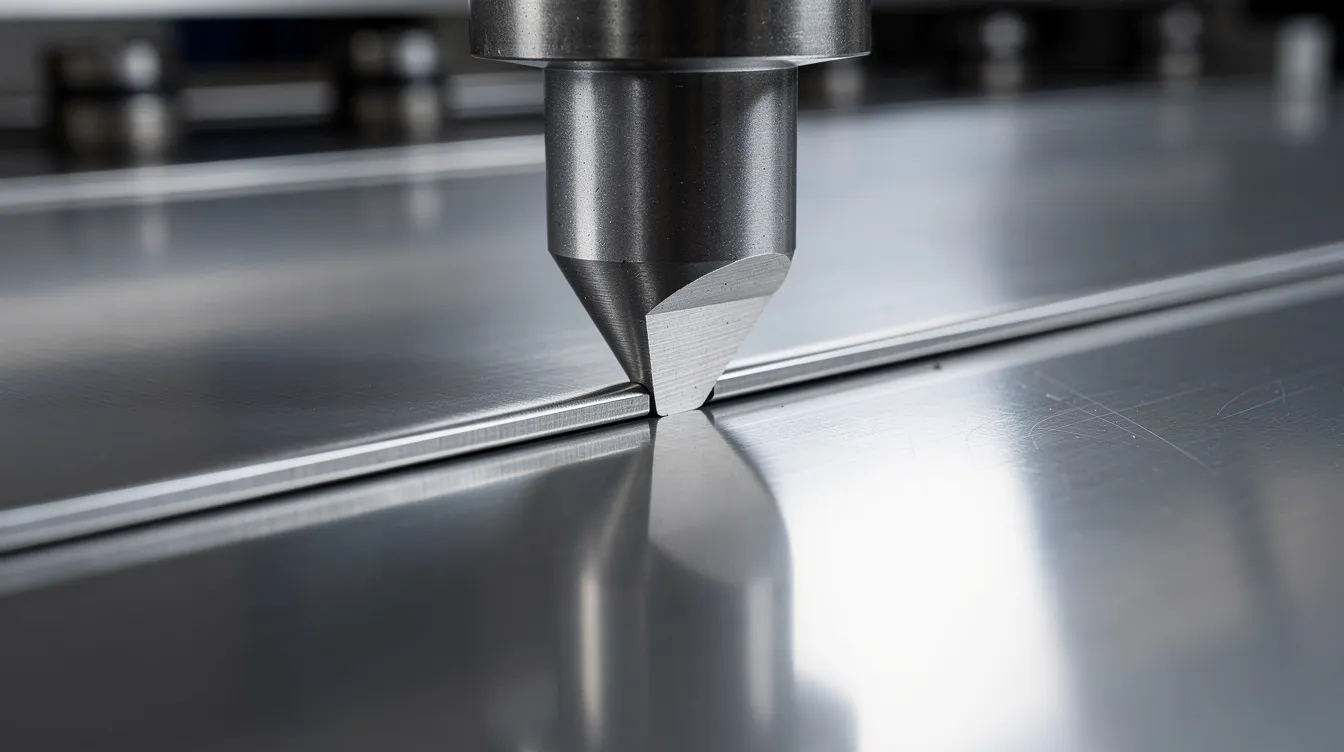
Understanding Grades, Grain Direction, and Work Hardening
Before choosing any bending process, check three things: alloy grade, temper, and grain direction. These determine whether your part will form cleanly or crack on the outer fiber.
Common grades differ significantly:
-
304: austenitic, non-magnetic, excellent ductility-the most widely used grade for bent sheet metal components. 304 stainless steel is more ductile than 316, making it slightly easier to form.
-
316: similar structure but with added molybdenum for enhanced corrosion resistance; a bit more difficult to bend.
-
430: ferritic, magnetic, and notably less ductile. The 430-series stainless has less nickel than 300-series grades, which limits its formability.
-
Full-hard tempers (e.g., 301 spring-hard): full-hard stainless has no ductility left for bending and must be annealed before forming.
Grain direction matters. On a #4 brushed stainless sheet, you can see the rolling lines visually and feel them with a fingernail. Align bends perpendicular to the grain to avoid cracking. If you must bend parallel to the grain, increase your inside bend radius by roughly 50%.
Work hardening occurs immediately when bending stainless steel. The bent zone hardens after a single pass, meaning you get one clean bend-attempts to re-bend or “bump” the same line will drop ductility and invite fractures.
Choosing the Right Bending Process for Stainless Steel
No single method fits all stainless parts. The right bending process depends on material thickness, required bend radius, angle tolerance, part geometry, surface finish requirements, and production volume. Below are the primary methods.
Air Bending and Bottoming on a Press Brake
Press brakes create straight-line angular bends in flat sheet metal using a punch and v die. In air bending, the punch pushes the sheet into the die opening without full contact-the material floats, and the inside radius forms at roughly 15–20% of the die opening. Air bending in press brakes requires less tonnage but accounts for the most springback.
Bottoming brings the punch closer to the die, locking the angle more tightly but increasing pressure on the stainless surface-risking tool marks and stress concentration.
For stainless steel, follow these guidelines:
-
Modify v-dies to 8 times the material thickness for stainless (versus ~6× for mild steel)
-
Punch nose radius should be at least 1× thickness to prevent cracking
-
Prevent buckling by using tools that provide support during bending
Practical example: Bending a 2.0 mm 304 sheet to 90° on an 80-ton CNC press brake. Use a 16 mm die opening (8× thickness), a 2.0 mm punch radius, and program a stroke to about 95–98° to reach 90° after springback. Anebon relies on CNC air bending with machine-controlled stroke depth and springback compensation for most 1.0–3.0 mm 304 and 316 stainless sheet metal work.
Roll Bending and Large-Radius Curves
Roll bending creates large-radius bends using a series of rollers-typically three or four-to form smooth arcs in stainless sheet or plate. This process is especially effective for radii several times greater than material thickness, where a press brake would be impractical. Think cylindrical housings, machine covers, and architectural panels shaped into circles.
Common thickness ranges for roll bending stainless run from 1.5 to 6 mm. Even with a larger radius, stainless springback must be addressed: operators intentionally over-bend and verify the finished shape with gauges or templates to hold the original shape specification. Anebon can combine roll-bent shells with CNC-machined end rings or brackets to deliver complete OEM assemblies.
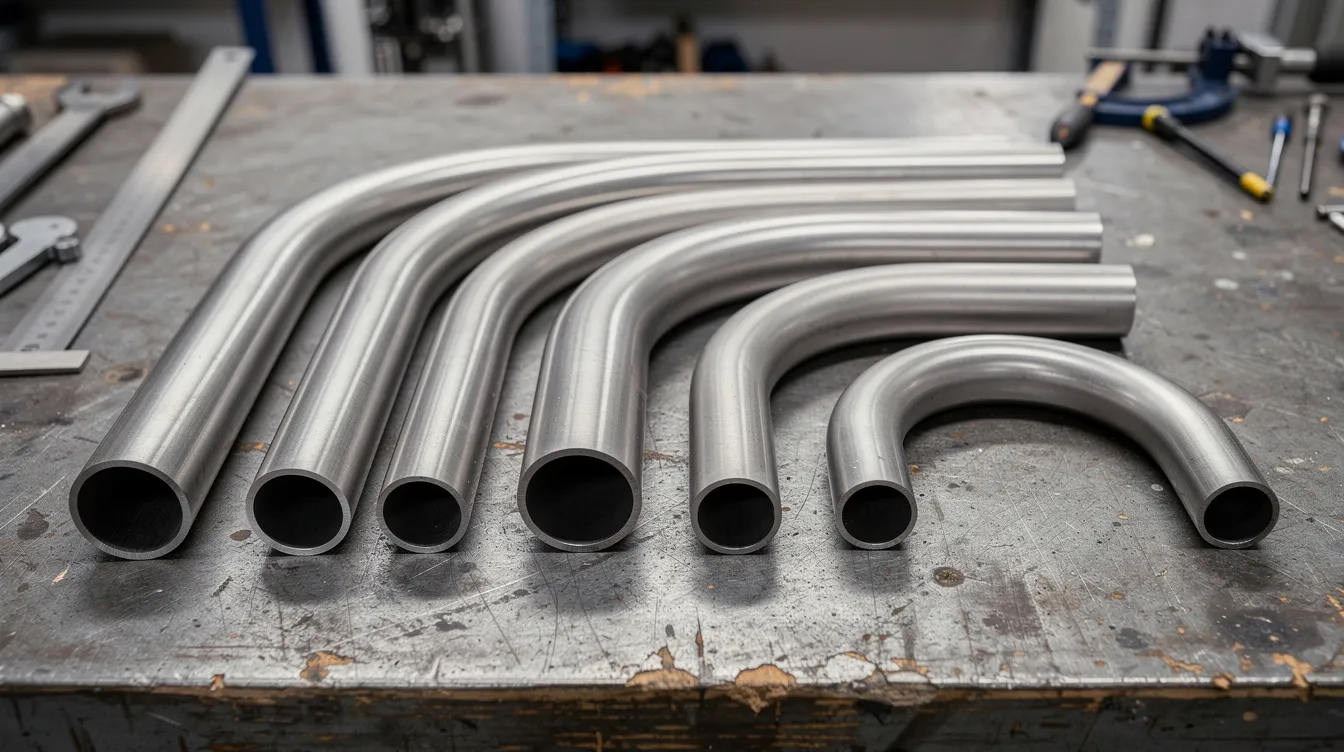
Bending Stainless Steel Tubing: Mandrel, Rotary Draw, and Press Bending
When you bend stainless steel tubing, preserving the cross-section is the primary challenge. Collapsing, wrinkling, or flattening are the main failure modes for stainless steel tubing under bending loads.
-
Rotary draw bending is ideal for tight radius bends. The tube is drawn around a fixed-radius die with clamping and pressure dies, producing precise curves for automotive exhausts, medical frames, and sanitary fluid lines.
-
Mandrel bending prevents collapsing in thin-walled tubing by inserting a solid or ball mandrel inside the tube during the bend. Pipe benders curve hollow cylindrical stock without collapsing the walls using a mandrel-essential when the wall-to-diameter ratio is high.
-
Press bending pushes the tube around a form die. It is simpler and cheaper but press bending can lead to deformation without internal support, so it suits applications where minor ovality is acceptable-simple frames, supports, or pipe runs.
-
Pipe bending shapes tubing to avoid kinking or flattening by using a circular die, which is standard for large-radius stainless tube arcs used in architectural handrails or construction elements.
Calculating Bend Radius, Allowance, and Springback in Stainless
Geometry and math matter more for stainless than for mild steel or aluminium because higher springback and rapid work hardening make “eyeballing” bends risky. Key terms to understand:
-
Inside bend radius (Ri): the radius on the inner surface of the bend
-
Bend allowance (BA): the arc length of the neutral axis through the bend, calculated as BA = (π/180) × angle × (Ri + K × t)
-
K-factor: the ratio of neutral axis position to thickness (typically 0.33–0.50 for stainless)
-
Bend deduction: the difference between bend allowance and the flat length consumed by two flanges
For mild steel, inside radius often equals material thickness. For stainless, the minimum inside bend radius for 304 stainless is 1 to 1.5 times thickness, and it must increase further when bending parallel to grain. Springback in stainless steel can range from 5 to 15 degrees depending on thickness, alloy, and bend configuration. Anebon uses CAM software and empirical data from production jobs since 2010 to refine bend deductions for each stainless grade.
Practical Rules of Thumb for Bend Radius and Die Selection
Keep these rules handy when designing parts or setting up bending machines:
-
Bend stainless steel at least 1.5 times its thickness for the inside radius when working with annealed 304 across the grain. The minimum inside bend radius for 304 stainless is 1.5 times thickness; when bending parallel to grain, push that to 2× or more.
-
Using a larger inside bend radius reduces stress on the outer surface of stainless steel, cutting cracking risk dramatically.
-
Die opening for air bending stainless: 8× material thickness (versus ~6× for mild steel).
Example: A 1.5 mm 304 stainless steel sheet uses a 12 mm v die opening and a 1.5 mm punch nose radius. This setup gives enough clearance to form a clean bend without surface cracking or the “orange peel” texture that signals over-strained material. Ignoring these minimum radius guidelines leads to cracking, reduced corrosion resistance at the bend, and cosmetic defects. Anebon’s engineers confirm tooling choices during DFM review when customers submit stainless sheet metal drawings.
Springback Compensation and Test Bends
Austenitic stainless grades spring back 5 to 15 degrees after bending, depending on the configuration. For a target 90° bend in 304 stainless, press brake programs often aim for around 93° or more. Overbending by 3 degrees compensates for springback in stainless steel in many standard setups, though thicker or wider parts may need more.
Always bend a scrap coupon from the same batch, thickness, and temper before committing to production parts. Springback is nonlinear-different angles, radii, and material lots behave differently, so tests must match the exact configuration.
CNC bending ensures high precision and repeatability: Anebon’s CNC press brakes store bend correction data per material and thickness, improving first-pass yield on repeat stainless jobs. Avoid “bumping” angles in multiple light hits-each strike accelerates work hardening and reduces ductility, creating a brittle zone right at the bend.
Cold Bending vs Heat: Protecting Stainless Properties
Production shops overwhelmingly favor cold bending for stainless steel sheet and thin plate. Cold bending preserves stainless steel’s mechanical properties and maintains the alloy’s chemical integrity without heat. The protective chromium oxide layer stays intact, and there is no risk of carbide precipitation at grain boundaries.
Using a torch to “soften” stainless before bending is dangerous: uneven heating causes localized annealing, and overheating above roughly 500°C can trigger sensitization-permanently degrading corrosion resistance. Cold bending preserves the alloy’s chemical integrity without heat, which is why Anebon relies almost entirely on controlled cold bending methods for aerospace, medical, and electronics applications.
When Heat-Assisted Bending Is Used in Industry
Heat-assisted bending applies heat to make thick material more pliable for bending, and it has legitimate uses-just not for typical OEM sheet metal. Heavy-wall stainless pipe, solid bar, and large structural sections may use induction bending in petrochemical or power-plant construction, where bends are made under controlled temperature and cooling conditions with metallurgical oversight.
Heat bending allows for substantial bends without cracking in these thick sections, but requires engineering approval, post-bend inspection for hardness and microstructure, and verification of corrosion performance. Annealing relieves internal stresses in stainless steel to make bending easier, but full annealing demands a controlled furnace at roughly 1040°C (1900°F) with specific cooling rates-not a hand-held torch.
Anebon does not torch-heat stainless sheet as a routine bending aid. Instead, where formability is an issue, the recommendation is a design change: for example, redesigning a sharp 1.0 mm 304 corner with a 0.2 mm inside radius into a 1.5–2.0 mm radius bend that can be cold-formed reliably.
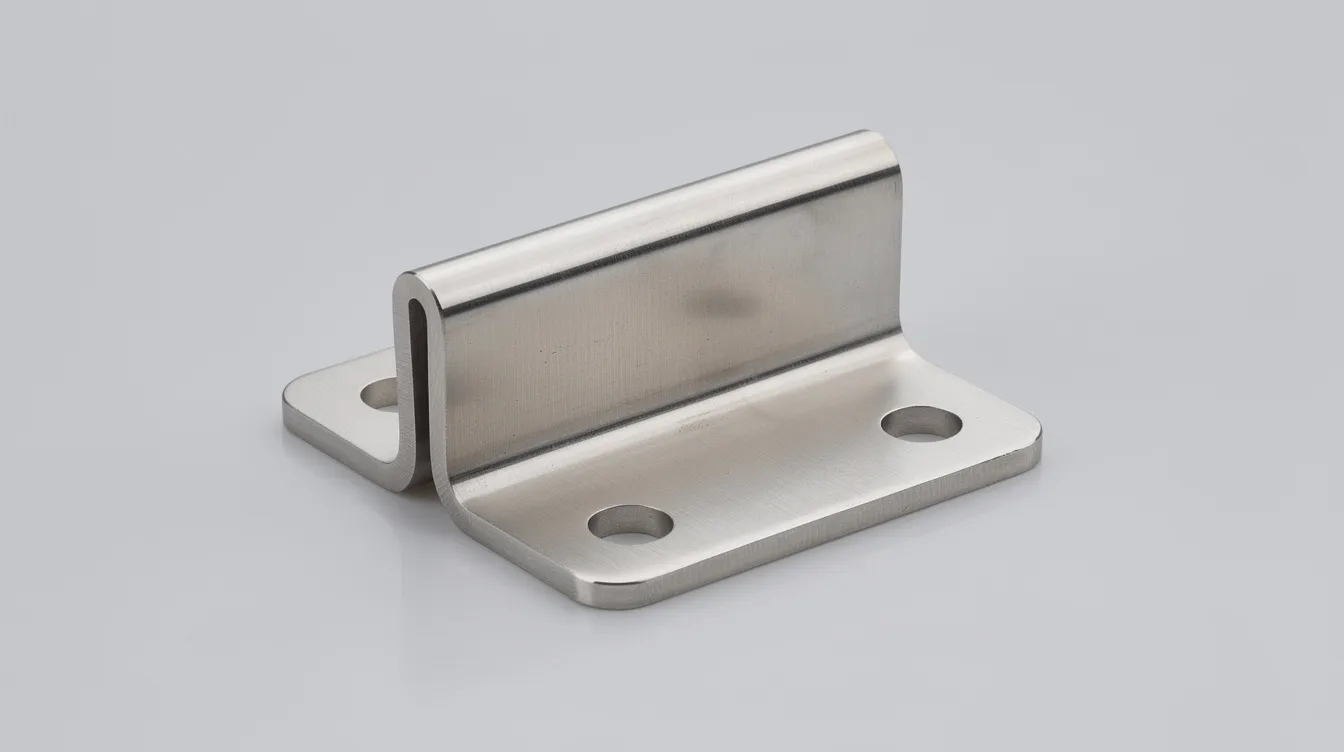
Practical Limits: Thickness, Tonnage, and Equipment for Bending Stainless
Stainless steel’s higher strength directly translates into higher required force and stricter equipment selection. Here is how thickness categories affect your approach:
-
Thin gauges (0.5–1.0 mm): Easier to bend, lower tonnage, but thinner material is more sensitive to edge cracking and wrinkles. Use a dead-blow mallet for bending thin stainless sheets only in hand-forming situations; a press brake is better. Proper lubrication formulated for stainless steel reduces friction and prevents galling during forming.
-
Common OEM sheet (1.0–3.0 mm): The sweet spot for CNC press brake air bending or bottoming. This is where most enclosures, brackets, and chassis fall.
-
Heavy plate (>4.0 mm): May require specialized equipment, very high tonnage, or heat assistance. Roll bending or dedicated forming force setups become more practical.
Stainless often needs about 1.3× the tonnage of mild steel for the same thickness, die opening, and bend length. Underpowered machines cause inconsistent angles and deflection; overloading a small shop brake risks tool damage or safety hazards. Anebon operates industrial CNC press brakes sized to handle typical stainless OEM workpieces and will flag designs that exceed safe bending capacity during quotation.
When to Use Professional CNC Press Brakes Instead of Manual Methods
Hand bending or small bench brakes may work for very thin stainless (around 0.5–0.8 mm) and small, flat parts with loose tolerances. But once stainless sheet approaches 1.5–2.0 mm thickness or long bend lengths, precise angle control demands a rigid hydraulic or electric press brake operated by computer numerical control.
CNC press brakes deliver programmable overbend, automatic crowning to compensate bed deflection, offline programming from 3D CAD files, and tight repeatability for multi-bend stainless parts. Use professional fabrication tools for a superior finish in bending-you cannot replicate this with brute force on a manual brake.
OEM customers designing thick or complex stainless enclosures should assume professional CNC bending from the start, not garage-style fabrication. Where equipment limits or shipping constraints apply, Anebon can advise on splitting complex bends into multiple parts joined by spot welding, fasteners, or wire-feed welding.
Design for Manufacturability: How to Bend Stainless Parts More Easily
Thoughtful design decisions made at the CAD stage reduce cost, scrap, and risk when you bend stainless steel sheet or need to bend stainless steel tubing. A few principles go a long way:
-
Choose bend radii that align with common tooling sizes and material thickness multiples. Arbitrary sharp corners force custom tools and drive cost.
-
Keep bend lines away from holes, cutouts, and welds. For stainless steel sheet, maintain at least 2× material thickness between the edge of a feature and the bend line.
-
Design bend sequences that avoid interference between flanges and machine tools. Use 3D models or bend simulation to check clearances before cutting.
-
Consider grain direction early-orient blanks so bends run perpendicular to rolling direction whenever possible.
Anebon’s engineering team reviews CAD files and advises design engineers on optimizing stainless parts for CNC bending, machining, and final assembly.
Integrating Bending with CNC Machining and Other Processes
For many OEM components, bending stainless sheet is one step in a larger process that may include laser cutting, CNC machining, welding, and surface treatment. Materials like stainless, titanium, copper, brass, and aluminium each demand different sequencing, but stainless is particularly sensitive to process order.
Machine critical features-countersinks, threaded bosses, or precision slots-before bending when possible, but account for how bending will shift reference surfaces. Specify realistic tolerances at bends; extremely tight flatness or hole-position tolerances may require post-bend machining. Anebon combines 5-axis machining, laser cutting, and press brake operations in a controlled workflow under ISO 9001:2015 quality assurance.
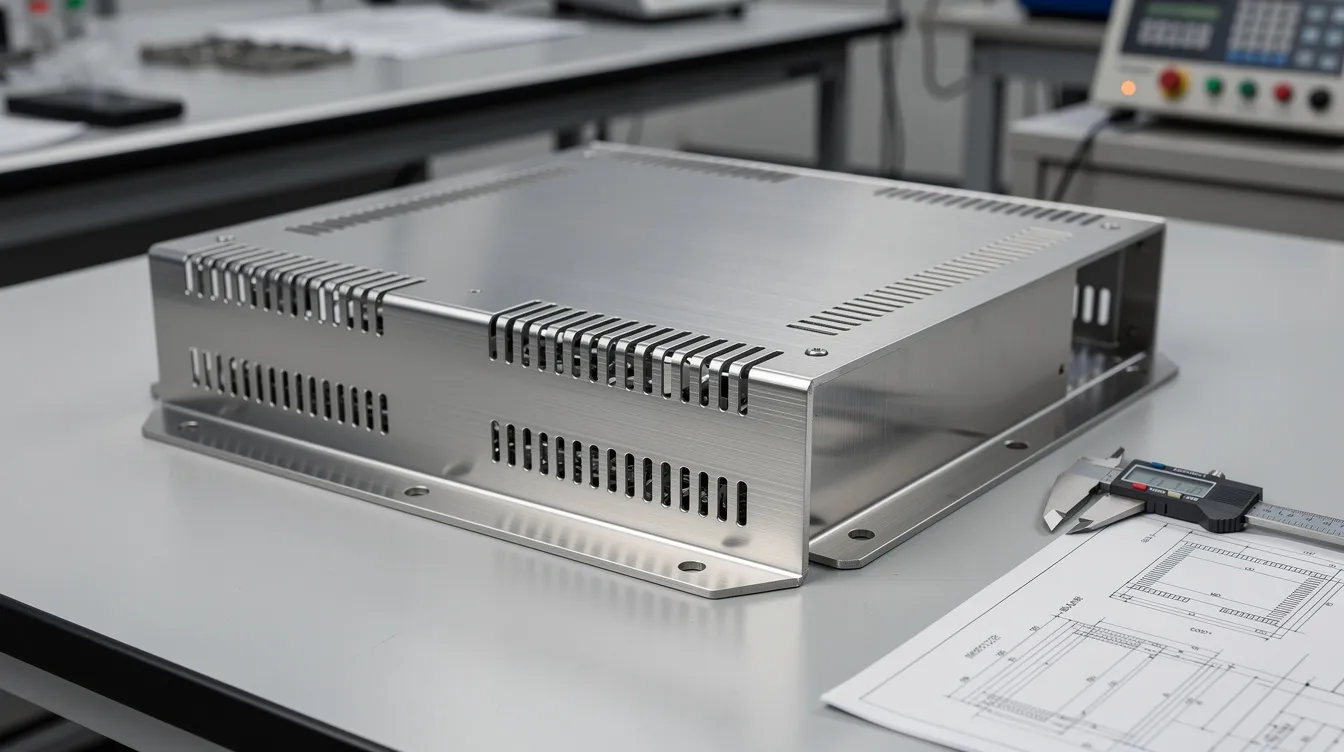
Example: A stainless electronic enclosure with machined brass standoffs, laser-cut glass-panel vents, silver-anodized aluminium trim, and four precise 90° bends. The flat blank is laser-cut, then features are machined, then bends are formed in sequence-all tracked in house under one quality system.
Quality Control, Surface Protection, and Anebon’s Capabilities
Precise bending of stainless steel matters most in industries like medical devices and electronics, where dimensional accuracy and cosmetic standards are non-negotiable. A drop in quality at the bend can render an entire part unusable.
To prevent tooling marks on polished, brushed, or mirror-finish stainless surfaces:
-
Apply protective masking films to the sheet before bending
-
Use soft die covers or liners on the v die and punch
-
Ensure tooling surfaces are clean, polished, and free of burrs or wood-like surface texture from wear
Typical inspection steps include checking bend angles with digital protractors, verifying dimensions after springback, and inspecting bends for cracks or surface defects under proper lighting and magnification. Any glass-like fracture patterns on the outer fiber indicate the bend was too tight or the material was over-hardened.
Anebon holds ISO 9001:2015 and ISO 14001:2015 certifications, which govern process control for bending stainless steel and other materials including titanium, aluminium, copper, and various alloys. These frameworks ensure that every step-from clamping and forming to inspection-is documented and repeatable across production runs in construction, medical, and electronics sectors.
Ready to create your next stainless steel part without costly trial and error? Send your 2D flat patterns or 3D CAD files to Anebon’s engineering team for DFM feedback and a detailed quote. Getting it right the first time starts with choosing a fabrication partner that understands how stainless actually behaves under a punch.