Mastering Sheet Metal Fabrication: A Guide for Modern Manufacturers
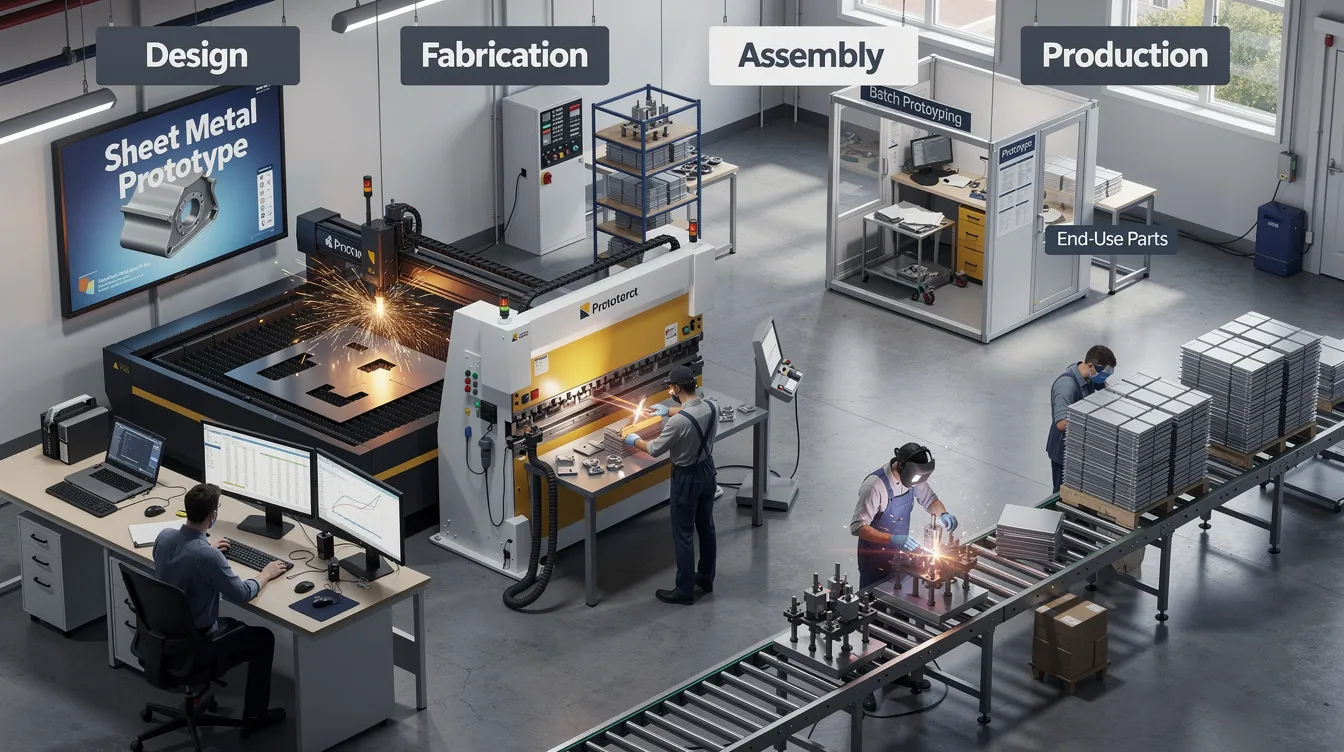
Sheet Metal Fabrication: From Prototype to End-Use Production
Introduction to Modern Sheet Metal Fabrication
Humans have been shaping thin metal for millennia, from hammered bronze panels on ancient temple doors to hand-formed copper roofing on medieval cathedrals. Today, that same instinct to transform flat sheets into functional structures drives a global industry supporting EV chargers, data center enclosures, surgical instrument housings, and satellite brackets. The materials are more advanced, the machines are digitally controlled, and the tolerances are measured in hundredths of a millimeter, but the core idea remains the same: start with a sheet, end with a useful part.
Sheet metal fabrication is a manufacturing process that converts flat metal sheets into finished components through cutting, bending, forming, and joining. It supports both prototyping and production quantities, making it one of the most versatile disciplines in metal fabrication. Parts made from sheet metal are typically lighter than machined parts while remaining strong, an advantage that matters greatly when weight budgets are tight in aerospace or automotive programs. The combination of high strength and low weight compared to solid blocks is a primary reason engineers specify sheet metal parts across so many sectors.
Anebon Metal Products Limited, founded in 2010 in Dongguan, China, specializes in high-precision custom sheet metal parts for overseas OEMs. We serve industries including aerospace, robotics, electronics enclosures, renewable energy, and automotive battery systems. Sheet metal fabrication is essential for diverse industries including automotive, aerospace, and construction, and our facility is built to handle all of them.
If you already have a project in mind, you can send 3D CAD models or engineering drawings to request a quote. Typical lead times are discussed in detail later in this article.
Primary Sheet Metal Fabrication Processes
Most custom sheet metal projects do not rely on a single operation. Instead, they combine multiple sheet metal fabrication processes in a single fabrication process route, moving from profiling to forming to joining to finishing. Understanding each step helps engineers make smarter design choices and communicate more clearly with fabricators.
Laser Cutting
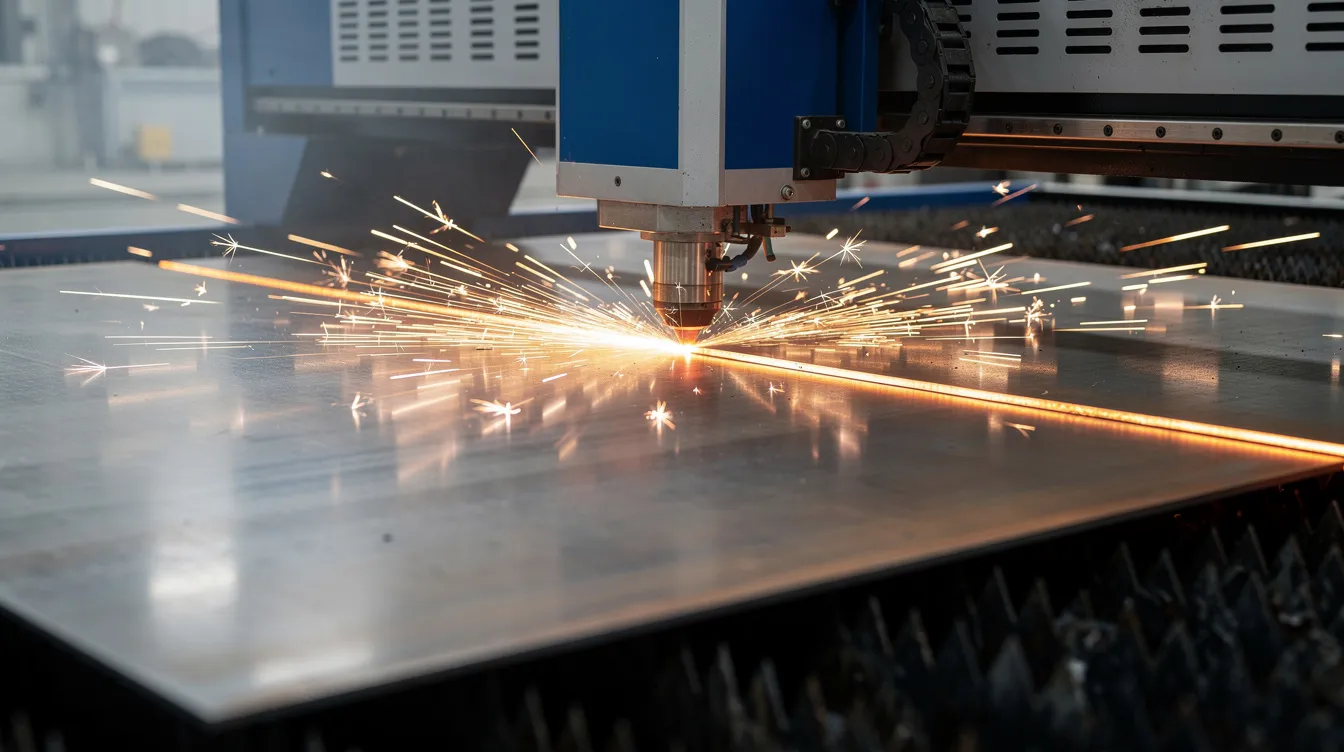
Cutting is typically the first step to separate raw sheet metal into specific sizes or patterns. Laser cutting uses a focused laser beam directed through a laser cutting head to profile parts from flat sheets with minimal heat-affected zone. A high power laser beam from a fiber laser cutter in the 3–6 kW range is the sweet spot for mixed-material shops, cleanly profiling carbon steel up to approximately 20 mm, stainless steel up to 10–12 mm, and aluminum in moderate thicknesses. Positional accuracy typically falls within ±0.05–0.15 mm, which is tighter than what most alternative methods offer. Other cutting methods include plasma cutting for thicker plate and waterjet cutting, which employs high-pressure water mixed with abrasive material for cutting metals without heat. Unlike a subtractive manufacturing process like CNC milling that removes material from a solid block, laser cutting works on flat stock and produces very little waste.
CNC Punching
For parts loaded with repetitive holes, slots, or louvers, a CNC punch press with a turret of tools is often more economical than laser cutting. Punching combines a punch tool with a matching punch and bottom die to cut shapes using mechanical force. A turret punch press indexes rapidly through patterns, making it ideal for ventilation panels or bracket arrays in mass production. Limitations include the inability to cut fine freeform contours and tooling lead time for custom punch geometries.
Bending and Forming
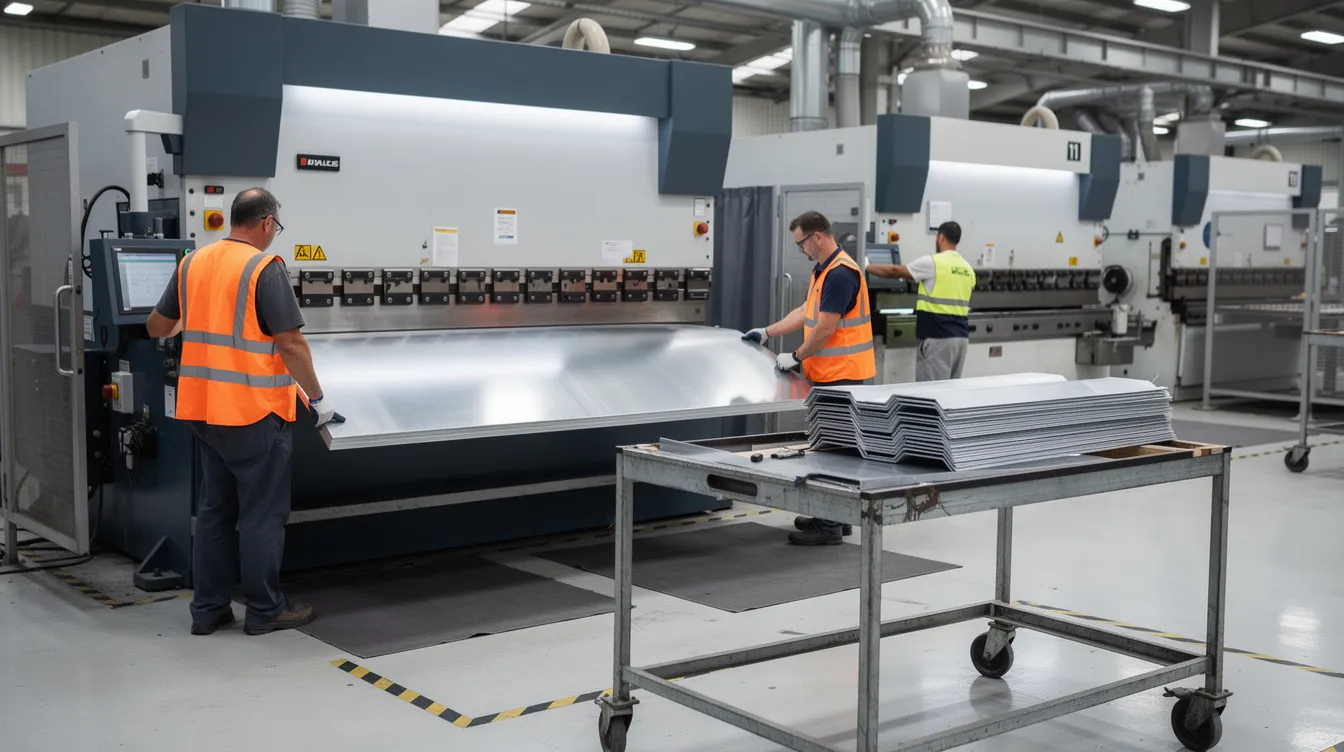
Bending is often performed using a press brake to create specific angles in sheet metal. CNC press brakes produce V-bends, U-channels, hems, and flanges along a straight axis with high repeatability. Programmable backgauges and automatic tooling changers maintain consistency across production runs. Press brake forming produces linear bends on metal sheets, and the technique is the primary way manufacturers form sheet metal into three-dimensional enclosures, brackets, and chassis. Metal stamping, by contrast, produces high volumes of uniform parts quickly using dedicated dies, but requires higher upfront tooling investment.
Secondary Processes
After forming, some features need tighter tolerances than standard sheet methods allow. CNC machining operations such as countersinks, tapped holes, and milled mating surfaces are added when interface dimensions are critical. Additional operations like embossing, louvering, and hardware insertion (PEM nuts, studs, standoffs) are addressed during design review and scheduled into the production sequence.
Common Terms and Concepts in Sheet Metal Fabrication
Designers and manufacturers need a shared vocabulary for efficient communication and accurate quotes. When both sides use the same terms in the same way, RFQ cycles shorten and revision loops shrink.
Cutting Terms
-
Laser cutting – thermal profiling with a laser beam; best for complex contours, prototypes, and low-to-medium volumes.
-
Punching – mechanical removal of material using a punch tool and die; best for repetitive internal features in higher volumes.
-
Blanking – cutting the entire component outline in one press stroke; the blank becomes the part. Preferred when production volumes justify die cost.
Each method serves a different sweet spot in the manufacturing process. Choosing the right one depends on contour complexity, volume, and material thickness.
Bending Terminology
Bending sheet metal accurately requires understanding several interrelated concepts:
-
Bend radius – the internal radius of a bend; minimum values are typically ≥ 1× material thickness for steels to avoid cracking.
-
K-factor – represents the neutral axis location and is used to calculate bend allowance.
-
Bend allowance – the arc length consumed by the bend, critical for developing the correct flat pattern so the final part hits its desired shape.
Material and Process Terms
Grain direction, minimum flange length, and relief cuts all influence whether a bend cracks, distorts, or comes out clean. Bending across the grain can cause splitting in certain alloys, and relief cuts near tight bends prevent tearing at intersections. Standard tolerances, such as those defined in ISO 2768-m, impact manufacturing efficiency and costs. For linear dimensions up to 30 mm, ISO 2768-m allows ±0.2 mm; up to 120 mm, ±0.3 mm.
Finishing Terms
Terms like powder coating, anodizing, and chem film (chromate conversion coating) describe ways to improve durability and appearance. Including these terms explicitly in engineering drawings and RFQs reduces ambiguity and lead times.
Materials and Surface Finishes for Custom Sheet Metal Parts
Choosing the right sheet metal fabrication materials and appropriate surface finishes directly impacts cost, performance, and corrosion resistance. Material selection should happen early, during sheet metal design, not as an afterthought.
Common Materials
Common materials used in sheet metal fabrication include aluminum, stainless steel, copper, and brass. Here is a quick reference for the most frequently specified sheet metal materials:
|
Material |
Typical Grades |
Best For |
Key Property |
|---|---|---|---|
|
Aluminum |
5052, 6061 |
Lightweight enclosures, EV battery trays |
Good formability, good conductivity properties |
|
Stainless Steel |
304, 316L |
Food, medical, corrosive environments |
Resistant to corrosion and oxidation |
|
Carbon Steel |
SPCC, DC01, 1018 |
Structural brackets, frames |
Strength-to-cost ratio |
|
Copper |
C110 |
Bus bars, EMI shielding |
Ideal for electrical applications due to high electrical conductivity |
|
Brass |
C260, C360 |
Connectors, low-friction contacts |
Suitable for low-friction contact applications |
|
Titanium |
Grade 2, Grade 5 |
Aerospace, high-performance |
Used for its strength and lightweight properties |
Sheet metal is 100% recyclable, saving energy in production and supporting sustainability goals across all of these material families.
Surface Finishes
Finishing processes improve corrosion resistance, strength, and appearance of metal parts. Core options include:
-
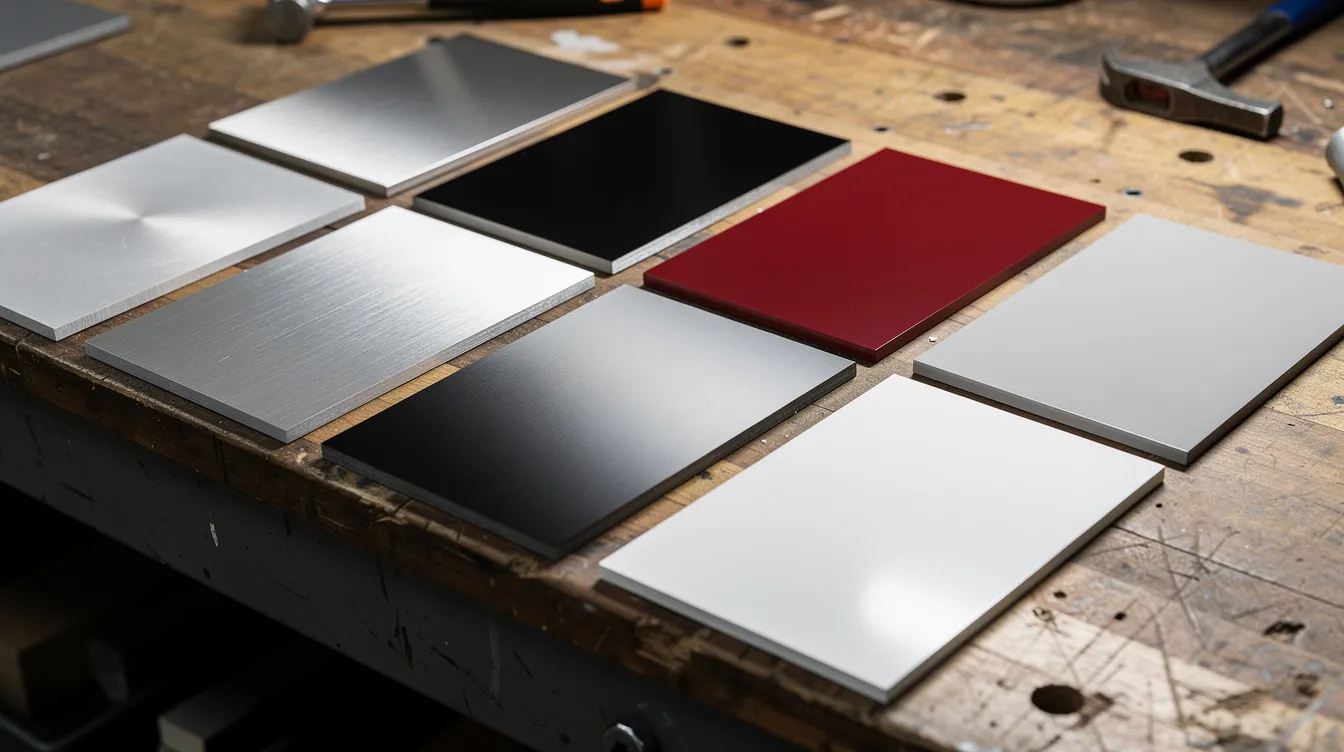
Powder coating – a powdered paint is electrostatically applied to the part surface, then heat-cured to form a durable, colored protective layer typically 50–80 microns thick. It outperforms standard painting methods in chip and fade resistance and achieves virtually any desired aesthetic.
-
Bead blasted textures use glass beads to create a uniform matte finish, often as a pretreatment before coating.
-
Anodizing – an electrolytic process for aluminum that builds an oxide wear resistant layer (type ii is decorative at 10–25 microns; type iii hardcoat provides heavier wear protection).
-
Black oxide – a chemical conversion for steel parts requiring a dark, corrosion resistant finish.
-
Chem film – a chromate conversion coating per MIL-DTL-5541 Type I/II that creates a thin, conductive, corrosion resistant layer with very little thickness added. It is often applied before painting or where electronics grounding requires conductivity across surfaces.
Powder coating applies a protective coating to enhance the appearance and durability of metal parts, making it the most popular finish for general-purpose enclosures.
Our surface treatment guide covers additional options. Anebon can recommend material and finish combinations during DFM review to match end use production conditions such as indoor vs. outdoor, marine, or high-temperature environments.
Design-to-Production Workflow for Sheet Metal at Anebon
This section walks through the complete fabrication process from first idea to mass production, showing how each stage builds on the previous one.
Ideation and 3D Modeling
Designers set functional goals, pick wall thicknesses (1.0–3.0 mm is typical for many enclosures), and model bend radii compatible with standard press brake tooling. At this stage, the sheet metal design should already consider how the part will be nested, bent, and assembled.
Engineering Drawings and Specifications
3D models are converted into detailed engineering drawings that specify tolerances, materials, finishes, and critical-to-function dimensions for custom sheet metal parts. Critical dimensions must be specified beyond the cad file itself, because automated fabrication equipment reads tolerances from drawings and inspection plans, not just geometry.
DFM Review
Our Design for Manufacturing review focuses on simplifying geometries, minimizing part count, and choosing hardware that shortens lead time. DFM feedback helps manage project costs effectively, and automated DFM analysis highlights fabrication challenges quickly, often catching issues that would otherwise surface only after rapid tooling or programming has begun. Excessive forming can increase costs and complicate bending, so we look for opportunities to consolidate bends or eliminate unnecessary flanges.
Prototyping and Validation
Anebon fabricates first articles using the same laser cutting and forming equipment as production to verify fit, strength, and assembly steps. These low volume prototypes give the customer a chance to run functional tests, fit checks with mating parts, and thermal or vibration tests for electronics enclosures. The design is then frozen to exact specifications before committing to full scale production.
Once validated, we lock in process parameters, inspection plans, and quality checks for repeatable mass production runs.
Step-by-Step Sheet Metal Fabrication Process on the Shop Floor
Here is a practical, factory-level view of how a typical part moves through Anebon’s workshop, from raw material sheet stock to packed shipment.
Cutting
Multiple parts are nested on large sheets (commonly 1250 × 2500 mm) using optimization software to maximize material efficiency. The laser cutter or punch press then profiles each part and cuts internal features. Parts can be delivered in as fast as 1 day for urgent prototype orders when material is in stock and geometry is simple.
Deburring and Edge Treatment
Deburring is the process of removing sharp edges left from cutting in sheet metal fabrication. Mechanical deburring and edge rounding improve safety, coating adhesion, and fit quality during assembly.
Bending and Forming
Technicians program CNC press brakes, set up tooling, and follow a defined bend sequence. Each bend is verified against the drawing before proceeding to the next. The goal is to keep tolerances tight and surfaces free of tool marks across every material sheet processed.
Joining
Welding joins metal pieces by melting the base material and adding filler material. Common joining methods include:
-
Spot welding – fast, economical for overlapping panels.
-
TIG welding (tungsten inert gas) – clean, precise, preferred for visible joints on stainless or aluminum.
-
MIG welding – higher deposition rate, good for structural steel assemblies.
-
Riveting and hardware insertion – PEM nuts, studs, and standoffs pressed into punched or laser-cut holes.
The method depends on material, strength requirements, and cosmetic expectations.
In-Process Inspection
Bend angle measurements, gauge blocks for key dimensions, and go/no-go fixtures for high-volume parts catch deviations before they propagate downstream.
Final Finishing and Assembly
Surface treatments are applied, multi-part housings or frames are assembled, and every unit undergoes final dimensional and cosmetic inspection before packing.
Automation, Quality Assurance, and Lead Times
Anebon combines automated equipment with skilled technicians to deliver production parts on competitive lead times to overseas OEMs. While no shop has infinite capacity, our investment in automation and process control means we scale efficiently across production volumes without sacrificing quality.
Equipment and Automation
CNC laser cutters, automated tool changers on press brakes, and offline programming reduce setup time and increase repeatability. Unlike many traditional sheet metal shops that rely on manual setups, our approach ensures that both prototypes and high volume production runs benefit from the same manufacturing efficiency.
Certifications and Process Control
ISO 9001:2015 and ISO 14001:2015 are important quality and environmental certifications in precision manufacturing. These certifications structure our process control, traceability, document management, and environmental compliance. B2B OEM manufacturing services often involve tight tolerances and a wide materials range, and our quality system ensures consistency across all of them.
Tolerances
Standard sheet metal tolerances follow ISO 2768-m for general dimensions. For features requiring greater accuracy, we apply tighter controls, and cnc machining can achieve tolerances as precise as ±0.002 mm on critical surfaces.
Lead Times
|
Order Type |
Typical Lead Time |
Notes |
|---|---|---|
|
Rapid prototypes (simple geometry) |
5–7 working days |
After drawing approval, material in stock |
|
Small production runs (tens to low hundreds) |
10–15 working days |
Simple finishes included |
|
Mid-volume with complex finishing |
3–5 weeks |
Powder coating, anodizing, assembly |
Sheet metal fabrication is cost effective for high-volume production because tooling amortizes quickly and cycle times per part drop significantly. We provide full inspection reports, first article inspection (FAI) options, and capability studies (CP/CPK) for long-term OEM programs. Sheet metal fabrication supports high-volume production of parts with consistent quality at every quantity break.
Applications and Real-World Examples of Sheet Metal Parts
Sheet metal is used wherever strong, lightweight, and easily manufactured structures are needed. Common sheet metal parts include brackets and assemblies that appear in virtually every industry.
Electronics
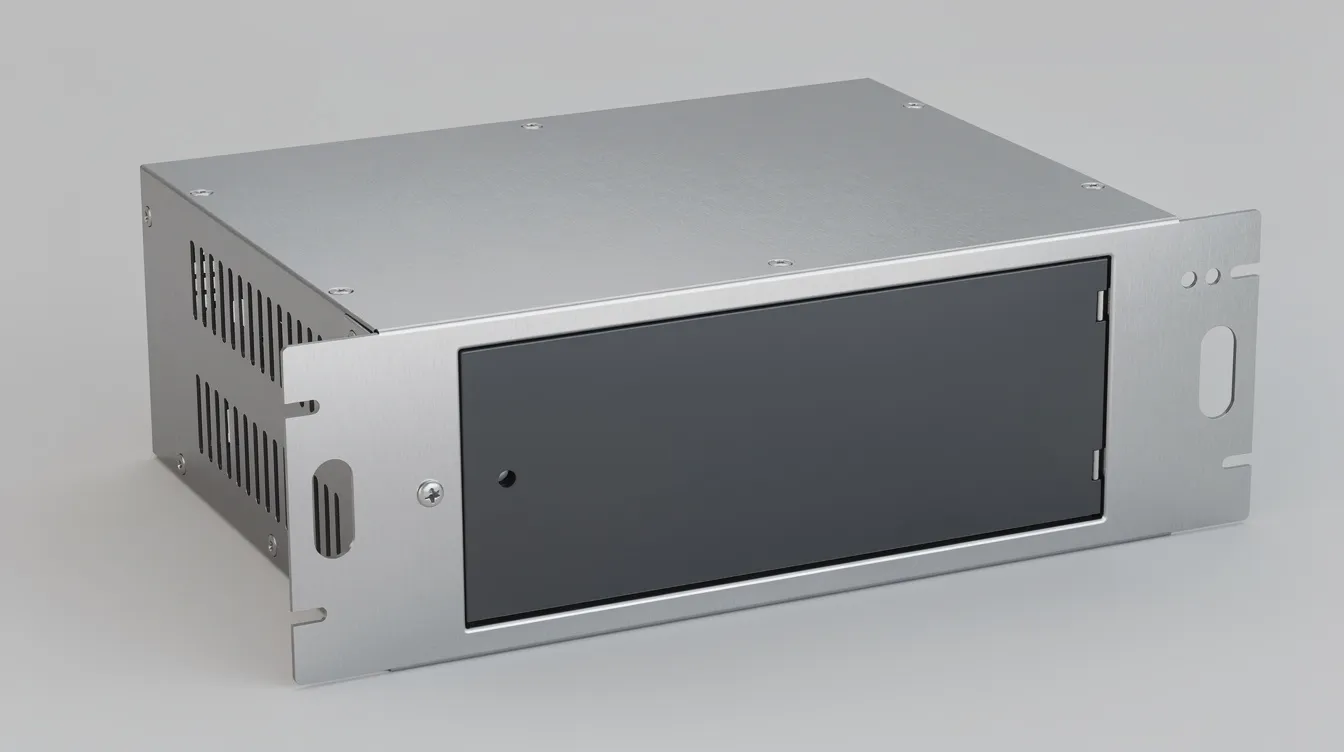
19-inch rackmount chassis, network server enclosures, and custom EMI/RFI shields use copper or tinned steel panels with precise cutouts for connectors and ventilation. Sheet metal is ideal for creating electrical enclosures and bus bars where both structural integrity and electromagnetic performance matter.
Automotive and EV
Sheet metal is used for automotive chassis and enclosures, battery module trays, inverter housings, brackets for ADAS sensors, and cooling ductwork. Aluminum and coated steel dominate these applications for their strength-to-weight ratio. Sheet metal parts are known for their durability and strength, which is non-negotiable in crash-critical structures.
Medical and Laboratory
Stainless steel frames, covers, and panels designed for frequent cleaning and strict hygienic requirements rely on smooth welded joints and electropolished or bead blasted finishes. Aerospace applications utilize sheet metal for structural components where certified traceability is required.
Industrial and Robotics
Machine guards, robot base plates, cable routing channels, and control cabinet enclosures are common uses. Engineers should consider when sheet metal is more cost effective than alternative processes like CNC machining or die casting, particularly for enclosure-type geometries where the labor intensive process of milling from solid billet would waste material and time.
Design Best Practices to Reduce Cost and Lead Time
The goal here is straightforward: help engineers design custom sheet metal parts that are robust, economical, and fast to produce.
-
Use standard bend radii and material thickness values that match common tooling. A bend radius equal to at least 1× material thickness avoids cracking in most steels and keeps setup times short.
-
Favor common hardware like widely available PEM inserts over special-order fasteners that can extend lead times by weeks.
-
Simplify geometry. Avoid unnecessary small cutouts and extremely tight internal corners that slow the laser cutter and increase deburring effort. Every eliminated feature can save money on both cutting and finishing.
-
Include a clear bill of materials (BOM) and complete notes on finishes, hardware, and welding requirements in engineering drawings or CAD exports.
-
Engage early for DFM feedback. Changes made at the CAD stage cost almost nothing; changes after tooling and programming cost time and budget. Our team at Anebon reviews sheet metal fabrication capabilities against your design before quoting.
Working with Anebon Metal Products for Custom Sheet Metal
Anebon is a long-term B2B manufacturing partner for overseas OEMs needing precision parts, cnc machining, and die casting under one roof. Since 2010, we have served as one of the trusted manufacturing partners for companies across North America, Europe, and Asia-Pacific who need precision sheet metal, machined components, and assembled modules from a single source.
How to Start a Project
Upload 3D cad file exports and engineering drawings, then specify material, thickness, surface finish, and target quantities for both low volume prototypes and mass production. Our online sheet metal fabrication quoting process provides pricing for multiple quantity breaks, estimated lead time, and DFM suggestions to improve manufacturability and cost.
Combined Capabilities
We combine sheet metal fabrication service capabilities with CNC machining (milled heatsink bases, turned shafts) and die casting to deliver complete OEM assemblies. This lets us handle all your manufacturing needs for complex products that span multiple processes.
IP Protection and Global Shipping
We support NDAs, respect intellectual property, and have experience shipping export-compliant assemblies worldwide since 2010. Our custom precision sheet metal bending parts and sheet metal precision parts pages showcase examples of the custom sheet metal work we deliver every day.
Ready to move from concept to production? Contact Anebon with your designs, and our engineering team will return a DFM-reviewed quotation with material recommendations, tolerance guidance, and lead time commitments tailored to your project.