Finding the Best CNC Parts Suppliers for Your Manufacturing Needs

Best CNC Parts Suppliers: How to Choose (and Why Anebon Belongs on Your Shortlist)
Finding the right cnc parts supplier can make or break your product timeline. Whether you’re sourcing cnc machined parts for a first prototype or scaling to full scale production, the supplier you choose directly affects part quality, lead time, and your bottom line. This guide walks you through how to evaluate cnc machining companies, what to look for in a reliable partner, and where Anebon Metal Products Limited fits into the picture.
Quick Answer: Where to Get Reliable CNC Machine Parts Right Now
Engineers and procurement teams can source custom cnc machined parts from four main channels: OEM cnc machining companies that own machines and manage everything in-house, local job shops for fast turnarounds, online manufacturing platforms that aggregate supplier networks, and specialized distributors for spare machine parts. Anebon Metal Products Limited sits squarely in the OEM category as a precision manufacturing partner based in Dongguan, China, serving overseas OEMs since 2010.
For custom parts made from your CAD drawings, working directly with certified cnc machining companies is almost always the better route compared to generic marketplaces. You get consistent quality, a single point of accountability, and engineering support throughout the manufacturing process.
It’s worth clarifying the difference between two types of “cnc parts” buyers commonly search for:
-
Spare machine parts (bearings, ball screws, drives, spindles) keep your own machines running. These come from distributors, not custom machining shops.
-
Custom cnc machined parts (brackets, housings, shafts, enclosures) are produced from your engineering drawings or CAD models for OEM assemblies. These require a machining partner.
Anebon focuses on the second category. With ISO 9001:2015 and ISO 14001:2015 certifications, the company specializes in tight tolerances, die casting, and sheet metal fabrication for overseas OEMs.
Here’s a quick guide on when to pick each supplier type:
-
Local job shop: You need a same-week fix, an emergency replacement, or a handful of simple parts with no time for shipping.
-
Online platform: You want instant quoting for small batches, broad process options, or a quick comparison across many shops.
-
OEM manufacturer like Anebon: You need prototyping-to-production consistency, engineering support, competitive pricing at volume, and a direct relationship with the factory making your parts.
Selecting the right CNC supplier reduces the risk of delays and out-of-spec parts. Solid communication is key for effective supplier relationships, and that starts during the quoting phase.
How to Define Your CNC Part Requirements Before Contacting Suppliers
Clear technical requirements reduce quote turnaround, prevent miscommunication, and minimize scrap. This is especially true for complex parts where ambiguous drawings lead to expensive rework. Selecting suppliers requires detailing project needs, including materials and tolerances, before you even send your first email.
Every RFQ should include:
-
3D CAD model (STEP or IGES format) for geometry
-
2D drawing with all critical dimensions, tolerances, and GD&T callouts
-
Material grade (e.g., 6061-T6, 316L, Grade 5 titanium)
-
Quantity per batch and annual forecast
-
Surface finish (e.g., bead blast + anodizing, polishing, powder coating)
-
Target lead time and delivery expectations
Requirements differ significantly between a simple 3-axis cnc milling bracket and a complex 5 axis aerospace component with tight tolerances and traceability documentation. The more complete your RFQ package, the faster and more accurate the quote.
Well-prepared RFQs allow suppliers like Anebon to return accurate quotes within 24 hours for most cnc machining projects, rather than entering a multi-day back-and-forth over missing specs.
Material Selection for CNC Machined Parts
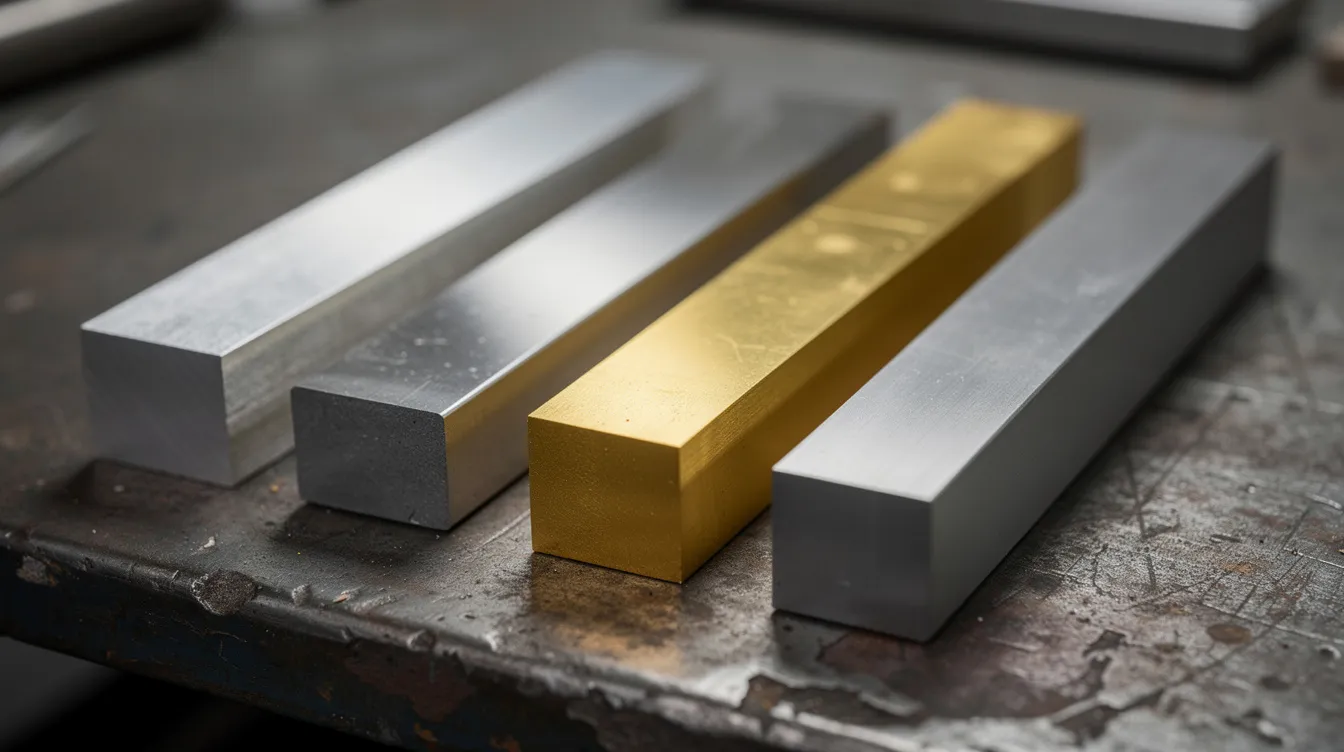
Material choice directly affects machinability, cost, weight, and corrosion resistance. CNC machining can use over 50 industrial-grade metals and plastics, and the right selection depends on your application’s mechanical, thermal, and environmental demands.
Common CNC machining materials include aluminum, stainless steel, and titanium. Here’s how they map to real applications:
-
Aluminum 6061 is a popular choice for CNC machining, widely used for drone frames, robotics housings, and automation brackets. Aluminum 6061-T6 machines quickly and anodizes well. 7075-T6 offers higher strength for structural aerospace parts.
-
Stainless steel (304, 316L, 17-4 PH) suits medical devices, food-contact surfaces, and harsh environments where corrosion resistance matters.
-
Titanium (Grade 5, Ti-6Al-4V) is the go-to for aerospace brackets and implants where strength-to-weight ratio and thermal stability are critical.
-
Engineering plastics like POM (acetal) work well for sliding components, while PEEK is used for high-temperature, high-stress applications in CNC machining. CNC machining can also produce parts from engineered plastics like PEEK and ABS.
The best cnc suppliers keep common alloys in stock and can source specials (7075-T73, titanium Grade 5) with traceable mill certificates. Manufacturers should verify material traceability and certification to ensure compliance, particularly for aerospace and medical programs.
Anebon typically machines aluminum, stainless steel, brass, copper, titanium, and engineering plastics across various materials, and can advise on substitutions to lower cost without sacrificing performance.
Precision, Tolerances, and Surface Finish
Aerospace, optics, and medical devices may require tolerances down to ±0.002 mm, while industrial brackets can tolerate looser specs like ±0.1 mm. CNC machining provides high precision with tolerances as tight as ±0.002 mm, and CNC turning and milling achieve tolerances as tight as ±0.001 inches.
Tighter tolerances increase machining time, inspection effort, and price. A part held to ±0.01 mm might cost 30–50% more than the same geometry at ±0.1 mm, because it demands slower feeds, more inspection passes, and sometimes specialized fixturing. Tolerances as tight as ±0.001″ can be achieved in CNC machining, but only specify them where function actually requires it.
Common surface finishes and their trade-offs:
-
Standard machined: Ra 1.6–3.2 µm, lowest cost
-
Bead blast: uniform matte texture, hides tool marks
-
Anodizing (Type II & III): corrosion resistance, color options, hardened steel-like surface hardness on aluminum
-
Powder coating: thick protective layer, good for outdoor or industrial use
-
Polishing: mirror finish, Ra < 0.4 µm, highest cost
Advanced inspection equipment includes optical comparators and surface roughness testers. Inspection capabilities like Coordinate Measuring Machines (CMMs) ensure accurate measurements on critical features. Anebon performs dimensional checks using CMM and optical inspection, with surface treatment handled through audited finishing partners.
Part Complexity and Design for Manufacturability (DFM)
Undercuts, deep pockets, thin walls, and hard-to-reach features may require 4-axis or 5-axis machining and specialized fixturing. CNC machining includes 3-axis, 4-axis, and 5-axis processes, and supplier capabilities should align with complexity and requirements of designs.
Consider a thin-wall aluminum housing with a 15:1 depth-to-width pocket ratio. The long tool required for this feature will chatter, producing poor surface finish and potentially cracking the wall. Redesigning with a 10:1 ratio, adding support ribs, or splitting into two assembled pieces can cut machining time by 40% and eliminate scrap.
The best cnc machining companies provide DFM feedback early, suggesting radius changes, reliefs, or feature simplifications to improve yield and reduce cost. Anebon’s engineers routinely review cad file submissions and send practical DFM suggestions before cutting material, especially for first-time prototype runs.
Production Volume and Lifecycle (Prototype to Mass Production)
The typical lifecycle moves through phases:
-
Rapid prototyping (1–20 pcs): validating form, fit, function
-
Bridge / pilot runs (50–1,000 pcs): design verification testing and early customers
-
Full production (1,000+ pcs): scaled volume production
Rapid prototyping reduces product development time significantly and supports low-volume production and design iterations. Some suppliers handle only prototypes. Others, like Anebon, support the entire lifecycle using cnc machining, die casting, and sheet metal fabrication where appropriate. Die casting and sheet metal fabrication are important processes in precision manufacturing, particularly when transitioning from machined prototypes to cost-optimized production parts.
For example, a robotics OEM might start with cnc milling for an aluminum housing during 2024 prototyping, then move to die casting with CNC post-machining in 2025 when volumes exceed 10,000 pieces per year. Production capacity must align with project volume requirements, and CNC machines can operate continuously for 24 hours a day to meet aggressive timelines.
Always confirm a supplier’s maximum monthly output and how they ramp capacity without sacrificing product quality.
Key Criteria for Evaluating the Best CNC Parts Suppliers
The “best” doesn’t mean cheapest. It means consistent accuracy, on-time delivery, responsive support, and competitive total cost across the product lifecycle. Creating a checklist for supplier evaluation can improve sourcing decisions and prevent costly mistakes.
Core evaluation categories:
-
Technology & machine capability (axis machining range, turning centers, supporting processes)
-
Quality systems & certifications (ISO certifications enhance customer trust in manufacturing processes)
-
Engineering support (DFM, quoting speed, problem-solving)
-
Scalability (facility size, machine count, throughput)
-
Logistics experience (export documentation, shipping options, customs handling)
Score potential suppliers across these categories before awarding long-term business. Anebon competes directly with well-known companies like Protolabs, WayKen, RapidDirect, and Xometry’s network on precision, cost, and support for OEM projects.
Technical Capabilities: 3-Axis, 4-Axis, 5-Axis, and Beyond
Understanding which axis machining configuration your parts need helps you filter suppliers quickly:
-
3-axis cnc milling: flat brackets, plates, simple pockets. The tool moves in X, Y, Z while the workpiece stays fixed.
-
4-axis: prismatic parts needing machining on multiple sides without re-fixturing. A rotary axis indexes the part.
-
5 axis machining: impellers, turbine components, medical implants, and any geometry with compound angles. Two additional rotary axes allow the tool to approach from virtually any direction.
Leading suppliers also offer cnc turning, swiss turning for small-diameter precision parts, EDM for hardened steel features, and cnc routers for larger sheet or plastic components. Xometry offers CNC milling, turning, and routing for metals and plastics through its network, giving buyers broad process coverage.
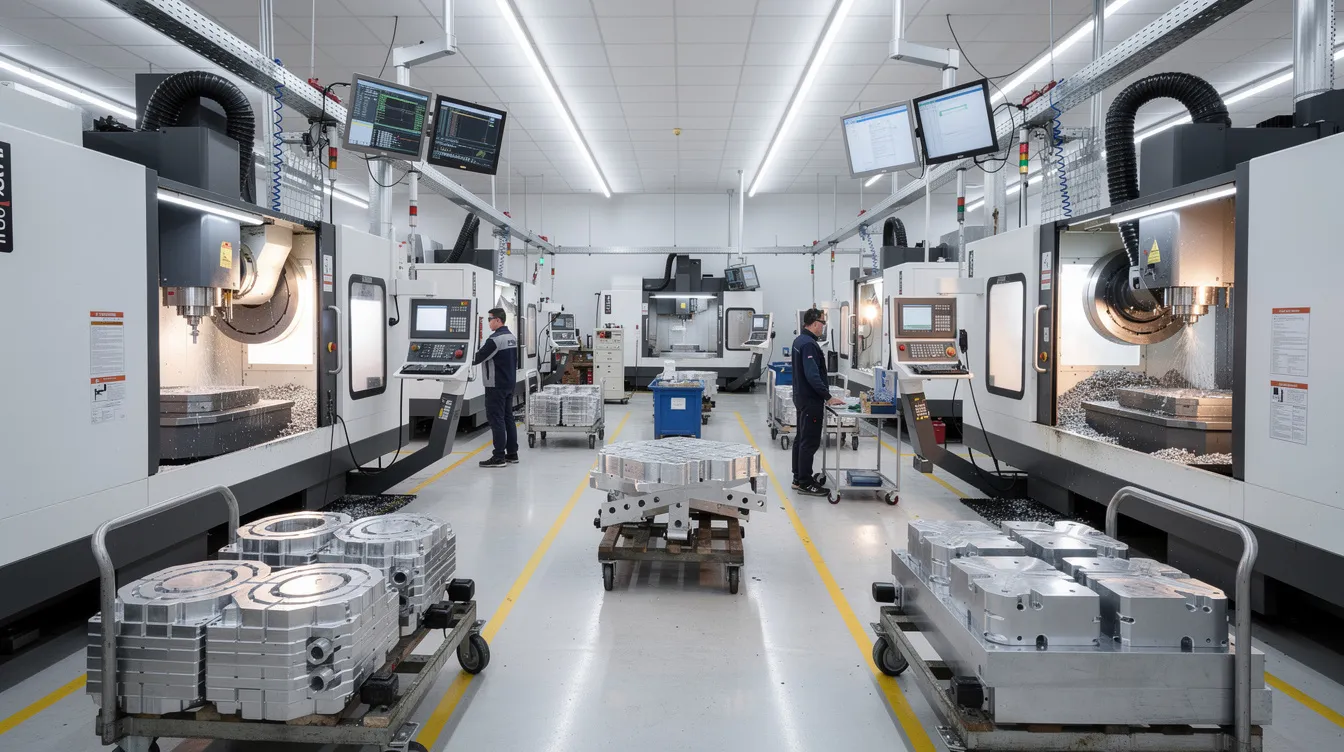
Anebon operates multi-axis machining centers including 5-axis equipment, CNC lathes with live tooling, horizontal machining centers, and multitasking machines, plus supporting processes like sheet metal to handle complex assemblies. These multi tasking machines reduce setups and improve part accuracy for complex geometries.
Quality Assurance, Metrology, and Traceability
ISO 9001:2015 certification ensures quality management in CNC machining, providing the foundation for documented quality control processes. Beyond that baseline:
-
ISO 13485 certification is crucial for medical device manufacturing
-
AS9100D certification is essential for aerospace industry compliance and is crucial for aerospace CNC machining quality
-
ISO 14001 certification focuses on effective environmental management
-
ISO 9001 certification ensures consistent quality management systems across all production
Documented quality systems correlate with fewer rework cycles in manufacturing. In-house inspection processes enhance quality control in CNC machining, and top suppliers maintain CMMs, height gauges, profilometers, thread gauges, and documented first article inspection (FAI) procedures.
Full traceability matters: material certificates, lot tracking, and inspection reports stored for years are non-negotiable in aerospace and medical devices. Xometry offers inspections and material certifications for quality assurance across its network.
Anebon holds ISO 9001:2015 and ISO 14001:2015, with in-house inspection and documented quality workflows for every order since 2010.
Industry Experience and Application Knowledge
Suppliers familiar with aerospace, robotics, medical devices, or automotive know the specific quality standards, finishes, and documentation those various industries require. General-purpose shops often stumble on sector-specific requirements.
Concrete application examples:
-
CNC machined aluminum drone frames requiring anodized finishes and ±0.02 mm flatness
-
Stainless steel surgical fixtures with mirror-polished contact surfaces and full material traceability
-
Precision gears for automation systems machined from hardened steel with ground tooth profiles
Ask suppliers for anonymized case studies or sample parts demonstrating similar complex geometries or performance requirements. Anebon has ongoing work with overseas OEMs in Europe and North America, particularly in electronics enclosures, medical housings, and robotics brackets.
Lead Times, Capacity, and On-Time Performance
Normal benchmark lead times for cnc services:
-
Simple prototypes: 3–7 working days
-
Complex 5-axis parts or medium batches: 10–20 days
-
Integrated assemblies: 20+ days
Protolabs delivers prototypes in days, not weeks, setting industry expectations for speed. Ask potential suppliers for historical on-time delivery rates and average quote response times. Great Light, a Chinese precision OEM, reports a 98.6% on-time delivery rate, showing what top performers achieve.
Red flags include chronic schedule slips, vague delay explanations, and no capacity planning visibility. Testing the market can involve starting with small trial orders to evaluate quality before committing to a multi-year production contract.
Communication, Engineering Support, and Transparency
The best cnc machining companies behave like engineering partners, not just vendors. They offer DFM suggestions, flag potential issues proactively, and respond quickly to tolerance questions or design changes.
Key indicators of strong support services:
-
Named contact person for each project
-
Bilingual support (English–Chinese for overseas OEMs)
-
Consistent update cadence during production
-
Willingness to discuss cnc technology choices and machining strategies
Check responsiveness during the RFQ phase. If a supplier takes a week to answer a simple question about mechanical engineering tolerances, production communication will be worse.
Anebon provides one-to-one project engineers for international clients, ensuring consistent technical communication from RFQ to shipment.
Types of CNC Parts Suppliers: Which Model Fits Your Needs?
CNC parts suppliers fall into four categories: local job shops, online platforms/marketplaces, OEM-focused cnc machining companies, and spare parts distributors for machine tool components. Each has strengths and trade-offs on cost, speed, customization, and engineering depth.
Anebon belongs in the OEM-focused category, serving design engineers and purchasing teams globally with on demand manufacturing services.
Local CNC Job Shops (USA & Europe)
Typical profile: 5–20 employees, 3-axis and 4-axis mills, a few lathes, servicing regional customers. Think of a Midwest U.S. shop making 6061 brackets for automation equipment, or a German shop specializing in stainless steel medical fixtures.
Pros: Quick iteration, no time zone gap, easier for urgent rework, on-site visits possible.
Cons: Higher per-part costs, limited capacity, narrower material range, fewer finishing options.
Use local shops for early cnc machined prototypes or emergency replacement machine parts when speed outweighs cost.
Online Manufacturing Platforms
Platforms like Xometry, Protolabs, and RapidDirect act as “network orchestrators” connecting thousands of CNC machine shops through a digital manufacturing interface. Xometry has over 10,000 suppliers in its network for rapid prototyping and production. Xometry offers precision tolerances down to ±0.001 inches. RapidDirect is ISO 9001 certified for quality assurance. Protolabs delivers parts within days, not weeks.
Benefits: Instant quoting, wide material and process options, strong brand-level QA systems, access to additive manufacturing and injection molding alongside cnc machining.
Downsides: Less direct control over which factory produces your production parts, potential variability between batches if routed to different shops, limited ability to build a relationship with the actual machinist.
Anebon offers an alternative where the buyer knows exactly which factory is machining their custom parts and can build a long-term relationship with the people running the machines.
OEM-Focused CNC Machining Companies (Like Anebon)
Characteristics of this category:
-
Own machines (multi-axis cnc milling, turning, 5-axis, cnc routers)
-
In-house QA and metrology
-
Dedicated engineering team providing DFM and material advice
-
Integration with die casting and sheet metal for complete assemblies
-
Direct export experience
These suppliers are ideal for overseas OEMs needing consistent supply from prototype through high volume production. Consider a European robotics OEM that starts with 20 prototypes in 2024, scales to 5,000 units in 2025, and reaches 30,000 units in 2026 with the same supplier. That continuity eliminates re-qualification costs and quality risk.
Anebon, founded in 2010 in Dongguan, Guangdong, operates exactly in this mode, combining precision cnc machining with other processes for turnkey solutions.
Machine Tool and CNC Router Parts Distributors
This category focuses on spare CNC machine parts: ball screws, drives, spindles, tool changers, and cnc parts dept components rather than custom OEM parts. A U.S.-based distributor might supply replacement parts for 3-axis and 5-axis cnc routers to cabinet shops across the country.
Use these suppliers when repairing your own CNC machines. Use OEM machining suppliers like Anebon when outsourcing part production from your computer aided design files.
While Anebon does not sell machine spare parts, its production relies on high-quality CNC equipment maintained to OEM specifications.
What Makes a CNC Parts Supplier “Best”: Concrete Benchmarks
The word “best” should be measurable. Delivery performance, defect rates, cost stability, and support responsiveness are what separate the best cnc machining companies from average ones.
Key benchmark metrics to request from potential suppliers:
-
PPM defect rate (parts per million nonconforming)
-
On-time delivery percentage over the past 12 months
-
Average RFQ response time (hours, not days)
-
Engineering change turnaround (how fast modifications are implemented)
-
Scrap/rework policy (who bears cost, what corrective actions follow)
Ask for real numbers from 2023–2025 rather than marketing promises. BDE Inc. achieves tolerances as tight as ±0.0001 inches, showing that extreme precision manufacturing is available when needed. Anebon tracks these metrics internally and can share aggregated performance data with major OEM clients under NDA.
Real-World Problem Solving: How Good Shops React Under Pressure
All cnc machining operations occasionally encounter issues: tool breakage, chatter, unexpected warping, or tolerance drift in long production runs. Here’s what separates good shops from bad ones.
Scenario 1: A thin-wall aluminum enclosure vibrates during 5 axis machining, producing chatter marks. Solution: change toolpath strategy from conventional to climb milling, reduce stepover, add sacrificial support tabs, adjust feeds and speeds.
Scenario 2: A batch of stainless steel shafts drifts 0.008 mm on diameter after 200 pieces due to thermal expansion. Solution: implement mid-run offset corrections, add coolant flow, reduce cut depth per pass.
The best suppliers halt production, investigate root causes, and propose fixes instead of shipping marginal parts. Automation in manufacturing can enhance production efficiency and quality control, but human judgment remains essential when problems arise.
Anebon performs trial runs, first article inspections, and process adjustments before full-scale production to prevent such issues.
Transparency on Pricing, Revisions, and Cost Drivers
Main cost drivers in cnc machining:
-
Machine time (complexity, number of setups)
-
Material cost (a solid block of titanium costs far more than aluminum)
-
Tool wear (especially in durable materials or small features)
-
Inspection complexity (CMM time, documentation)
-
Secondary operations (bead blast, anodizing, powder coating, laser engraving, metal stamping)
-
Surface treatment requirements
Ask for clarification when a quote is significantly higher or lower than competitors. The difference often comes down to tolerances, material grades, or finishes being interpreted differently. Reputable suppliers flag cost multipliers, such as extremely tight tolerances on non-critical surfaces.
Anebon’s quotes typically break down major cost drivers and may include alternative suggestions to help buyers hit a target budget without sacrificing exact specifications.
Common CNC Machined Parts and Components Sourced from Top Suppliers
Across the manufacturing industry, the most commonly sourced cnc parts include brackets, enclosures, housings, manifolds, gears, shafts, and custom fasteners. These span computer numerical control machining processes from 3-axis milling through CNC turning, often combined to produce complete assemblies.
Anebon routinely produces such metal parts for customers in robotics, medical devices, automotive electronics, and industrial machinery.
Brackets, Frames, and Structural Components
Common materials include high precision anodized aluminum (6061-T6, 7075-T6) and stainless 304, used in automation frames, drone arms, and sensor mounts. Key design considerations include stiffness versus weight, mounting hole patterns, and flatness requirements.
Bead blast plus anodizing is a popular combination for visual consumer and robotics parts, providing both corrosion resistance and a clean aesthetic. Anebon often machines these in small batches for R&D teams, then scales to mass production as designs freeze.
Housings, Enclosures, and Heat Sinks
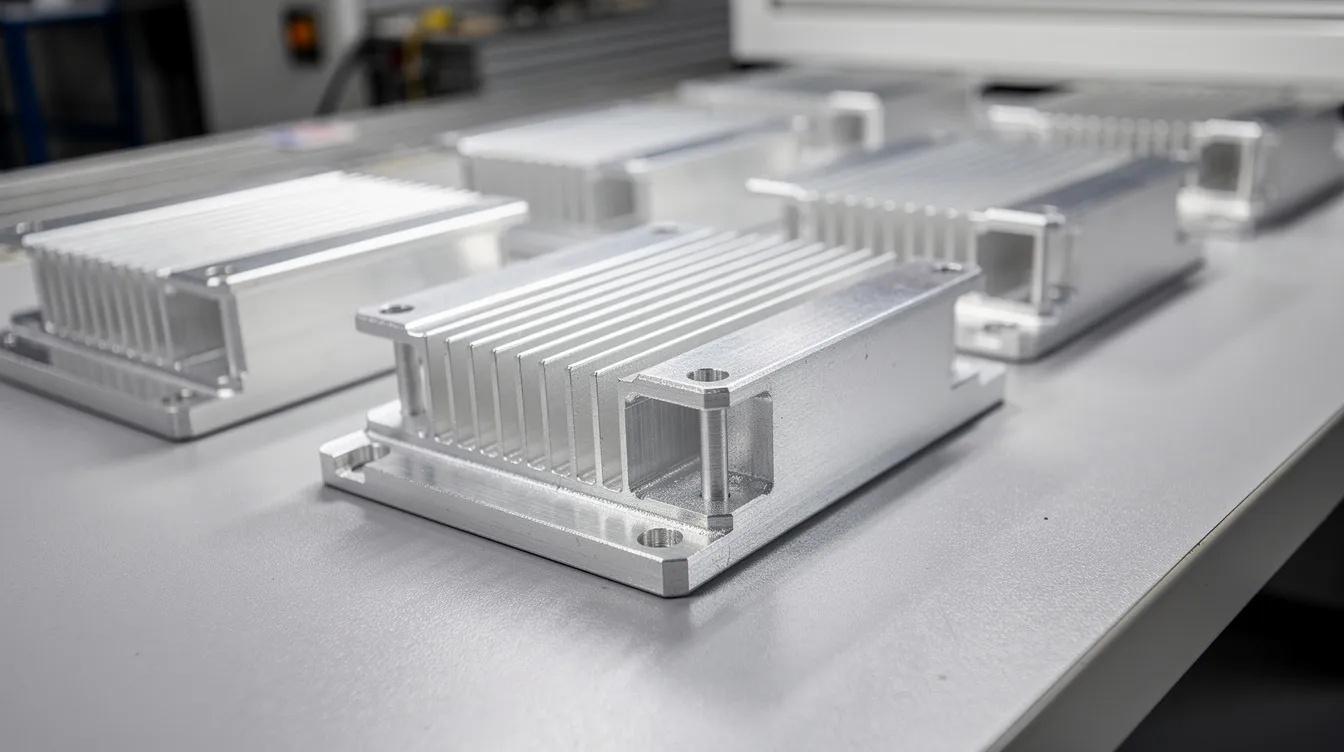
CNC milled enclosures provide precise fit for PCBs, seals, and connectors, especially in harsh environments where composite materials or standard plastics won’t suffice. Typical features include O-ring grooves, threaded ports, cooling fins, and EMC shielding considerations.
A 5-axis milled aluminum enclosure for a medical imaging sensor, for example, might require critical sealing surfaces with ±0.01 mm parallelism and specific surface roughness for O-ring contact. Anebon has experience with both solid machined heat sinks and machined-from-extrusion profiles for energy sectors and electronics cooling.
Shafts, Bushings, and Rotational Components
CNC turning and live-tool lathes create precision shafts, pins, bushings, and couplers from steel, stainless steel, brass, and aluminum. Critical features include concentricity, surface roughness, and thread accuracy for mating components.
An example: a hardened 4140 shaft with keyway and threaded ends for an industrial gearbox, requiring concentricity within 0.005 mm and surface finish of Ra 0.8 µm. Anebon’s turning centers handle both prototype quantities and multi-thousand-piece runs for OEM customers.
Overseas vs. Domestic CNC Parts Suppliers: Cost, Lead Time, and Risk
The classic trade-off: lower part cost from high volume production regions like China versus faster turnaround and easier communication from local shops in the U.S. or Europe. By 2024–2026, modern logistics and communication tools have narrowed many of these gaps.
Anebon is a Chinese supplier optimized for overseas OEMs, with English-language engineering support and established export logistics.
Cost Structure and Total Landed Cost
Total cost elements beyond unit price:
-
Per-part price
-
Freight (air or sea)
-
Import duties (varies by material and country)
-
VAT and broker/handling fees
Compare total landed cost over a 12-month period, not just the number on the quote. A part costing $20 domestic versus $10 from China with $1.50 shipping and 5% duty delivers real savings only when annual volumes spread fixed logistics costs across enough pieces. Anebon typically becomes most competitive when annual volumes exceed a few hundred pieces.
Lead Time, Logistics, and Buffer Stock
Typical transit times from China in 2024–2026:
-
Air freight: 3–7 days
-
Sea freight: 20–35 days
Strategies to balance cost and responsiveness include safety stock, scheduled releases, and combined air/sea shipping. Reliable suppliers provide realistic timelines, tracking information, and proactive alerts on delays.
Anebon works with customers to align production slots and shipping schedules around product launches or seasonal demand through digital manufacturing planning tools.
Quality Control Across Borders
Common concerns about overseas quality are valid but manageable. Robust incoming inspection at the factory plus clear documentation addresses most risks.
Recommended quality gates:
-
First article inspections before production release
-
PPAP-level documentation for automotive programs
-
Golden-sample approvals for consumer hardware
-
Photos and inspection reports before shipment for high-value orders
Anebon provides detailed inspection reports and retains reference samples for long-term programs, ensuring product quality remains consistent across shipments.
Anebon Metal Products Limited: Your CNC Parts Supplier in China
Founded in 2010 in Dongguan, Anebon Metal Products Limited holds ISO 9001:2015 and ISO 14001:2015 certifications. The company serves overseas OEMs with precision cnc machining, die casting, and sheet metal fabrication, operating as a reliable partner from prototype through volume production.
Core cnc services include cnc milling, cnc turning, 5 axis machining, rapid prototyping, low-volume production, and full OEM production with secondary operations (anodizing, bead blast, powder coating, and more).
Industries served include aerospace components (non-flight critical), medical housings and fixtures, automotive electronics, industrial robots, and consumer electronics. Anebon can hold tight tolerances as precise as ±0.002 mm and supports mechanical engineering teams with DFM and material advice using computer numerical control machining technology.
Our Process: From RFQ to Shipped CNC Parts
The step-by-step workflow:
-
RFQ submission – upload cad file and 2D drawing
-
24-hour quote – detailed pricing with quantity options
-
DFM review – engineering feedback on manufacturability
-
Prototype machining – first articles for approval
-
Production machining – full batch per approved specs
-
Inspection – 100% or sampling inspection per plan
-
Packaging and export – tracked shipping to your door
A dedicated project engineer is assigned to each project and remains the main point of contact throughout. For new projects, Anebon typically delivers first cnc machined prototypes in 7–10 working days after order confirmation, depending on complexity. Repeat orders benefit from shorter lead times due to existing fixtures and validated processes.
Equipment, Materials, and Surface Finishes at Anebon
Equipment: Multi-axis machining centers (3-axis, 4-axis, 5-axis), CNC lathes with live tooling, horizontal machining centers, sheet metal lasers and press brakes, and inspection equipment including CMMs and height gauges.
Materials: Aluminum (6061, 6082, 7075), stainless steels (304, 316L, 17-4PH), carbon steels, brass, copper, titanium, and engineered plastics such as POM, PA, PC, and PEEK. CNC machining can produce parts from over 50 industrial-grade materials.
Finishes: Standard machined, bead blast, anodizing (Type II & III), hard anodize, powder coating, electroplating, brushing, and laser marking for logos and serial numbers.
All materials are verified on receipt and, where specified, provided with material certificates to support traceability.
Case Examples: How OEMs Use Anebon for CNC Parts
European robotics OEM (2022–2024): Started with 15 prototype 5-axis milled aluminum robotic arm joints. After two design iterations with DFM support from Anebon, the design was frozen. Production scaled to 2,000 units in 2023 and 8,000 in 2024, with tolerances held at ±0.01 mm across all batches. Cost per unit dropped 35% from prototype to production due to optimized fixturing and batch efficiency.
U.S. medical device startup (2021–2023): Required precision turned stainless steel (316L) housings for a diagnostic instrument. Critical requirements included Ra 0.4 µm surface finish on sealing faces and full material traceability. Anebon delivered first articles in 8 working days, passed incoming inspection on first submission, and supported three design revisions over 18 months without delivery disruption.
Asian electronics OEM (2023–2025): Sourced cnc milling custom irregular aluminum enclosures with integrated heat sink fins and EMC shielding features. Anebon recommended switching from solid-block machining to machined extrusion profiles, reducing material waste by 40% and cycle time by 25%.
How to Request a CNC Parts Quote from Anebon
A complete quote package speeds up pricing and avoids multiple rounds of clarification emails. Prepare:
-
3D CAD file (STEP/IGES)
-
2D drawing with dimensions, tolerances, and GD&T
-
Quantity per batch and annual forecast
-
Material specification
-
Surface finish and any special inspection requirements
Anebon returns a detailed quote within 24 hours on working days, with options for different quantities or lead times where appropriate. Start with a pilot order in 2024–2025 to validate fit, function, and communication before shifting higher volumes.
Checklist: Choosing the Best CNC Parts Supplier for Your Project
Use this checklist during your sourcing process:
-
☐ Technical capabilities: Does the supplier offer 3-axis, 4-axis, and 5 axis machining plus cnc turning?
-
☐ Materials supported: Can they machine your specific alloy, steel, or engineered plastic?
-
☐ QC systems: Are certifications (ISO 9001, AS9100D, ISO 13485) current and verified?
-
☐ On-time performance: Can they share delivery rate data from the past 12 months?
-
☐ DFM support: Do they review your design and suggest improvements before quoting?
-
☐ Responsiveness: How fast do they answer technical questions during the RFQ phase?
-
☐ Sample quality: Have you ordered and inspected trial parts?
-
☐ Scalability: Can they grow from prototype to mass production without changing factories?
-
☐ Total landed cost: Have you compared all-in cost (unit + freight + duty), not just unit price?
-
☐ Communication: Is there a dedicated contact who speaks your language?
When evaluating overseas cnc machining companies, always compare total landed cost rather than unit price alone. Anebon is a strong candidate for overseas OEMs who need high precision cnc machined parts with dependable engineering support from prototype to production.
Conclusion: Get CNC Parts That Fit, Function, and Ship on Time
The best cnc parts suppliers combine advanced computer numerical control machining (including 5-axis), robust quality assurance systems, real engineering support, and reliable logistics. There is no single “best” for every situation, but the right supplier for your project is the one whose capabilities, certifications, and communication style match your exact specifications and volume needs.
Define clear requirements, vet suppliers with real performance data, and start with small pilot orders before committing to long-term contracts. This approach works whether you’re sourcing from a local shop, an online platform, or an OEM manufacturer overseas.
Anebon Metal Products Limited has been an ISO-certified, China-based OEM precision manufacturing partner for cnc machining, die casting, and sheet metal fabrication since 2010. Send your CAD files and drawings to Anebon for a 24-hour cnc machining quote and discuss your 2024–2026 product roadmap with our engineering team. The best time to choose the right machining vendor is before your next design freeze.