Comparing Hot Rolled and Cold Rolled Steel: Which Is Right for You?
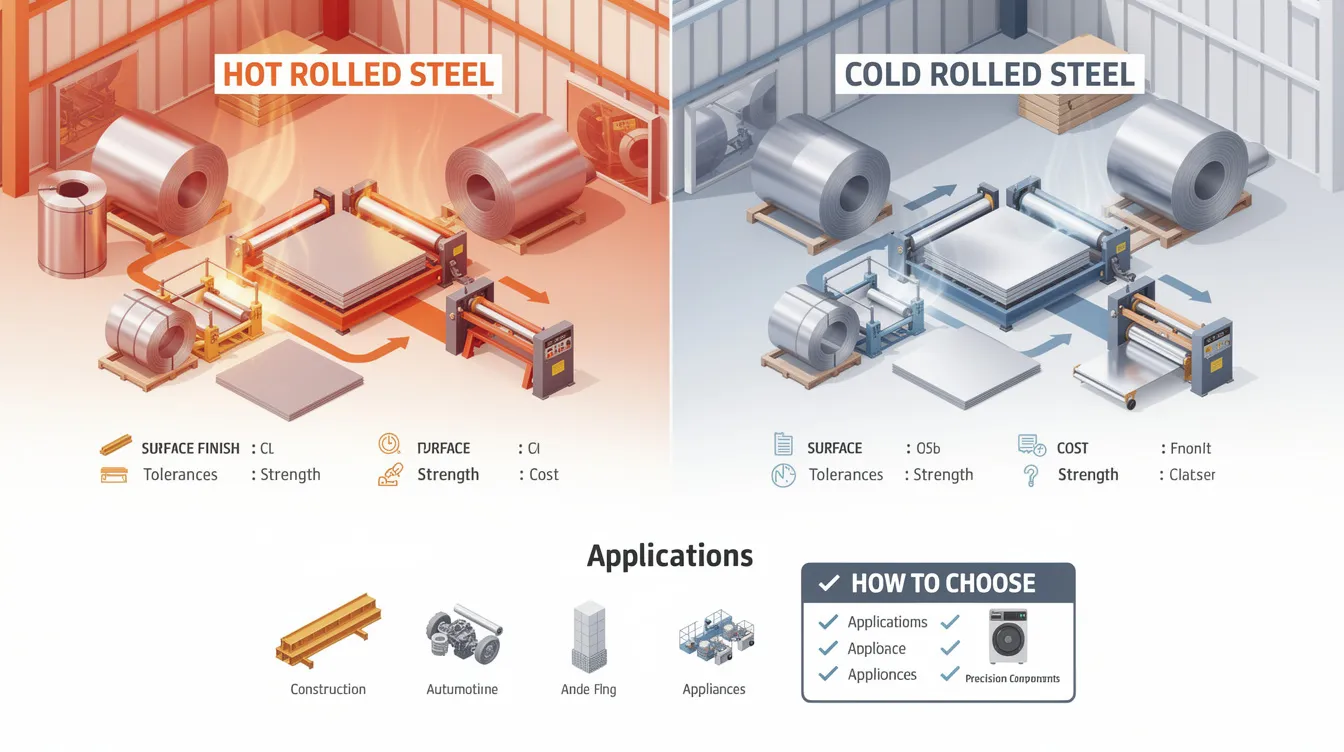
Hot Rolled and Cold Rolled Steel: Differences, Applications, and How to Choose
Introduction: Hot Rolled vs Cold Rolled Steel in Modern Manufacturing
Every steel part in your product started as a slab that was squeezed between heavy rollers. Whether that squeezing happened at extreme heat or near room temperature determines much of what you can do with the material afterward. Hot rolled steel is shaped above the steel’s recrystallization temperature-typically above 1,700°F (927°C)-while cold rolled steel is re-rolled at room temperature after initial hot rolling. Both come from similar steel grades, so the main difference between hot rolled and cold rolled steel is not chemistry but processing temperature and finishing steps.
These processing differences directly affect OEM components, CNC machining, and sheet metal projects. Cold-rolled steel is typically 20% stronger than hot-rolled steel of the same grade, but it costs more. Here are the four decision factors that matter most:
-
Cost: Hot rolled is cheaper; cold rolled adds processing expense
-
Surface finish: Hot rolled has a rougher surface; cold rolled delivers a smooth finish
-
Dimensional accuracy: Cold rolled holds closer dimensional tolerances
-
Strength: Cold rolling increases yield and tensile strength through strain hardening
Understanding the Rolling Process
Rolling is a metalworking process where steel slabs or billets pass through pairs of rollers that progressively reduce thickness and control shape. Steel production begins with melting in a basic oxygen or electric arc furnace, casting into continuous slabs, then feeding those slabs into the rolling process. The raw materials enter as thick, rough slabs and exit as plate products, coils, steel sheet, bars, or structural profiles in various shapes.
Hot rolling deforms the steel above its recrystallization temperature, where grains reform during deformation-leaving a softer, more ductile material. Cold rolling deforms the steel near room temperature, trapping dislocations inside the grain structure and creating work hardening that raises strength but reduces ductility. Think of the process flow as a temperature line: starting above 900°C during hot rolling, dropping to ambient during cold rolling, with pickling, annealing, and temper rolling steps in between.
What Is Hot Rolled Steel?
Hot rolled steel is steel shaped above the steel’s recrystallization temperature-typically above 1,700°F-in continuous or plate mills. The step-by-step process runs: slab reheated to ~1,100–1,250°C in a furnace → roughing mill for large thickness reductions → finishing mill for final gauge → coiling or cutting → cooling at ambient conditions. When hot rolled steel cools in open air, it is essentially hot rolled steel that has been normalized, meaning new grains formed and internal stresses largely relaxed. Common product forms include plate, wide coil, i beams, H-beams, channels, angles, and rail profiles.
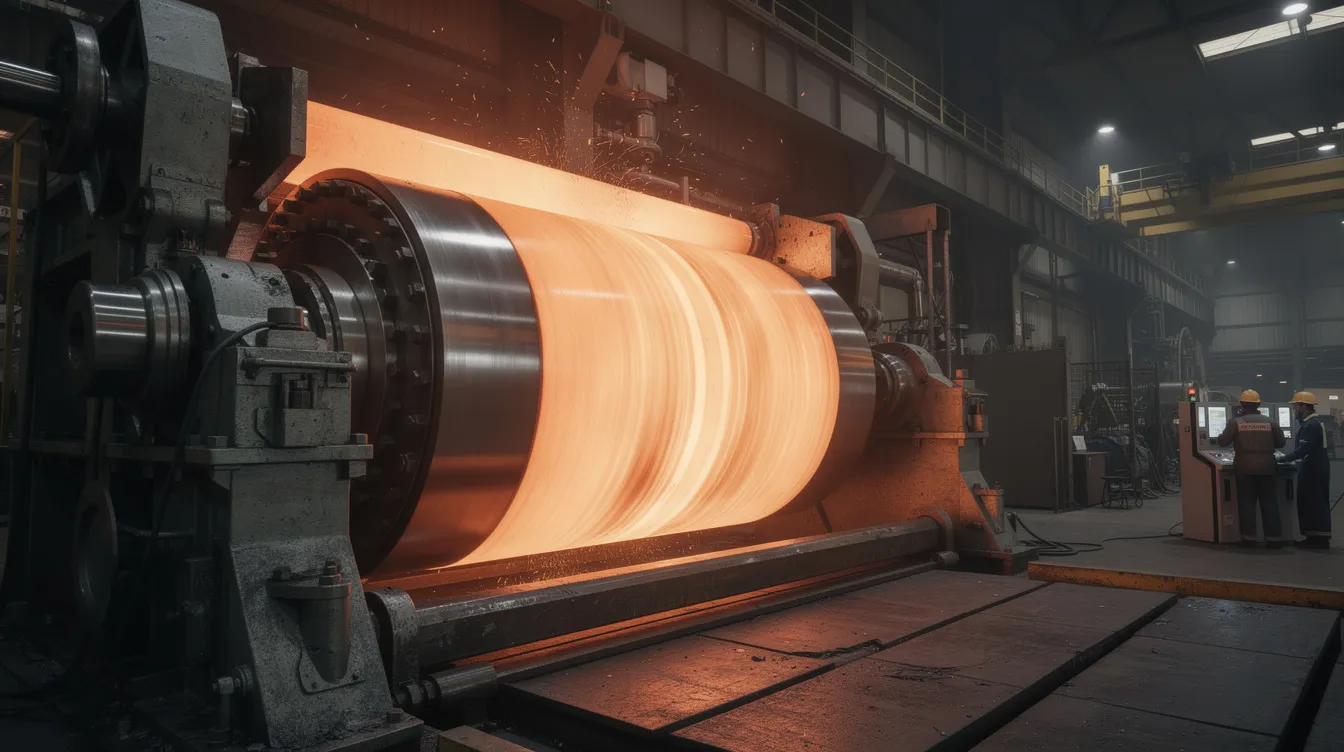
Characteristics and Mechanical Properties of Hot Rolled Steel
Hot rolled steel has a rough surface finish due to oxidation during cooling, producing a dark, scaled surface known as mill scale. Physical characteristics include rounded edges, slight distortions in flatness, and larger dimensional tolerances-thickness tolerances for hot rolled strip typically run ±0.15–0.50 mm, which means less control over exact dimensions compared to cold rolled alternatives. Hot rolled steel has less precise dimensional tolerances due to thermal contraction as the steel cools unevenly.
Mechanical property trends favor ductility: elongation of 20–35% in mild grades, tensile strength of 340–520 MPa, and moderate yield strength. Weldability is generally excellent, and machinability is acceptable once the mill scale is removed through sand blasting or grinding. Unlike hot rolled steel, cold rolled material skips the scale-removal step entirely because it never develops that oxide layer.
Advantages of Hot Rolled Steel
Hot rolled steel is cheaper due to less processing-fewer passes, no annealing, no temper rolling. For large, heavily loaded structural components, it is the cost effective choice.
-
Lower cost: Significantly cheaper per kilogram than cold rolled of the same grade
-
Large cross-sections: Capable of producing thick plates, long beams, and heavy shapes
-
Faster lead times: Standard sizes widely stocked globally for construction and heavy machinery
-
Superior formability: Hot rolled steel is easier to shape and form, with better ductility for forming processes
-
Acceptable where precision is secondary: A rougher surface and wider tolerances are fine when surfaces will be machined, welded, or hidden
Hot Rolled Steel Applications
Hot rolled steel is ideal for structural applications where load capacity and cost efficiency outweigh surface quality. Common hot rolled steel applications include building frames, bridges, shipbuilding hulls, railroad tracks, and earthmoving equipment frames. ASTM A36 hot rolled steel beams and plates are standard in construction and industrial machinery bases. Hot rolled steel is used for structural components like beams and is commonly used in railroad tracks and heavy equipment.
These applications accept lower dimensional accuracy and a rougher surface because further processing-CNC machining, welding, or painting-happens downstream. For OEM projects, heavy brackets, machine frames, jigs, and fixtures are often cut from hot rolled plate, then only critical surfaces are machined to precise dimensions. Hot rolled steel is ideal for applications needing less precision and is often used in construction projects where strength is prioritized.
What Is Cold Rolled Steel?
Cold rolled steel starts as hot rolled coil that has been pickled to remove mill scale, then further processed at or near room temperature through cold reduction mills. The typical route runs: hot rolled pickled coil → cold rolling in multiple passes → annealing to restore ductility → temper rolling or skin pass for surface quality → final coil or sheet. For bars and tubes, the equivalent terms are “cold drawn” or “cold finished,” describing material pulled through dies at ambient temperature.
Cold rolling increases strength via strain hardening-dislocation density rises sharply, pushing yield and tensile values up. Cold rolled steel is typically stronger than hot rolled steel. The result is a smooth surface with sharper edges, tighter thickness control, and more exact dimensions suited to precision applications.
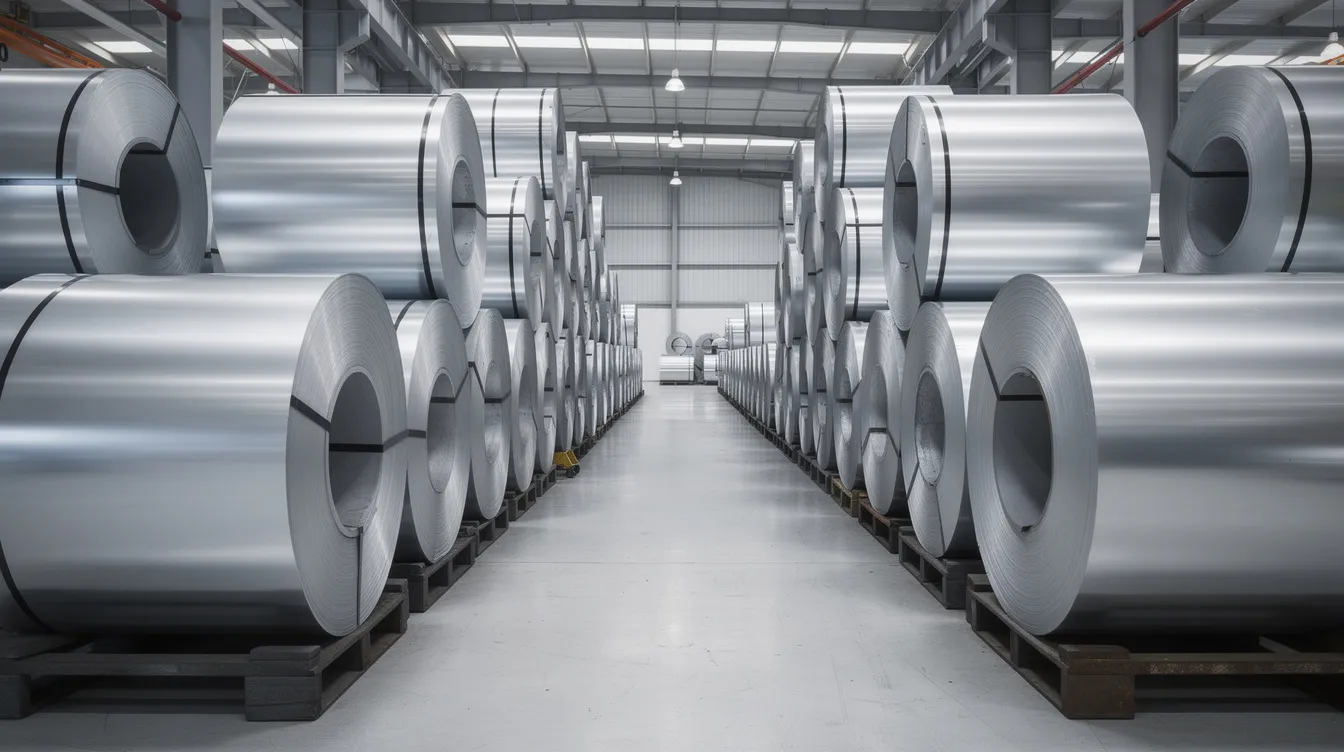
Characteristics and Mechanical Properties of Cold Rolled Steel
Cold rolled steel provides a superior surface finish compared to hot rolled steel: bright, smooth, minimal scale, and sharper corners with excellent dimensional accuracy and flatness. Thickness tolerances for cold rolled strip typically fall within ±0.02–0.08 mm-an order of magnitude tighter than hot rolled. Cold rolled steel has tighter dimensional tolerances than hot rolled steel, making it critical for sheet metal fabrication, stamping dies, and precision housings.
Mechanical property changes from cold work include increased yield and tensile strength-often 10–20% higher than equivalent hot rolled grades. Cold rolled steel provides tighter dimensional tolerances overall, but ductility drops unless annealing restores it. Residual internal stresses from cold rolling can cause warping during machining; annealing and temper rolling balance strength, formability, and flatness. Cold rolled sheet typically ships with a lightly oiled surface to prevent corrosion in storage.
Advantages of Cold Rolled Steel
Cold rolled steel offers superior precision engineering: consistent thickness, high dimensional accuracy, squarer and sharper edges, and a smooth surface ready for coating. The steel’s hardness and strength cold rolled steel achieves allow designers to use thinner sections carrying the same loads-a strength-to-weight advantage valuable in automotive and electronics. Cold rolled steel is preferred for applications requiring tight tolerances and aesthetics.
For CNC machining and laser cutting, the absence of mill scale means more predictable behavior and less variability between batches. Cold rolled steel is typically more expensive due to additional processing, but the trade-off in reduced rework and precise finishing often justifies the price in precision applications.
Cold Rolled Steel Applications
Cold rolled steel is used for automotive parts-body panels, brackets, chassis covers. It is commonly used in manufacturing appliances such as refrigerator shells and oven housings. Cold rolled steel is ideal for furniture production, including office desks and filing cabinets. It is frequently used in consumer electronics construction: thin chassis, stamped brackets, and enclosure panels.
Industries like medical devices, aerospace structural components, and consumer electronics specify cold rolled or cold formed steel for cosmetic surfaces where tolerances, flatness, and clean bends are non-negotiable. When dimensional accuracy, surface quality, and repeatability matter, cold rolled steel is the right material despite its higher cost.
Key Differences Between Hot Rolled and Cold Rolled Steel
This hot rolled vs cold rolled comparison targets design engineers and buyers making material decisions. The chemical composition can be identical between the two; differences arise entirely from processing and subsequent microstructure changes.
Quick comparison: Hot rolled delivers a rougher surface, a scaled surface, rounded edges, and lower cost. Cold rolled delivers a smooth finish, precise shapes, closer dimensional tolerances, and higher strength-at a higher price. These differences directly affect downstream operations: bending, forming, welding, coating, and painting all behave differently depending on the steel type selected.
Dimensional Accuracy and Tolerances
Cold rolled steel offers significantly better dimensional accuracy, with thickness tolerances often 5–10× tighter than hot rolled. Where tolerances of ±0.15–0.50 mm are standard for hot rolled plate, cold rolled sheet routinely holds ±0.02–0.08 mm. Tighter tolerances reduce the need for secondary machining or grinding, saving time and machining cost. Hot rolled steel may be preferred when designers accept wider tolerances in exchange for lower cost and faster availability.
Surface Finish and Appearance
Hot rolled steel has a rough surface finish with scale-a dark, bluish-grey oxide layer with possible pits and waviness. Hot rolling results in a scaly surface finish that may need pickling for finishing. Cold rolled steel surfaces are smooth, uniform, and often lightly oiled-ideal for painting, powder coating, or plating. For visible panels and housings, cold rolled is the clear choice; for hidden structural components, the scaled surface of hot rolled is perfectly acceptable.
Strength, Hardness, and Formability
Cold rolling and work hardening processes raise yield strength and the steel’s hardness, often by 10–20% compared to the same grade in hot rolled condition. Hot rolled steel tends to be more ductile, making it better for heavy bends, complex shapes, and deep drawing. The trade-off is clear: choose hot rolled for heavily formed brackets requiring unique properties in ductility, or cold rolled for thin, strong panels where material properties favor rigidity.
Cost and Supply Considerations
Hot rolled steel is typically cheaper than cold rolled steel-fewer rolling passes, no annealing, no temper rolling. For large volumes of heavy sections, this is the cost effective path. Cold rolled carries a premium for additional processing and stricter quality control. But total cost of ownership matters: savings in machining, rework, and finishing when using cold rolled for precise parts can offset the higher material price. Standard hot rolled sections are easiest to source quickly worldwide across various industries. Balance material price against downstream processing to select the right steel for your final product.
Cold Rolled Steel vs Cold Formed Steel
Cold formed steel refers to structural components-studs, channels, custom profiles-created by roll forming or press braking flat sheet or coil at room temperature. Cold rolled describes the flat material; cold formed describes the final shaping process. Cold forming introduces additional work hardening and residual stresses, further increasing strength in thin-gauge profiles. Examples include light-gauge framing, cable trays, rack systems, and custom channels for industrial equipment. Understanding this distinction helps avoid confusing the two in specifications.
Selecting Hot Rolled or Cold Rolled Steel for Your Project
Use this checklist when choosing between hot and cold rolled steel:
-
Tolerance requirements: Does the part need closer dimensional tolerances or are wider ranges acceptable?
-
Surface finish needs: Visible or hidden? Cosmetic or functional?
-
Strength and weight targets: Can thinner, stronger cold rolled material save weight?
-
Forming complexity: Heavy bends favor hot rolled; sharp, precise bends favor cold rolled
-
Budget: Material cost plus finishing, machining, and rework
Use-case scenarios: A structural machine base plate works well as hot rolled plate with only critical faces machined to more exact dimensions. A thin cosmetic housing for a consumer product demands cold rolled steel sheet for its smooth surface and tight tolerances. A precision automotive bracket needs cold finished bar for both strength and exact dimensions. Sometimes a hybrid strategy-hot rolled for bulk structure, cold rolled only where appearance or precision matters-is most cost considerations-friendly. Collaborate early with your manufacturing partner to validate choices against real production methods.
How Anebon Uses Hot Rolled and Cold Rolled Steel in OEM Manufacturing
Anebon Metal Products Limited is an ISO 9001:2015 and ISO 14001:2015 certified precision manufacturer founded in 2010 in Dongguan, Guangdong, China. For hot rolled steel, Anebon cuts and machines thick plates for heavy-duty brackets, welds structural frames, and fabricates fixtures for industrial machinery-then CNC machines critical surfaces to tight tolerances.
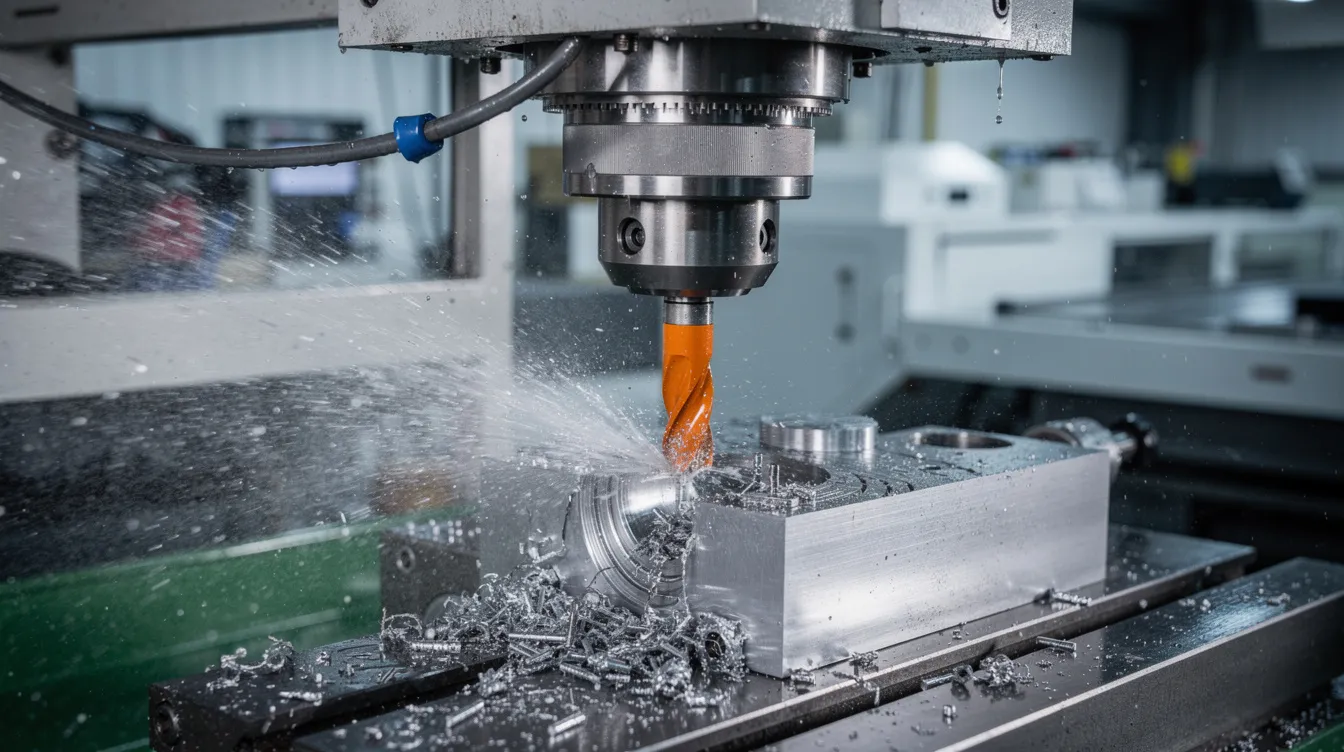
For cold rolled steel, Anebon performs high-precision sheet metal fabrication-laser cutting, punching, and bending-along with CNC machining of cold finished bar for shafts and pins. Key services span 3- and 5-axis CNC machining, rapid prototyping, die casting inserts, and tolerance control down to ±0.002 mm on suitable features. Anebon’s DFM feedback helps overseas OEMs choose between hot rolled and cold rolled, optimizing wall thickness, bend radii, and tolerances for cost and manufacturability across most steels and steel grades used in steel production today.
Requesting a Quote and Next Steps
When requesting a quote, prepare 3D models (STEP/IGES), 2D drawings with tolerances, material specification (hot rolled vs cold rolled grade and re rolled conditions if applicable), surface finish requirements, and quantity. Specify whether hot rolled steel or cold rolled steel is acceptable, or ask Anebon to recommend based on functional and cosmetic requirements-including any additional processing or tension breaking needs for flatness.
The difference between hot rolled and cold rolled steel shapes everything from cost to performance in your final product. Whether your project calls for heavy plate products or precise finishing on thin enclosures, selecting the right steel type early prevents costly rework. Contact Anebon’s engineering team today to discuss material selection, get DFM feedback, and request a quote for your next project involving hot and cold rolled steels.