Compare CNC Machining vs Die Casting Prototyping: Pros and Cons
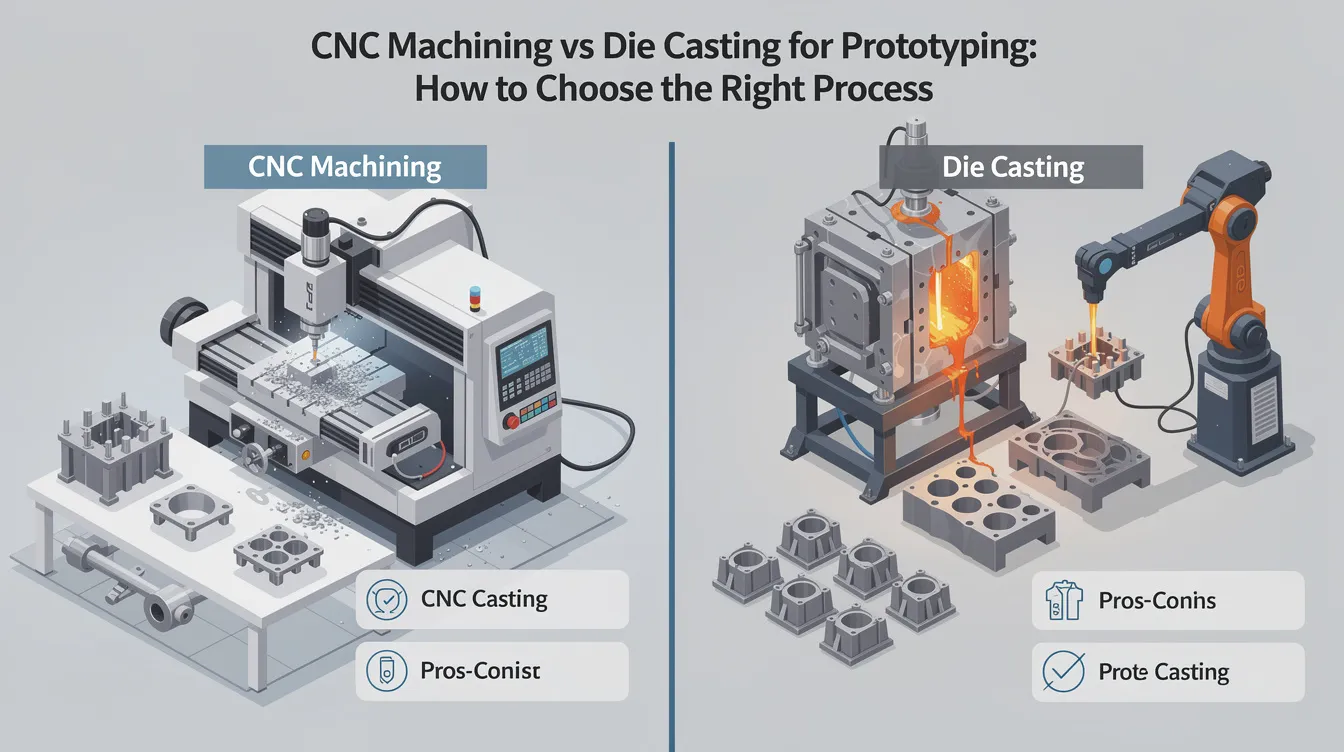
CNC Machining vs Die Casting for Prototyping: How to Choose the Right Process
Deciding between CNC machining and die casting for your next prototype can save you weeks of lead time and thousands of dollars in tooling. But picking the wrong process at the wrong stage of development? That gets expensive fast. This guide will help you compare cnc machining vs die casting prototyping across every factor that matters – cost, tolerances, materials, design complexity, and production volume – so you can make a confident decision for your project.
Quick Answer: When to Choose CNC Machining vs Die Casting for Prototypes
If you need a direct answer before diving into details, here it is: CNC machining is almost always the better choice for early-stage prototypes in quantities of 1 to 200 pieces when you need tight tolerances, the fastest possible lead time (often 3–7 working days), and full wrought-material mechanical properties. CNC machining is ideal for rapid prototyping because it requires no expensive tooling for prototypes and can efficiently produce functional prototypes when the design is still developing.
Die casting prototyping makes sense later in the development cycle – when your design is close to frozen, part geometry mirrors the final mass production intent, and you need 200 to 5,000 parts to validate real casting behavior before committing to full production tooling.
Anebon Metal Products Limited offers both CNC machining and die casting in-house, so the guidance in this article is neutral and focused on helping you pick the optimal manufacturing method, not pushing one process over the other.
Rules of thumb:
-
Low volume production + high precision parts → choose cnc machining
-
One off prototypes or one off parts needing design flexibility → CNC machining
-
Higher volume + complex metal casting geometry → consider die casting
-
Design still changing → CNC machining every time
-
Design frozen, targeting high volume production → die casting
Overview of CNC Machining and Die Casting
Both CNC machining and die casting are standard routes from prototype to production for metal parts across aerospace, automotive, electronics, and medical devices. CNC machining is a subtractive manufacturing process that removes material from solid stock using computer controlled tools, while die casting is a metal casting process that forces molten metal into permanent steel molds under high pressure. CNC machining dominates rapid prototyping and low volumes; die casting dominates mass production of complex metal parts.
Anebon Metal Products Limited, founded in 2010 in Dongguan, China, holds ISO 9001:2015 and ISO 14001:2015 certifications and serves overseas OEMs with integrated CNC machining and die casting capabilities. The rest of this article compares these two processes specifically from a prototyping perspective – not general manufacturing.
What Is CNC Machining for Prototyping?
The cnc machining process uses programmed instructions to drive cutting tools – end mills, drills, lathes – that remove material from a solid block of metal or plastic to create the desired shape. It is a subtractive process, which means it can generate significant material waste, but it delivers unmatched dimensional accuracy and flexibility.
Common cnc machining types used for prototyping include:
-
CNC milling – for prismatic parts like brackets, housings, and plates using 3-axis or 5-axis machines
-
CNC turning – for cylindrical metal components like shafts, bushings, and connectors
-
5-axis machining – for complex parts in aerospace or medical devices requiring tool access from multiple angles, such as aerospace brackets
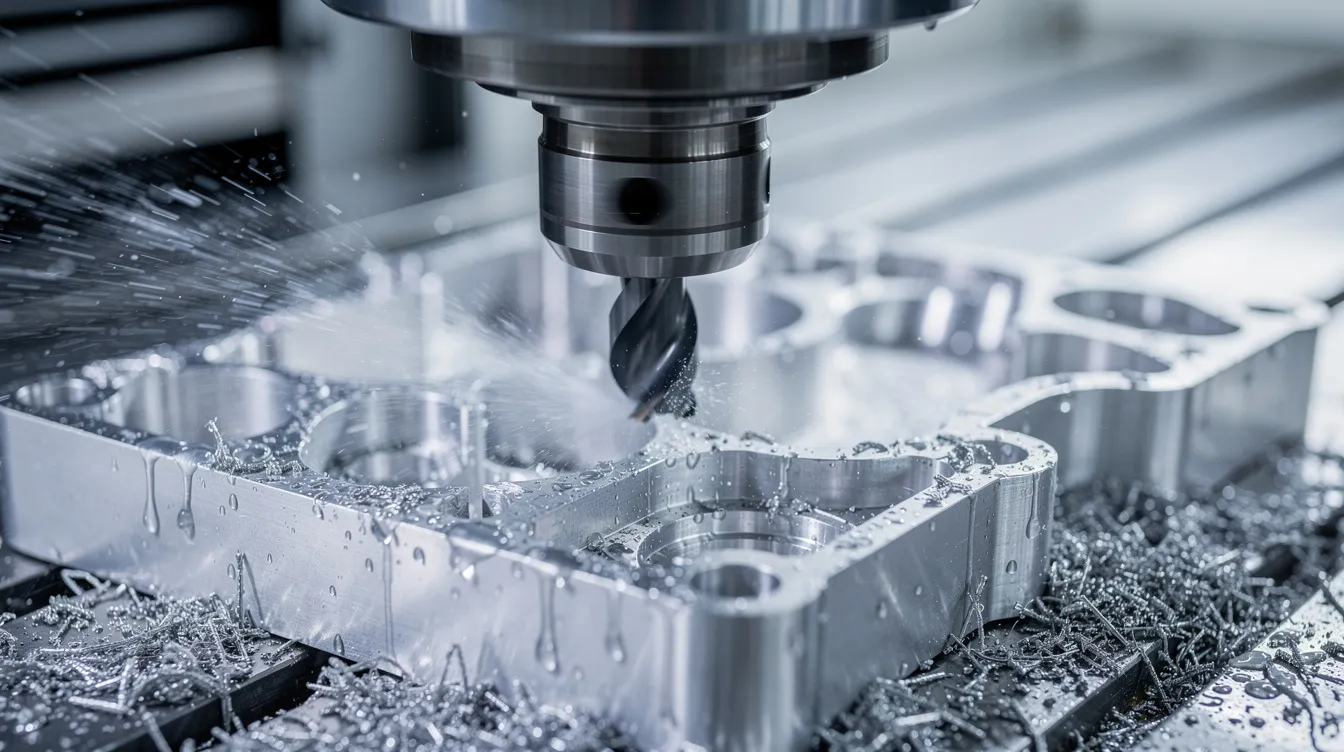
At Anebon, CNC machining achieves tolerances as tight as ±0.002 mm on critical features and ±0.01 mm on standard features, with excellent repeatability part-to-part. CNC machining provides superior surface finishes of Ra 0.4–1.6 μm with proper tooling, making it the go-to for high precision parts. CNC machining supports a broad range of materials – aluminum 6061/7075, stainless steel 304/316, titanium alloys, brass, and engineering plastics like PEEK and ABS – enabling close simulation of final mechanical performance. CNC machining supports a wide range of metals and plastics, far more than any single casting technique.
For one off parts to a few dozen pieces, no special tooling is required beyond standard fixtures and cutting tools, keeping lead time as short as 5 working days. CNC machining excels at simple to moderately complex geometries and is more economical for low-volume production runs.
What Is Die Casting Prototyping?
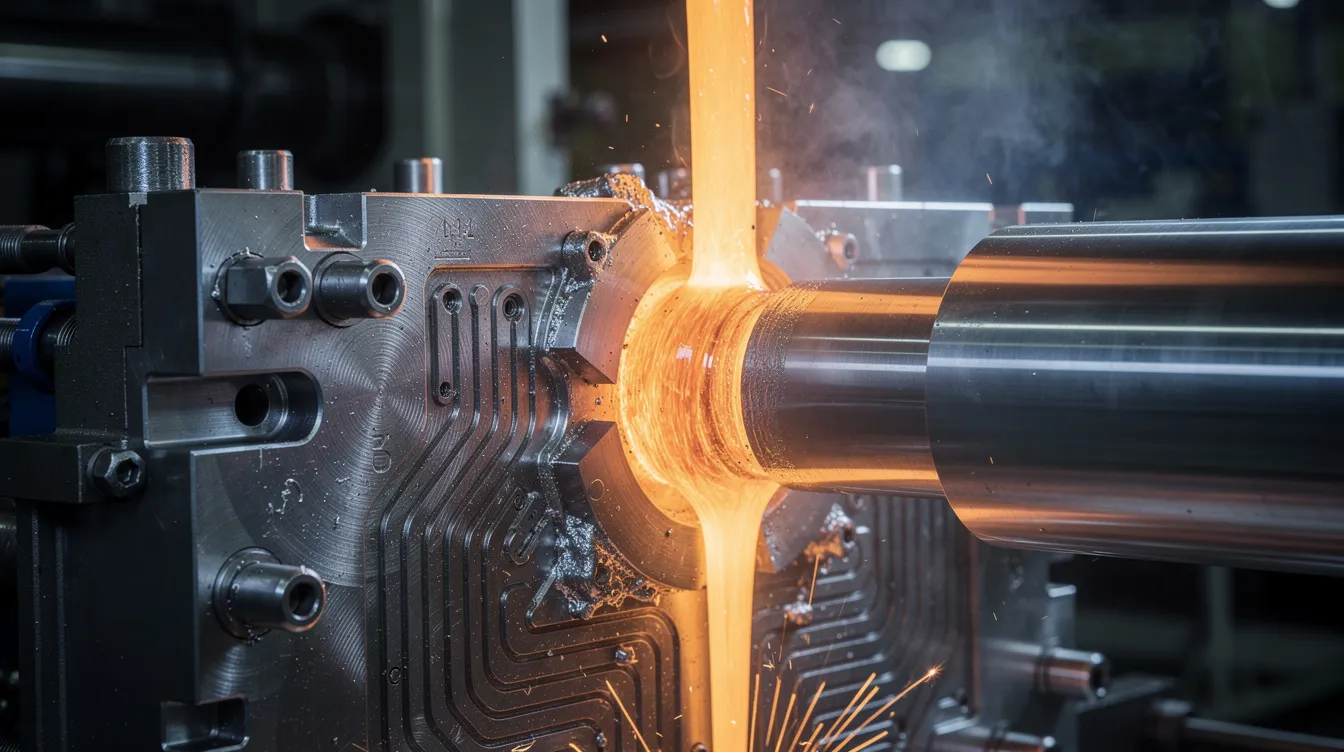
Die casting is a high-pressure metal casting method in which molten metal is injected into a steel mold (die) under pressure, filling internal cavities to produce near-net-shape metal parts. It is best suited for non-ferrous metals like aluminum, zinc, and magnesium. The process minimizes material waste by forming near-net shape parts rather than cutting away excess.
“Die casting prototyping” means building prototype dies – often from softer tool steels – or using modified production dies to produce early runs of tens to a few thousand parts before full-scale production. This differs from other metal casting techniques like sand casting or investment casting in that it uses reusable steel molds and high injection pressures for tighter as-cast tolerances.
Typical alloys for die-cast prototypes include ADC12/A380 aluminum for automotive housings and electronics enclosures, and zinc alloys like Zamak 3 for fine-detail smaller parts. Cast aluminum in these grades offers good fluidity and structural integrity, making it popular for heat sinks, gear housings, and LED enclosures.
Realistic tolerance expectations for prototype die casting are ±0.10–0.20 mm depending on part size, with surface finish as-cast around Ra 1.6–6.3 μm. Complex geometries with intricate details are easier to produce with die casting than CNC machining, and die casting can produce intricate designs with minimal machining. Casting enables exceptional design freedom for complex geometries and can produce complex shapes with high accuracy. Die casting is well-suited for parts requiring excellent structural integrity due to its dense grain structure.
However, even prototype die casting requires time and cost to design and machine the die (often using CNC and EDM), which significantly affects lead time compared to cnc machined parts.
Key Differences: CNC Machining vs Die Casting in Prototyping
Before diving into specifics, here are the key differences relevant to prototyping decisions:
-
Setup and tooling cost – near zero for CNC vs. thousands to tens of thousands for die casting
-
Lead time – days for CNC vs. weeks for die casting
-
Dimensional accuracy – tighter with CNC; coarser as-cast for die casting
-
Design complexity – CNC handles moderately complex geometries; die casting handles intricate shapes and thin walls
-
Mechanical properties – wrought properties preserved in CNC; porosity risk in cast parts
-
Material choices – CNC supports a wider range of materials than casting; material options for casting depend on the technique used
-
Scalability – die casting scales to mass production; CNC costs stay flat per part
The following sections expand on each factor. For many projects, Anebon recommends a hybrid path: CNC prototypes first, then die casting for pre-production runs once the design is validated.
Cost, Tooling, and Lead Time
For prototypes, upfront tooling cost and time-to-first-part are usually the most critical constraints. Getting these wrong can stall an entire development program.
CNC machining costs are driven by machine time, setup, material, and part complexity. CNC machining incurs lower setup costs than die casting because no custom mold is needed. A typical CNC prototype cost ranges from tens to a few hundred dollars per part depending on material and part complexity. CNC machining allows for rapid design changes without tooling costs. However, CNC machining has higher per-part costs for large batches because each part requires full machining time.
Die casting costs tell a different story. Die casting requires expensive tooling and initial lead times due to mold creation. Initial tooling costs for die casting can range from thousands to hundreds of thousands of dollars. Die casting molds can cost between $20,000 to $100,000 for production-grade single-cavity tools, while softer prototype dies run $5,000–$15,000. Design modifications are expensive and time consuming in die casting compared to CNC machining, since each revision may require die rework or an entirely new cavity.
|
Factor |
CNC Machining |
Die Casting |
|---|---|---|
|
Tooling cost |
Near zero |
$5,000–$100,000+ |
|
Lead time (first part) |
3–7 working days |
3–6 weeks |
|
Per-part cost (low vol.) |
Cost effective |
Cost prohibitive |
|
Per-part cost (high vol.) |
Higher cost |
Very low |
|
Design change cost |
Minimal |
Expensive |
High-pressure die casting achieves low per-part costs at scale, and overall manufacturing costs are typically lower for die casting at higher production volumes than CNC machining. Die casting is economical for producing large quantities once the upfront tooling cost is absorbed – the break-even typically falls in the 1,000–5,000 unit range.
Bottom line: CNC machining is more economical for low-volume production. Die casting makes financial sense only when you are confident the design is frozen and quantities justify the tooling investment.
Dimensional Accuracy, Surface Finish, and Mechanical Properties
Precision and mechanical performance are key considerations for why many OEMs still rely on CNC machining for critical prototypes heading into 2026.
Dimensional accuracy: CNC machining achieves tolerances as tight as ±0.002 mm on select features and ±0.01 mm on most standard features, with excellent repeatability across identical parts in a batch. Die casting can achieve tolerances of ±0.1–0.2 mm depending on part size and die design, with more variability at thin walls or long flow paths. CNC machining is preferred for high-precision aerospace components and any application where tight tolerances are non-negotiable.
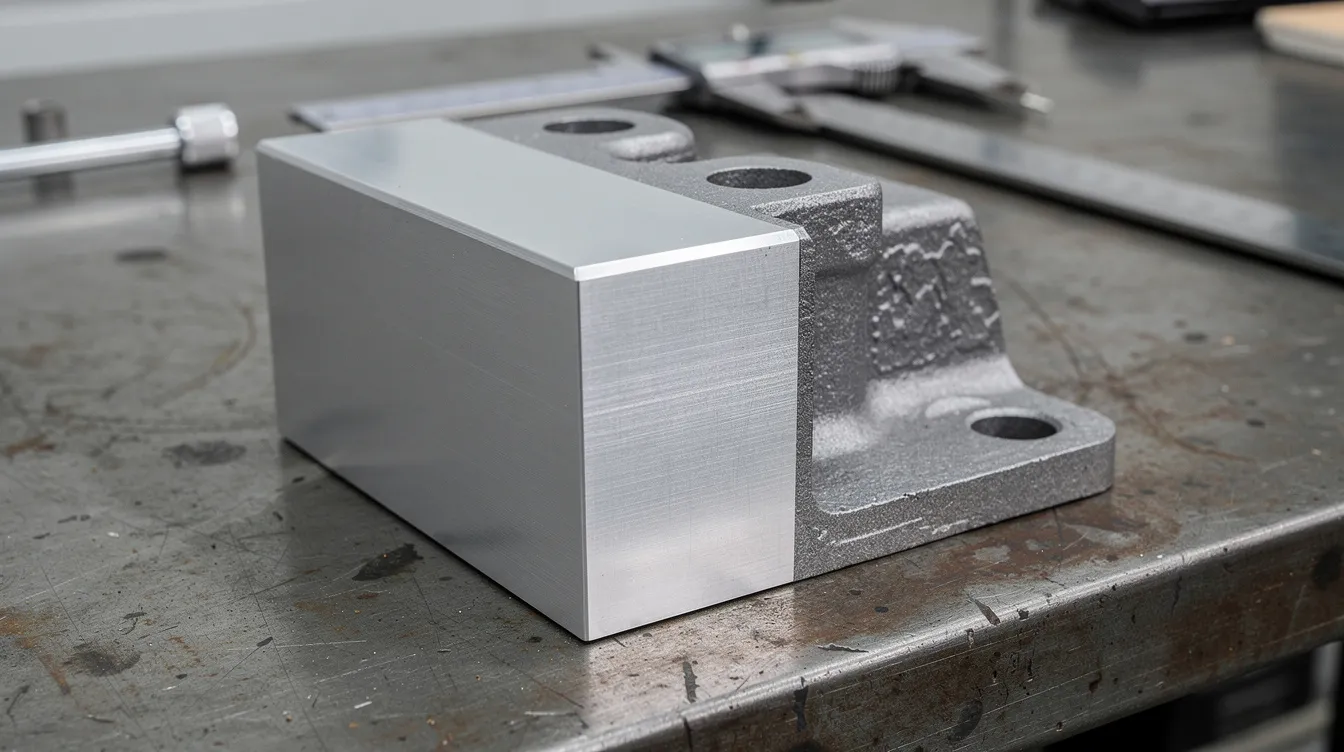
Surface quality: Machined surfaces reach Ra 0.4–1.6 μm with proper tooling and speeds, while as-cast surfaces are rougher (Ra 1.6–6.3 μm) and often show parting lines, ejector pin marks, and draft artifacts. Post processing – bead blasting, anodizing, powder coating – is frequently required on cast parts. Casting processes have improved in precision and surface quality, but machined parts still set the benchmark.
Mechanical properties: Machined parts from wrought bar or plate maintain full, homogeneous mechanical properties and fatigue strength with no porosity. Die-cast prototypes can have porosity and local variations that reduce fatigue performance, though they are more representative of final production casting behavior.
Guidance: CNC machining is generally favored for initial prototypes and functional testing under high loads, pressure sealing, or fatigue – think structural brackets or medical device frames. For validating the real-world behavior of die-cast housings, brackets, or heat sinks, die cast prototypes are more representative of what you’ll get in volume production.
Design Complexity, Geometry, and Part Size
Design complexity and design-for-manufacture (DFM) requirements differ significantly between the two processes. What’s easy in one can be labor intensive or impossible in the other.
CNC machining constraints:
-
Tool access limits deep pockets and internal features
-
Sharp internal corners require small-radius end mills and slower feeds
-
Undercuts need special fixturing or multi-setup operations, adding higher cost
-
Very thin walls (<1 mm) risk vibration and deflection during machining
Die casting advantages for complex shapes:
-
Thin walls (1.0–1.5 mm in aluminum) formed in a single shot
-
Internal ribs, bosses, logos, and intricate shapes produced directly
-
Complex 3D external features and internal cavities achievable
-
Die casting is suitable for high-volume production of complex non-ferrous parts once the design is finalized
-
Casting is suitable for complex shapes and large parts
Die casting requires draft angles (1–3°), parting line planning, and gating design – constraints that don’t apply to CNC. CNC machining is flexible from very small precision components to medium-sized machined parts limited mainly by machine travel. High-pressure die casting has optimal size windows because very large dies become costly and heavy.
Anebon’s DFM feedback helps adjust design features – draft angles, fillets, wall thickness, ribs – depending on whether the customer plans for CNC machining or die casting as the final production method.
Material Options and Prototyping Scenarios
Material choice impacts both manufacturability and how realistically the prototype represents final parts. Casting methods are better for high volume production, but CNC opens up far more material options.
Typical CNC machining materials:
-
Aluminum 6061-T6 and 7075-T6 for aerospace and robotics
-
Stainless steel 304/316 for medical and food applications
-
Titanium Grade 5 (Ti-6Al-4V) for high strength-to-weight (though machined aluminum in titanium alloys carries a 5–10× cost premium)
-
Brass for connectors, POM/PC/PEEK for engineering plastic prototypes
Common die casting alloys:
-
ADC12/A380 aluminum for automotive and electronics housings
-
AlSi9Cu3 for better fluidity in thin-wall parts
-
Zamak 3/5 zinc for fine details and small volumes
Some alloys used in final production die casting are difficult to machine from solid, and vice versa. A CNC prototype might use a similar wrought alloy instead, which affects thermal and mechanical behavior slightly.
Scenario examples:
-
Early-stage medical device frame: CNC machined from 6061-T6 aluminum for 10 functional test units – full wrought properties, ±0.01 mm on critical bores, delivered in 7 days
-
Late-stage automotive ECU enclosure: Die cast in ADC12 with minor CNC finishing on sealing faces – validates wall thickness, cooling channels, and injection molding-like repeatability before committing to production dies
Anebon can advise on material substitutions between wrought and cast alloys to keep prototypes practical while staying close to production mechanical performance.
From Prototype to Production: Hybrid and Step-by-Step Strategies
Most successful OEM programs don’t lock into one process. They phase from CNC to die casting as the design matures and production volume grows.
A common path Anebon sees:
-
Initial CNC prototypes (1–20 pcs) for design verification and functional testing
-
Second-round CNC or small batches (50–200 pcs) for beta testing and customer samples
-
Prototype die casting (hundreds to a few thousand pcs) using soft tooling for pre-production validation
-
Full production tooling for high volume production runs of thousands or more
Hybrid approaches are increasingly common: die casting the near-net-shape body, then CNC machining critical interfaces, threaded holes, or sealing surfaces for maximum dimensional accuracy. This mirrors final production workflows and gives realistic production cost data.
Using CNC machining first allows quick iteration on design complexity before locking in die features such as draft, ejector pin locations, and gating systems. Engineers should think about the final process as early as possible so features like wall thickness, ribs, and fillets are compatible from the first CNC prototypes.
Anebon’s engineering team can review CAD models and recommend whether to start with CNC machining, go straight to prototype die casting, or combine both for complex parts.
How Anebon Helps You Choose: Practical Guidelines and Next Steps
The “best” process depends on your project constraints: budget, deadline, annual volume, and performance requirements.
Choose CNC machining when:
-
You need fewer than 200 parts
-
Fastest lead time is critical
-
You require maximum dimensional accuracy and tight tolerances
-
Flexible material options matter (including titanium alloys, stainless steels, plastics)
Choose die casting prototyping when:
-
You’re targeting thousands of identical parts per year
-
Part geometry features thin walls, ribs, and intricate designs typical of cast parts
-
You need to validate real casting behavior before committing to production tooling
Anebon can quote both CNC machining and die casting for the same design so you can directly compare production cost, lead time, and surface quality trade-offs. Our ISO 9001:2015 quality system, CMM inspection, and experience across both processes help ensure prototypes and production parts match specifications.
Ready to decide? Send your 3D CAD files (STEP, IGES) and 2D drawings to Anebon for a free DFM review and dual-process quotation. Our engineering team will recommend whether CNC machining or die casting is the right fit for your next prototype – or whether a hybrid approach delivers the best result.