CNC Machining vs Die Casting Prototyping: Choosing the Right Method
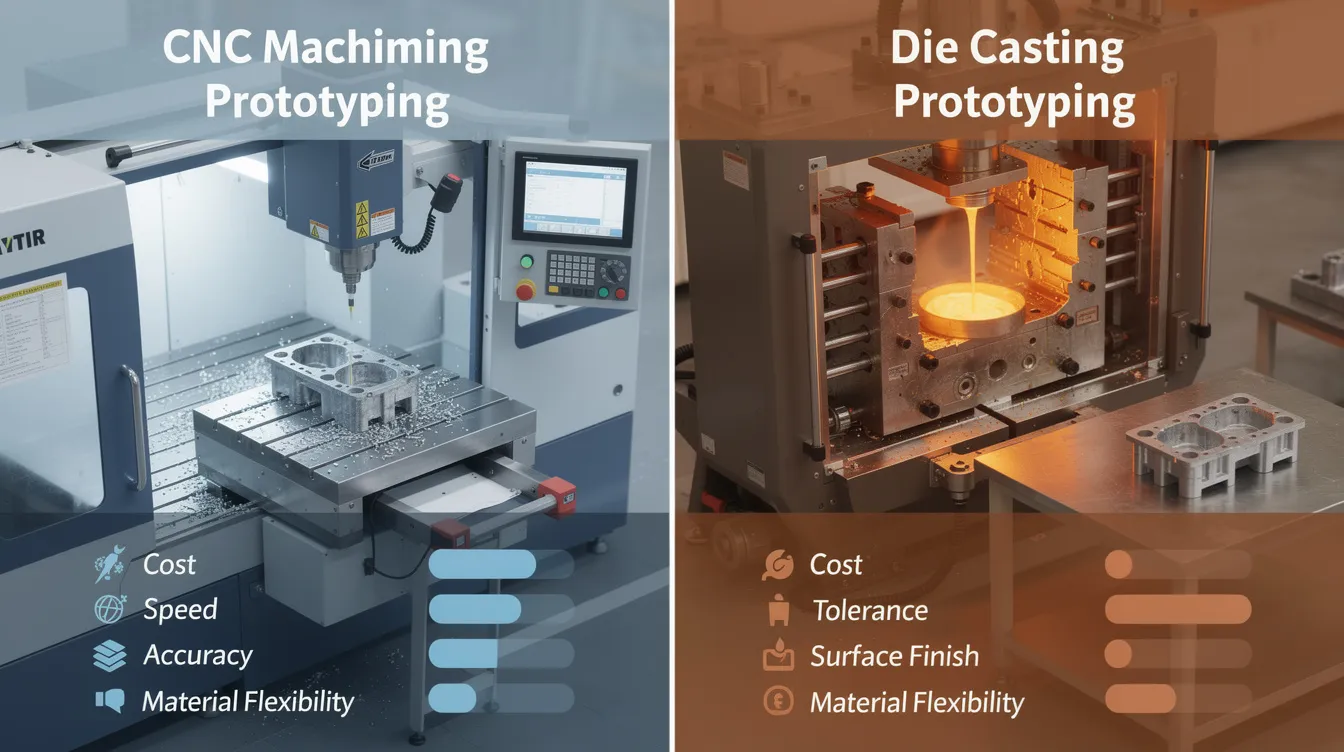
CNC Machining vs Die Casting Prototyping: How to Choose for Real Projects
If you’re developing a new metal part and trying to decide between CNC machining and die casting for your prototypes, the answer depends on where you are in the design cycle, how many parts you need, and how close to final production geometry you want to get. This guide breaks down the real trade-offs with specific numbers, costs, and scenarios so you can make a confident decision.
Quick Answer: CNC Machining vs Die Casting for Prototypes
For most prototyping scenarios in 2024–2026, CNC machining is the faster, more flexible, and lower-risk starting point. CNC machining is ideal for prototypes in quantities of 1 to 200, with lead times of 3 to 7 working days and tolerances as tight as ±0.002 mm on critical features. It’s a subtractive manufacturing process that starts from a solid block of wrought metal or plastic, so there’s no mold creation step and no upfront tooling investment. CNC machining is generally preferred for prototyping due to its speed and flexibility, and it’s best for running several design iterations before finalizing a product.
Die casting prototyping enters the picture once your design is largely frozen and you need 300–5,000 parts to validate real casting behavior. The die casting process involves forcing molten metal into a steel mold under high pressure, producing complex shapes with thin walls, ribs, and bosses in a single shot. But it requires expensive tooling-initial tooling costs for die casting range from $5,000 to $100,000-and lead times of several weeks for tool build alone. Die casting becomes attractive for prototypes that need to closely represent mass-produced parts.
Here are the rules of thumb:
-
Low volume production + evolving design + special materials → choose CNC machining
-
Higher production volumes + cast-oriented geometry + near-production validation → consider die casting prototyping
-
Volume crossover: below ~300 pcs, CNC almost always wins on cost and speed; above 500–2,000 pcs, die casting starts becoming more economical per part
Anebon Metal Products Limited offers both CNC machined parts and prototype die cast parts from a single facility in Dongguan, China, and can recommend the right or hybrid route based on your CAD model, volume forecast, and tolerance requirements.
Overview: CNC Machining and Die Casting in Prototyping
Understanding cnc machining vs die casting for prototyping requires looking past general manufacturing descriptions and focusing on what matters during early development: iteration speed, cost risk, and how faithfully your prototype represents the final part.
CNC machining is a subtractive manufacturing process-CNC milling, CNC turning, and 5-axis machining cut material from billet or plate stock. It excels at rapid prototyping across diverse materials and produces metal parts that are dimensionally precise using wrought alloys like 6061-T6 aluminum. Die casting is a manufacturing method where molten metal (typically ADC12/A380 aluminum or Zamak 3/5 zinc) is injected under high pressure into steel dies, optimized for high volume production but also used with prototype tooling for validation runs.
Key differences at a glance:
-
Setup cost: CNC requires minimal fixturing; die casting demands a steel mold costing thousands to tens of thousands of dollars
-
Lead time: CNC delivers parts in days; die casting prototyping takes 3–8 weeks including tool fabrication
-
Precision: CNC achieves tolerances tighter than ±0.05 mm; die casting as-cast tolerances are typically ±0.10–0.20 mm
-
Part complexity: Die casting produces thin-walled, rib-integrated geometry in one shot; CNC handles deep pockets, exotic alloys, and complex internal features
-
Scalability: CNC costs stay flat per part; die casting costs drop dramatically at higher production volumes, making it the path to mass production
What Is CNC Machining for Prototyping?
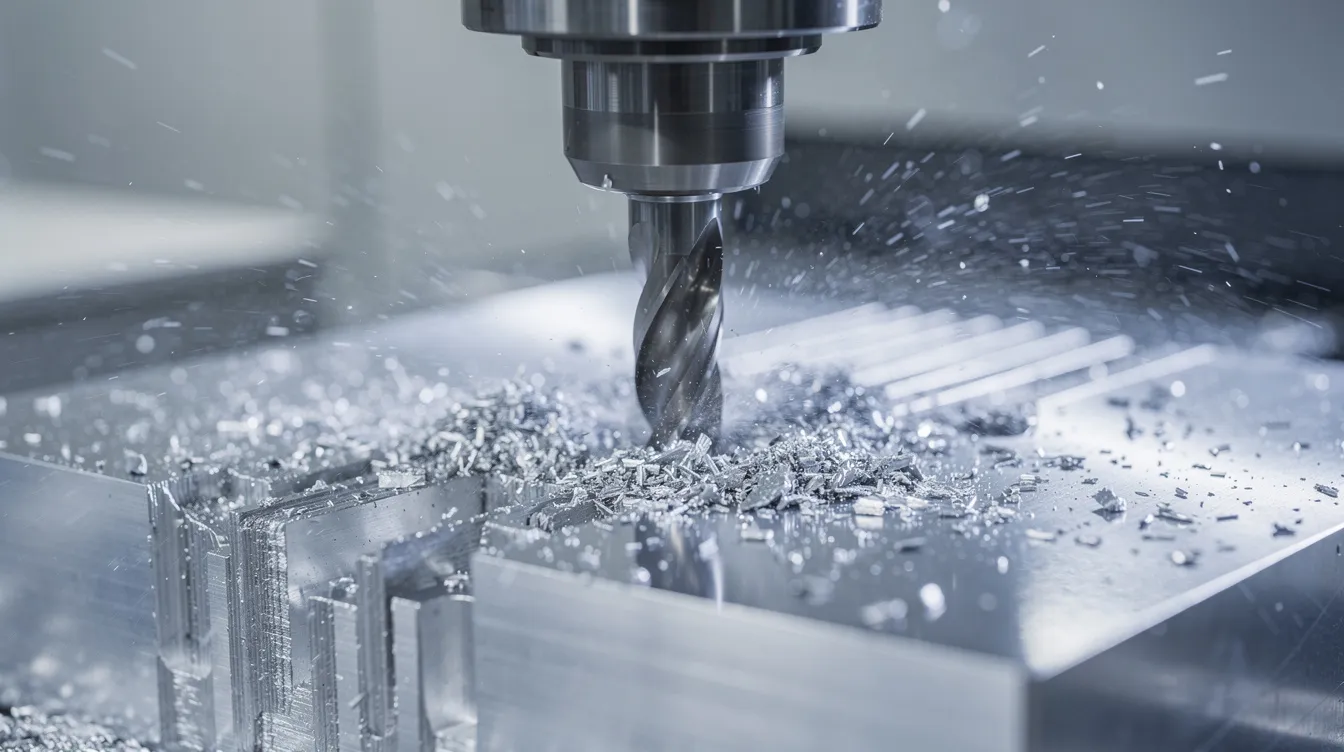
The CNC machining process for prototyping starts with a CAD model, which is converted into toolpaths using computer aided manufacturing (CAM) software. A CNC machine-guided by computer numerical control-then cuts the desired shape from metal or plastic stock through material removal. CNC machining can produce parts in hours for simple prototypes, making it the go-to manufacturing process for early-stage R&D.
Key aspects of CNC machining for prototypes:
-
Machine types: 3-axis mills for flat-envelope parts, 5-axis machining centers for complex contours and undercuts, CNC lathes for turned features, and Swiss-type turning for small-diameter shafts
-
Tolerances: CNC machining achieves tolerances as tight as ±0.002 mm on critical features, with standard tolerances of ±0.01–0.03 mm depending on geometry and material
-
Surface finish: Ra 0.4–1.6 μm after finishing operations, before any secondary operations like anodizing or bead blasting. CNC machining achieves surface finishes as fine as Ra 0.4 μm
-
Materials: aluminum 6061/7075, stainless steels 304/316, titanium, brass, and engineering plastics like PEEK and PC. CNC machining can work with hundreds of materials, and CNC machining supports materials like titanium and plastics that cannot be die cast
-
Prototyping strengths: no tooling cost, design changes implemented by updating the NC program, and CNC machining is ideal for low-volume production runs of 1 to 500 parts. CNC machining is recommended for small batches and testing for fit and function
What Is Die Casting Prototyping?
Die casting prototyping uses prototype or soft steel dies to produce early batches of die cast parts, typically 300–5,000 pieces, before committing to full production tooling. The die casting process injects molten metal into steel molds for complex shapes but requires high upfront tooling investments.
Prototype dies differ from full production dies in important ways:
-
Tooling: cheaper steels, single-cavity design, shorter tool life (hundreds to a few thousand shots). Prototype soft tooling can be built in ~3–6 weeks in Asia, versus 8–16 weeks for hardened multi-cavity production tooling. Die casting has long lead times for tool creation, typically 8 to 16 weeks for production dies. The initial investment for die casting molds can range from $10,000 to over $100,000
-
Alloys: common prototype die cast alloys include aluminum ADC12/A380 for structural housings, AlSi9Cu3 for automotive applications, and Zamak 3/5 zinc for small detailed parts. Die casting alloys include A380 and Zamak 3 for fine details. Common die casting alloys include aluminum, zinc, and magnesium
-
Tolerances and finish: die casting tolerances typically range from ±0.1 mm to ±0.2 mm as-cast, with surface roughness of Ra 1.6–6.3 μm. Die-cast parts typically have surface finishes of Ra 1.6–6.3 μm. Critical features often need secondary CNC machining
-
Why prototype in die casting: to verify mold filling patterns, shrinkage behavior, porosity levels, and assembly fit before investing in multi-cavity production tooling. Die casting is more cost-effective for high-volume production and more efficient for high-volume production once tooling is amortized
-
Production speed: die casting cycle times are 30–90 seconds per part once the die is ready, and die casting can produce parts with wall thicknesses as thin as 0.5 mm. Die casting excels at producing intricate 3D shapes with thin walls and internal cavities
Detailed Comparison: CNC Machining vs Die Casting for Prototyping
When evaluating casting vs CNC for prototyping specifically, the comparison goes beyond raw specs. Here’s what matters in practice:
-
Dimensional accuracy: CNC machined prototypes use wrought stock with full mechanical properties-6061-T6 wrought aluminum delivers ~310 MPa tensile strength vs ~240 MPa for ADC12 die cast. CNC machining is preferred for parts requiring tight tolerances and high precision
-
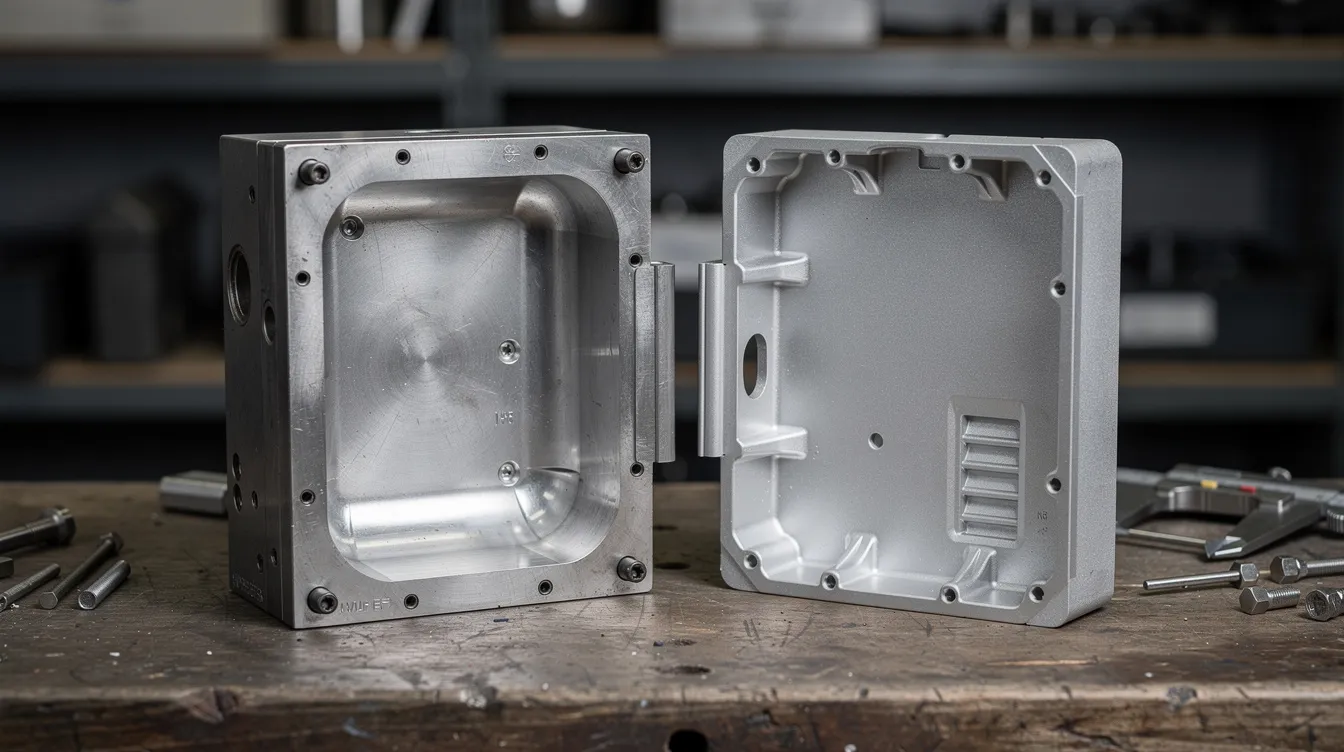
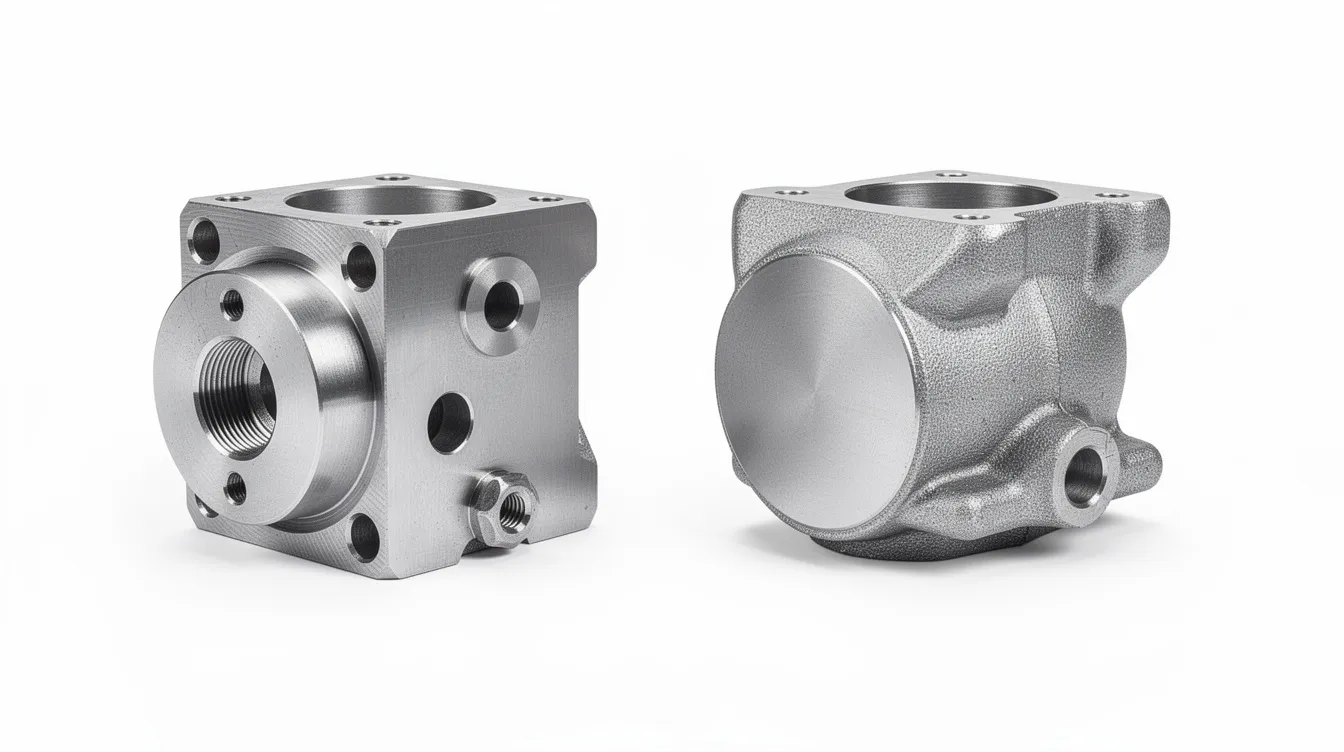
Geometry fidelity: die cast prototypes replicate near-net-shape production geometry including draft angles, ribs, bosses, and gating effects. CNC machined prototypes lack draft and cast-specific features, so they may not perfectly represent how the final die cast part behaves in assembly
-
Internal features: CNC machining is unsuitable for deep internal cavities without specialized tooling, whereas die casting can form enclosed internal channels using die cores-though at added die cost
-
Porosity risk: die cast parts can contain porosity in thick sections that affects fatigue life and leak testing. CNC billet parts are fully dense, eliminating this variable during early functional tests
-
Material waste: CNC machining generates 50–80% significant material waste during production from subtractive cutting. Die casting produces near-net shapes with minimal scrap, though gating and runner systems create some waste
-
Design change cost: updating a CNC program takes hours; once the die is made in die casting, modifying the design can incur high costs for die rework or full rebuild
-
Production intent: many OEMs pair both methods-start with CNC prototypes for iteration, then validate with prototype die casting once the die casting design and annual volume forecasts stabilize. This staged approach to machining and die casting reduces risk at every step
Cost, Tooling, and Lead Time in Early Development
Understanding the cost structure behind cnc machining and die casting prototyping prevents budget surprises. Here’s how costs break down:
CNC machining costs are driven by machine hours, setup time, material stock, and finishing. CNC machining has minimal tooling costs for prototypes-just fixtures and cutting tools. CNC machining eliminates high tooling costs associated with die casting for initial prototypes. CNC machining is cost-effective for low-volume production, and CNC machining is faster for low production volumes.
Die casting costs are dominated by upfront tooling cost. Initial tooling costs for die casting range from $5,000 to $100,000 depending on part size, complexity, and cavity count. Die casting lead times include 3–6 weeks for prototype tooling alone. Die casting is cost-effective for production runs over 5,000 units, and die casting becomes cheaper per part above 10,000 units as die casting’s per-part cost decreases significantly with higher volumes. Die casting becomes cost-effective above 5,000 units for most geometries.
|
Factor |
CNC Machining |
Die Casting Prototyping |
|---|---|---|
|
Upfront tooling cost |
Minimal (fixtures, cutters) |
$5,000–$100,000 for prototype die |
|
Lead time (first parts) |
3–7 working days |
3–8 weeks (tooling + first shots) |
|
Per-part cost at 100 pcs |
$40–$80 (aluminum housing) |
Higher due to amortized tooling |
|
Per-part cost at 1,000 pcs |
$40–$80 |
$4–$12 |
|
Cost of design change |
Update NC program (hours) |
Modify or rebuild die ($$$) |
|
Hidden costs |
Tool wear, stock material |
Die shipping, scrap, maintenance |
Precision, Tolerances, and Functional Testing
When prototypes need to pass functional tests, tolerance capability determines which manufacturing process you should use.
-
CNC machining tolerances can reach ±0.002 mm on critical bores and mating surfaces, with standard prototype tolerances of ±0.01–0.03 mm. CNC machining can achieve tolerances tighter than ±0.05 mm across most common metals
-
Die casting often requires secondary machining for higher precision, delivering ±0.2 mm standard as-cast or ±0.05 mm with post-machining on functional surfaces
-
Porosity and internal defects in die cast prototypes can compromise leak testing, pressure-tight features, and fatigue life-issues that don’t arise with dense CNC machined billet parts
-
For functional tests involving bearings, sliding fits, or sealing surfaces, engineers usually rely on CNC machining or die cast parts with secondary CNC machining operations
-
CNC is preferred for early functional validation of critical interfaces; die casting prototypes validate production-like performance later in the development cycle
Concrete example: A 2025 EV motor housing designed for A380 high pressure die casting has its main body cast to net shape, but bearing bores and mounting pads require ±0.02 mm fit. These features receive secondary CNC machining after casting to achieve the required dimensional accuracy for structural integrity under load.
Design Complexity, Geometry, and Part Size in Prototyping
Part complexity and geometry drive the choice between these other manufacturing methods in important ways.
Die casting can form thin walls (1.0–1.5 mm wall thickness for aluminum), external ribs, bosses, and complex 3D shapes in a single shot-features that would take hours of expensive machining from a solid block. Die casting produces complex geometries like die cast housings, engine blocks, and ribbed enclosures efficiently. However, die casting design requires draft angles (typically 0.5–1.5° external), and deep internal cavities need cores that add die cost.
CNC machining offers advantages when:
-
Parts are very small (surgical components, connector pins) or very large (800 mm machine bases) where die casting tooling would be impractical
-
Sharp internal corners or complex metal parts with tight internal features are needed
-
Geometry changes frequently during development-no sunk tooling investment at risk
Case example: A handheld medical device frame was first prototyped via CNC machining from 6061-T6 aluminum to test fit, strength, and assembly. After three design iterations, the frame was redesigned for ADC12 die casting with integrated ribs, draft angles, and optimized wall thickness to reduce weight and material waste. The final die cast version kept CNC-machined hinge pin holes and connector pads for high precision where it mattered.
Material Choices: What You Can and Cannot Prototype
Material flexibility is one of the clearest differentiators when comparing vs CNC machining and die casting.
CNC machining offers access to virtually any machinable material. Die casting is limited to non-ferrous alloys with good fluidity. Here’s how the two line up:
CNC-only prototype materials: aluminum 7075, stainless steels (304, 316L, 17-4 PH), titanium (Ti-6Al-4V), tool steels, brass, copper, engineering plastics (PEEK, PC, ABS, Delrin). Choose CNC machining when you need exotic alloys or high-temperature materials that cannot survive the die casting process.
Die cast-compatible prototype materials: aluminum ADC12/A380/A383, AlSi9Cu3, A360, zinc Zamak 3/5, and magnesium alloys for specialized applications.
Can die cast parts be CNC machined? Yes-many die cast parts receive secondary operations to refine bores, threads, and sealing faces. But the reverse isn’t true: most CNC-only materials (stainless steels, titanium, PEEK) cannot be die cast, making the CNC machining process the only viable path for those alloys.
For prototypes meant to match final production mechanical properties, it’s important to use the same wrought or cast grade. Anebon can advise on material equivalence between CNC machined and die cast parts to ensure your prototype test data transfers to production.
Hybrid Strategy: Die Cast + CNC Machined Features in Prototyping
The hybrid approach combines the best of both casting processes: produce near-net-shape die cast parts for the shell and structural geometry, then apply CNC machining on critical datums, bores, threads, and sealing surfaces.
This strategy is used in prototyping for:
-
Automotive gearbox housings where the cast body integrates ribs and cooling channels, while bearing seats and flange interfaces get CNC finishing
-
Robotics gearboxes and LED housings where production speed matters but functional surfaces require tight tolerances
-
Electronics enclosures where cast thin walls reduce weight but connector openings need high precision
Anebon routinely produces die cast parts with secondary CNC machining in-house, reducing logistics and alignment risk for overseas OEMs. This means a single partner handles the entire process chain.
Scaling benefit: prototype with hybrid parts (cast shell + CNC-machined pads), then transition to full large scale production using the same process chain-only the die cavity count and tooling hardness change. The cast surface texture vs machined pads are clearly visible on the same part, confirming which features meet spec.
From First Prototype to Mass Production: Step-by-Step Path
Here’s the chronological roadmap many OEMs follow between 2024–2026 when developing complex parts:
-
Concept phase (Weeks 1–4): CAD designs refined, 1–10 concept prototypes produced via CNC machining in aluminum or engineering plastic to test form, fit, and look. CNC machining works here because designs change daily.
-
Engineering validation (Months 1–3): 20–200 pieces via CNC (or additive + CNC) to test strength, thermal behavior, vibration, and assembly. Multiple design iterations happen here. CNC machining offers the speed and flexibility needed.
-
Prototype die casting (Months 3–6): design largely locked with draft angles, ribs, and optimized wall thickness. Build soft steel prototype tooling, produce 300–5,000 die cast pieces with secondary CNC machining to validate shrinkage, porosity, warpage, and assembly compatibility.
-
Pilot production (Months 5–9): multi-cavity prototype dies, polished tooling, customer sign-off samples. Production tooling decisions finalized.
-
Full production: hardened steel production dies, streamlined die casting + CNC finishing for high volume production runs, optimized for cost per part and quality.
Typical timelines from initial concept to mass production span 3–12 months depending on part complexity and industry requirements. Anebon supports at each step with DFM feedback, tolerance stack reviews, material recommendations, and dual-quoting CNC vs die casting for the same geometry.
Decision Guide: Which Process Should You Use Now?
When deciding between CNC machining vs die casting for your prototype, use this framework:
-
If you need fewer than ~300 parts, design is still evolving, tolerances tighter than ±0.05 mm, or you’re using steels/titanium/engineering plastics → choose CNC machining
-
If you need 300–5,000 parts, design is mostly frozen, geometry already includes draft, ribs, and bosses, and production will also be die cast → choose die casting prototyping
-
If high volume production is expected but some critical features need CNC precision, or multiple variants share one die cast base → choose hybrid (CNC + die casting)
-
If you’re unsure about production volume but need to test fit and function fast → start with CNC, revisit die casting later
The best manufacturing process for your project depends on answering these questions honestly: What’s your production volume target? How stable is the design? What factor does CNC machining costs play versus tooling investment risk? A wrong choice at this stage costs weeks and thousands of dollars.
Why Work with Anebon for CNC Machining and Die Casting Prototypes?
Anebon Metal Products Limited is an ISO 9001:2015 and ISO 14001:2015 certified manufacturer in Dongguan, Guangdong, China, operating since 2010. We offer integrated capabilities across precision CNC machining, high pressure die casting, sheet metal fabrication, and a wide range of surface treatments-all under one roof for both prototype and production.
-
Single partner for both CNC machined parts and die cast parts, eliminating coordination between multiple vendors
-
DFM consulting and CMM inspection included with every project
-
Target industries: aerospace, medical devices, automotive, electronics, robotics, and industrial machinery
-
Competitive lead times: 3–7 days for CNC prototypes; expedited soft tooling for die casting prototyping
Send your CAD files for a free DFM review and request parallel quotes for “CNC machining only” vs “die casting + CNC secondary machining” to see exactly which path saves you time and money.
FAQs: CNC Machining vs Die Casting Prototyping
Is CNC machining more expensive than prototype die casting for 500 pcs? It depends on part size and complexity. For a moderately sized aluminum housing at 500 pieces, CNC machining costs per part ($40–$80) may exceed die casting ($4–$12 per part) if tooling is amortized. However, the initial die investment of $5,000–$25,000+ makes the total project cost comparable. Below ~500 pcs, CNC is almost always cheaper overall.
Can die cast parts achieve the same precision as CNC machined prototypes? Not as-cast. Die casting tolerances are typically ±0.10–0.20 mm, while CNC machining achieves ±0.002 mm. Die casting often requires secondary machining to reach ±0.05 mm on functional surfaces. For parts that require tight tolerances on every feature, CNC remains the better choice.
When should I switch from CNC prototypes to die cast prototypes? Switch when your design is stable enough that the risk of scrapping a die is low, you need 300+ parts, and your final production method will be die casting. The goal of die cast prototyping is to validate casting-specific behavior-not just geometry.
Can I start with CNC machined aluminum and later move to aluminum die casting without changing material grade too much? You can, but be aware of mechanical properties differences. CNC prototypes in 6061-T6 (tensile ~310 MPa, yield ~276 MPa) will outperform A380/ADC12 die cast parts (tensile ~240 MPa, yield ~130–160 MPa). Anebon can help you evaluate whether the strength reduction matters for your application or if a different cast alloy like A356-T6 bridges the gap. Note that investment casting or sand casting processes may also be relevant alternatives depending on your geometry and volume.
What about comparing die casting to other methods like investment casting or sand casting? Investment casting and sand casting serve different niches. Investment casting handles complex geometries in ferrous alloys at low-to-medium volumes. Sand casting works for very large parts. High pressure die casting is the best manufacturing process for the manufacturing industry when you need high volume production runs of complex metal parts in non-ferrous alloys. Each casting method has its place-Anebon can help you evaluate which fits.
How can Anebon help me choose between CNC machining and die casting for my next prototype? Send us your CAD model along with your target quantity, timeline, and tolerance requirements. Our engineering team will provide DFM feedback and parallel quotes for both CNC machining and die casting (with secondary CNC if needed), so you can make a data-driven decision. Many die cast parts we produce today started as CNC prototypes in our facility, giving us firsthand insight into producing metal parts efficiently across both processes.