CNC Machining Services Aerospace Industry Overview
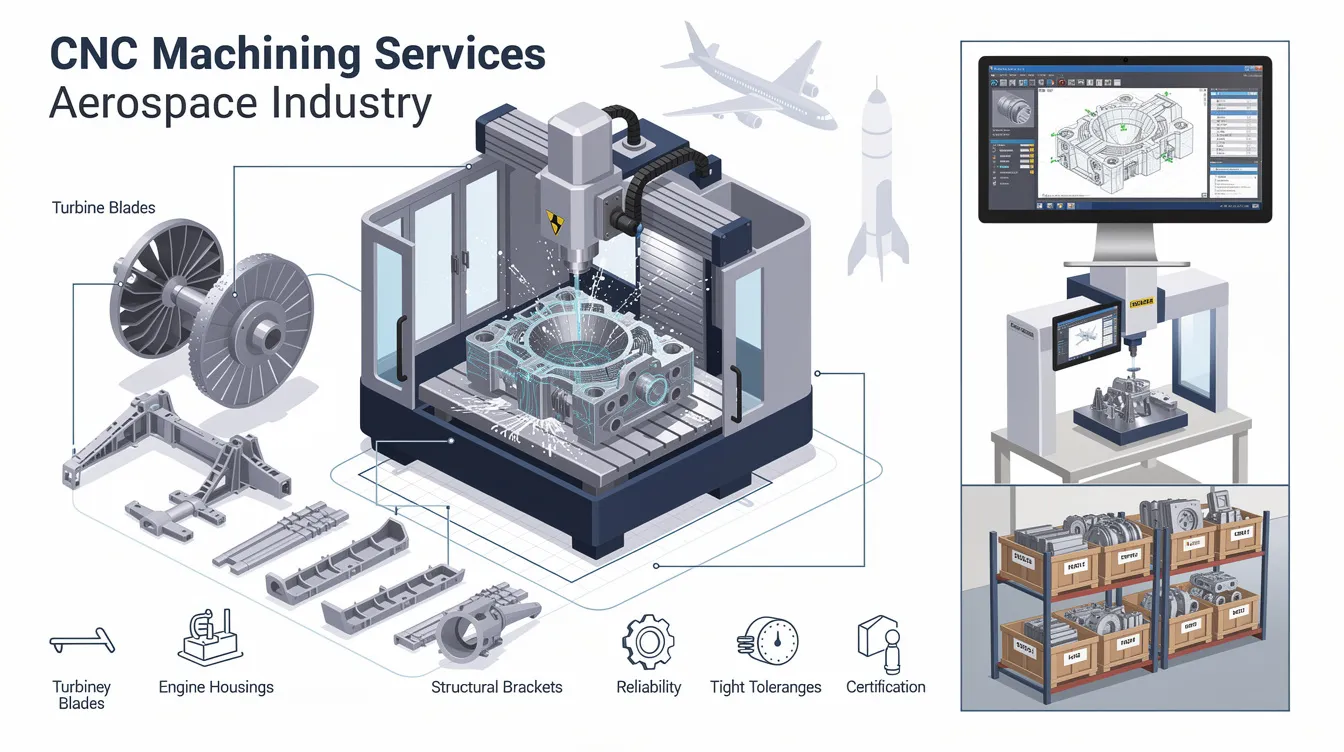
CNC Machining Services Aerospace Industry Overview
Overview: Aerospace CNC Machining Services
Aerospace CNC machining involves using computer numerical control equipment-milling, turning, drilling, and grinding machines-to produce flight-critical and flight-adjacent parts from metals and high-performance plastics. It is central to modern aerospace manufacturing because commercial jets, defense platforms, spacecraft, and UAVs all depend on components that must survive extreme loads, temperatures, and vibration without failure. Aerospace CNC machining is, by definition, high-precision manufacturing for aviation and space sectors where every micron matters.
What makes CNC machining for aerospace stand apart is its ability to deliver tight tolerances (CNC machining can produce parts with tolerances as tight as ±0.002 mm), reliable repeatability across production batches, and compatibility with advanced materials like titanium, Inconel, and PEEK. This article provides an end-to-end overview covering key applications (engine parts, landing gear, electrical components), common cnc machining processes (3-axis, 5-axis, turning, grinding), aerospace materials, surface finishes, quality control, costs, and emerging trends.
Anebon Metal Products Limited, an ISO 9001:2015 and ISO 14001:2015 certified manufacturer based in Dongguan, China, provides aerospace cnc machining services from rapid prototyping to production for overseas OEMs, design engineers, and R&D teams worldwide.
The Role of CNC Machining in Modern Aerospace Manufacturing
The shift from manual machining and basic NC in the 1960s–1980s to today’s multi-axis machining centers has been transformative. Major OEMs-Airbus, Boeing, SpaceX, COMAC-now rely on modern cnc machines and computer controlled machines running sophisticated CAM software to produce everything from wing ribs to rocket injector plates. This evolution has made aerospace component production faster, more accurate, and globally scalable.
Aerospace machining is classified as “no-fail” production. CNC machining is essential for producing flight-critical hardware with extreme precision and repeatability because the components operate under punishing conditions-high-cycle fatigue, thermal cycling, corrosive atmospheres, and sustained vibration-where failure is catastrophic. CNC machining plays a central role in ensuring that every critical component leaving the shop floor meets exact specifications.
Automation, G-code programming, and CAM simulation eliminate most human error and enable consistent results across global supply chains. Parts precision machined in China can be assembled in Europe or the US with full interchangeability, provided tolerances and standards are met. The importance of 5 axis machining and multi-axis machining centers cannot be overstated: they allow complex aerospace parts and satellite structures to be produced in fewer setups, which directly reduces cumulative positioning error.
CNC machining is used across the full product lifecycle:
-
Prototyping – CNC machining enables rapid production of aerospace prototypes, with turnaround times ranging from hours to days. Prototypes can be made from the same materials as final parts, ensuring representative testing.
-
Qualification hardware – test articles and first-article inspection (FAI) pieces verify design and process readiness.
-
Full-rate production – CNC machining supports low to high-volume production with consistent quality.
Core benefits for aerospace applications:
-
Precision down to ±0.0001 inches (≈±0.0025 mm) for critical features
-
Repeatability batch after batch
-
Flexibility from prototype to production without hard tooling
-
Throughput gains from multi-axis setups and live tooling
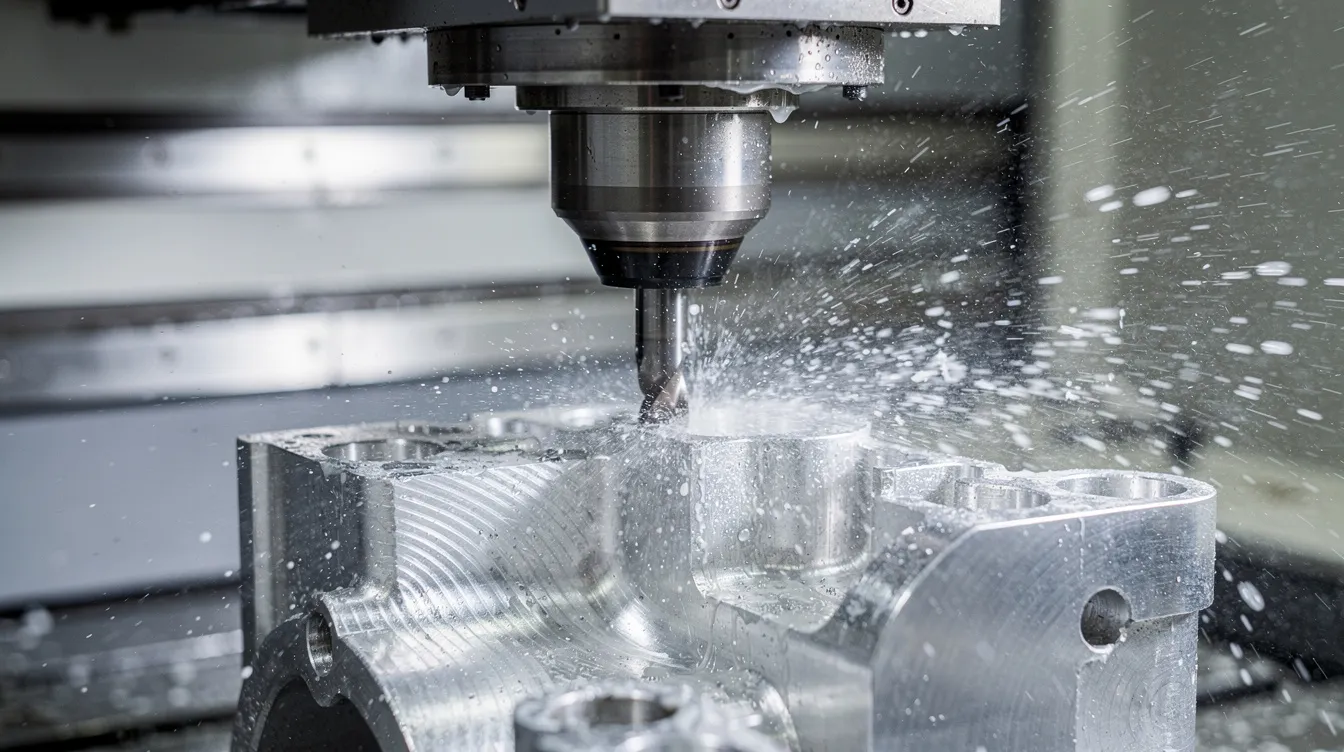
Key Aerospace Applications for CNC Machined Parts
Aerospace cnc machining covers aircraft, spacecraft, satellites, UAVs, and ground support equipment. Design engineers use cnc machined parts for both flight-critical hardware and test or qualification fixtures. Here is a high-level view of the main application clusters:
-
Structural airframe and landing gear – ribs, spars, frames, seat tracks, struts, bogie beams
-
Engine, propulsion, and thermal management – turbine and compressor blades, combustion chambers, bearing housings, heat exchangers
-
Avionics, electrical components, and interiors – EMI enclosures, sensor housings, connector shells, seat brackets, stowage bin fittings
-
Satellite and space structures – cubesat frames, reaction wheel housings, antenna mounts
-
Other aerospace components – ground support tooling, test fixtures, jigs
Structural Airframe and Landing Gear Components
CNC machining aerospace structural parts includes wing ribs, spars, fuselage frames, seat tracks, and bulkhead fittings for programs like the Boeing 737 MAX and Airbus A350. These structural elements are typically machined from aluminum alloys (7075-T6, 7050-T7451) or titanium forgings, and they demand tight geometric tolerances-position, profile, and perpendicularity callouts per ASME Y14.5-to maintain structural integrity under flight loads.
Landing gear components such as main struts, bogie beams, axle sleeves, torque links, and pistons are machined from high-strength steel (300M, 4340) or titanium forgings. These parts must withstand high-cycle fatigue and impact loads during thousands of landings. 5 axis machining and large vertical machining centers are used to mill long, thin-walled parts while managing distortion through optimized fixturing and cut strategies.
Key requirements for landing gear components include:
-
GD&T tolerances on mating surfaces down to ±0.013 mm
-
Shot-peening allowances built into machined dimensions
-
Surface preparation for coatings (cadmium, HVOF, chrome)
-
Full material and process traceability
Engine, Propulsion, and Thermal Management Parts
CNC machining processes are essential for jet engines (e.g., LEAP, PW1000G) and rocket propulsion systems, including upper-stage pump housings and injector plates. Engine components represent some of the most demanding aerospace applications due to extreme temperatures, rotational speeds, and pressure differentials.
Parts produced include:
-
Turbine and compressor blisks and blades – complex blade profiles require 5 axis cnc machining with spindle speeds up to 15,000–24,000 RPM
-
Combustion chambers and rings – machined from nickel superalloys, operating at temperatures up to 980 °C
-
Bearing housings and engine mounts – tight cylindricity and concentricity requirements
-
Fuel pump and oil system housings – complex internal passages, sealing surfaces with Ra ≤0.8 µm
-
Heat sink plates and cold plates – machined from aluminum or copper alloys for thermal management
Turbine blades and impellers require precise machining of undercuts and cooling channels in Inconel 718 or Ti-6Al-4V, demanding rigid setups, high-pressure coolant, and require specialized tooling. Precision machining minimizes friction and promotes fuel efficiency in rotating engine assemblies-a direct link between manufacturing quality and airline operating costs.
Avionics, Electrical Components, and Interiors
CNC machined parts in avionics include EMI-shielded enclosures, instrument bezels, control panel plates, sensor housings, and connector shells for electrical components. CNC machining supports miniaturization and high packing density in flight computers, radar systems, and communication modules, where precise hole patterns and flatness are non-negotiable.
Cabin interior and cockpit hardware-seat brackets, seat tracks, oxygen mask housings, latches, hinges, stowage bin fittings-are machined from aluminum and engineering plastics like PEEK and ULTEM. For aircraft like the Boeing 787 and Airbus A321neo, cosmetic finishes and hole-position accuracy (often ±0.13 mm or better) are critical. Anebon machines both metallic and plastic precision machined components for enclosures and mounting hardware.
Core CNC Machining Processes Used in Aerospace
Aerospace machining relies on a mix of manufacturing processes-CNC machining includes cutting, milling, turning, and drilling-with process selection driven by part geometry, material, and production volume. CNC machining faces limitations with extremely intricate shapes, which is why process selection and design-for-manufacturability reviews matter so much. Finding skilled CNC operators is also a significant challenge in aerospace, making proven process documentation and automation even more important.
Key processes at a glance:
-
CNC milling (3-axis and 5-axis) – the workhorse for prismatic and contoured parts
-
CNC turning and Swiss turning – for shafts, fasteners, and cylindrical parts
-
CNC grinding – for sealing surfaces, bearing journals, and ultra-fine finishes
-
EDM (wire and sinker) – for internal features and hardened materials
-
Drilling and tapping – often integrated into milling or turning cycles
3‑Axis and 5‑Axis CNC Milling
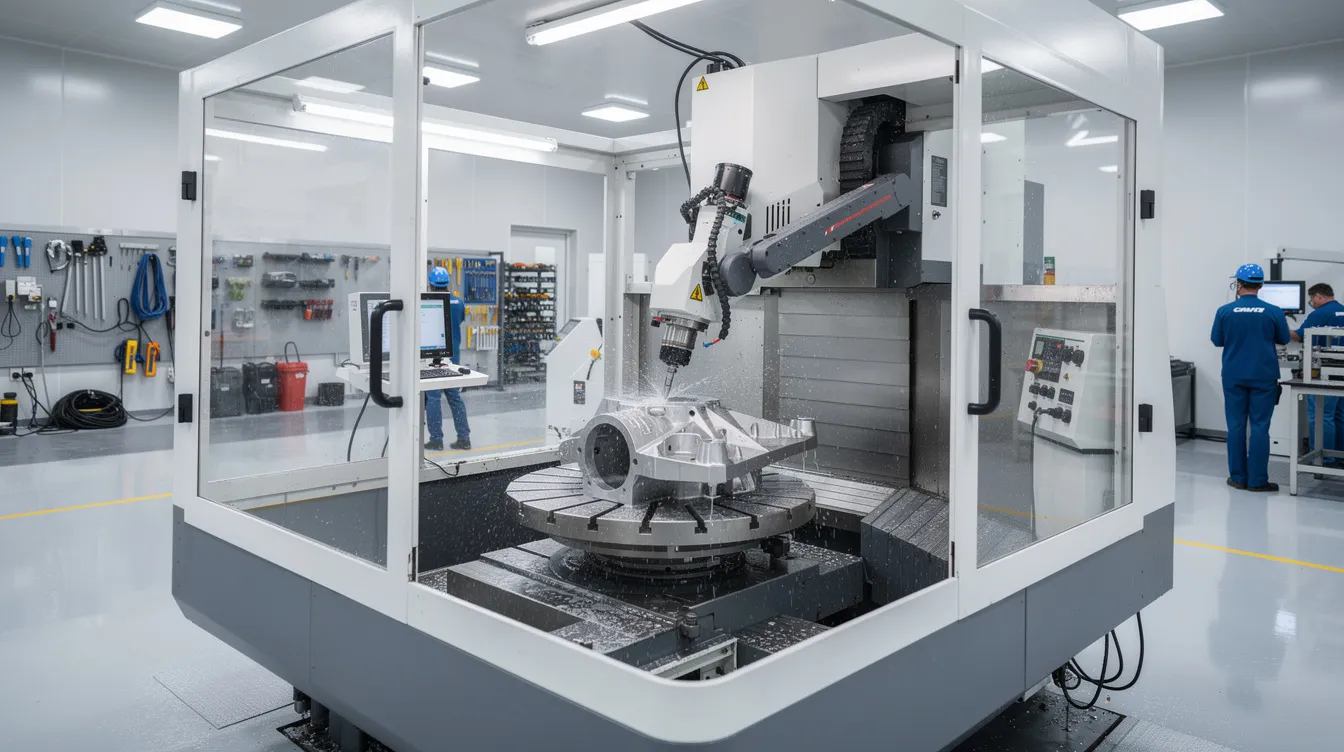
CNC milling fundamentals involve a rotating cutting tool moving along X, Y, and Z axes to remove material. For aerospace, 3-axis machining handles prismatic brackets, plates, covers, and simpler housings efficiently. However, complex geometries-contoured turbine blades, structural ribs with compound angles, impellers with undercuts-demand 5 axis cnc machining.
5-axis CNC machining handles complex geometries effectively by allowing the tool to approach the workpiece from virtually any angle. Five-axis machining allows complex components to be produced in fewer setups, and multi-axis machining reduces repositioning errors and enables intricate geometries that would otherwise require multiple fixtures. CNC machining’s ability to produce these geometries in a single clamping is what makes axis cnc machining indispensable for aerospace precision machining.
Practical design tips for engineers:
-
Avoid undercuts inaccessible to 3-axis tooling unless 5 axis cnc capability is confirmed
-
Specify fillet radii compatible with standard end mill sizes (e.g., R1.5 mm minimum for small pockets)
-
Leverage 5-axis milling to reduce setup-induced tolerance stack-ups
-
Indicate datum scheme clearly to guide fixturing strategy
CNC Turning, Swiss Turning, and Grinding
CNC turning is used for round and cylindrical aerospace parts-shafts, actuator pistons, bushings, threaded fasteners, hydraulic fittings, and cylindrical landing gear parts. Typical materials include stainless steel (17-4PH, 15-5PH), 300M, Inconel, and titanium.
Swiss-type turning excels at very small, high precision parts with diameters under ~32 mm, such as avionics connector pins and miniature fasteners. Precision CNC turning on these machines achieves IT5–IT7 tolerance classes routinely.
CNC grinding refines surface finishes on aerospace components-bearing journals, hydraulic spools, and critical sealing surfaces where sub-micron finishes and tight cylindricity are mandatory. Designers should specify grinding when surface finish requirements drop below Ra 0.4 µm or when roundness below 2 µm is needed.
Materials in Aerospace CNC Machining
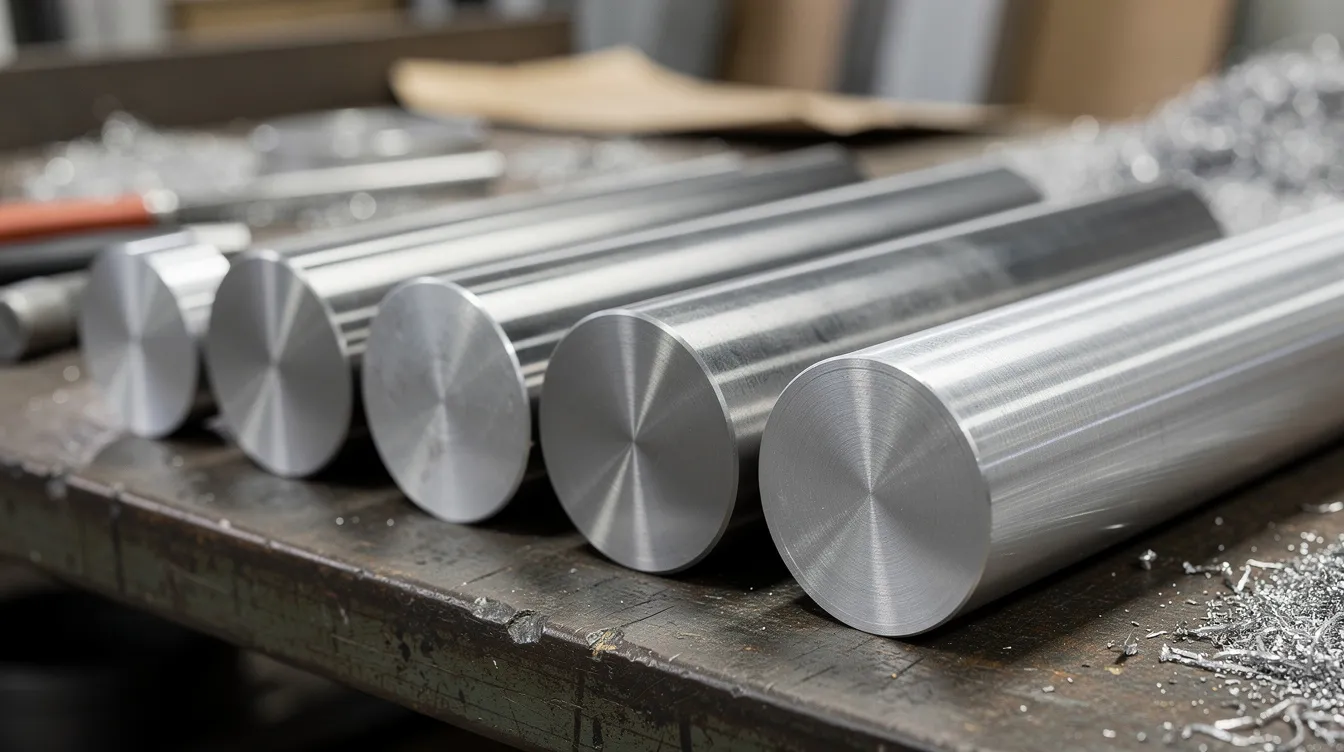
Aerospace materials must balance strength, weight, fatigue life, temperature resistance, corrosion resistance, and manufacturability. Advanced material capabilities are required for machining difficult-to-machine materials like titanium. CNC machining can produce complex geometries from advanced materials, which is why material selection and machining strategy go hand in hand.
Anebon sources and machines common aerospace grades and can certify material traceability upon request:
-
Aluminum alloys – 6061-T6, 7075-T6, 2024-T3, 7050-T7451
-
Titanium alloys – Ti-6Al-4V (Grade 5), Ti-6Al-4V ELI
-
High-strength steels – 300M, 4340, 17-4PH, 15-5PH
-
Nickel superalloys – Inconel 718, 625, Waspaloy
-
High-performance polymers – PEEK, ULTEM (PEI), PPS
-
Composites and tooling – carbon fiber trimming, aluminum layup tooling
Aluminum, Titanium, and High‑Strength Steels
Aluminum alloys are lightweight and corrosion resistant, making them the most widely used aerospace materials by volume. The 7xxx series (7075-T651, 7050-T7451) serves highly loaded structural and wing components-think bulkheads on business jets-while 6xxx grades (6061-T6) handle interior brackets and non-primary structural parts. Aluminum machines fast with high material removal rates and minimal tool wear.
Titanium alloys like Ti-6Al-4V withstand high temperatures and have excellent fatigue resistance, with tensile strengths of ~900–1,170 MPa. They are used in engine pylons, landing gear components, and hot-zone structures where high strength-to-weight and excellent corrosion resistance are needed. However, titanium requires rigid setups, high-pressure coolant, and slower feeds due to heat accumulation and challenging machinability.
High-strength alloy steels (300M, 4340) and precipitation-hardened stainless steels (17-4PH, 15-5PH) serve landing gear, fasteners, and structural fittings exposed to very high loads. These materials require specialized tooling and careful heat management during machining.
Nickel Superalloys, High‑Performance Plastics, and Composites
Nickel-based superalloys are used in aerospace applications exposed to extreme thermal loads-turbine disks, exhaust components, and high-temperature fasteners operating at up to 980 °C. Superalloys are used in high-temperature aerospace applications but certain high-temperature alloys are difficult to machine effectively due to rapid tool wear, work hardening, and chip evacuation challenges. Specialized tooling (ceramic and CBN inserts), rigid fixturing, and through-spindle coolant are essential.
PEEK is a high-performance polymer used in critical engine parts, bushings, bearings, and electrical insulators where weight savings and dielectric strength matter. PEI (ULTEM) and PPS serve similar roles in interior hardware and avionics assemblies.
Carbon fiber composites are used in approximately 50% of the Boeing 787 airframe. CNC machining supports composite-related operations: machining aluminum tooling for carbon fiber layup, trimming and drilling CFRP panels, and producing hybrid metal-composite assemblies. Ceramic matrix composites are emerging in high-temperature exhaust and thermal protection applications.
Anebon works with both metals and engineering plastics, supporting mixed-material assemblies such as aluminum avionics enclosures with PEEK insulators.
Surface Treatments and Finishes for Aerospace CNC Parts
Surface finishes often require additional post-processing in aerospace to extend fatigue life, improve corrosion resistance, enhance wear behavior, and meet electrical or EMI requirements. Common surface treatments on cnc machined parts include:
-
Anodizing (Type II/III per MIL-A-8625) – corrosion and wear protection for aluminum
-
Chemical conversion coating (Alodine per MIL-DTL-5541) – conductive base for painting or bonding
-
Passivation – corrosion protection for stainless steels per ASTM A967
-
Plating (electroless nickel, silver) – wear and conductivity
-
Painting and specialized coatings (Teflon, ceramic erosion coatings)
-
Laser marking – serial numbers and 2D DataMatrix codes for traceability
Anebon coordinates these finishes with certified local partners, ensuring documentation and traceability for aerospace customers.
Functional, Protective, and Identification Finishes
Functional finishes like hard anodizing and electroless nickel provide wear and corrosion resistance on loaded surfaces. Protective finishes-Alodine and passivation-prepare parts for bonding, painting, or service in corrosive environments. Identification features such as laser-engraved DataMatrix codes and serial numbers ensure full part traceability throughout service life.
Concrete examples include:
-
Hard anodized 7075 landing gear components for abrasion resistance
-
Alodined 6061 brackets prepared for structural adhesive bonding
-
Passivated 17-4PH hydraulic fittings for long-term corrosion protection
-
Laser-marked avionics plates for permanent identification
Surface finish levels vary by application: Ra ≈1.6–3.2 µm for structural parts, Ra ≤0.8 µm for engine flow paths, and Ra 0.2–0.4 µm for sealing faces.
Quality Requirements, Standards, and Inspection in Aerospace CNC
Quality control and traceability requirements are stricter in aerospace compared to other industries. Aerospace components must adhere to rigorous quality and safety standards because parts may remain in service for decades, and regulatory bodies like the FAA and EASA require documented evidence of conformance throughout the product lifecycle.
The standard framework includes:
-
ISO 9001:2015 – baseline quality management (Anebon holds this certification)
-
AS9100 – AS9100 certification is the internationally recognized quality management standard for aerospace
-
NADCAP – accreditation for special processes (heat treat, NDT, coatings)
-
Customer-specific requirements from OEM primes
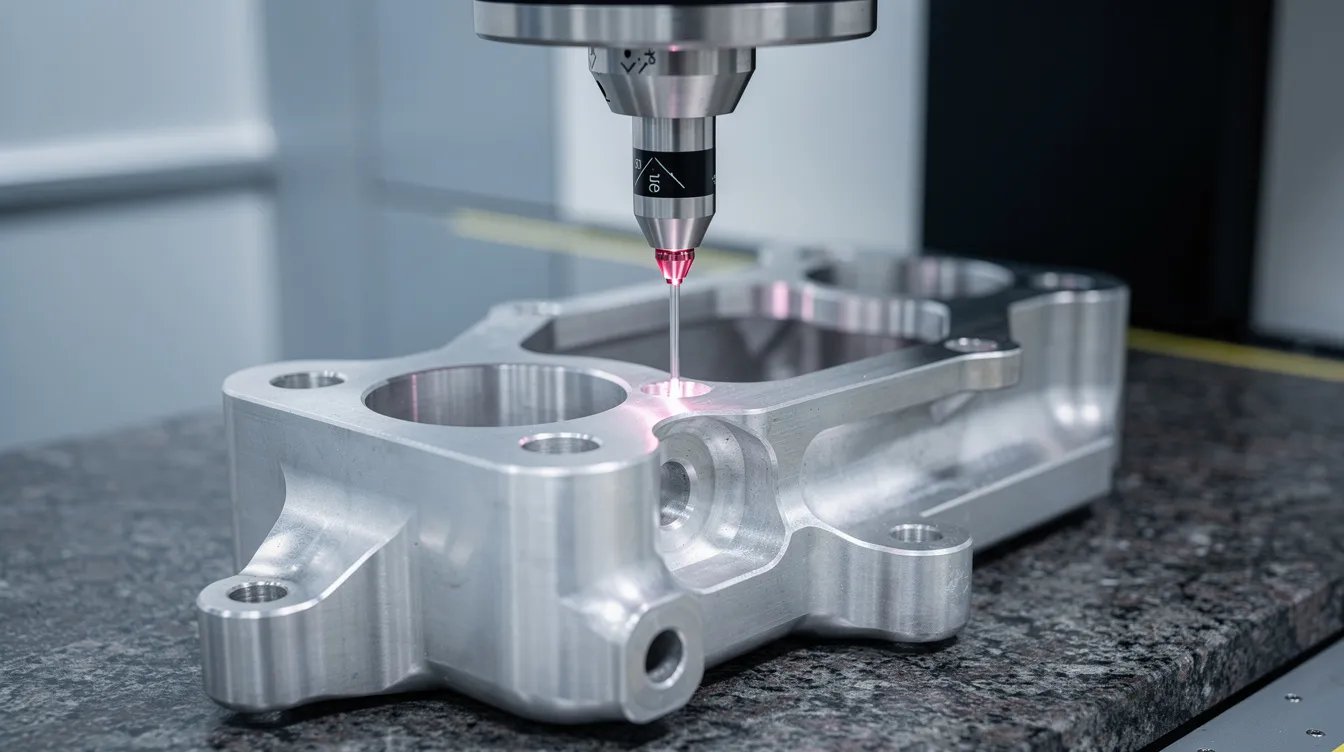
Key inspection methods for aerospace cnc parts include CMM (coordinate measuring machines) with repeatability down to ~0.001 mm, optical and laser scanning for freeform surfaces, surface roughness profilometry, hardness testing, and NDT (dye penetrant, ultrasonic). Full traceability is required for components in aerospace manufacturing-material test certificates, lot heat numbers, process records, and serialized part marking.
Achieving tight tolerances is critical for aerospace components, and CNC machining achieves precision down to ±0.0001 inches for aerospace components on critical features. CNC machining ensures aerospace parts meet strict tolerances, and CNC machining produces parts with tight tolerances for safety across every production run.
Tolerances, GD&T, and Design for Manufacturability (DFM)
Aerospace cnc machining often holds tolerances of ±0.01 mm as typical, down to ±0.002 mm for critical fits, with complex GD&T callouts including position, profile, and runout. Engineers should keep tolerances as loose as the function allows to reduce cost-reserving ultra-tight specifications for truly critical interfaces.
Anebon’s DFM feedback process reviews 3D models and drawings to flag:
-
Unnecessarily tight tolerances on non-functional surfaces
-
Features inaccessible for 3-axis machining without repositioning
-
Very deep pockets (depth-to-width ratios > 4:1) that cause tool deflection and distortion
-
Underspecified datums that leave inspection ambiguous
-
Missing surface finish or coating callouts
Aerospace machining needs to demonstrate compliance with strict regulatory frameworks such as ITAR for US defense programs. Early DFM review improves lead times, reduces scrap, and helps aerospace companies align design intent with manufacturing reality.
Cost Drivers and Sourcing Strategy for Aerospace CNC Machining
The main cost factors in aerospace cnc machining are:
-
Material – titanium and superalloys cost significantly more than aluminum
-
Part complexity – deep pockets, thin walls, undercuts, and complex parts drive cycle time
-
Tolerances and finishes – tighter tolerances and finer finishes increase inspection and machining time
-
Batch size – unit cost drops with volume; prototypes carry higher per-part overhead
-
Documentation and compliance – FAI per AS9102, material certs, and special process control add cost and lead time
Multi-axis machining centers and optimized fixturing reduce setups and lower total cost for complex 5-axis parts. Partnering with an experienced overseas supplier like Anebon in Dongguan can reduce piece-price for OEMs while maintaining high quality, especially for small-to-medium aerospace parts and assemblies.
Outsourcing makes sense when internal capacity is constrained, when exotic material expertise is lacking in-house, or when cost pressure requires competitive sourcing-provided the supplier meets aerospace quality expectations.
How to Prepare RFQs and Drawings for Aerospace CNC Suppliers
When requesting a quote from aerospace machining companies, include:
-
3D CAD files (STEP or IGES) and detailed 2D drawings with all tolerances and GD&T
-
Material specification – alloy grade, temper, and required certification level
-
Surface treatments and finishes – type, standard (e.g., MIL-A-8625), and any coating thickness requirements
-
Inspection level – FAI, in-process inspection, CMM report, NDT if applicable
-
Expected volume – prototype, small batch, or annual production quantity
-
Part classification – prototype, test, or flight hardware (this drives quality strategy and pricing)
-
Applicable standards – AS9100, customer specs, ITAR/EAR restrictions for US customers
-
Packaging and labeling – any cleanroom or ESD requirements
Anebon provides rapid quotations, manufacturability feedback, and sample parts to validate fit, form, and function before scaling to full production. CNC machining produces prototypes with extreme accuracy, enabling engineers to validate designs before committing to production tooling.
Anebon’s Aerospace CNC Machining Capabilities
Anebon Metal Products Limited, founded in 2010 in Dongguan, Guangdong, China, is an ISO 9001:2015 and ISO 14001:2015 certified manufacturer focused on precision cnc machining, die casting, and sheet metal fabrication. Anebon serves the global aerospace industry with capabilities that include:
-
3-axis and 5-axis machining centers for complex aerospace parts
-
CNC turning and Swiss turning for high precision cylindrical components
-
Small-batch rapid prototyping with turnaround from hours to days
-
Low- to mid-volume production with tight tolerance machining to ±0.002 mm
-
Aerospace materials: aluminum 6xxx/7xxx, stainless steels, titanium, PEEK
-
Coordinated surface treatments: anodize, Alodine, passivation, plating
Typical project types include structural brackets, precision spacers, housings for electrical components, ground support tooling, and interior hardware. Design engineers and OEM buyers are invited to contact Anebon for a detailed review of their aerospace cnc machining project and to request a quote.
Future Trends in Aerospace CNC Machining
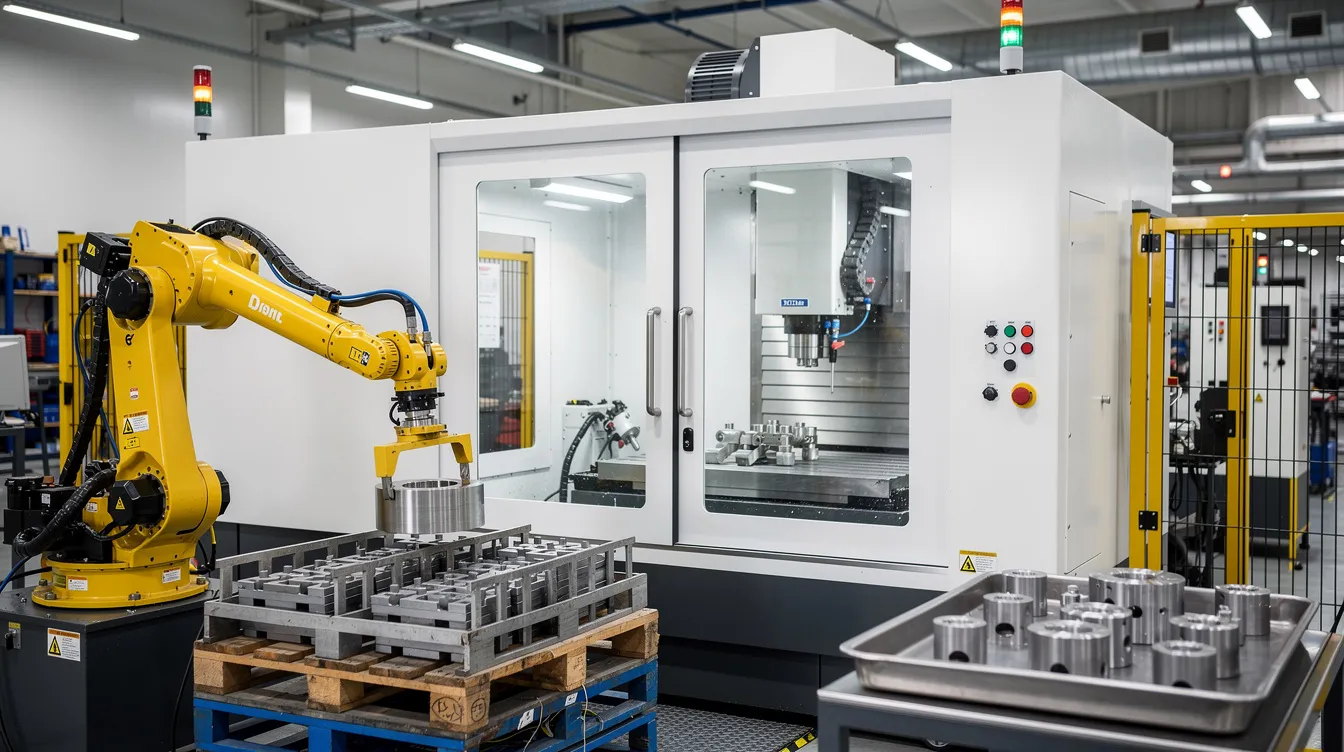
The aerospace sector is evolving rapidly. Higher-speed multi-axis machining centers, advanced automation, and real-time process monitoring with in-machine sensors are pushing first-time-right rates higher. Machine learning is being applied to predictive maintenance and toolpath optimization, reducing unplanned downtime and improving tool life.
Additive manufacturing integration-combining additive manufacturing processes (such as DMLM or EBM) with CNC machining-is gaining traction for lightweight lattices, topology-optimized satellite structures, and rocket nozzle repairs. This hybrid approach uses additive manufacturing to build near-net shapes, then precise machining to finish critical surfaces. Cutting edge technology in data-driven machining, digital twins, and connected manufacturing ecosystems links CAM, machine tools, and quality systems into Industry 4.0 frameworks.
Sustainability pressures are driving optimized toolpaths, reduced scrap from expensive alloys, efficient coolant systems, and better chip recovery. Aerospace manufacturers are also expanding the use of carbon fiber composites, ceramic matrix composites, and high-performance polymers, all of which demand evolved machining processes.
Working with agile suppliers like Anebon helps aerospace companies adapt to these trends quickly-from rapid prototype validation to certified production-without heavy capital investment.
Conclusion
Aerospace cnc machining underpins the safety and reliability of every aircraft and spacecraft by producing high precision components for structures, engines, propulsion systems, landing gear, and electrical components. CNC machining is essential for producing complex aerospace components that meet the rigorous demands of the global aerospace industry.
Success in aerospace manufacturing depends on:
-
The right mix of machining processes-5 axis machining, turning, grinding
-
Deep material expertise across aluminum alloys, titanium alloys, superalloys, and engineering plastics
-
Properly specified surface treatments for fatigue life and corrosion resistance
-
Rigorous quality control with full documentation and traceability
Anebon delivers precision cnc machined parts with strong DFM support, ISO-certified quality, and the capacity to support overseas OEMs from early design through production. Share your CAD files or drawings with Anebon today to explore how to reduce lead times and improve manufacturability for your next aerospace cnc machining project.