CNC Machining Services: Aerospace Industry Overview and Insights
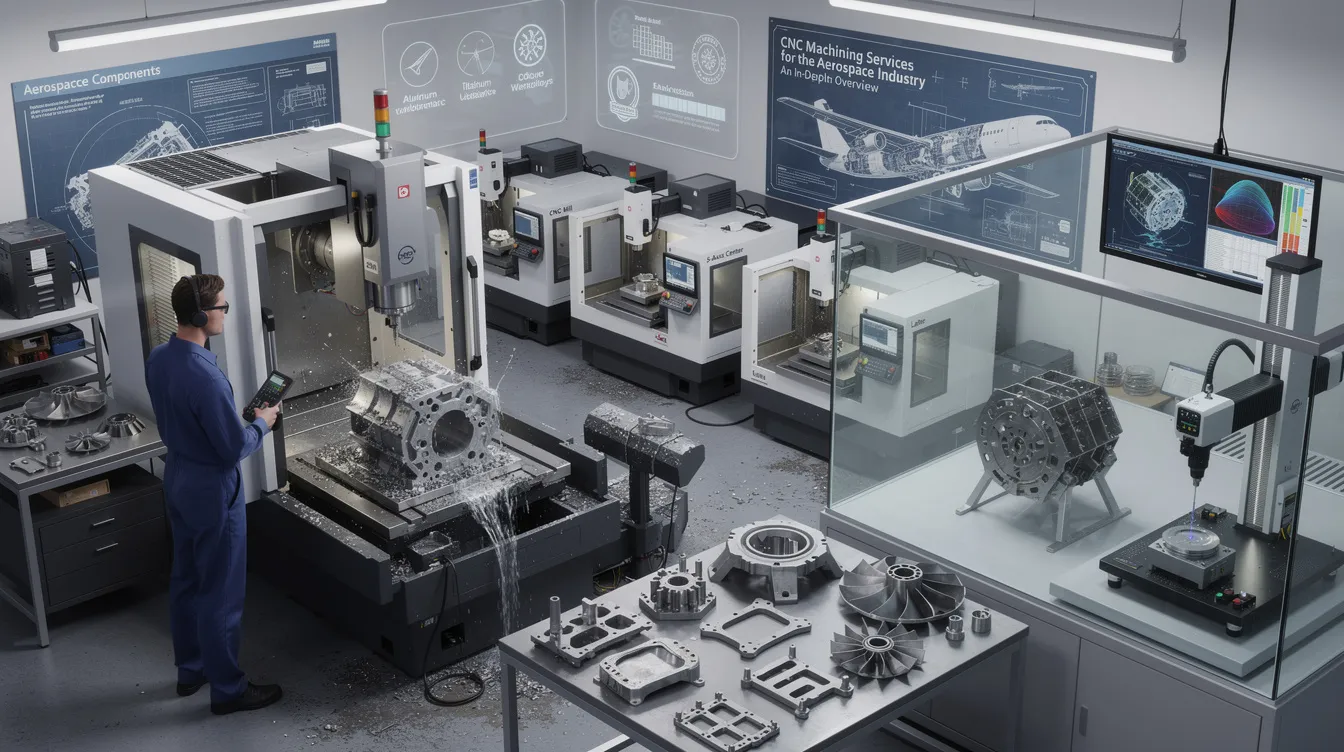
Introduction to Aerospace CNC Machining Services
The global aerospace and defense industry surpassed US$1 trillion in revenue in 2025, fueled by expanding commercial aviation backlogs, rising defense budgets, and accelerating investment in space systems. Behind every airframe panel, turbine disk, and satellite bracket in this massive ecosystem sits a fundamental aspect of production: CNC machining. Computer numerical control transforms raw materials into flight-critical hardware with the unmatched precision, repeatability, and traceability that the aerospace sector demands.
Aerospace CNC machining is the use of computer-controlled, multi-axis machine tools to produce safety-critical aircraft components and aerospace parts with micron-level tolerances. Unlike general industrial machining, every step of the aerospace machining process carries additional requirements for material traceability, documented inspection results, and regulatory compliance. CNC machining services for the aerospace industry demand high precision, and the history of this technology in aviation stretches back to around 1942, when early numerical control concepts began enhancing manufacturing precision for military applications.
At Anebon Metal Products Limited, an ISO 9001:2015 and ISO 14001:2015 certified OEM partner founded in 2010 in Dongguan, China, we bring over a decade of experience machining aluminum alloys, titanium, stainless steel, and high performance plastics for aerospace projects. This article covers the benefits, processes (from 3-axis to 5 axis CNC machining), materials, surface finishes, quality standards, and future trends shaping aerospace manufacturing today.
Overview of the Aerospace Industry and CNC Machining’s Role
The aerospace industry spans several major segments: commercial airlines, business jets, helicopters and rotorcraft, defense aircraft, UAVs and drones, and space systems including satellites and launch vehicles. Each segment places distinct performance and certification demands on its supply chain, yet all share a dependence on precision machining to deliver reliable operation in extreme environments.
Aerospace manufacturing has evolved dramatically over the past century:
-
Mid-20th century: Aircraft parts were produced primarily through manual milling, lathes, casting, forging, and sheet metal forming.
-
1940s–1960s: The MIT/Parsons project produced early NC milling machines capable of fabricating wing spars and bulkheads with curved surfaces, marking the birth of CNC technology in aviation.
-
1990s–present: Multi-axis CNC machining, CAD/CAM integration, and modern CNC machines enabled fabrication of turbine blades, blisks, and complex aerofoil surfaces that were previously impossible to produce at scale.
Aerospace machining must combine high precision, light weight, and fatigue resistance because operating environments are extreme-structural loads, constant vibration, temperatures swinging from −50 °C at cruise altitude to over 800 °C inside jet engines. Even as additive manufacturing and advanced composites grow in importance, CNC machining in aerospace remains central to prototyping, low-volume production, and critical spares where metals deliver the strength and temperature resistance that the aerospace industry requires.
What Is Aerospace CNC Machining?
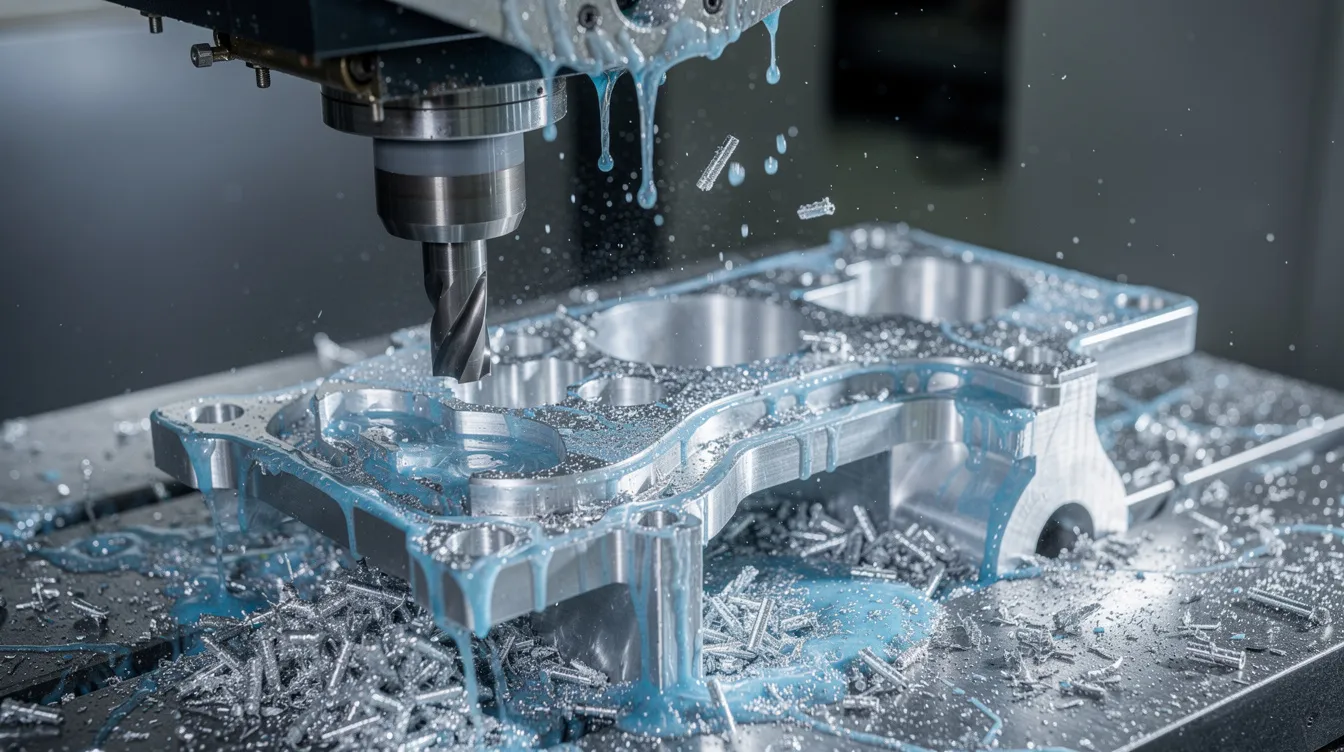
Aerospace CNC machining is the use of computer numerical control to cut, mill, turn, and drill high-performance metals and plastics into aircraft components and space hardware that meet stringent aerospace standards such as AS9100-aligned processes and full material traceability. It differs from generic CNC work in several important ways:
-
CAD-to-part workflow: Design engineers create 3D models in software like CATIA, SolidWorks, or Siemens NX. Manufacturers often integrate CAD/CAM systems for efficient tooling and machining processes, converting these models into multi-axis toolpaths that drive the production process.
-
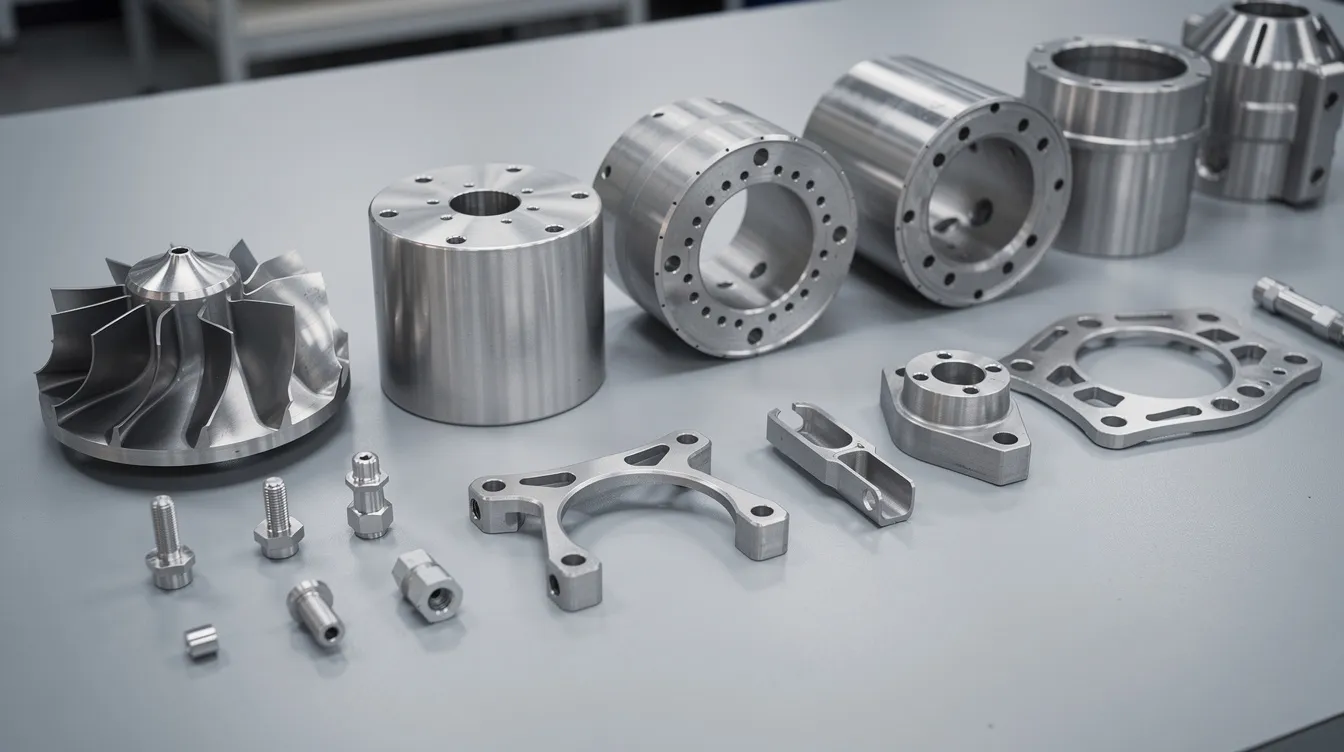
Part complexity: Typical aerospace parts made by CNC machining include structural brackets, ribs, seat tracks, avionics housings, hydraulic manifolds, fuel system blocks, antenna mounts, and precision fasteners. Aerospace components include engine parts, structural elements, and avionics housing-all of which must meet exact specifications.
-
Documentation rigor: Every machined part requires documented machining parameters, inspection results, and material certificates. CNC machining is essential for producing complex aerospace components where any deviation can compromise safety.
Tolerances for aerospace CNC machined parts often reach ±0.002 mm for small precision features, far tighter than what most industrial applications demand.
Key Benefits of CNC Machining for Aerospace Parts
CNC machining supports lighter, safer, and more efficient aircraft and spacecraft through several core advantages:
-
High precision and repeatability: CNC machining minimizes errors through automated processes, delivering fleet-wide interchangeability of machined parts. This process stability is critical for spares and retrofits where every replacement must match design specifications exactly.
-
Complex geometries: Undercuts, internal channels, compound curvatures, and aerofoil profiles are all achievable. CNC machines can produce thin-walled components for aircraft that manual methods cannot replicate consistently.
-
Lightweight design: Machining thin-walled structures from titanium and aluminum alloys removes up to 90–95% of billet material, leaving skeleton parts that minimize weight while preserving stiffness-directly impacting fuel efficiency and emissions.
-
Speed and cost control: CNC machining enables rapid prototyping of aerospace components, with some shops producing prototypes within three days. This capability allows for quick iterations of aerospace designs, and aerospace prototypes are tested for form, fit, and function before committing to production tooling.
-
Waste reduction: CNC machining minimizes waste and defects in aerospace production by optimizing toolpaths and automating chip removal, reducing both material waste and human error.
At Anebon, we combine CNC machining with die casting and sheet metal fabrication, allowing OEMs to optimize cost and performance per part-reserving precision CNC machining for high-precision components and functional surfaces while using more economical methods for non-critical areas.
Precision, Tolerances, and Quality Requirements in Aerospace Machining
There is no margin for error in aerospace engineering. A dimensional deviation on a sealing surface can cause hydraulic leaks; a misaligned turbine blade root can trigger vibration cascades that shorten engine life. Precision is not aspirational-it is a non-negotiable requirement.
Tolerance ranges
|
Feature Type |
Typical Tolerance |
|---|---|
|
General geometries |
±0.01 mm |
|
Critical interfaces, bores, sealing surfaces |
±0.002–0.003 mm |
|
Ultra-precision fits (bearing bores, rotating assemblies) |
±0.001 mm |
Tight tolerances in aerospace machining can be as precise as ±0.001 mm, and aerospace components require precision measurements down to 4 microns. CNC machining achieves tolerances as tight as ±0.002 mm on critical features such as turbine blade root fits, landing gear pins, actuator housings, and avionics enclosures.
Metrology and inspection
Coordinate measuring machines are used for advanced inspection in aerospace machining, alongside optical scanners, surface roughness testers, and height gauges. ACCREDIA-certified machines verify component tolerances, and inspection systems determine whether 100% inspection or statistical sampling plans apply based on control plans and criticality.
Quality frameworks
-
ISO 9001 certification ensures rigorous quality standards in aerospace machining, forming the foundation of quality management.
-
AS9100D is a certification standard specifically for aerospace quality management, adding requirements for risk management, configuration management, counterfeit parts prevention, and product safety.
-
Quality-control procedures in aerospace CNC machining include non-destructive testing such as dye penetrant, eddy current, and X-ray inspection for safety-critical applications.
-
The aerospace sector requires stringent documentation and traceability for manufactured parts. Material traceability is crucial in aerospace manufacturing for safety and compliance-every heat of metal must carry mill test certificates linked to the finished part.
At Anebon, we hold tolerances down to ±0.002 mm, provide full CMM inspection reports, and support PPAP and First Article Inspection Report procedures to meet international aerospace OEM documentation expectations.
CNC Machining Processes Used in Aerospace Manufacturing
Different CNC processes are selected depending on the geometry, material, and production volume of aerospace parts. Here is how each core process serves the aerospace sector.
CNC milling handles structural aerospace parts such as ribs, brackets, and complex housings. Simpler prismatic parts use 3-axis setups, while contoured surfaces, thin walls, and undercuts demand 4- or 5-axis CNC milling. Wing skins, trailing edges, and fuselage bulkheads are typical examples.
CNC turning produces shafts, bushings, actuators, and landing gear pins. Concentricity, surface finish, and run-out are critical for rotating or sliding aircraft components, particularly in materials like titanium where work hardening complicates the machining process.
CNC drilling is a critical operation for creating precise holes in wing and fuselage structures, hydraulic manifolds, and engine mounts. Deep-hole drilling in titanium and Inconel requires specialized tooling, careful control of hole straightness, and burr management to ensure reliable operation.
Thread milling and tapping create fastener interfaces in high-load zones where thread quality directly affects fatigue life. Thread milling is preferred over tapping in hard aerospace materials to avoid microcracks.
Anebon uses multi-operation machining centers to combine milling, turning, and drilling in a single setup wherever possible, reducing cumulative positioning errors, shortening cycle times, and improving production efficiency.
The Role of 5 Axis CNC Machining in Aerospace
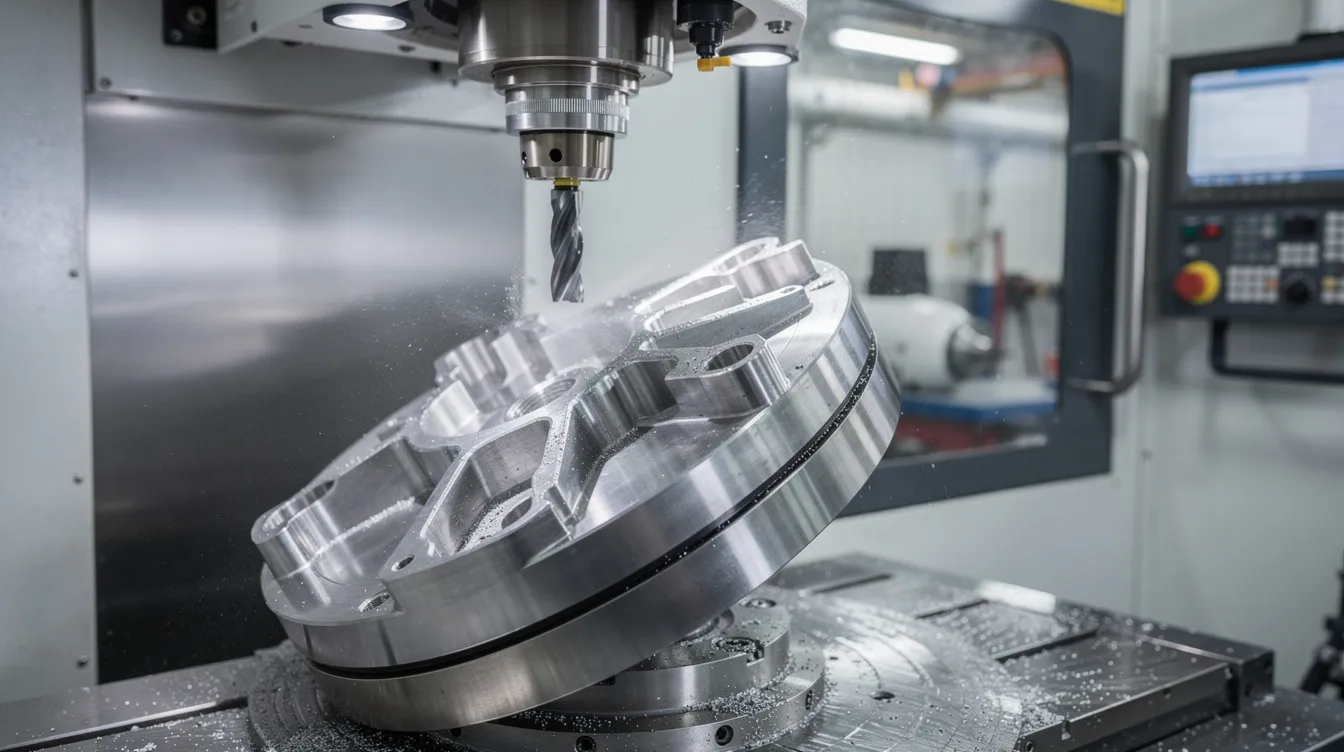
5 axis CNC machining allows simultaneous movement on five axes-X, Y, Z plus two rotational axes-enabling the tool to approach the workpiece from virtually any angle. This technology produces complex geometries for aerospace components that would otherwise require multiple setups or be impossible to machine.
Key aerospace applications for 5 axis CNC include:
-
Turbine blades, blisks, impellers, and guide vanes
-
Structural brackets with deep undercuts and complex shapes
-
Engine casings and aerofoil surfaces
-
Satellite structural frames requiring machining on multiple faces
5-axis machining reduces the need for multiple setups during production. Some manufacturers report 50–60% setup time reduction and cost savings exceeding 30% per part when switching complex components to simultaneous 5-axis. It enhances production efficiency in aerospace manufacturing processes by eliminating repositioning errors and fixture changeovers.
5 axis CNC machines achieve high precision for intricate aerospace parts, particularly when machining difficult-to-reach surfaces on thin-walled aluminum alloys and titanium-vital for advanced aircraft components and satellite structures. At Anebon, we use axis CNC machining combined with optimized fixturing and CAM strategies to minimize vibration, tool deflection, and heat build-up, which is crucial for aerospace-grade surface integrity.
Materials for Aerospace CNC Machining
Material selection in aerospace balances weight, strength, corrosion resistance, fatigue performance, and temperature capability. CNC machining supports multiple materials including titanium, aluminum, and nickel superalloys. Here are the primary materials used across the aerospace sector.
Aluminum alloys are critical in aerospace for their lightness and strength. Common series include 6061-T6 for brackets and housings, 7075-T6 for high-strength structural aircraft components, and 2024 for fatigue-critical applications. The 7075 aluminium alloy is known for its high mechanical resistance, making it a go-to choice for critical structural components.
Titanium alloys such as Ti-6Al-4V (Grade 5) serve airframes, landing gear, and engine parts where a high strength-to-weight ratio matters. Titanium is 30% stronger and 50% lighter than steel, but its low thermal conductivity and tendency to work-harden make it one of the most challenging aerospace materials to machine, requiring rigid machines, sharp tooling, and controlled cutting speeds.
Steels and stainless steels (304, 316, 17-4 PH, 15-5 PH) are used in fasteners, fittings, shafts, and high-load mechanical parts. Machining requires wear-resistant tools, appropriate coolant strategies, and often post-machining passivation for corrosion resistance.
Nickel-based superalloys like Inconel 718 are used in aerospace for their heat resistance, serving hot sections of jet engines, exhaust components, and turbine blades. These advanced materials work-harden rapidly and generate significant heat during cutting, demanding slow feeds, special coatings, and roughing-plus-finishing strategies.
Engineering plastics such as PEEK, Ultem, and high-temperature nylons fill roles in cabin interiors, electrical connectors, and lightweight secondary structures. PEEK is used for seals and insulators in aerospace applications where chemical resistance and low weight are required.
Anebon sources aerospace-grade raw materials with full mill certifications and provides material traceability documentation as required by OEMs, ensuring every batch of high quality materials is linked to the finished complex parts.
Surface Finishes and Treatments for CNC Machined Aircraft Components
Nearly all aerospace parts require post-machining surface treatments to deliver corrosion resistance, wear resistance, or identification marking. The finish must not compromise tolerances or introduce residual stress.
-
Anodizing (including hard anodizing) is used extensively for aluminum aircraft components such as brackets, housings, and seat structures. Hard anodized layers of 25–100 µm improve wear and corrosion resistance while allowing color coding for part identification.
-
Passivation enhances corrosion resistance on stainless steel aerospace parts like fittings and fluid connectors using nitric or citric acid treatment, without measurably changing dimensions.
-
Conversion coatings (chromate or non-chromate alternatives) protect aluminum surfaces and serve as paint adhesion primers.
-
Painting and powder coating are applied to exterior and interior cabin components, with thickness factored into the tolerance stack.
-
Specialty coatings such as ceramic thermal barrier coatings protect hot-section engine parts from oxidation.
Certain aerospace applications require specific surface roughness-for example, Ra < 0.8 µm for sealing surfaces, bearing bores, and aerodynamic surfaces. Anebon works with qualified finishing partners to provide consistent aerospace-grade coatings integrated into turnkey machining services.
Aerospace Applications and Typical CNC Machined Parts
CNC machining connects directly to real-world aerospace applications across commercial transport aircraft, regional jets, rotorcraft, UAVs, and satellites. Aerospace components must operate under extreme stress and temperature variations, making precision CNC machining a non-negotiable part of the manufacturing process.
|
Application Area |
Typical CNC Machined Parts |
Common Materials |
|---|---|---|
|
Airframe |
Fuselage frames, ribs, brackets, seat tracks, hinges, avionics mountings |
Aluminum alloys, titanium |
|
Engine & propulsion |
Turbine blades, compressor casings, shafts, flanges, fuel systems, exhaust brackets |
Inconel, titanium, high-grade steel |
|
Hydraulic & fuel |
Manifolds, valve bodies, pump housings, precision fittings |
Stainless steel, aluminum |
|
Interiors |
Seat hardware, latch mechanisms, ventilation fittings, electrical connectors |
Aluminum, engineering plastics |
|
Space & satellite |
Structural panels, instrument housings, antenna brackets, reaction wheels |
Titanium, lightweight aluminum |
Anebon frequently supports aerospace R&D teams with rapid prototyping and small-batch production for new aircraft components and system upgrades, helping aerospace companies accelerate development timelines.
Anebon’s Aerospace CNC Machining Capabilities and Services
Anebon serves as a one-stop manufacturing partner for overseas aerospace OEMs, design engineers, and R&D teams requiring complex aerospace parts with full quality control documentation.
Core CNC capabilities:
-
3-axis, 4-axis, and 5 axis CNC machining
-
CNC milling, CNC turning, CNC drilling
-
Secondary operations: threading, reaming, and surface finishing coordination
Full lifecycle support: We cover everything from rapid prototyping to low- and medium-volume production, including bridge manufacturing before full aerospace production ramps up at the OEM’s facility.
DFM feedback: Our engineering team provides early-stage design for manufacturability consulting on wall thickness, tool access, tolerance schemes, and material selection for aerospace applications.
Quality and certification: ISO 9001:2015 and ISO 14001:2015 certified, with quality assurance systems capable of producing FAI/FAIR-style reports, full CMM inspection data, and material traceability packages aligned to customer requirements.
We achieve tolerances down to ±0.002 mm and have extensive experience machining thin-walled aerospace parts that are prone to distortion if not fixtured and machined correctly. If you are developing complex components for defense industries, commercial aviation, or space applications, we invite you to request a quote or share your aerospace drawings and CAD files for evaluation.
How to Collaborate with a CNC Machining Partner for Aerospace Projects
Whether you are an established aerospace manufacturer or a startup building its first prototype, engaging an external CNC machining services provider effectively starts with preparation.
What to provide with your RFQ:
-
3D CAD files and 2D drawings with GD&T
-
Material specifications (ASTM, AMS grade designations)
-
Heat treatment, surface finishing, and coating requirements
-
Required industry standards and inspection level (100% vs. sampling)
Tolerance decisions should reflect function and cost. Only specify ultra-tight tolerances on features where they are truly necessary-sealing surfaces, bearing bores, mating interfaces. Unnecessarily tight callouts on non-critical features increase machining time and pricing without adding functional value.
Typical workflow with Anebon: RFQ submission → DFM feedback from our engineering team → prototype machining → customer validation and testing → design iteration → scaling to production quantities. We handle time zone differences through digital collaboration tools and have extensive experience shipping aerospace machining projects to North America, Europe, and other regions, with appropriate packaging for sensitive aircraft components.
Future Trends in Aerospace CNC Machining
The aerospace machining landscape is shifting rapidly. Several trends will define the next decade of CNC machining in aerospace:
-
Hybrid manufacturing combines additive manufacturing for near-net-shape parts with subtractive CNC finishing on critical surfaces. Printing a titanium bracket and then finishing bearing bores and sealing faces on a 5 axis CNC machine reduces material waste and machining hours.
-
Digitalization and Industry 4.0 are transforming the production process through machine monitoring, tool wear prediction, and data-driven optimization of cycle times and quality. Skilled machinists increasingly work alongside AI-assisted toolpath planners and predictive maintenance systems.
-
Advanced materials including next-generation superalloys, refractory metals, and advanced composites require more complex machining strategies, specialized machine tools, and innovative fixturing approaches.
-
Sustainability matters. Efficient CNC machining, responsible coolant handling, swarf recycling, and ISO 14001:2015 compliance all support greener aerospace manufacturing-a priority as aerospace manufacturers face growing pressure to reduce lifecycle environmental impact and improve fuel efficiency across fleets.
Anebon is committed to remaining a flexible, technology-driven partner ready to adapt its CNC machining services to the evolving needs of the global aerospace industry. Whether you need high precision components for a next-generation engine program or aerospace prototypes for a satellite constellation, our team is ready to help you move from concept to flight-ready hardware.
Ready to get started? Contact Anebon’s engineering team to discuss your aerospace project, submit CAD files for DFM review, or request a quote today.